What Is a Good 5K Time: Realistic Benchmarks and Tips

This is one of the most common questions in the running world, and the answer is wonderfully personal. While most runners would agree that a finish time between 25 to 35 minutes is a solid accomplishment, the real definition of "good" depends entirely on you.
For a brand-new runner, finishing a 5K in 30 to 40 minutes is a huge win. For a more seasoned competitor, the goal might be to duck under the 25-minute mark. Ultimately, the best time is the one you feel proud of.
Defining a Good 5K Time for Your Journey
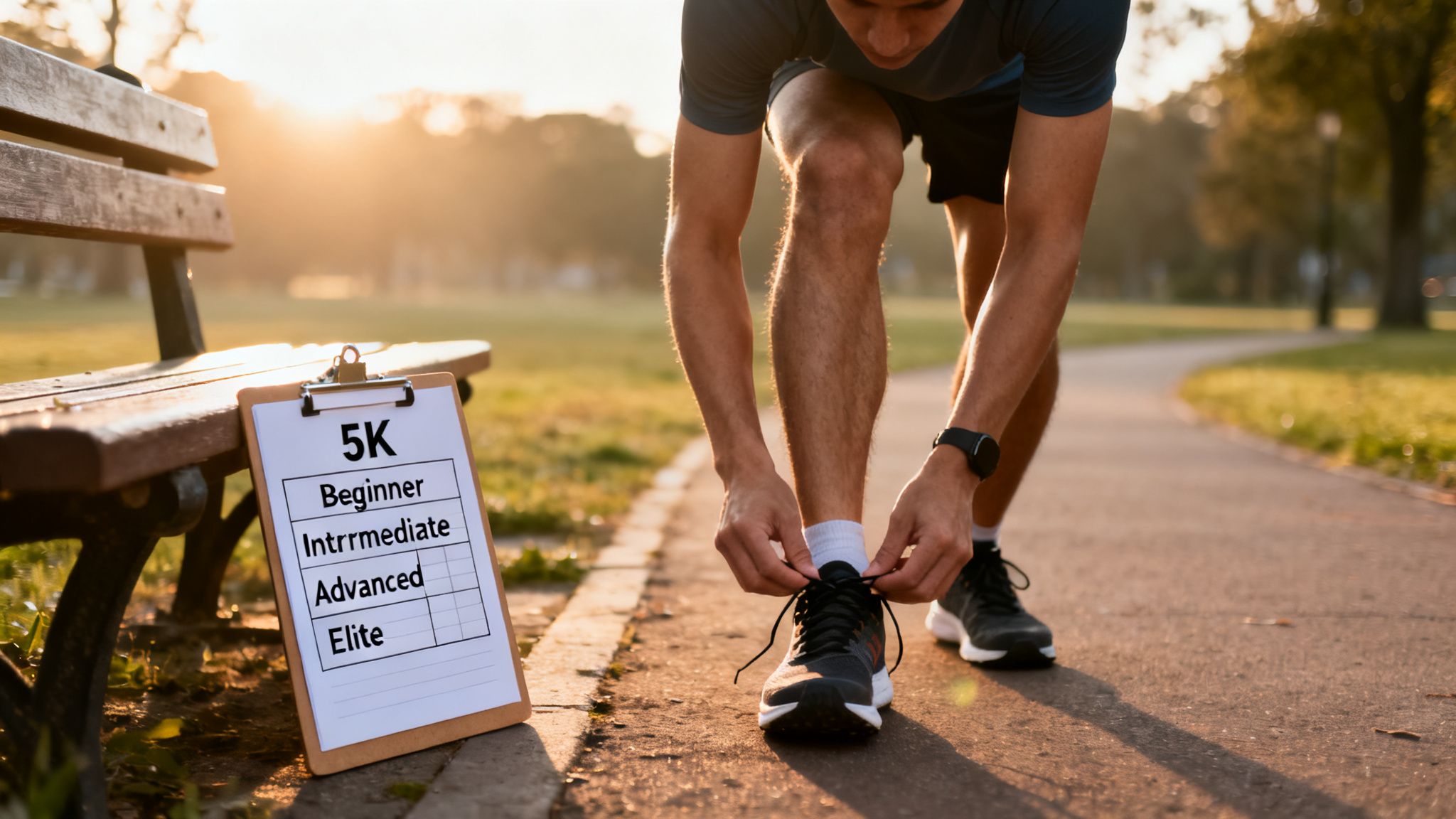
Asking "what is a good 5K time?" is a bit like asking "what makes a good painting?" It's all about perspective. An elite athlete might see "good" as a blistering sub-15-minute finish—a pace that feels almost superhuman to the rest of us. But for someone just starting their running journey, crossing that finish line without walking is an absolutely massive victory.
The healthiest and most effective way to define a "good" time is to measure it against yourself. Your personal record (PR) is your true north. The goal is to beat that time, even if it's just by a few seconds. This simple shift in focus from comparing yourself to others to celebrating your own progress makes running a much more rewarding and sustainable sport.
Benchmarks for Every Runner
Still, it helps to have a rough idea of where different times fall on the performance spectrum. Think of these benchmarks not as strict rules, but as general guidelines to help you see where you are and set some exciting, realistic goals.
The true measure of a "good" 5K time isn't found on a universal chart, but in the story of your own training, effort, and improvement. Your best time is the one you worked for.
Here’s a quick-reference guide to what constitutes a good 5K time across different experience levels for both men and women, helping you immediately find where you stand.
| Level | Men's Time | Women's Time | Description |
|---|---|---|---|
| Beginner | 30-40 min | 33-43 min | A great starting point for new runners or those training inconsistently. |
| Novice | 25-30 min | 28-33 min | Breaking the 30-minute mark is a huge milestone for many runners. |
| Intermediate | 20-25 min | 23-28 min | This shows consistent training and places you well above average. |
| Advanced | Under 20 min | Under 23 min | Highly competitive territory requiring serious dedication and training. |
These benchmarks give you a great starting point for understanding your own performance. As you can see, what's considered "good" shifts significantly based on experience.
Remember, these numbers exist in a vacuum. They don't account for real-world race conditions. A hilly trail race on a sweltering summer day will naturally lead to slower times than a flat, paved course in cool, crisp weather. The clock only ever tells part of the story.
Looking Beyond the Clock to Understand Performance
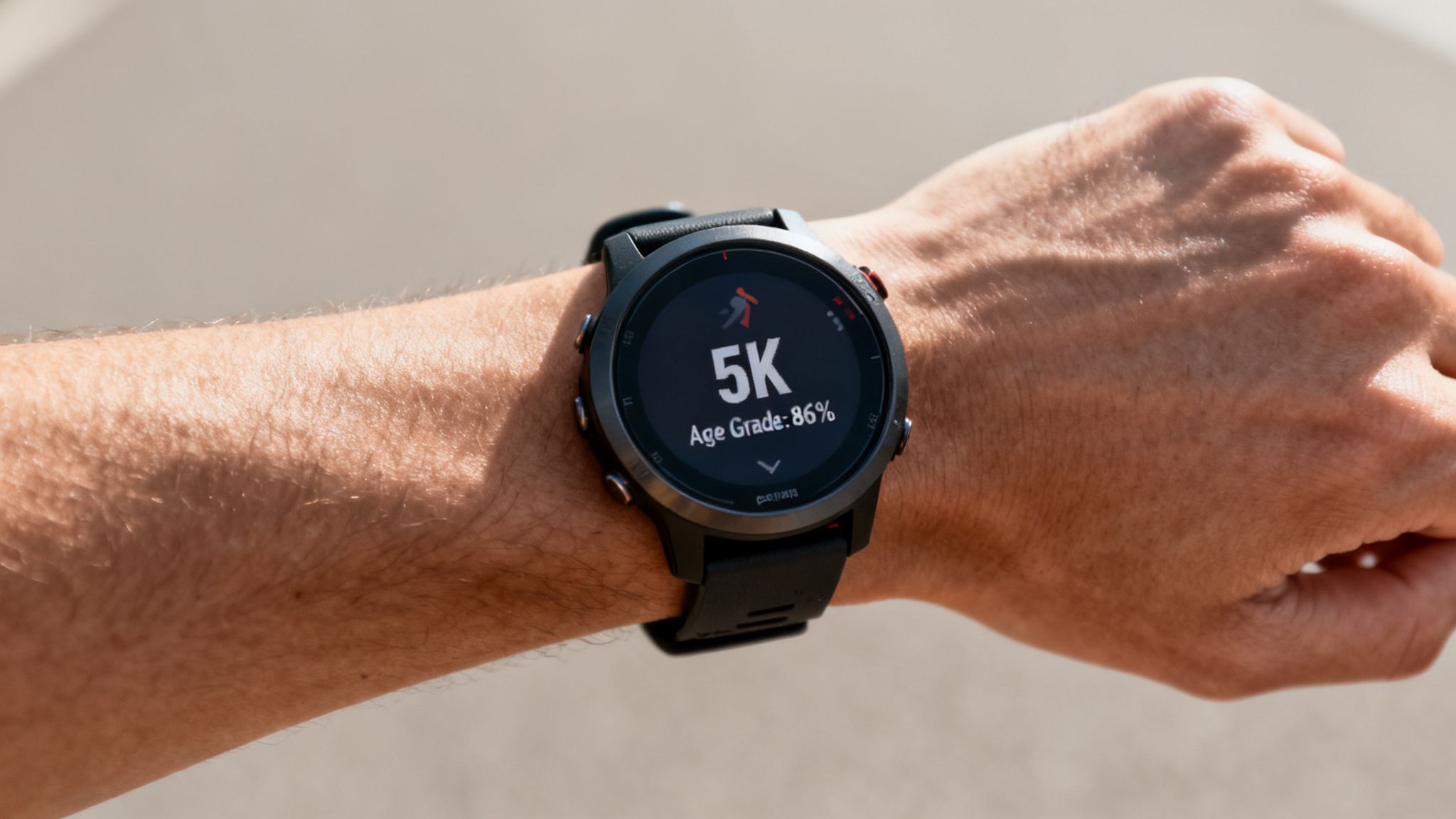
The time on your watch is a simple, clear measure of how you did. It's the number everyone asks about. But on its own, it’s just a single data point that doesn't tell the whole story.
To really understand what makes a 5K time "good," you have to layer in some context. Factors like your age, gender, and how long you've been running are huge. They completely reshape what a realistic and impressive performance looks like for you.
After all, a 22-year-old guy who ran track in college is playing a different game than a 55-year-old woman who just picked up running six months ago. Comparing their finish times directly is classic apples-to-oranges—it completely misses the nuance of their individual accomplishments.
That's why looking at your performance relative to your own demographic is so powerful. It shifts the focus from a raw number to a much more meaningful evaluation of your personal fitness and effort.
Introducing Age Grading Your Performance
One of the best tools out there for adding this context is age grading. If you've ever heard of a handicap in golf, it's the same idea, but for running. It's a clever statistical method that levels the playing field by comparing your time against the world-record performance for someone your exact age and gender.
The result is a simple percentage. This score lets you see how your run stacks up, allowing runners of all ages and genders to compare their results on a much more equal footing.
An age-graded score turns your 5K time into a personal performance rating. It’s not just about how fast you ran, but how well you ran for you, right now.
With an age-graded score, you can suddenly see how different times can represent the exact same level of effort and achievement. For example:
- A 25-minute 5K for a 50-year-old man could easily be an equivalent achievement to a 25-year-old man running a sub-20-minute race.
- A 60-year-old woman running a 28-minute 5K might actually score a higher age-grade percentage than a 30-year-old woman running a 24-minute 5K.
Why This Perspective Matters
When you start thinking this way, your entire approach to goal-setting changes. Instead of chasing a time that might be completely unrealistic for your age group, you can focus on a much more personal—and motivating—goal: improving your age-grade percentage.
This approach validates all the hard work you put in. It allows you to celebrate your progress fairly, no matter how old you are or where you're starting from.
It’s all about benchmarking your performance against your own potential. At the end of the day, a good 5K time is one that reflects your dedication and pushes your personal limits, and age grading gives you a crystal-clear way to see that.
Data-Driven Benchmarks for 5K Runners
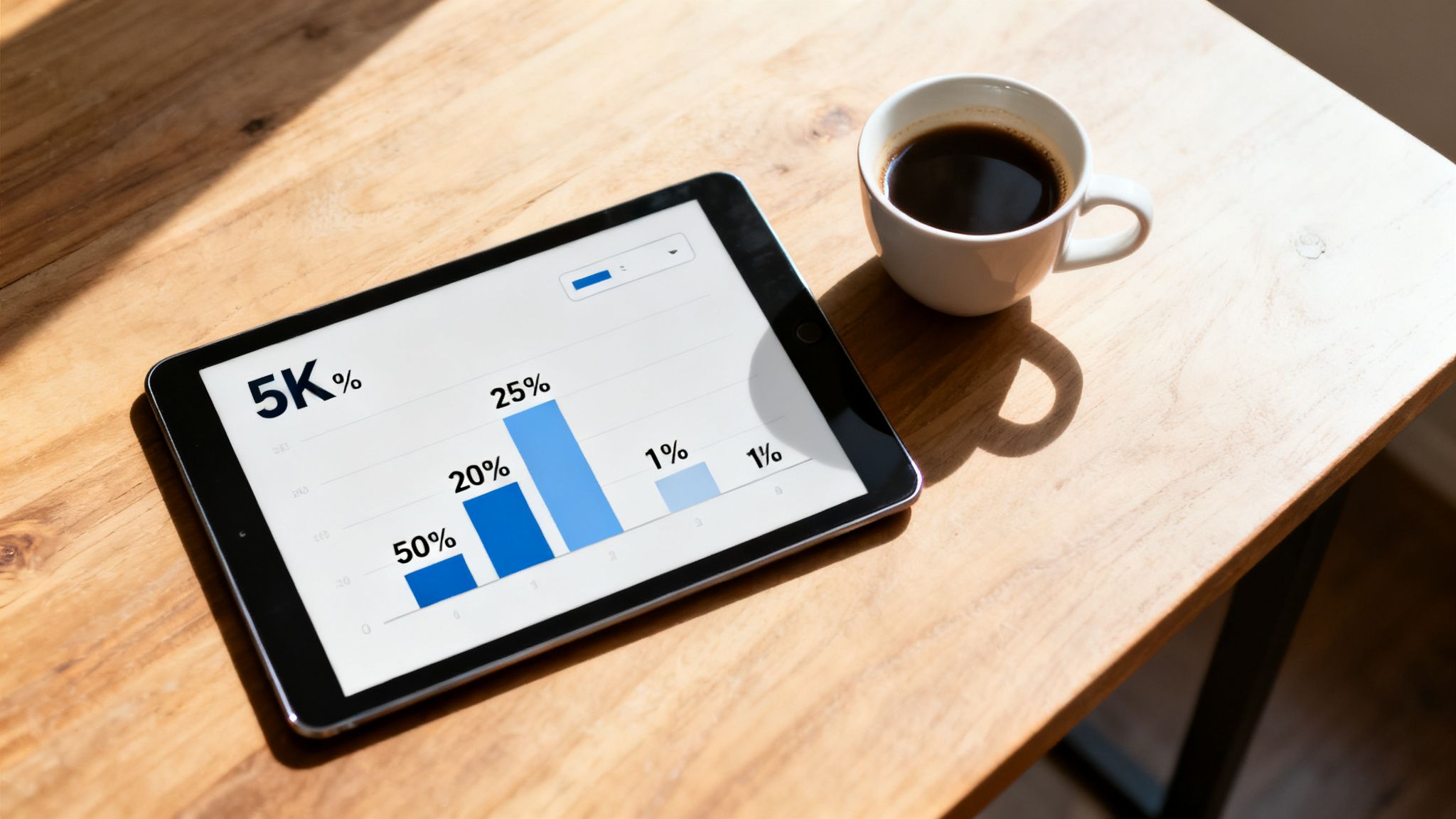
While your personal progress is always the most important win, it's incredibly motivating to see how your time stacks up against the wider running community. When we dig into real-world data, the fuzzy question of "what's a good 5K time?" gets a surprisingly clear answer.
Looking at stats from runners all over the world, we can get a real sense of what it takes to land in the top half, the top quarter, or even the top one percent. These numbers aren’t for judging yourself harshly. Think of them more like a map that shows you where you are and all the places you could go.
Suddenly, a goal like breaking 30 minutes or chasing a sub-20 finish feels less arbitrary and more like a true milestone.
Finding Your Place in the Pack
Let's ground this in reality by talking about percentiles. Percentiles simply tell you what percentage of runners you're faster than. For example, if you're in the 75th percentile, you ran faster than 75% of the other runners in that race or data set. It’s a powerful way to see your performance in context, moving beyond just the numbers on the clock.
Understanding your percentile gives you a clear, data-backed view of your performance. It’s not just about your time; it’s about where that time places you among thousands of your peers.
By pulling together data from large-scale running events, we can paint a picture of what different finish times really mean.
- Top 50% (The Median Runner): Finishing faster than half the field puts you squarely in the middle of the pack. This typically means a time somewhere between 28 and 34 minutes.
- Top 25% (Advanced Amateur): Breaking into the top quarter of finishers takes consistent training and a solid fitness base. This usually requires running a 5K in 23 to 27 minutes.
- Top 10% (Highly Competitive): This is where dedicated and talented runners start to shine. Finishing a 5K under 20 minutes will almost always place you in the top 10-15% of participants.
- Top 1% (Truly Elite): To find yourself in the top one percent, you’re looking at some seriously fast times—typically under 17 minutes for men and under 19 minutes for women.
5K Finish Times by Age and Gender
Of course, your age and gender play a huge role in what constitutes a "good" time. A 25-year-old man will have a different baseline than a 55-year-old woman. The table below breaks down average and competitive times across different groups, giving you a much more tailored benchmark.
| Age Group | Average Male Time | Top 10% Male Time | Average Female Time | Top 10% Female Time |
|---|---|---|---|---|
| 20-29 | 29:00 | 21:00 | 32:30 | 25:30 |
| 30-39 | 30:00 | 22:30 | 33:45 | 27:00 |
| 40-49 | 31:30 | 24:00 | 35:00 | 28:30 |
| 50-59 | 33:00 | 26:00 | 37:30 | 31:00 |
Use these numbers as a guidepost. They can help you set specific, realistic goals that feel right for where you are in your running journey.
Turning Data into Your Next Goal
With these benchmarks in hand, you can set goals that are both ambitious and achievable. If you're currently running a 35-minute 5K, aiming to get under 30 minutes is a fantastic, measurable goal that would move you well into the top half of most races.
This data-driven approach gives you a clear roadmap for your training. It’s also a great way to think about other race distances; you can apply the same logic when looking at your average 10K time and setting goals for longer events.
What the Pros Can Teach Us About the 5K
To really get a feel for what’s possible in a 5K, it’s worth looking at the absolute top of the sport—the times being run by elite athletes who have dedicated their lives to running. The idea here isn't to make you feel slow or discouraged. Far from it. These world-class performances are a source of pure inspiration, a glimpse into the upper limits of human speed and endurance.
Watching a professional runner is like watching a master craftsman. Their form is poetry, their speed almost unbelievable. It’s a powerful testament to years of focused training, natural talent, and an iron will. These records don't just set a bar; they redefine what's physically possible and give us all a deeper appreciation for the 3.1-mile distance, no matter our own finish time.
The World Record Pace Is Mind-Boggling
When you hear about the top tier of the sport, you’re talking about times that completely shatter our perception of speed. The current men’s 5K road world record is the perfect example.
On December 31, 2021, Berihu Aregawi ran a jaw-dropping 12:49 for the 5K. Just try to wrap your head around that. He averaged a pace of 4:07.52 per mile (or 2:33.8 per kilometer). That's a sustained speed of 14.54 mph (23.4 kph) for the entire race. Most people couldn't hold that pace on a treadmill for even a minute. Digging into the details of these world record paces really helps you appreciate just how fast these athletes are moving.
Looking at elite times isn't about comparing yourself to them. It's about giving yourself context. It helps frame your personal best—whatever it may be—as the monumental achievement it truly is.
These elite times are the "North Star" for the 5K distance. They show what can happen when everything aligns perfectly, from training and nutrition to perfect race-day weather. For the rest of us, it’s just an incredible reminder of what the human body is capable of.
Lessons We Can All Steal from the Elites
So, what does this mean for someone whose goal is to break 30 minutes? The real lesson from the pros isn’t about chasing their impossible times, but about borrowing from their mindset.
- Respect the Distance: Even for the fastest runners on the planet, a 5K is a full-on effort that demands a smart race plan. They don't just wing it.
- Celebrate Your Personal Bests: Every time you set a new personal record (PR), whether it's dropping from 40 minutes to 38, or finally breaking 25, you are pushing your own unique limits. That’s your victory.
- Embrace the Grind: Elite runners aren't born fast; they are built through thousands of hours of consistent, dedicated training. They show up day after day, even when they don't feel like it.
In the end, watching the best in the world gives us a greater appreciation for our own journey. It turns a number on a clock into a story of your personal effort and dedication. Whether you're chasing a world record or simply your own best time, every runner shares that same fundamental drive: to be just a little bit better than you were yesterday.
How to Train for Your Fastest 5K Ever
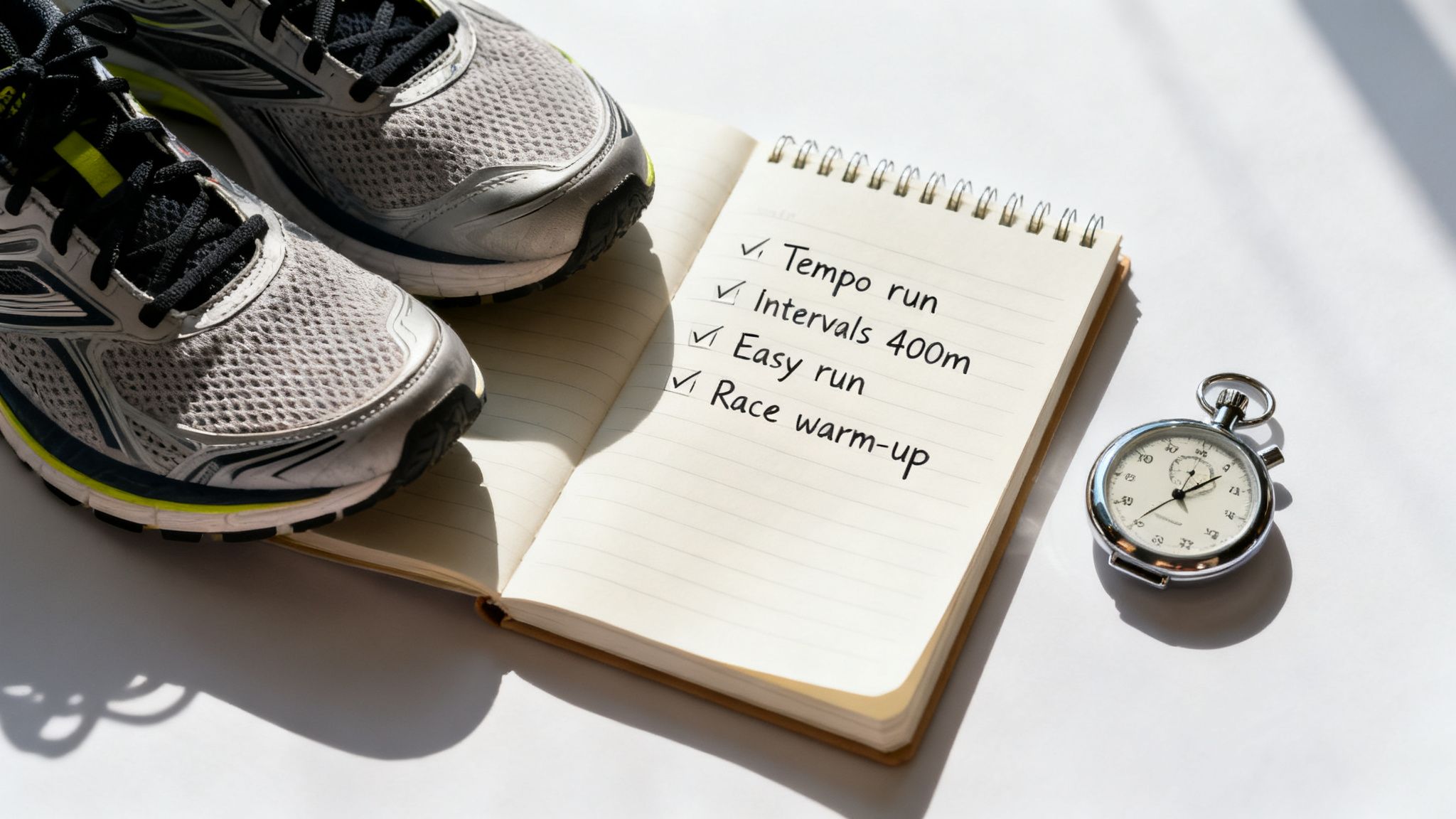
Knowing the data is one thing, but actually getting faster? That's where the real fun begins. The journey to shaving seconds—or even minutes—off your personal best comes down to three things: training smarter, pacing wisely, and executing on race day.
The first big leap is moving beyond just logging miles. If you want to run faster, you have to practice running faster. This means adding specific, targeted workouts that push you just outside your comfort zone, forcing your body to adapt and get stronger.
Build Your Engine with the Right Workouts
Think of your running fitness like building a performance car. You need a powerful engine for speed and a big fuel tank for endurance. The best training plans build both. Mixing in a few key workouts during the week is the secret to developing the speed and stamina you need for a strong 5K.
Here are a couple of essential workouts to add to your routine:
- Tempo Runs: This is what I like to call the "comfortably hard" pace. It's a challenging effort you feel like you could hold for about an hour if you had to. A solid 20-minute tempo run trains your body to process lactate more efficiently, which is a fancy way of saying it helps you hold a faster pace for longer without hitting a wall.
- Interval Training: These are short, sharp bursts of speed followed by a recovery period. The classic track workout is doing 400-meter repeats (one lap) at a hard effort, with a slow 200-meter jog or walk to recover. This is your ticket to boosting your top-end speed and making your goal pace feel easier.
Structured training isn't just for elite athletes. By swapping one or two of your easy runs for a focused workout each week, you're giving your body the specific signal it needs to adapt, improve, and ultimately smash your 5K goal.
Nailing these workouts builds your fitness, but how you use that fitness on race day is what gets you a new personal record.
Master Your Pacing Strategy
One of the most common mistakes I see runners make is going out way too fast. Race day adrenaline is a powerful thing! It can trick you into running at a pace you can't possibly sustain, leaving you gasping for air by the first mile marker. A GPS watch is your best friend here, giving you instant feedback to keep you honest.
A fantastic race-day tactic is to aim for negative splits. It’s a simple concept: run the second half of the race just a little bit faster than the first half. This takes serious discipline at the start, but it feels incredible to fly past other runners in the final mile while they're fading. For more on this, check out these great tips for running a 5K.
To put it all in perspective, even at the very top, the numbers are mind-boggling. Joshua Cheptegei’s world record of 12:35.36 is almost beyond human comprehension. But for the rest of us, data shows that breaking 16:00 puts a male runner in the top 1% of all 5K road race finishers in the U.S. Seeing where you stack up can help you set goals that are both ambitious and achievable. You can explore more about elite 5000m records and top lists at World Athletics.
Celebrating Every Milestone on Your Running Journey
After digging into all the data, benchmarks, and training plans, the most important takeaway is actually pretty simple. The real answer to “what is a good 5K time?” has less to do with the clock and everything to do with you.
A good time is one that reflects your effort, your progress, and your dedication. That's it.
Every single run is a building block. Whether you just ran your first 5K without stopping or finally smashed a time barrier you've been chasing for months, that achievement is a huge deal. These are the real wins in running, and they absolutely deserve to be celebrated. They’re tangible proof that you’re stronger today than you were yesterday.
Redefining Your Finish Line
Ultimately, the best measure of success isn't how you stack up against the person running next to you. It's how you measure up against the runner you were last week or last month.
Shifting to this mindset turns running from a pure competition into a deeply personal practice of self-improvement. It’s about finding joy in the effort and appreciating what your body is capable of.
A "good" 5K time is any finish that makes you proud. It's the physical proof of your commitment, a reward for showing up on days you didn't want to, and a milestone on your unique path.
Keeping track of how far you’ve come is one of the best ways to stay fired up. Seeing your progress in black and white is a powerful reminder of your own strength. Nailing a new personal best is an incredible feeling, and you can learn more about the importance of a PR in running in our detailed guide.
As you look toward your next goal, remember that every finish line is also a starting line for something new. Take a moment to acknowledge your hard work, celebrate how far you’ve come, and carry that positive energy into your next run. That’s the real secret to a long and happy running journey.
Got Questions About Your 5K? We've Got Answers.
Even after you've got the data and a plan, a few questions always seem to pop up as you chase a new personal record. Let's tackle some of the most common ones that runners ask on their journey to a faster 5K.
How Much Can I Realistically Improve My 5K Time in 3 Months?
This is the big one, and the honest answer is: it really depends on where you're starting from.
- If you're new to running, the sky's the limit. You'll see dramatic improvements just by building consistency. Simply getting out there 3-4 times a week to build your endurance base can easily slash several minutes from your initial time.
- For more seasoned runners, the gains get a little tougher to earn. But dropping 30 to 90 seconds is a very achievable goal. The key is shifting from just running to training with purpose—adding specific speed work like intervals and tempo runs will get you there.
Remember, the faster you get, the more you have to fight for every second. But smart, consistent training will always move the needle forward, no matter your pace.
Should I Train on a Treadmill or Run Outdoors?
Why not both? Each has its place in a smart training plan, and the best approach is to use them strategically.
Running outdoors is non-negotiable for race prep. It gets your body ready for the real world of uneven pavement, changing weather, and rolling hills. It builds strength and stability in a way a treadmill just can't replicate.
That said, the treadmill is an incredible tool. It offers a perfectly controlled environment, which is a massive advantage for nailing the precise pacing required for interval workouts. It's also a lifesaver when ice, snow, or dangerous heat makes running outside impossible.
Will Strength Training Actually Make Me Faster?
One hundred percent, yes. If you're not doing any strength work, you're leaving free speed on the table. Think of it as building a more powerful engine for your body.
Strength training is your secret weapon for a faster 5K. It builds the power to maintain your form and push harder through the crucial final kilometer of the race.
By strengthening your legs and core, you improve your running economy, meaning you use less energy to run at the same speed. Two focused sessions a week with exercises like squats, lunges, and planks will make a huge difference, not just in your finish time, but also in keeping you healthy and injury-free.
Ready to celebrate your next big race? At RoutePrinter, we turn your hard-earned miles into beautiful, personalized art. Commemorate your 5K personal best or any other endurance achievement with a custom poster you can be proud of. Design your unique race poster today!