What Is PR in Running: How to Chase Your Personal Records

So, you've heard runners throwing around the term 'PR' and you're wondering what all the fuss is about. Let's get right into it.
A PR, which stands for Personal Record, is simply the fastest time you have ever run a specific, official distance. It’s your all-time best performance for a 5K, a 10K, a half-marathon, or the full marathon. Think of it as your personal running hall of fame—a single number that captures your peak performance.
Breaking Down Your Personal Best
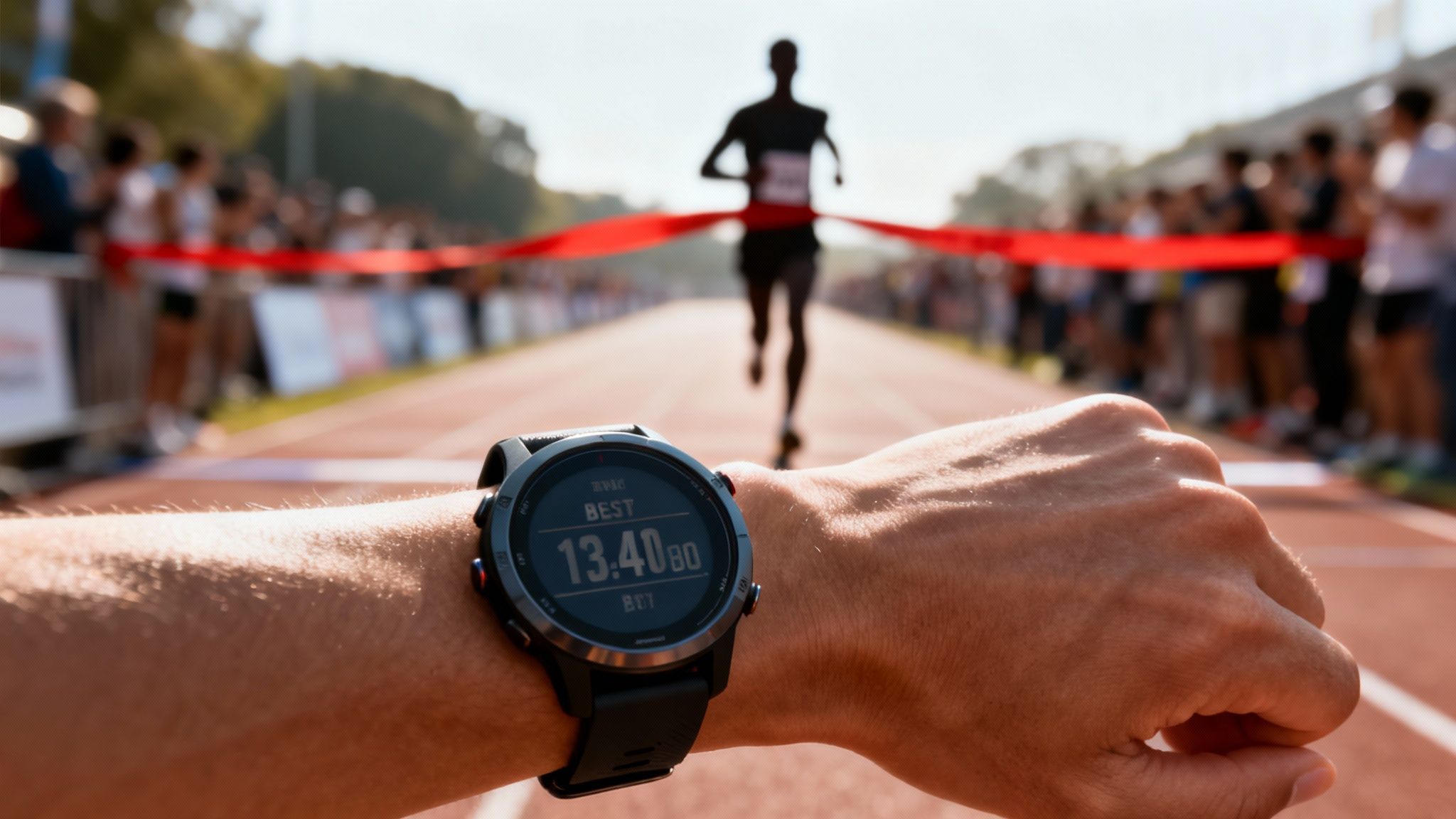
That shiny new PR is so much more than just numbers on a stopwatch. It's the culmination of countless early morning alarms, gritty training sessions, and sticking to the plan when you didn't feel like it. It’s a snapshot in time that proves all that hard work paid off.
This is what makes the concept of a PR so powerful. It’s a universal language that connects runners all over the world, from local parkrunners to elite marathoners. We're all chasing that feeling of self-improvement. Understanding your PR gives every training run a deeper purpose and shifts the focus from competing with the person next to you to competing with the only runner who truly matters: the past version of yourself.
And this obsession with getting faster is a huge part of the running world. The 2025 Global Runner Survey, which gathered insights from over 12,700 runners worldwide, found that achieving a new PR is a primary motivator for racers everywhere. You can dive into more of the global trends in the full survey from Running USA.
Why Does a PR Matter So Much?
So, why does this little two-letter acronym carry so much weight? It’s because a PR serves a few critical functions in a runner's journey:
- It Sets a Clear Benchmark: A PR is your starting line. It gives you a concrete, no-fluff number that you're aiming to beat.
- It Fuels Your Motivation: Training to beat a PR gives every run, from the long, slow miles to the gut-busting speed workouts, a clear and tangible goal.
- It Measures Your Progress: Seeing your PR drop is the ultimate validation. It’s concrete proof that your training is working and that you're becoming a fitter, stronger, and faster athlete.
A PR is your personal running history written in a single line of data. It’s not about being the fastest person in the race; it’s about being faster than you’ve ever been before.
In the end, chasing a PR is really about celebrating how far you've come.
Decoding the Lingo: PR, PB, and Other Key Terms
Once you start spending time in the running world, you quickly realize there’s a whole vocabulary that goes beyond just miles and pace. Getting a handle on the lingo is key to tracking your own progress and sharing in the excitement of others' achievements.
The two big ones you'll hear constantly are PR (Personal Record) and PB (Personal Best). Functionally, they mean the exact same thing: the absolute fastest you've ever run a particular distance. The only real difference is geography. PR is the go-to term in the United States, while you’ll hear PB more often in the UK and other parts of the world. So, whether it's a new PR or a new PB, the celebration is the same!
PR vs. Other Running Benchmarks
While PR and PB are basically twins, a few other terms pop up that measure success in different ways. Knowing the difference helps you put your own runs—and the achievements of others—into the right context.
Here's a quick rundown of what you might see on a race results page:
- Season Best (SB): This is your fastest time over a certain distance, but only within the current season or calendar year. It's a fantastic way to measure progress if you're coming back from an injury or building up your fitness for a bigger goal race down the line.
- Course Record: This one isn't about your personal performance. It's the fastest time ever recorded on that specific race course by any runner, ever. These are usually held by elite, professional athletes and are incredible feats of speed and endurance.
Think of it this way: Your PR is your personal all-time high score in a video game. A Season Best is your high score for just this year's game. And a Course Record? That's the world-record high score on that specific arcade machine.
Understanding these distinctions helps you set smarter, more motivating goals. Maybe you aren't in shape to chase an all-time PR right now, but aiming for a Season Best is a perfect target to keep you pushing. Likewise, knowing the average 10K time for your age group can add another valuable layer of perspective to your performance. It's all part of the language of running that lets you appreciate every single milestone.
How Your Official Running PR Is Recorded
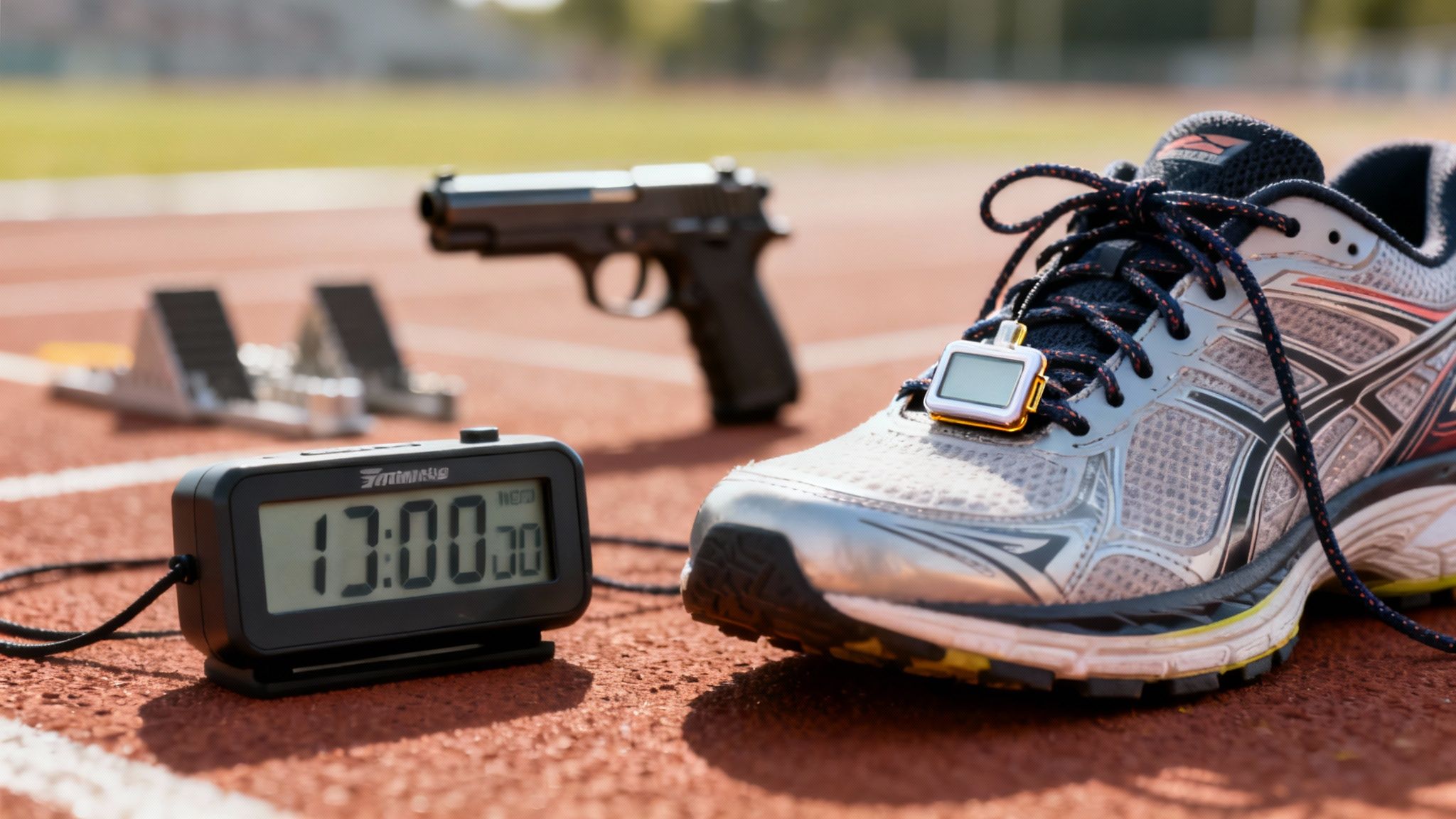
When you look up your race results online after crossing that finish line, you’ll almost always see two different times listed next to your name. Knowing which one to claim as your shiny new PR is crucial, and it all comes down to understanding Gun Time vs. Chip Time.
Gun Time is exactly what it sounds like: the clock starts for everyone the second the starting gun goes off. It doesn't matter if you're a pro at the front or stuck in a sea of runners ten minutes back—the clock is ticking.
Chip Time, however, is your personal race clock. A tiny electronic tag on your bib activates the moment you physically cross the starting line mat and stops the second you cross the finish line. It’s a measure of your individual race.
Chip Time: The Gold Standard For Your PR
For virtually every runner out there, Chip Time is the only time that matters for a PR. It’s the true, accurate measure of how long it took you to cover the distance.
Think of it this way: Gun Time is like starting a stopwatch when the concert doors open, while Chip Time is like starting it the moment your favorite band actually hits the stage. One measures the entire event, but the other measures your real experience.
This is why modern running platforms like Strava rely on Chip Time to log your official achievements and award those coveted trophies. If you're curious about how your fitness tracker and running app communicate, our guide on Fitbit and Strava breaks it down.
For a personal record, always use your Chip Time. It is the most accurate measure of your individual performance and the universally accepted standard for recreational runners.
So, why does Gun Time even exist? It's mainly a holdover for determining the official winners of the race. For the elite runners at the very front of the starting line, their Gun Time and Chip Time are almost identical, so it provides a clear-cut way to crown the top finishers. For the rest of us, it’s all about the chip.
Why Chasing a PR Is Such a Powerful Motivator

Knowing what a PR is gets you to the starting line, but understanding why it matters is what keeps you going. The pursuit of a personal record gives your running a powerful sense of direction. It turns a casual jog into a focused journey of self-improvement.
With a PR in your sights, every training session gains a new layer of meaning. Suddenly, those easy miles, long plods, and lung-busting intervals aren’t just about putting in the time. They become the essential ingredients in a bigger project—a project where every step moves you closer to a concrete, measurable goal. This process creates an incredible feedback loop, proving that your hard work is paying off.
It’s All About You vs. You
The most beautiful thing about a PR is that it belongs to you and you alone. It completely strips away the pressure to keep up with others and distills the challenge down to its simplest, most powerful form: your current self versus your best self. This internal competition is a fantastic way to build mental toughness.
You learn to sit with discomfort, to show up even when you don't feel like it, and to appreciate the small wins along the way. The goal isn't to be the fastest runner out there; it's about seeing if you can become a faster, stronger version of the person you were yesterday.
This personal quest is taking place on a global stage. The running community is booming, with participation in running clubs jumping by 59% globally in 2024. When you're chasing a PR, you're part of a massive movement where 58% of club members are making new friends. You can see more on how running is connecting people in 2025.
Chasing a PR is the ultimate form of self-investment. It’s a commitment to discovering your own limits and then proving to yourself that you can push past them. The race is long, and in the end, it's only with yourself.
That personal drive is what transforms a simple finish line into a major milestone on a lifelong path of growth.
How to Track and Celebrate Your Running Milestones
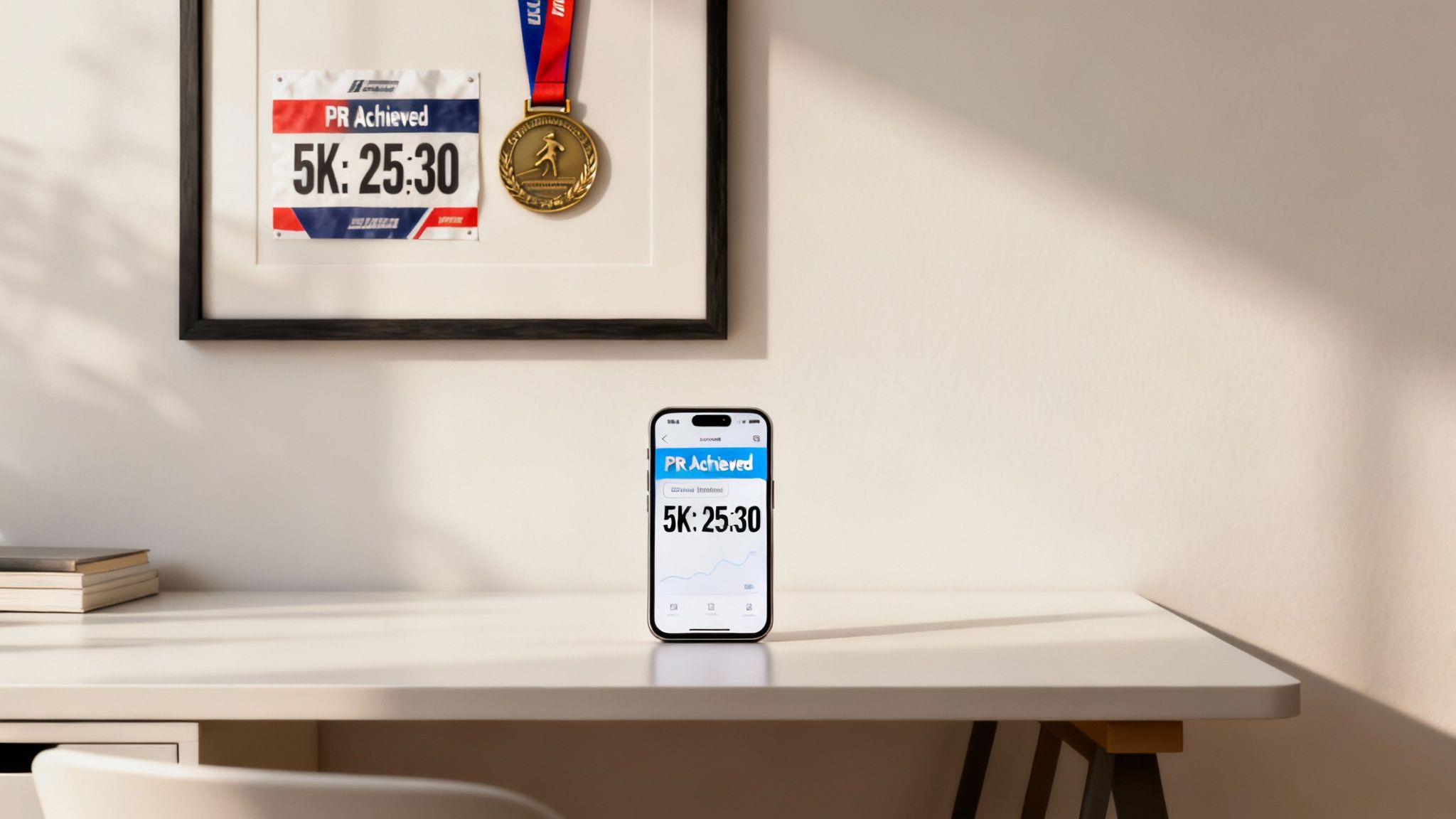
Hitting a new PR is a huge moment—it’s a real, tangible marker of progress in your running journey. Keeping track of these milestones does more than just build a history; it gives you solid data you can use to shape your future training. And thankfully, technology makes this whole process pretty seamless.
Apps like Strava have become the modern runner's logbook. Once you finish a race, you can plug in your official chip time, and the platform will instantly recognize it, awarding you a little digital trophy for your new record. It’s a great way to keep an ongoing, easy-to-access timeline of your progress across every distance you run.
Making Your Achievements Tangible
While digital logs are fantastic, there's something special about having a physical reminder of what you’ve accomplished. It can be a powerful source of motivation on days when you just don't feel like lacing up. Celebrating your PR isn't about showing off; it's about acknowledging the grind and the discipline it took to get there.
When you take a moment to celebrate, you're reinforcing all the positive habits that led to that success. It's your brain's way of saying, "Okay, that hard work was totally worth it."
Here are a few simple ideas to make that PR feel a little more permanent:
- Create a Memento: Turn your race into a piece of art. A custom RoutePrinter poster showing the course map, personalized with your name and that shiny new PR time, is a stylish way to remember your hard work.
- Frame Your Bib and Medal: Don't just toss your race bib and medal in a drawer to be forgotten. Putting them together in a shadow box creates a fantastic visual story of your race day.
- Plan a Reward Meal: Go ahead and enjoy that pizza or burger you've been craving, completely guilt-free. Tying your effort to a reward is a great psychological boost.
Your PR is more than just a set of numbers—it's a story of perseverance. Celebrating it cements the memory and gives you a deep well of inspiration to draw from the next time your motivation wanes.
Honoring your victories, both big and small, is a key part of making running a sustainable and joyful part of your life. For more inspiration, check out these ideas on how to display race medals and other race-day keepsakes.
Your Top Running PR Questions, Answered
Even after you've got the basics down, a few common questions always seem to pop up about personal records. Let's dig into some of the nitty-gritty details to clear up any confusion and get you back to chasing your goals.
Does a PR from My GPS Watch Count as Official?
This is a classic question. While your GPS watch is an amazing training partner, any PR it records for you is generally considered unofficial. An official PR is one you set in an organized race, on a certified course, with an official timing system. Race directors go to great lengths to make sure a 5K is exactly 5.0 kilometers, something your watch can only approximate.
It's completely fine to keep track of both! Many runners have their official race PRs and their "training bests." But when it comes to things like qualifying for the Boston Marathon or claiming bragging rights, the official time from a real race is the one that counts.
Think of it this way: your watch's PR is like hitting a new high score in a practice scrimmage. Your official race PR is what you achieve in the championship game.
Is It Normal for My PRs to Stop Improving?
Yes, 100% normal. Hitting a plateau is a natural part of every single runner's journey. When you're new to the sport, PRs can fall like dominoes, and it's an incredible feeling. But as you get fitter and more experienced, those gains get harder to come by.
Don't let it discourage you! A plateau is actually a sign of how far you've come. It’s a great time to shift your focus and find new ways to define success. You could try:
- Chasing consistency: Just focus on getting out the door regularly and enjoying the routine.
- Trying a new distance: If your 5K has stalled, maybe it's time to train for a 10K or half marathon.
- Running for joy: Forget the clock entirely and rediscover what made you love running in the first place.
A plateau isn't the end of your progress; it's just an evolution.
Do I Need a PR for Every Distance I Run?
Not at all. While you could technically have a PR for a 1-mile, 5K, 8K, 10-mile, and everything in between, most runners stick to the standard race distances they compete in. For most, that means focusing on the 5K, 10K, half marathon, and full marathon.
Trying to be in peak PR shape for every distance at once is a surefire way to burn out. A much better approach is to pick one or two distances that really motivate you and build your training around them. Let your passion guide your goals.
How Often Should I Try to Set a New PR?
It's so tempting to go for broke every time you line up for a race, but that strategy often leads to disappointment, injury, or burnout. The smartest runners play the long game.
Most coaches and experienced athletes will tell you to pick just one or two "A" races per year (or season) for a true PR attempt. These are the big ones you pour all your energy into. Treat your other races as "B" or "C" events—they're perfect for a hard workout, a tune-up, a chance to practice your fueling strategy, or just to have fun with your running community. This focused approach gives you the best shot at smashing your goal when it really counts.
Ready to commemorate that next big achievement? A PR is more than just a time; it's a story of your hard work and dedication. Turn those miles into a piece of art that reminds you of what you're capable of. RoutePrinter creates stunning, personalized posters of your race route, complete with your name, date, and official finish time.
Design your custom race poster at RoutePrinter.com and immortalize your personal record!