Conquer Your First Race: 8 Actionable Running a 5k Tips for 2026

Running a 5K is a landmark achievement, whether you're a seasoned runner aiming for a new personal record or a beginner lacing up for your first major race. The 3.1-mile distance presents a unique challenge, blending speed with endurance. It demands smart preparation but offers immense satisfaction upon crossing the finish line.
A successful race day doesn't happen by chance. It is the direct result of a structured plan, disciplined execution, and a bit of inside knowledge. Generic advice often falls short, leaving runners unprepared for the specific demands of the event. This is why having a clear, actionable strategy is crucial for both performance and enjoyment.
This guide moves beyond the basics to provide a comprehensive roundup of practical running a 5k tips. We will cover everything from selecting the right 4-to-8-week training plan and mastering your pace to optimizing race-day nutrition and developing a resilient mindset. Each tip is designed to give you a strategic advantage, ensuring you arrive at the starting line confident, prepared, and ready to run your best race yet. You will learn not just what to do, but how and why it works.
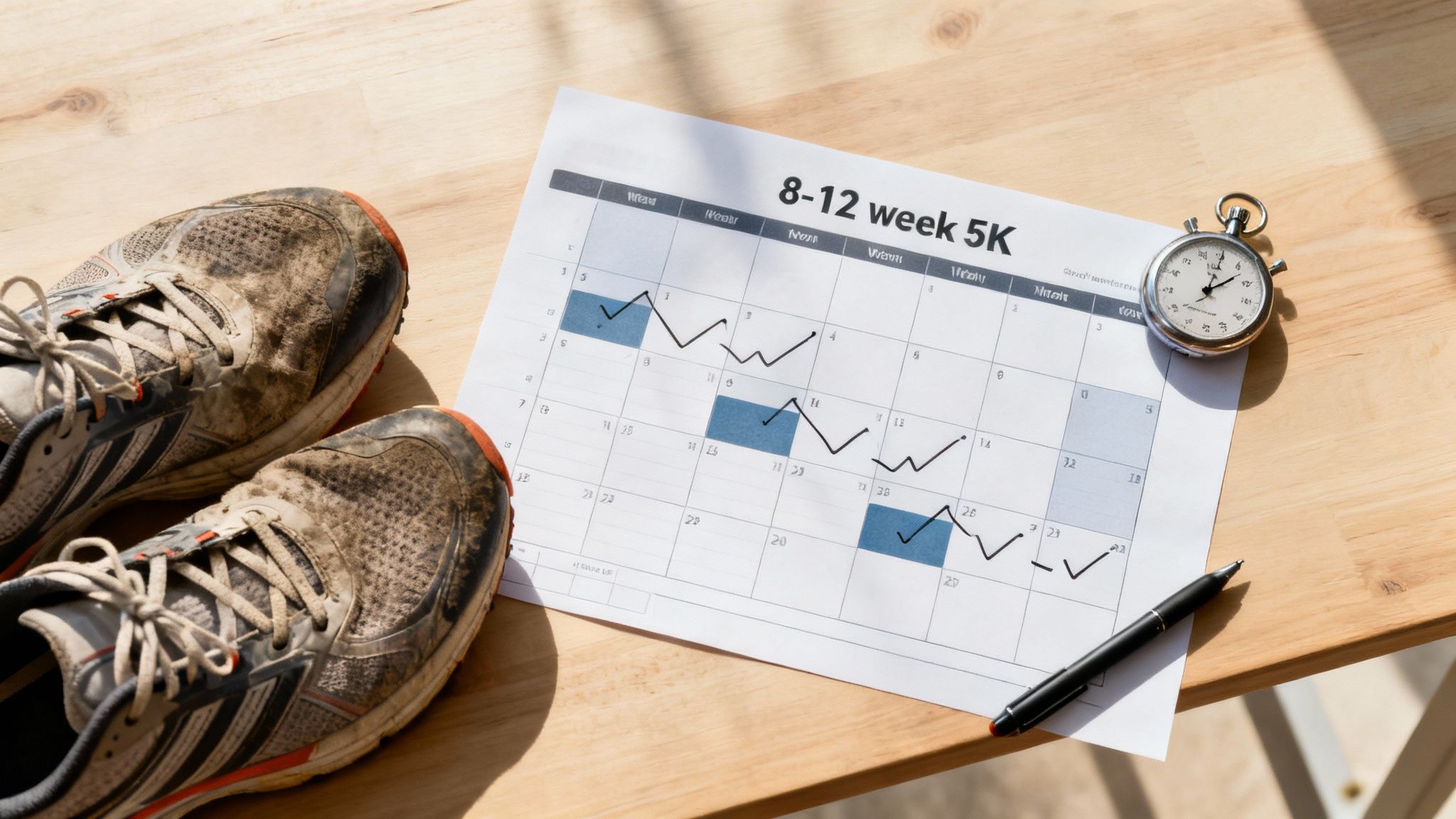
1. Follow a Structured 8-12 Week Training Plan
Attempting to run a 5K without a plan is like building a house without a blueprint. A structured training plan is the single most important tool for success, providing a progressive roadmap that safely builds your endurance and speed. This approach prevents the common pitfalls of doing too much too soon or not doing enough to be prepared, making it one of the most effective running a 5k tips for beginners and seasoned runners alike.
A well-designed 5K plan typically spans 8 to 12 weeks. It carefully balances different types of workouts to develop a well-rounded fitness base. The core principle is gradual progression, often following the "10% rule," where you increase your total weekly mileage by no more than 10% to minimize injury risk while consistently improving your aerobic capacity.
Why It Works
A structured plan methodically prepares your body for the specific demands of a 5K race. By incorporating easy runs, speed work like intervals, and tempo runs, you train different energy systems. This variety not only prevents boredom but also makes you a stronger, more efficient runner. The built-in rest days and taper period (a reduction in training volume before the race) ensure you arrive at the starting line feeling fresh and powerful, not fatigued.
How to Implement This Tip
- Choose the Right Plan: Select a plan that matches your current fitness. Beginners might start with the famous Couch to 5K (C25K) program, which eases you from walking into running. More experienced runners can find advanced plans on apps like the Nike Run Club or Strava.
- Track Your Progress: Log every run. This helps you see how far you've come and keeps you motivated. Tracking your routes also gives you data to create a commemorative RoutePrinter poster after your race.
- Listen to Your Body: Don't be afraid to adjust the plan. If a workout feels too hard, ease back. If you need an extra rest day, take it. The plan is a guide, not a rigid set of rules.
This structured approach is foundational for any race distance. For those looking ahead, many of the same principles apply to longer events; you can find more details in our guide on how to train for a 10K on routeprinter.com.
2. Incorporate Interval and Tempo Training
To race faster, you have to run faster in training. This is where interval and tempo workouts come in, serving as the engine room of your 5K preparation. These specialized sessions push your body beyond its comfort zone, directly improving your speed, lactate threshold, and VO2 max, making them indispensable running a 5k tips for anyone aiming to set a personal record.
Interval training involves short bursts of high-intensity running followed by recovery periods, while tempo runs are sustained efforts at a "comfortably hard" pace for 20-40 minutes. Together, they teach your body to clear lactate more efficiently and sustain a faster pace for the entire 3.1-mile race distance.

Why It Works
These workouts directly target the physiological systems required for 5K racing. Intervals boost your top-end speed and aerobic power (VO2 max), while tempo runs raise your lactate threshold, which is the point where fatigue rapidly sets in. By improving both, you become a more resilient and efficient runner, capable of holding a faster pace without hitting a wall. This type of training is a staple in programs from the Nike Run Club to elite training groups.
How to Implement This Tip
- Start with Intervals: Begin with simple repeats like 6 x 400 meters at your goal 5K pace, with a 400-meter jog for recovery in between. Over several weeks, you can progress to longer intervals, such as 5 x 1000 meters.
- Add Tempo Runs: Once a week, perform a tempo run. A classic example is to warm up for 10 minutes, run 20 minutes at a pace where you can only speak in short phrases, and then cool down for 10 minutes.
- Listen to Your Body: Speed work is demanding. Schedule these workouts mid-week on fresh legs, never back-to-back, and always start with a dynamic warm-up. If you feel pain, stop. Building speed is a gradual process.
3. Master Your Race Pace and Negative Split Strategy
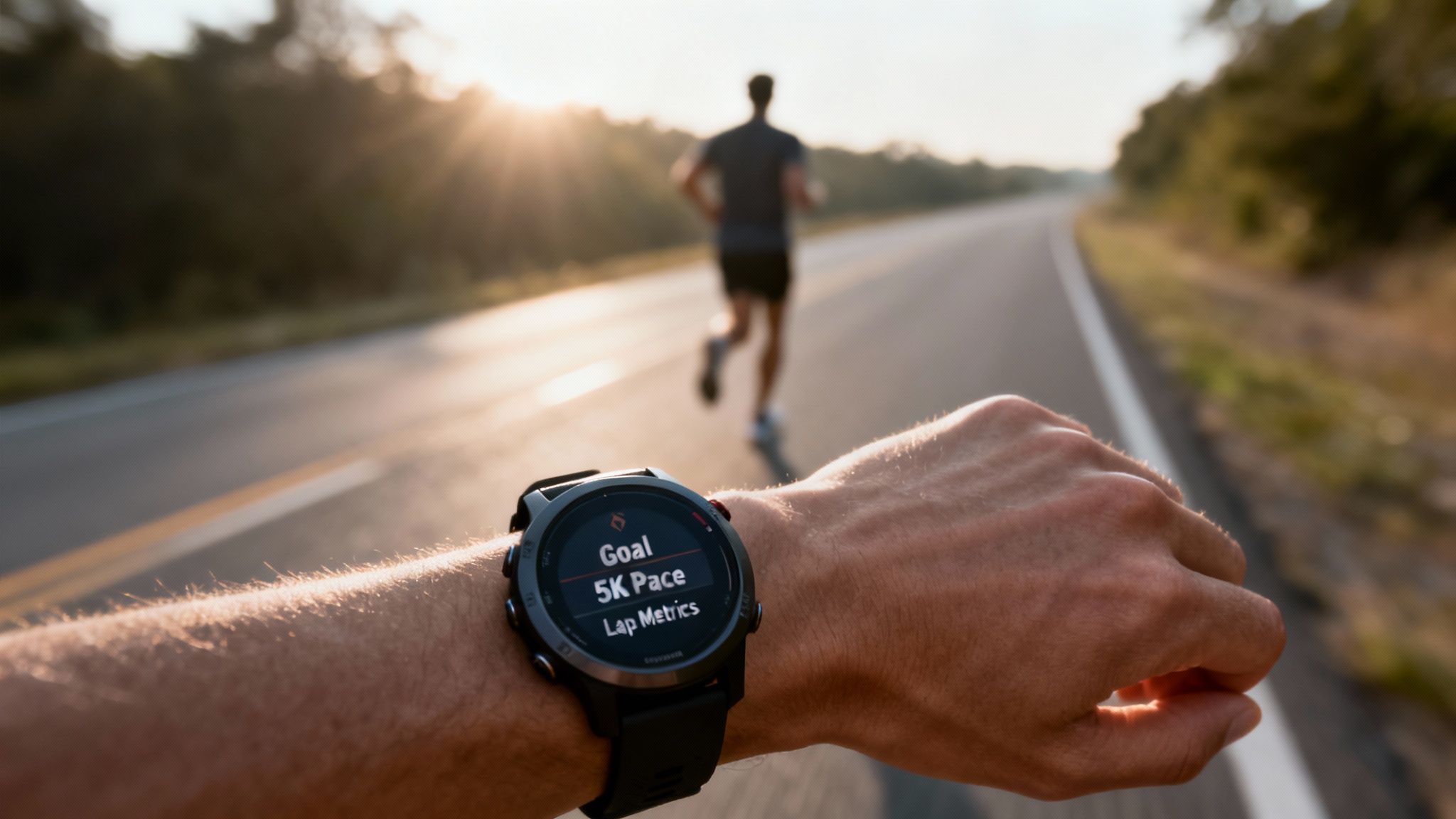
One of the most common race-day mistakes is starting out too fast. Mastering your pace and executing a negative split strategy, where you run the second half of the race faster than the first, is a game-changer. This disciplined approach conserves precious energy early on, allowing you to finish strong while others are fading from their initial surge of adrenaline. Learning this technique is one of the most powerful running a 5k tips for achieving a new personal best.
A negative split requires knowing your realistic pace capabilities, which you can determine from recent training runs like tempo workouts or time trials. The goal is to resist the excitement of the starting line, run the first mile slightly slower than your goal pace, settle in during the second mile, and then accelerate in the final mile. This strategy is used by elite athletes like Eliud Kipchoge and Shalane Flanagan to dominate the final stages of a race.
Why It Works
Starting conservatively prevents you from going into oxygen debt too early, which can lead to a painful and slow final mile. By saving your energy for the back half of the race, you can maintain better form, push harder when it counts, and mentally gain confidence as you pass other runners. This controlled effort leads to a faster overall time and a much more enjoyable race experience.
How to Implement This Tip
- Calculate Your Goal Pace: Use a recent time trial or your pace from a hard tempo run to set a realistic 5K goal pace. Don't base it on a dream time; base it on your actual fitness.
- Practice in Training: Dedicate some of your weekly runs to practicing pacing. Try running a 3-mile workout where each mile is progressively faster to get a feel for a negative split.
- Use Technology: Leverage the real-time pace alerts on your GPS watch or apps like Strava and Garmin Connect. Set them to notify you if you're running too fast in the first mile.
- Run by Effort: On race day, especially if it's hot or hilly, focus more on your perceived effort than on your watch. Your first mile should feel comfortably hard, not like an all-out sprint.
4. Optimize Nutrition and Hydration Strategy
Thinking about nutrition and hydration for a 5K might seem like overkill, but proper fueling is what allows your training to pay off on race day. What you eat and drink directly impacts your energy levels, performance, and comfort during the run. This strategy isn't about complex carb-loading, but rather about making smart, simple choices to ensure your body’s engine is topped off and ready to go, making it one of the most critical running a 5k tips.
A successful 5K nutrition plan starts days before the event, not just the morning of. The goal is to arrive at the starting line well-hydrated and with fully stocked glycogen (energy) stores without feeling heavy or bloated. This involves a focus on familiar, easily digestible carbohydrates and consistent hydration in the 48 hours leading up to the race.
Why It Works
Your body primarily uses carbohydrates for fuel during a high-intensity effort like a 5K. By consuming an easily digestible, carb-rich meal 2-3 hours before the race, you ensure your blood sugar levels are stable and your muscles have readily available energy. Proper hydration prevents performance-killing issues like cramps, fatigue, and dizziness. A well-executed fueling strategy means you can focus on your pace and effort, not on an upset stomach or a sudden energy crash.
How to Implement This Tip
- Plan Your Pre-Race Meal: Stick to what you know. A small meal of oatmeal with a banana or a bagel with honey, consumed 2-3 hours before the race, is a classic choice. Avoid high-fat, high-fiber, and excessively protein-heavy foods that can cause digestive distress.
- Hydrate in Advance: Start increasing your water intake 2-3 days before the race. On race morning, drink about 400-800ml of water 2-3 hours pre-race to ensure you're hydrated, giving your body time to process the fluid.
- Listen to Your Body During the Race: For a 5K that takes under 45 minutes, you typically don’t need to consume fuel during the run. However, if it's particularly hot, grabbing a quick sip of water at an aid station is a smart idea.
These fundamental fueling principles are scalable to longer distances. For more detailed nutritional planning for bigger races, you can explore our guide on what to eat before running a 10K on routeprinter.com.
5. Implement a Proper Warm-Up and Activation Routine
Showing up to the starting line cold is a surefire way to underperform and risk injury. A dynamic warm-up is a non-negotiable part of race day, designed to gradually elevate your core temperature, increase heart rate, and activate key muscle groups. This primes your body and mind for the effort ahead, making it one of the most critical running a 5k tips for hitting your goal time safely and effectively.
Unlike static stretching (holding a stretch for a long time), a dynamic routine involves active movements that mimic running. It prepares your neuromuscular system for the demands of a 5K, improving running economy and helping you feel strong and confident from the first step. This 15 to 20-minute investment before the race pays dividends in performance and injury prevention.

Why It Works
A proper warm-up sends a signal to your body that intense work is coming. It increases blood flow to your muscles, making them more pliable and efficient. By activating specific muscles like the glutes and hips through routines like the Myrtl circuit, you ensure the correct muscles are firing. The final part of the warm-up, strides, allows you to practice your goal pace, making it feel more natural when the gun goes off.
How to Implement This Tip
- Time It Right: Arrive at the race venue 45 to 60 minutes early. Start your warm-up about 20-25 minutes before the race is scheduled to begin, allowing time for a final bathroom stop.
- Follow a Sequence: Begin with 3-5 minutes of light jogging. Follow this with dynamic movements like leg swings, high knees, and butt kicks. Finish with 4 to 6 strides of about 100 meters at your goal 5K pace, with rest in between.
- Find Your Space: Locate a relatively quiet area away from the crowded start corral to perform your routine without obstruction. Focus on your movements and breathing, not the pre-race jitters around you.
6. Practice Smart Injury Prevention and Recovery
The most common reason for not reaching the 5K starting line is injury. Smart injury prevention and recovery are just as crucial as the runs themselves, ensuring your body can adapt to the training load without breaking down. This proactive approach involves balancing hard workouts with adequate rest, building functional strength, and listening to your body’s signals to prevent small aches from becoming race-day dealbreakers.
Treating recovery as a core part of your training is one of the most vital running a 5k tips for longevity in the sport. The goal isn't just to complete the 5K but to do so feeling strong and healthy. This means dedicating time to activities that support your running, from strength circuits and stretching to prioritizing sleep, which is when your muscles repair and grow stronger.
Why It Works
Running is a high-impact activity that places repetitive stress on your joints and muscles. Without a strong support system, this stress leads to common overuse injuries. Strength training builds resilient muscles to absorb impact, while proper recovery allows your body to make physiological adaptations. A planned recovery week, for instance, lets your body fully rebuild, preventing the cumulative fatigue that often precedes injury.
How to Implement This Tip
- Integrate Strength Training: Schedule 2-3 short, focused strength sessions per week. Concentrate on runner-specific exercises like single-leg squats, glute bridges, and planks to build stability in your core and hips.
- Prioritize Sleep: Aim for 7-9 hours of quality sleep per night. This is non-negotiable for muscle repair and hormonal regulation, which are critical for recovery and performance.
- Listen to Your Body: Do not "run through" sharp or persistent pain. Address minor aches immediately with rest, ice, and gentle stretching. A single day off is better than being sidelined for weeks.
- Schedule Recovery Weeks: Every fourth week, reduce your total running mileage by 30-50%. This "down week" allows for supercompensation, helping you come back stronger for the next training block.
A consistent prevention strategy is your best defense against setbacks. To explore this topic further, check out our in-depth guide on how to prevent running injuries on routeprinter.com.
7. Scout the Race Course and Plan Your Strategy
Arriving on race day without knowing the course is like taking a test without studying the material. Scouting the race course allows you to mentally and physically prepare for its specific challenges, transforming unknowns into strategic advantages. This crucial step, often overlooked by beginners, is one of the most effective running a 5k tips for building confidence and achieving a personal best.
By familiarizing yourself with the layout, you can anticipate every hill, sharp turn, and long straightaway. This knowledge helps you manage your energy effectively, knowing when to conserve power and when to push the pace. It eliminates race-day surprises, allowing you to focus purely on your performance rather than navigating an unfamiliar route.
Why It Works
A pre-race course review allows you to develop a specific strategy tailored to the terrain. Knowing exactly where the big hill is located, for example, lets you pace yourself accordingly in the kilometers leading up to it. This mental mapping reduces anxiety and gives you a significant tactical edge, helping you run a smarter, more efficient race from start to finish.
How to Implement This Tip
- Study the Official Map: The first step is to download and analyze the course map from the race organizer’s website. Pay close attention to the elevation profile to identify hills and their grade. Note the locations of water stations and any tight turns.
- Run or Drive the Course: If possible, run or drive the actual course one to two weeks before the event. This physical reconnaissance provides invaluable insight that a map cannot. Record your practice run on an app like Strava to review segments and elevation data afterward.
- Visualize Your Race: In the days before the race, use your knowledge of the course to visualize yourself running it successfully. Picture yourself powering up hills, cruising on the downhills, and finishing strong. This mental rehearsal is a powerful tool for race-day execution.
8. Develop Mental Toughness and Race-Day Mindset
Your physical training builds the engine, but your mental game is the driver that gets you across the finish line. Mental preparation is as crucial as any workout, especially in the final, most challenging mile of a 5K. Developing a strong race-day mindset allows you to manage discomfort, stay focused, and push through fatigue when your body wants to quit, making it one of the most powerful running a 5k tips you can implement.
This mental training involves building resilience through specific techniques like visualization, positive self-talk, and strategic goal setting. By conditioning your mind to handle the inevitable challenges of race day, you ensure your performance reflects the hard work you’ve put in during training. As legendary marathoner Eliud Kipchoge famously believes, “No human is limited,” a testament to the power of a trained mind.
Why It Works
A strong mental game helps you override the brain's natural protective instincts to slow down when you feel discomfort. Visualization primes your neuromuscular system for success, while a pre-planned mantra can cut through the negative chatter that often arises mid-race. By breaking the race into smaller, manageable chunks, you prevent feeling overwhelmed and maintain focus, transforming a daunting 3.1 miles into a series of achievable steps.
How to Implement This Tip
- Set Tiered Goals: Define three goals for race day: an "A" goal (your dream outcome), a "B" goal (a solid, realistic performance), and a "C" goal (the minimum you’ll be proud of). This provides flexibility and prevents an all-or-nothing mindset.
- Practice Visualization: For a few minutes each day in the weeks leading up to the race, close your eyes and vividly imagine yourself running strong, feeling powerful, and crossing the finish line successfully.
- Create a Mantra: Develop a short, powerful phrase to repeat during tough moments, such as "Strong and steady" or "I trained for this." Practice using it during your most challenging training runs.
- Chunk the Race: Mentally divide the 5K. Focus on mile 1 as the warm-up, mile 2 to find your rhythm, and the final 1.1 miles to push hard and finish strong.
5K Training: 8-Point Comparison
| Strategy | Implementation complexity | Resource requirements | Expected outcomes | Ideal use cases | Key advantages |
|---|---|---|---|---|---|
| Follow a Structured 8–12 Week Training Plan | Moderate — requires adherence to schedule | Low — time commitment, basic gear, tracking app | Improved aerobic base, progressive fitness, race readiness | Beginners to intermediate runners preparing for a target 5K | Reduces injury risk, builds confidence, clear progression |
| Incorporate Interval and Tempo Training | Moderate–High — precise pacing and workout design | Moderate — track/measured route, GPS watch, recovery time | Increased speed, VO2 max, and lactate threshold | Runners seeking faster 5K times or time-efficient gains | Rapid fitness improvements, scientifically proven performance boost |
| Master Race Pace and Negative Split Strategy | Moderate — requires pacing discipline and data | Low–Moderate — watch/pace alerts, recent time trials | Better race execution, stronger finish, fewer early fade | Experienced racers or those who practice pacing in training | Prevents starting too fast, enables a finishing kick |
| Optimize Nutrition and Hydration Strategy | Low–Moderate — needs testing and timing | Low — familiar foods, fluids, optional sports drinks/gels | Stable energy, reduced cramping/GI issues, faster recovery | All runners, especially in heat or longer efforts | Ensures glycogen availability, minimizes bonking risk |
| Implement Proper Warm-Up and Activation Routine | Low — brief pre-race routine to learn | Low — 15–20 minutes, small space for drills/strides | Elevated readiness, reduced injury risk, improved starts | All pre-race preparations and hard training sessions | Primes neuromuscular system, boosts confidence and economy |
| Practice Smart Injury Prevention and Recovery | Moderate — consistent cross-training and monitoring | Moderate — strength sessions, foam roller, adequate sleep | Fewer setbacks, sustained training continuity, long-term progress | Runners with high weekly mileage or past injuries | Builds durability, enables consistent progression |
| Scout the Race Course and Plan Your Strategy | Low–Moderate — research or recon runs required | Low — time for map review or practice run; possible travel | Tactical pacing, fewer surprises, terrain-aware decisions | Races with variable terrain or unfamiliar courses | Removes surprises, allows course-specific tactics |
| Develop Mental Toughness and Race-Day Mindset | Moderate — regular practice of techniques | Low — time for visualization, goal-setting, mantra practice | Improved focus, resilience, better performance under stress | Runners aiming for PRs or coping with race pressure | Enhances consistency, aids coping with discomfort and doubt |
Crossing the Finish Line and Commemorating Your Journey
You've now explored the essential framework for a successful 5K, from building a solid foundation with a structured training plan to mastering the mental game on race day. The journey from your first training run to the finish line is a powerful process of transformation. It's about more than just logging miles; it's a testament to your commitment, resilience, and the incredible capacity of the human body and spirit. By embracing these comprehensive running a 5k tips, you are not just preparing for a single event, but cultivating habits that will serve you long after the race is over.
Key Takeaways: Your Blueprint for Success
The difference between a good race and a great one often lies in the details. Remember that consistent, intelligent training always trumps last-minute cramming. The integration of interval and tempo runs builds speed and endurance, while a well-rehearsed pacing strategy prevents the common mistake of starting too fast and fading. Nutrition, hydration, and recovery are not afterthoughts; they are the pillars that support your physical efforts, allowing you to adapt, grow stronger, and avoid injury.
Ultimately, your success hinges on a holistic approach.
- Preparation is paramount: A solid training plan, course knowledge, and a race-day checklist remove uncertainty and build confidence.
- Listen to your body: Smart recovery, proper warm-ups, and proactive injury prevention ensure you arrive at the start line healthy and ready.
- The mental game is crucial: Your mindset dictates your performance. Cultivate a positive, resilient attitude to push through challenging moments.
From Training Log to Lasting Memory
Every step of this journey is part of your unique story. The early morning runs, the tough interval sessions, the moment you realize you can run further or faster than you ever thought possible, these are the milestones that define your achievement. Crossing that 5K finish line is the culmination of all that hard work, a moment of pure, earned exhilaration. That feeling of accomplishment deserves to be recognized and celebrated. It's a tangible reminder of what you can achieve through dedication.
Don’t let that achievement fade into just another digital entry in your running app. Preserving the memory of your race can provide powerful motivation for future goals. It serves as a visual cue, a daily reminder of your strength, discipline, and the joy of seeing your hard work pay off. Your 5K race is more than just a 3.1-mile run; it's a milestone worth cherishing.
Ready to celebrate your hard-earned victory? Turn your digital achievement into a work of art with RoutePrinter. Sync your Strava or GPX data to create a stunning, personalized print of your 5K course, complete with your finish time and race details. Visit RoutePrinter to design your unique race poster and commemorate your incredible journey today.