What Is a Good Average 10K Time for Your Age

So, you're wondering what a "good" 10K time is. If you're looking for a quick answer, most recreational runners find themselves finishing somewhere between 50 and 65 minutes. That's a solid benchmark, but it's really just the starting line for the conversation.
The truth is, a single number doesn't tell the whole story.
What Is a Good 10K Time, Really?
Pinning down a "good" 10K time is all about context. Think of it this way: asking for the perfect temperature is meaningless without knowing if you're planning to go skiing or swimming. The same logic applies to running. Your age, gender, training history, and personal goals are what really shape a successful race day.
Instead of getting hung up on one magic number, it’s much healthier to see 10K times as a broad spectrum. What an experienced club runner considers a light jog might be a massive personal best for someone who laced up their first pair of running shoes just a few months ago. Both are valid, and both are worth celebrating.
Finding Your Benchmark
To set a goal that feels both challenging and achievable, it helps to look at some general benchmarks. These aren't hard-and-fast rules but guideposts to help you find your place on the running map.
- Beginner Runners: The main goal here is often just to finish without stopping. Crossing the line anywhere between 60 and 75 minutes is a fantastic achievement.
- Intermediate Runners: If you're running a few times a week, you're likely focused on getting a little faster. Aiming for a time between 50 and 60 minutes is a strong, respectable goal.
- Advanced Runners: These folks are deep into structured training and are chasing down some impressive numbers. They typically push for times under 50 minutes, with many setting their sights on breaking the 45-minute barrier.
The only "good" time that truly matters is the one that marks your own progress. A new personal best is a new personal best, and that’s the real win.
The following table breaks these benchmarks down to give you a clearer picture of what these finish times look like in terms of real-world pacing.
10K Finish Time Benchmarks at a Glance
This quick reference chart helps you see where your time might fit across different levels of running experience.
| Runner Level | Average Finish Time | Average Pace (min/km) | Average Pace (min/mile) |
|---|---|---|---|
| Novice/Beginner | 60–75 min | 6:00–7:30 min/km | 9:40–12:00 min/mile |
| Intermediate | 50–60 min | 5:00–6:00 min/km | 8:00–9:40 min/mile |
| Advanced | 45–50 min | 4:30–5:00 min/km | 7:15–8:00 min/mile |
| Competitive | Under 45 min | Under 4:30 min/km | Under 7:15 min/mile |
| Elite | Under 35 min | Under 3:30 min/km | Under 5:40 min/mile |
This data shows just how wide the range of "good" can be, so focus on the level that best reflects your current training and goals.
A Look at Global Averages
When you zoom out and look at data from thousands of race participants, the median 10K finish time usually lands somewhere in the 50 to 60-minute range. This is where things get interesting, though. A deeper analysis of 10K race times often shows men averaging between 45-55 minutes and women averaging between 50-65 minutes. This is why comparing your performance to a generic, mixed-gender average can be a bit misleading.
Ultimately, understanding these benchmarks helps you set a goal tailored to your own running journey. And it’s that personal achievement—your hard-earned PB—that deserves to be celebrated. It's the kind of accomplishment you might even want to immortalize with a custom race poster from RoutePrinter.
How Age and Gender Shape Your 10K Performance

Trying to pin down a single "good" 10K time is a fool's errand. It's like asking for the perfect shoe size without knowing who's wearing the shoes. The numbers that matter are the ones that reflect your reality, and the two biggest factors influencing that are your age and gender.
It’s easy to get discouraged comparing your time to a 20-something speedster if you're a 50-year-old lacing up for your first race. A much healthier and more effective approach is to see how you measure up against runners in your own category. This isn't about setting limits; it's about setting smarter goals that make sense for your own running journey.
Understanding the Age Factor
Our bodies are constantly changing, and that's not a bad thing. From our teens to our golden years, these natural shifts directly impact our running potential. Understanding them is the key to setting goals that challenge you without breaking you.
One of the big players here is VO2 max—the maximum amount of oxygen your body can use while you're pushing hard. For most of us, VO2 max peaks in our late teens or early 20s and then starts a slow, gradual decline. This means an older runner has to work more efficiently to get the same amount of oxygen to their muscles as a younger one.
On top of that, our muscle mass and the elasticity of our connective tissues change over time. As we get older, we naturally lose a bit of muscle, which can impact our raw power and speed. Our tendons and ligaments also become a little less pliable, which just means warming up properly and focusing on recovery becomes that much more important.
A "good" 10K time is less about hitting a specific number and more about performing well within your age category. It celebrates personal progress over an arbitrary standard.
This is exactly why a 55-year-old runner who clocks a 60-minute 10K might actually be putting in a more impressive performance for their age group than a 25-year-old with the same finish time. Context changes everything.
How Gender Influences Performance
Physiological differences between men and women also create different performance baselines. On average, men tend to have a higher VO2 max, more muscle mass, and less body fat than women. Their hearts and lungs are typically larger, too, which helps with oxygen transport during a long run.
Now, these are just biological averages—they say nothing about an individual's work ethic or talent. An elite female runner will easily outpace the majority of male runners any day of the week. But these baseline differences help explain why, in large race datasets, the average men's 10K time is usually a few minutes faster than the average women's time.
This is precisely why races have separate categories for men and women. It creates a level playing field and ensures you're stacking your performance up against your direct peers, which makes every achievement that much more meaningful.
Average 10K Finish Times by Age Group and Gender
Enough with the theory—let's look at the numbers. The table below gives you a realistic snapshot of what an average 10K time looks like for different age groups and genders. Use it to find a benchmark that makes sense for you and to set your sights on your next goal.
Just remember, these are averages. That means plenty of people are faster and plenty are slower. The real power here is in finding your place on the spectrum and figuring out what a challenging but achievable next step looks like.
| Age Group | Average Male Time | Average Female Time |
|---|---|---|
| 16-19 | 46:30 | 55:30 |
| 20-24 | 51:15 | 58:45 |
| 25-29 | 52:30 | 1:00:15 |
| 30-34 | 53:45 | 1:01:00 |
| 35-39 | 54:30 | 1:01:45 |
| 40-44 | 55:15 | 1:02:30 |
| 45-49 | 56:00 | 1:04:00 |
| 50-54 | 58:30 | 1:06:15 |
| 55-59 | 1:01:00 | 1:09:00 |
| 60-64 | 1:04:30 | 1:13:00 |
| 65+ | 1:09:00 | 1:18:00 |
Armed with this data, you can stop chasing a one-size-fits-all number and start focusing on what really matters: your own progress. Whether you're aiming to land in the top half of your age bracket or just want to beat your last time, you now have the context to do it.
Finding Your Place on the Runner Spectrum
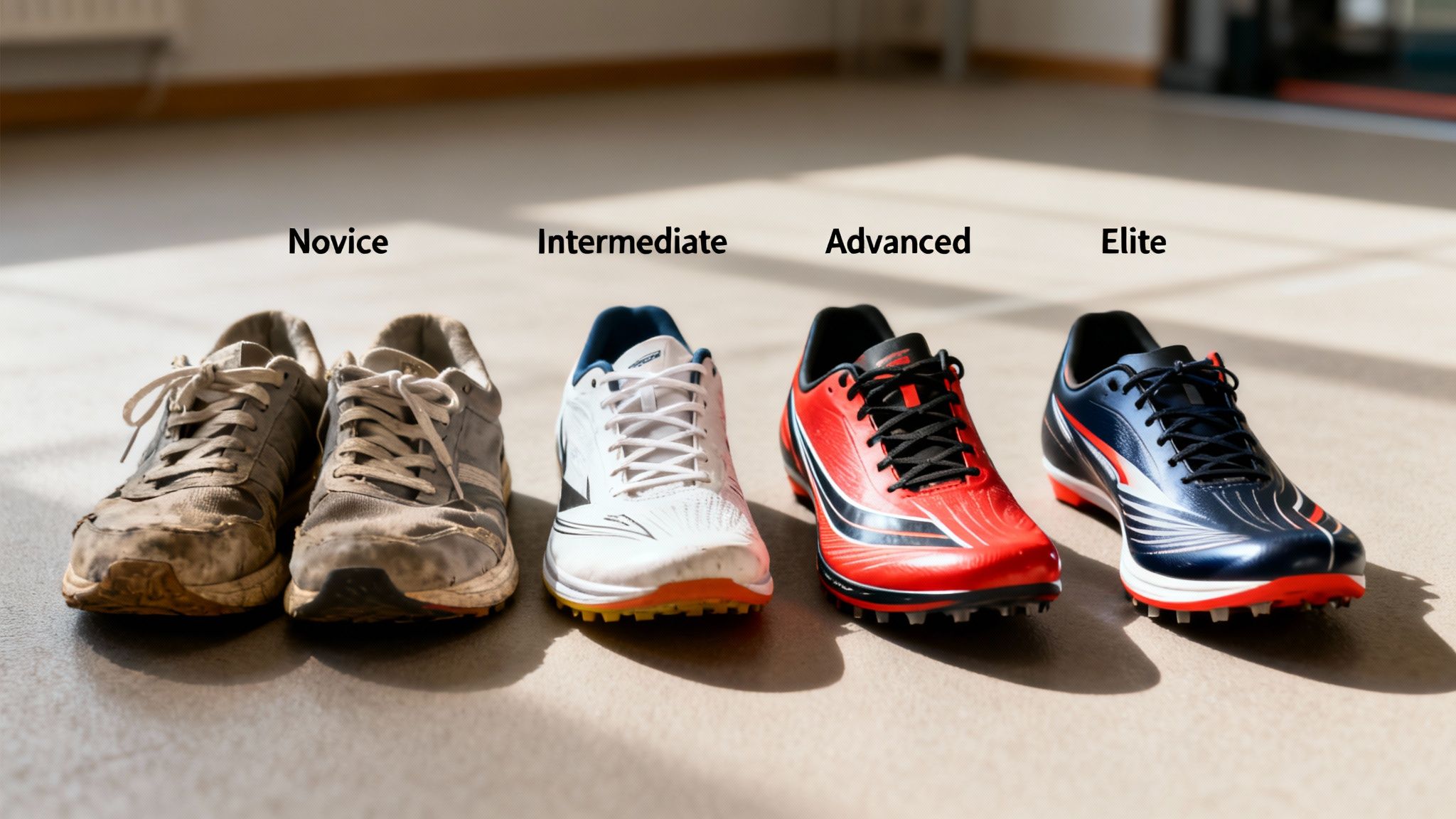
Every runner has their own story, and a finish time is just one small chapter. It's so much more than the numbers on the clock; it’s about the journey, the commitment, and the mindset you build along the way. To really understand your own progress, it helps to see where you fit into the different tiers of running, from the casual weekend jogger to the dedicated club competitor.
This isn't about slapping labels on people. Think of it more as a motivational roadmap. When you know where you are now, you can start setting realistic—but still ambitious—goals for where you want to go. The average 10k time you're chasing should always feel in sync with your life and what you can realistically put into your training.
The Novice Runner
For anyone just starting out, the goal is often beautifully simple: finish the race without stopping. The real focus is on building a consistent running habit and just soaking in the electric atmosphere of a race for the first time.
A typical finish time for this group falls somewhere between 60 and 80 minutes. Their training might involve two or three runs a week, slowly adding a bit more distance to build the endurance needed for the full 6.2 miles. For a novice, the victory isn't about a speed record; it's about proving to yourself that you can do it.
The Intermediate Runner
Intermediate runners have officially caught the running bug. They’ve probably got a few races under their belt and are now hungry to improve. This is where more structured training starts to become a game-changer.
Finish times for intermediate runners usually land between 50 and 60 minutes. You'll often find them running three or four times a week, mixing things up with long, slow runs and maybe even their first taste of tempo work. They're actively trying to get faster, and cracking that one-hour mark is a massive milestone. For runners targeting a steady 10-minute mile, our guide has some great insights on holding that pace.
Your runner "level" is not a permanent status. It's a snapshot of your current fitness and commitment. With consistent training, every runner has the potential to move up the spectrum.
The Advanced Runner
Advanced runners are all in. They follow a disciplined plan, often running four to six days a week, and are usually part of a local running club. Their mindset shifts from just completing a race to truly competing and pushing their own limits.
An advanced runner’s 10K is typically under 50 minutes, with many chasing that coveted sub-45 or even sub-40-minute mark. Their training is highly structured, blending speed intervals, tempo runs, long runs, and crucial recovery days. They get the science behind their performance and are always looking for that extra edge.
It's also interesting to see how the sport has evolved. For a long time, comparing road race times globally was a messy business. It wasn’t until 2003 that World Athletics (then the IAAF) started officially recognizing road distance records, which finally standardized how we track elite performances.
The Competitive and Elite Tiers
At the very top of the pyramid are the competitive and elite runners. These athletes live and breathe the sport. Their times are simply staggering—often under 35 minutes for men and under 40 for women—and come from years of relentless, high-volume training.
Their performance is a potent mix of natural talent and an almost superhuman work ethic. While their times are incredibly inspiring, they exist in a different stratosphere for most of us. They show us the absolute peak of human potential and give us all something to marvel at.
No matter where you fall on this spectrum, every finish line you cross is a huge accomplishment. Whether you're celebrating your first 10K or your tenth personal best, that achievement is yours. It's a story worth telling and a memory worth preserving—maybe even with a custom race poster that captures the route you conquered.
The Training Methods That Actually Lower Your 10K Time
Alright, so you know where you stand. But how do you get from here to a new personal best? If you want to see that 10K time drop, simply running more isn't the answer—in fact, it's a great way to burn out. The real key to getting faster is training with purpose.
This means trading in those aimless "junk miles" for a structured plan that builds your endurance, sharpens your speed, and forges the mental grit you need on race day. By weaving a few proven training methods together, you'll prepare your body for the unique challenge a 10K presents.
Think of it as building a house. You need a solid foundation (long runs), a sturdy frame (strength), and the high-performance wiring that makes it all work (speed). Each part is essential, and they all work together to create something you can be proud of when you cross that finish line.
Build Your Endurance with Long Slow Runs
The absolute bedrock of any distance running plan is the long slow run (LSR). It feels a little backward, doesn't it? Running slow to get faster? But this is where the real magic happens. These runs are done at a truly conversational pace—so easy you could hold a chat with a running buddy without gasping for breath.
The point isn't to break any records. It’s about spending time on your feet. This builds your aerobic base, makes your heart a more efficient pump, and teaches your body to get better at using oxygen. Just as importantly, it builds the mental toughness to grind through those last couple of miles when things get tough.
- How it's done: Once a week, make one of your runs longer than the others. Increase the distance by no more than 10% each week to keep injuries at bay.
- How it feels: Easy and controlled. If you're huffing and puffing, you're going too fast. Slow down.
Sharpen Your Speed with Interval Training
If long runs build your engine, interval training is how you add the horsepower. This is your classic "work/rest" workout: short, intense bursts of fast running followed by a recovery period of jogging or walking. This is one of the most potent ways to boost your VO2 max—a fancy term for how efficiently your body uses oxygen when you're pushing hard.
Interval training makes your goal pace feel easier by forcing you to run faster than it in short, controlled doses. It’s like practicing for a test with questions that are harder than the real thing.
By pushing into that uncomfortable, breathless zone, you teach your body to clear out lactic acid more effectively. This is what helps you hold a faster pace for longer before your legs start screaming. It’s the workout that gives you the biggest bang for your buck when it comes to pure speed.
A Classic Interval Workout:
- Warm-up: 10–15 minutes of easy jogging.
- Main Set: 6 x 400 meters (one lap of a track) at a hard effort.
- Recovery: 400 meters of slow jogging or walking between each hard lap.
- Cool-down: 10–15 minutes of easy jogging and some stretching.
Master Your Race Pace with Tempo Runs
The tempo run is arguably the most valuable workout for any 10K runner. This is a sustained effort at a pace that feels "comfortably hard"—you're definitely working, but you're not all-out sprinting. You should be able to say a few words, but not sing a song. This effort is typically held for 20–30 minutes.
Tempo runs are your dress rehearsal for race day. They train your body and mind to lock into a challenging pace and hold it, which is the exact skill a 10K demands. This is how you make your goal pace feel familiar and automatic when the starting gun goes off. For a deeper dive, our guide on how to train for a 10K breaks these workouts down even further.
The Supporting Cast: Strength and Recovery
Getting faster isn't just about what you do on the road or track. The work you do off of it is what keeps you healthy, strong, and consistent. Ignoring these pieces is a surefire way to hit a plateau or get sidelined with an injury.
- Strength Training: Two days a week can make a massive difference. Focus on big, compound movements like squats, lunges, and deadlifts. This builds a powerful chassis and a strong core, which improves your running economy (meaning you use less energy to run at the same pace).
- Cross-Training: Give your joints a break. Activities like cycling or swimming maintain your cardiovascular fitness without the constant pounding of running. It’s a great way to add more training volume without adding more risk.
- Recovery: This is non-negotiable. Your body doesn't get stronger during the workout; it gets stronger when you rest and rebuild afterward. Prioritize sleep, eat well, and listen to your body. A planned rest day is always smarter than a forced one.
Mastering Race Day for Your Personal Best
All that training—every single long run, every gut-busting interval, every well-earned rest day—boils down to these 6.2 miles. Race day is where your hard work finally gets to shine, but a great performance is about more than just fitness. It’s about having a smart strategy.
The classic rookie mistake? Letting that race-day adrenaline take over, blasting out of the starting gate like a cannonball, only to fade hard in the final miles. We’ve all been there.
A well-thought-out race plan is your secret weapon. It keeps you in control, helps you manage your energy, and makes sure you have enough left in the tank for a strong, satisfying finish. The key is to stop thinking of the 10K as one long, grueling effort. Instead, break it down.
The Three-Act Race Strategy
Mentally splitting the race into smaller, more digestible chunks makes the full distance feel far less intimidating. This simple trick helps you stay present and make smart decisions from the starting gun to the finish line.
-
Act I (Miles 1-2 / Kilometers 1-3): The Controlled Start
Your only job here is to hold back. Seriously. You should aim to run slightly slower than your goal pace. This conserves precious energy, allows your body to warm up properly, and stops you from crashing and burning later. It’s supposed to feel too easy. Trust the process. -
Act II (Miles 3-5 / Kilometers 4-8): Find Your Rhythm
Okay, now it's time to settle in. Gently ease into your goal pace—the one you drilled into your legs during all those tempo runs. This is the heart of the race. Focus on your breathing, keep your form smooth, and find that comfortable rhythm where you can just tick off the miles. -
Act III (The Final Stretch): The Strong Finish
With the finish line getting closer, check in with yourself. If you’re feeling strong, this is your green light to start gradually picking up the pace. This is where you can start passing people and really push for home, leaving every last bit of energy out there on the course.
The gold standard of a smart pacing strategy is to run the second half of the race slightly faster than the first. This is called a "negative split," and it's the signature of an experienced runner who managed their energy perfectly.
Fueling for a Powerful Finish
A 10K is just short enough that you don't need to worry about gels or complex in-race nutrition, but what you eat before the race is critical.
About two hours before the gun goes off, have a small breakfast that’s rich in easily digestible carbs. Think a banana, a small bowl of oatmeal, or a piece of toast with honey. This tops off your energy stores without weighing you down.
Make sure you're well-hydrated in the days leading up to the race, and have a small glass of water on race morning. Grabbing a few sips at a mid-race aid station is perfectly fine if you feel thirsty, but try not to overdo it. Your pre-race preparation is what will ultimately carry you across the finish line.
While a 10K strategy is pretty straightforward, the principles of pacing and fueling become even more critical as you tackle longer distances. You can see how this foundation applies on a much larger scale in our guide on how to train for a marathon. With a solid plan, you can turn your fitness into a performance you're genuinely proud of—an achievement truly worth celebrating.
How Far We've Come: The Story of the 10K World Record
To really get a feel for your own running journey, it’s sometimes helpful to look at the absolute pinnacle of the sport. The story of the 10K world record isn't just a dry list of statistics; it's a fascinating look at how athletes have systematically shattered what we once believed was humanly possible.
For years, the world’s best distance runners were obsessed with breaking the 30-minute barrier on the track. Then, legends like Finland's Lasse Virén came along in the 1970s and smashed the record down into the 27-minute range, setting a mark that seemed untouchable for a generation.
Each new record holder was driven by innovative training methods and incredible grit, chipping away precious seconds. It’s a powerful story of relentless progress.
Think about this: back in the 1960s, a world-class time was still over 30 minutes. Fast forward to today, and we've seen an almost unbelievable jump. Joshua Cheptegei’s jaw-dropping track record of 26:11.00, set in 2020, is nearly a four-minute improvement over those early benchmarks. If you're curious, you can trace the entire timeline of this incredible 10K record progression and see how the limits kept getting pushed.
The Modern Era of Speed
So, what changed? It wasn't just one thing. It's a mix of smarter science, tougher competition, and better gear.
- Advanced Training Science: Today's top athletes follow meticulously planned training programs that perfectly balance grueling high-intensity workouts with essential recovery.
- Nutrition and Recovery: Fueling is now a precise science. Runners know exactly what to eat and when, helping them perform at their best and bounce back faster than ever.
- Technological Leaps: There's no denying the impact of "super shoes." The combination of carbon-fiber plates and ultra-responsive foams has given runners a real, measurable boost in running economy, contributing to the recent flood of record-breaking times.
The story of the 10K world record is a reminder that progress is always possible. What seems like an impossible barrier today could be tomorrow's new standard.
This history isn't here to discourage you—quite the opposite. It’s meant to inspire. It shows that running is a continuous story of improvement, whether you're a world-record holder or a weekend warrior chasing your first sub-60.
Your own finish time is a small but meaningful part of this bigger narrative. Every personal best, no matter what the clock says, is a testament to that same human spirit of pushing boundaries and seeing what you're made of.
Got 10K Questions? We've Got Answers.
Let's tackle some of the most common questions runners ask when they're thinking about the 10K distance.
How Long Should I Train for a 10K?
If you're starting from scratch, give yourself a solid 8 to 12 weeks. This isn't just about getting fit; it's about letting your body adapt safely to the new demands of running, which helps you sidestep injuries.
Already have a bit of a running base? You can probably get race-ready in about 6 to 8 weeks, shifting your focus from just logging miles to more specific workouts that build speed and stamina.
Is Breaking the 60-Minute Barrier a Big Deal?
For most runners, it's a huge deal. Finishing a 10K in under an hour is a classic milestone that signals you've moved from being a casual jogger to a more serious, dedicated runner.
It's a fantastic goal that puts you well ahead of the average finisher. Hitting that sub-60 minute mark is definitely something to be proud of.
Think of a sub-60 minute 10K as your running graduation. It's not just a time on a clock; it's proof that your hard work and consistency have paid off, taking your fitness to a whole new level.
What’s a Realistic Goal for My First 10K?
Honestly? The best goal for your very first 10K is simply to cross the finish line with a smile on your face. Forget the pressure of the clock for a moment and focus on running a smart, comfortable race.
If you really want a number to aim for, a great first-timer's goal is anywhere between 60 and 75 minutes. The real win is completing the distance and feeling great about it.
Every finish line you cross tells a story of dedication and effort. At RoutePrinter, we help you capture that story by turning your race route into a piece of minimalist art. Celebrate your next achievement with a custom race poster and remember that personal best forever.