Your Ultimate Triathlon Training Plan for Any Distance

A triathlon training plan isn't just a generic schedule; it's a structured approach that carefully balances swimming, cycling, and running to get you ready for a specific race. The best plans are always built around you—your goals, your starting fitness, and your real-life schedule. They work by gradually increasing the challenge, which is the key to building serious endurance without getting sidelined by injury.
Building Your Personal Triathlon Roadmap
Signing up for a triathlon is a huge commitment, but like any epic adventure, you need a map before you take the first step. Before you start logging miles or splurging on new gear, you have to lay the groundwork with a clear, personalized roadmap.
This initial planning is the absolute foundation for a successful and, most importantly, enjoyable training experience. It’s all about matching your ambition to your reality. Doing this right sets you up for consistency and helps you dodge the burnout that can trip up even the most motivated athletes.
The goal here isn't to jump into the toughest workouts right away. It's about making smart, strategic decisions that build momentum. We'll kick things off by picking a race that excites you (without totally overwhelming you), setting goals that keep you motivated, and taking an honest look at where you're starting from.
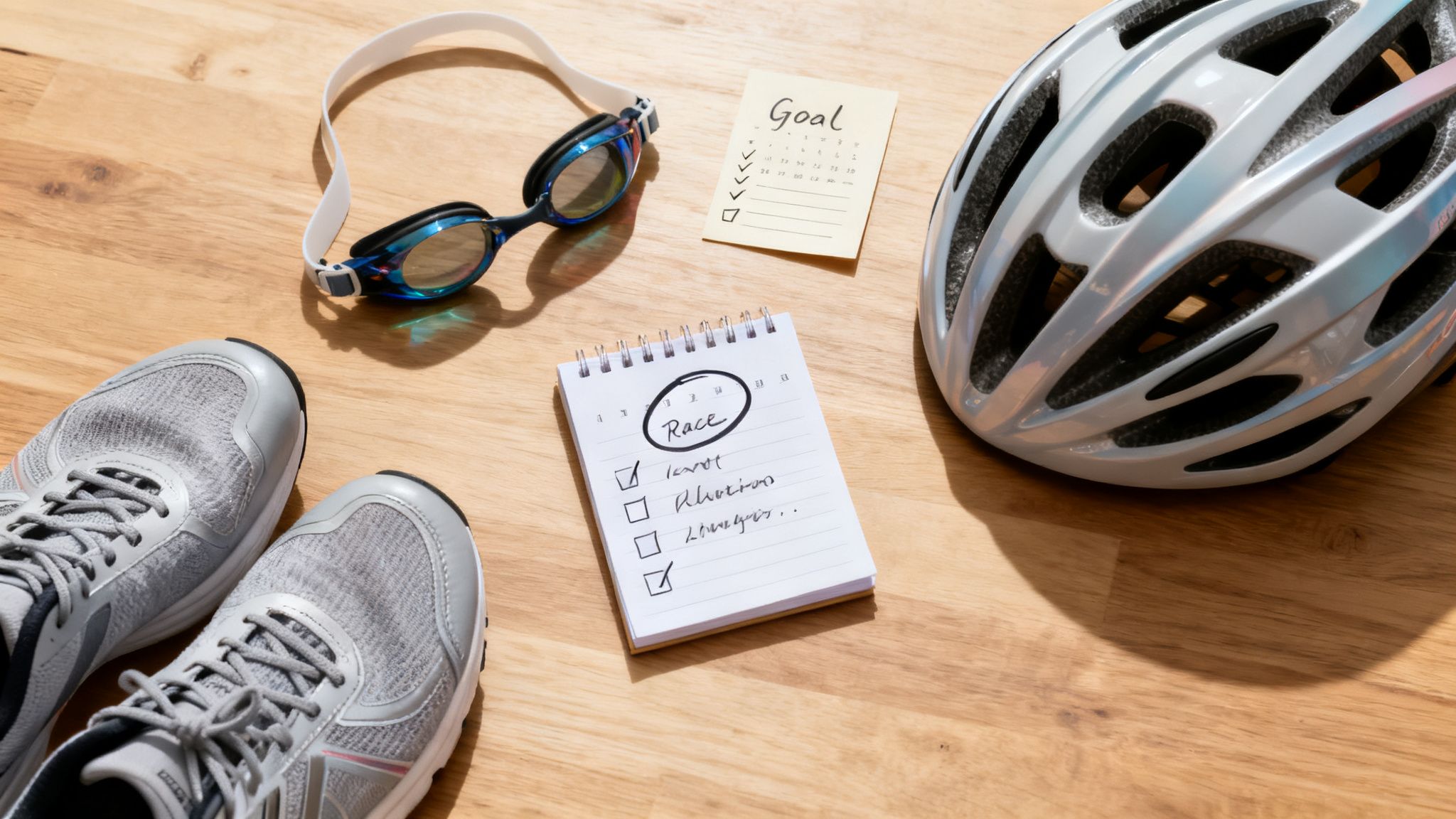
Choose Your Race Distance
The very first decision you need to make is which race distance to tackle. This single choice will shape everything that follows—your time commitment, how hard you train, and the entire structure of your plan. It’s critical to pick a distance that fits your current life and fitness level.
Here’s a quick rundown of the standard distances to help you decide.
| Distance | Swim | Bike | Run | Ideal For |
|---|---|---|---|---|
| Sprint | 750 m | 20 km (12.4 mi) | 5 km (3.1 mi) | Beginners, athletes seeking speed, or those with limited training time. |
| Olympic | 1.5 km | 40 km (24.8 mi) | 10 km (6.2 mi) | A great step-up from a Sprint or a solid challenge for fit newcomers. |
| Half-Ironman (70.3) | 1.9 km | 90 km (56 mi) | 21.1 km (13.1 mi) | Experienced athletes ready for a serious endurance test. |
| Full Ironman (140.6) | 3.8 km | 180 km (112 mi) | 42.2 km (26.2 mi) | The ultimate endurance challenge requiring immense dedication and training volume. |
Each distance presents a unique challenge and requires a different level of preparation. For example, a Sprint is the perfect entry point. You can often prepare for its 750m swim, 20km bike, and 5km run in just 4-6 hours per week.
Ready for a bigger challenge? The Olympic distance doubles that, with a 1.5km swim, 40km bike, and 10km run. It demands a more significant commitment of 6-10 hours weekly and is a fantastic goal after you've conquered a sprint. We cover everything you need to know in our detailed guide to the Olympic triathlon distance.
The Half-Ironman (70.3) is where things get serious. This endurance test involves a 1.9km swim, 90km bike, and 21.1km run, requiring 10-15 hours of training per week. Finally, the Full Ironman (140.6) is the ultimate one-day event—a 3.8km swim, 180km bike, and a full 42.2km marathon. It's a monumental achievement built on 15-20+ hours of weekly training.
Choosing a race isn't just about picking a distance; it's about committing to a process. Your first goal should be to cross the finish line healthy and with a smile. The speed can come later.
Set Meaningful Goals
Once you have a race on the calendar, it’s time to define what success looks like for you. A goal like "finish my first sprint triathlon" is a great start, but layering your goals can provide a massive motivational boost. A proven method is to set "A, B, and C" goals.
For instance, your "A" goal might be your dream outcome, like finishing in under two hours.
Your "B" goal could be a performance metric, like running the entire 5k without walking.
And your "C" goal—the most important one of all—is simply to complete the race, soak in the atmosphere, and enjoy the experience. This approach gives you multiple ways to feel successful, no matter what happens on race day.
Assess Your Starting Point
An effective training plan has to be built on reality. You need to know your current fitness level, not just where you want to be in a few months.
Be brutally honest with yourself. Can you swim 400 meters without stopping? Have you been cycling regularly? What's the farthest you can run right now?
Performing a simple baseline test in each sport will give you invaluable data to build from. This isn't just about stroking your ego; it's about preventing injuries from doing too much, too soon. A recent survey showed that 72% of triathletes rely on structured training plans for a reason—it's the smartest way to train.
Designing Your Weekly Training Schedule
Okay, you've got your goals and your big-picture roadmap. Now it's time to get down to the nitty-gritty and build the engine of your training plan. A solid weekly schedule is where the magic happens, turning those ambitious goals into daily, consistent action. This is how we translate the "what" you want to achieve into the "when and how" you'll actually do it, fitting everything into your real life.
The point isn't to just cram as many sessions in as possible. Far from it. The real goal is to create a balanced, repeatable structure that builds fitness piece by piece. This approach is what keeps you from burning out, helps sidestep injuries, and ensures you show up to the start line feeling strong, not just tired.
Understanding Periodization: Your Training Phases
A smart training plan isn't just a random collection of workouts. It follows a proven principle called periodization. All that means is your training is broken down into distinct phases, each with a very specific purpose. Think of it like building a house: you have to lay the foundation before you can start putting up the walls and the roof.
- Base Phase (12-16 weeks): This is all about that foundation. The focus here is on building a big aerobic engine with lots of low-intensity, higher-volume work. You're essentially teaching your body to be efficient for the long haul.
- Build Phase (8-12 weeks): With the foundation poured, you start framing the house. This is where you introduce more race-specific intensity—things like tempo runs and hard cycling intervals—while still keeping up your endurance.
- Peak Phase (4-6 weeks): Time for the final polish. Workouts get more intense and are designed to mimic the exact demands of your race. Your overall training time might even drop a bit to allow for these sharper, higher-quality sessions.
- Taper and Race (1-2 weeks): You pull way back on the training volume. This isn't slacking off; it's allowing your body to fully recover and soak up all the hard work you've done. You'll arrive at the race fresh and absolutely ready to go.
Following these phases is genuinely the safest and most effective way to build fitness that lasts. It keeps you from getting stuck on a plateau or, worse, getting injured by doing too much, too soon.
Structuring Your Training Week
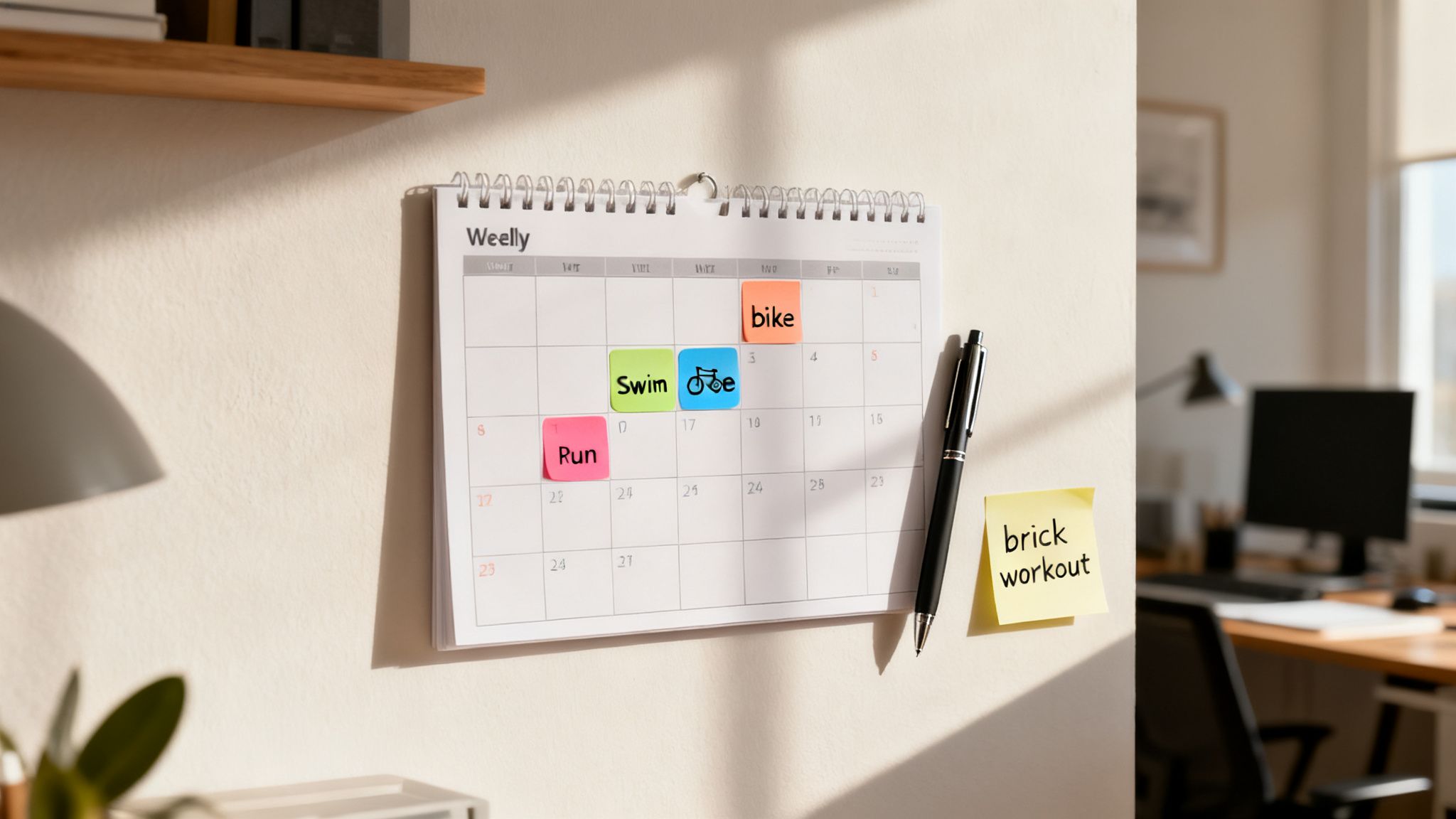
So, with those phases in mind, how do you actually slot your workouts into a week? Most athletes, especially when starting out, find that a consistent weekly pattern works best. A great rule of thumb is the "two of each" approach: two swims, two bike rides, and two runs per week, plus one dedicated rest day.
With over 1,500 triathlons happening globally each year, drawing nearly two million athletes, this structure is a tried-and-true method. For most amateurs, a typical training load hovers around 8 hours a week, which fits this schedule perfectly. If you're curious, you can dig into more triathlon participation trends on wifitalents.com.
Here’s what a sample week could look like:
| Day | Workout | Focus |
|---|---|---|
| Monday | Swim | Technique & Drills |
| Tuesday | Bike | Intensity (Intervals) |
| Wednesday | Run | Easy/Recovery |
| Thursday | Swim | Endurance |
| Friday | Rest | Complete Rest or Active Recovery |
| Saturday | Bike (Long) + Run (Short) | Brick Workout |
| Sunday | Run (Long) | Endurance |
See how that works? It balances hard days with easy days and cleverly places your longest workouts on the weekend when most of us have a bit more time.
The Importance of Brick Workouts
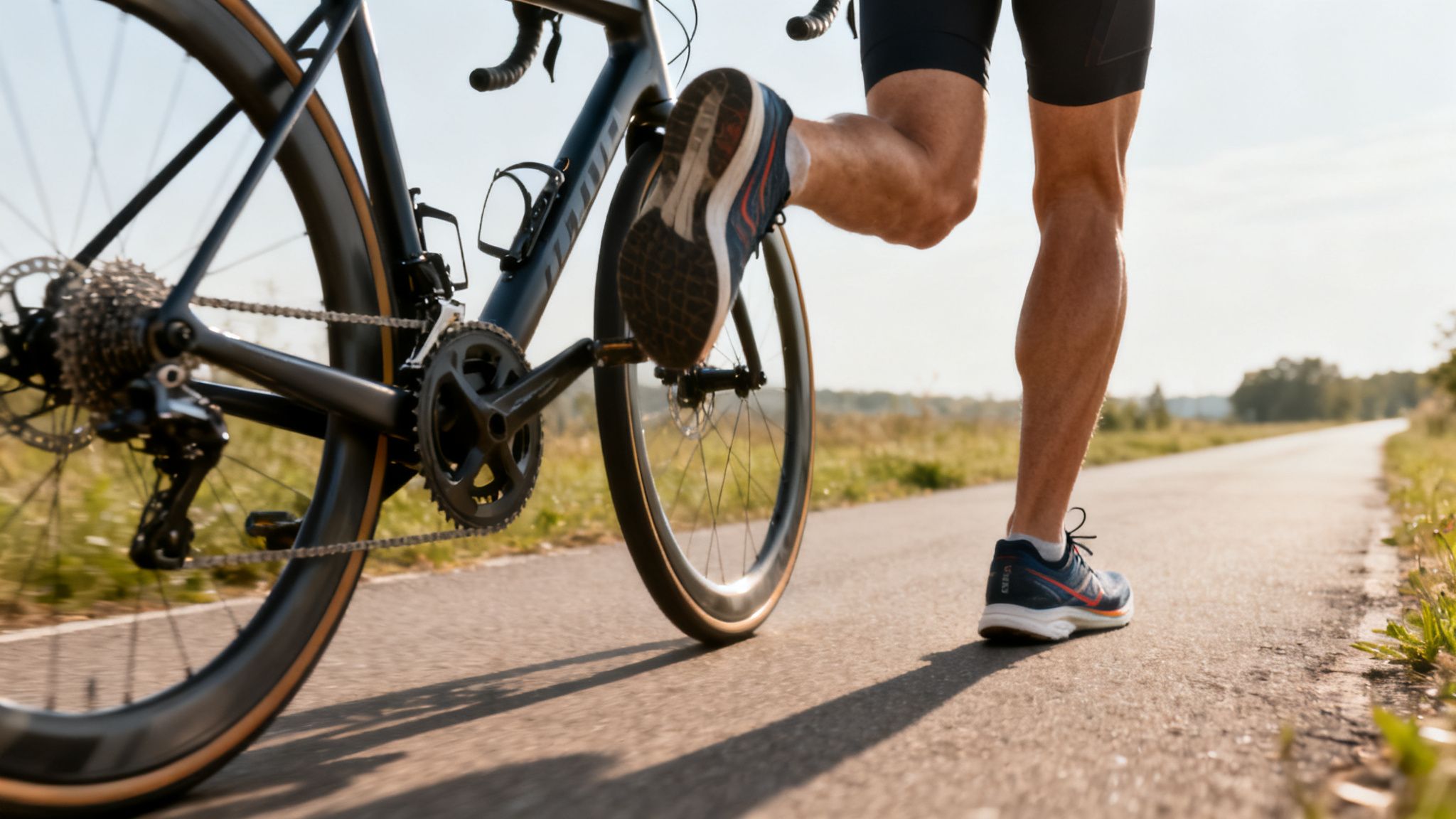
One of the most uniquely triathlon challenges is having to run right after a long bike ride. Your legs feel like lead, wobbly, and just plain weird—a feeling every triathlete knows as "jelly legs." This is precisely why brick workouts are non-negotiable.
A brick workout is a session where you tackle two disciplines back-to-back with zero break. The classic brick is a bike ride followed immediately by a short run.
The whole point is to get your body and mind used to that brutal transition. It doesn't need to be an epic session; even a quick 10-15 minute run right off the bike after your weekend ride makes a world of difference. This simple habit conditions your muscles and nervous system for what's coming on race day, making that bike-to-run shift feel much less shocking and a whole lot more natural.
Key Workouts for Swimming, Biking, and Running
Once you’ve sketched out your weekly schedule, it’s time to get into the nuts and bolts: the specific sessions that will actually build your triathlon engine. These workouts are the heart and soul of any good triathlon training plan. This is where the magic happens—where you sharpen your technique, build that deep well of endurance, and find the speed you’ll need on race day.
Mastering Your Swim Technique and Endurance
Let's be honest: for a lot of us, the swim is the most daunting part of a triathlon. The good news? Huge gains in the water almost always come from better technique, not just more brute force. Your number one goal should be efficiency—moving through the water smoothly without wasting energy.
You'll want to build your week around two key types of swim sessions: one dedicated to drills and the other to building your staying power.
-
Technique Session: Set aside one swim per week to focus purely on drills. This is your chance to slow everything down and fix the little hitches in your stroke. A classic drill to start with is the catch-up drill: keep one arm extended in front until the other hand "catches up" before you start the next pull. It’s a fantastic way to stop rushing your stroke and develop a longer, more powerful pull.
-
Endurance Session: Your second swim is all about building stamina. That doesn't mean you should just grind out endless laps at the same sluggish pace. Break it up. Try a set of 4 x 200 meters with 30 seconds of rest in between each. This keeps your heart rate up and mimics the sustained effort you'll need on race day.
So many new triathletes make the mistake of trying to muscle their way through the water. Remember, swimming is all about balance and body roll. Concentrate on keeping your hips high and rotating your torso with each stroke. This engages your core and makes you far more streamlined.
Building Power and Stamina on the Bike
The bike leg is the longest part of any triathlon, so building a massive aerobic base here is completely non-negotiable. The most effective approach is a mix of long, steady rides to build that all-day endurance and shorter, high-intensity sessions to boost your top-end power.
Interestingly, even elite athletes spend the vast majority of their time training at a lower intensity. One analysis revealed that a world-class female triathlete spent 88% of her bike sessions and 85% of her run sessions below her lactate threshold. The idea is to build a huge aerobic foundation that you can then sharpen with high-intensity work.
Here are the two bike workouts you can't skip:
-
The Long Ride: This is your weekend cornerstone. The goal is simple: ride at a steady, conversational pace for a duration that gradually builds toward your race distance. This is what teaches your body to become a fat-burning machine—a critical skill for any endurance event.
-
The Interval Session: This is your mid-week power-builder. After a solid warm-up, try a set like 5 x 5-minute intervals at a hard effort (you can still talk, but only in short, choppy sentences), with 3 minutes of easy spinning to recover between each one. These are the efforts that really raise your fitness ceiling. For more on this, check out our guide on how to build a cycling training plan for beginners.
Developing Your Run Speed and Resilience
Running is where the impact stress really adds up, so quality will almost always beat sheer quantity. The goal is to improve your running economy and your ability to hold a solid pace, especially when your legs are screaming at you after the bike.
A well-rounded run plan will include easy recovery runs, one long run, and one quality speed session each week.
-
Tempo Run: This might just be the single most valuable workout for any triathlete. After a 10-minute warm-up, settle in for 20-30 minutes at a "comfortably hard" pace—about the effort you feel you could hold for an hour-long race. This workout is incredible for teaching your body to clear lactate more efficiently, which directly translates to running faster for longer.
-
Hill Repeats: Forget the track for a bit. Find a decent hill and, after warming up, run hard up the incline for 60-90 seconds. Jog back down slowly for your recovery. Do this 6-8 times. Hills are a secret weapon for building serious leg strength and running power with a much lower risk of injury.
The All-Important Brick Workout
Finally, we have to talk about the brick. No triathlon plan is worth its salt without it. A "brick" is simply a bike workout followed immediately by a run, and it's absolutely crucial for getting your body ready for race day.
The first few times you do one, your legs will feel like jelly—heavy, awkward, and completely uncooperative. That’s normal! With practice, that feeling disappears.
A perfect place to start is to tack on a short 15-20 minute run right after your weekend long ride. Try to hit your goal race pace. It doesn't need to be a marathon; the real purpose is to train your nervous system to handle that jarring transition from cycling to running. Nail this workout consistently, and you'll have a massive advantage coming out of T2.
Fueling Your Body And Prioritizing Recovery
Your training plan is only half the battle. The real magic happens in the hours between workouts. Think about it: hard training breaks your body down. It’s the recovery—the food you eat and the rest you get—that builds you back up stronger.
If you skimp on recovery and nutrition, you're on a fast track to burnout, injury, or hitting a frustrating performance plateau. This isn't just an add-on; it's where your fitness gains are truly cemented.
Nutrition: The Engine of Your Training
You wouldn't put cheap gas in a performance car, so why would you do it to your body? A great training plan means nothing if you're not giving your body the high-quality fuel it needs to perform and repair itself.
Here’s a simple, real-world approach:
-
Before Your Workout: About 60-90 minutes before you start, have a small, easily digestible snack packed with carbs. A banana or a piece of toast with a little honey works perfectly. It tops off your energy stores without weighing you down.
-
During Your Workout: If you're going for longer than 75 minutes, you’ve got to start putting fuel back in. The goal is 30-60 grams of carbohydrates per hour. This is where you test out your race-day fuel—gels, chews, sports drinks—to see what your stomach can handle when you're working hard.
-
After Your Workout: The clock is ticking! You have a critical 30-60 minute window to kickstart the recovery process. A simple mix of carbs and protein is exactly what your muscles are screaming for. A protein shake with a banana or even a glass of chocolate milk gets the job done.
For a much deeper look into the specifics, check out our guide on how to fuel during a marathon, as the principles are almost identical for long-course triathlon.
Hydration And Electrolytes
Dehydration will tank your performance faster than almost anything else. Losing just 2% of your body weight through sweat can seriously slow you down. The key is to sip water all day long, not just chugging it right before a workout.
An easy gut-check is to look at your urine color—you're aiming for a pale straw color. And when it's hot or you're going long, water alone isn't enough. You're sweating out crucial electrolytes like sodium, which can lead to cramping and fatigue. A good sports drink or electrolyte tabs added to your water are non-negotiable in these conditions.
Your training doesn’t make you stronger—your recovery from that training does. Rest is not a sign of weakness; it is an integral part of the training process itself.
Strength Training For Injury Prevention
I get it. A lot of triathletes worry that hitting the gym will take up too much time or make them bulky. But here’s the reality: a smart, targeted strength program is one of your best defenses against injury while directly boosting your power.
You don't need to live in the weight room. Two focused sessions of 20-30 minutes a week can make a world of difference.
| Exercise | Focus Area | Why It Matters for Triathletes |
|---|---|---|
| Planks | Core Stability | A strong core is what keeps your form from falling apart late in a run or bike ride. |
| Squats | Leg Strength & Glute Activation | This is pure power for the bike and run. It builds a more efficient and resilient engine. |
| Glute Bridges | Hip Strength & Stability | Weak hips are a primary cause of common running injuries. This keeps your pelvis stable. |
| Push-ups | Upper Body Strength | Don't neglect the upper body! This directly translates to a stronger, more stable swim stroke. |
The Art Of Active Recovery And Rest
Finally, let's talk about the most powerful—and most overlooked—performance enhancer: sleep. This is when your body releases growth hormone and does the heavy-duty repair work. Making 7-9 hours of quality sleep a priority is just as important as any workout on your schedule.
On your rest days, don’t just become a couch potato. "Active recovery" is the name of the game. A gentle walk, an easy spin on the bike, or some quality time with a foam roller will do wonders for flushing out soreness and speeding up recovery. Remember, the ultimate goal is to stand on that starting line feeling fresh, strong, and ready to go—not completely fried.
Nailing Your Race Week and Crossing the Finish Line
You’ve put in months of hard work, followed your triathlon training plan to a T, and now it's finally here: race week. This isn't the time to cram in more fitness. It’s all about shedding fatigue, sharpening your senses, and making sure every ounce of that training pays off when the starting gun goes off.
The entire goal is to show up on race day feeling fresh, rested, and absolutely humming with energy. That’s where the taper comes in.
The Science of a Smart Taper
Tapering is the deliberate process of cutting back your training volume in the final 7-14 days before the race. It feels completely backward, right? To train less when the big day is so close? But trust me, this is where the magic happens. Your body uses this time to fully absorb all that hard work, repair muscles, and top off its glycogen stores.
The trick is to cut way back on duration but keep a little bit of intensity. This keeps your muscles firing and your nervous system sharp without adding any real fatigue.
- Slash the Volume: Chop your total training time by 50-60%. If you peaked at a 10-hour week, your race week should be around 4-5 hours, tops.
- Keep the Intensity: Don’t just jog. Weave in very short, race-pace efforts. For example, a 30-minute run might include 4 x 1-minute bursts at your goal 10k pace.
- Sleep Like It's Your Job: This is your best recovery tool, period. Aim for an extra hour of sleep every single night during race week.
Trust the process. You might feel restless, grumpy, or even a bit sluggish during the taper. We call this the "taper tantrums." It’s totally normal and a great sign that your body is soaking up the recovery and getting ready to perform.
Your Pre-Race Checklist
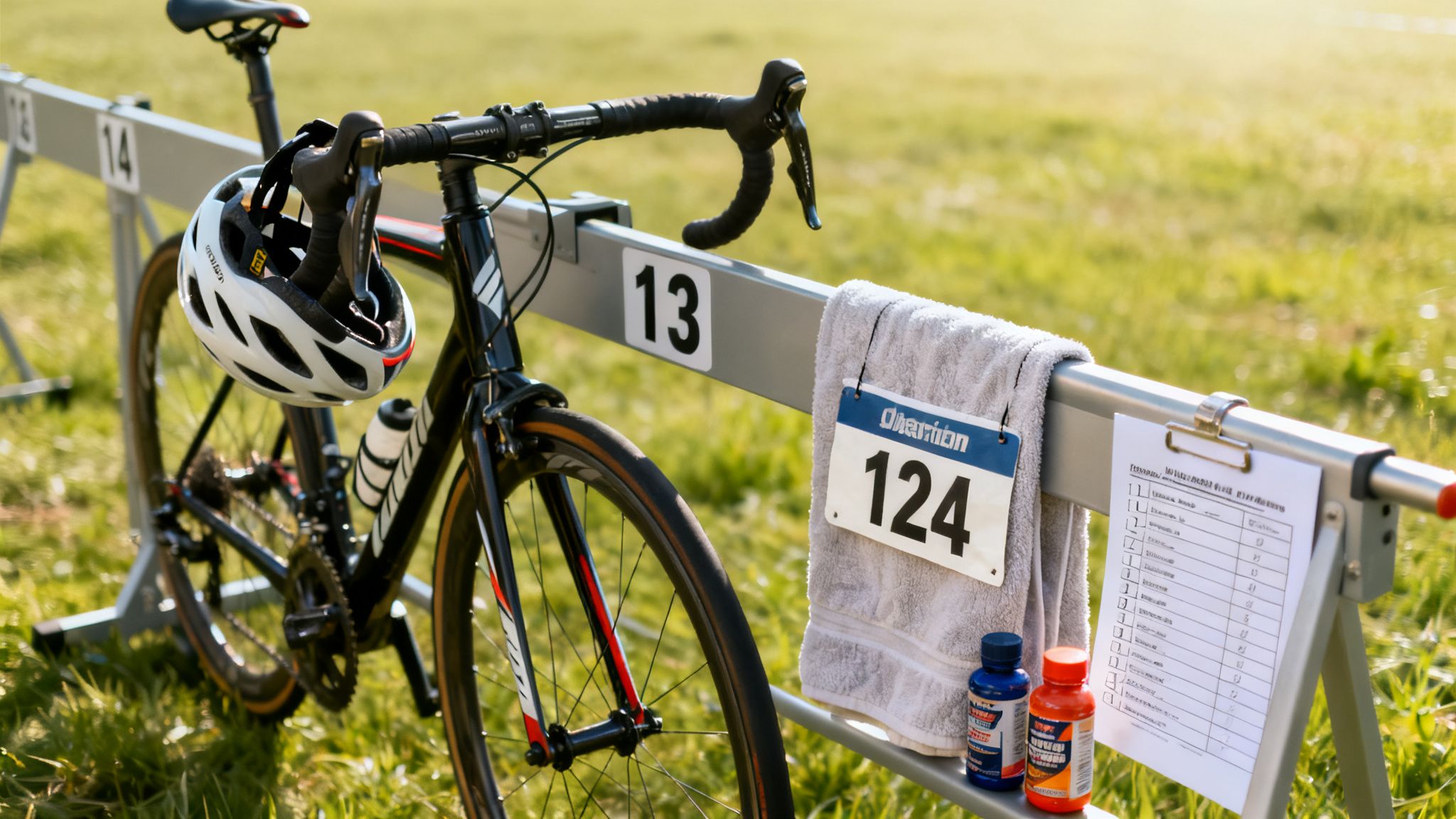
Getting the logistics dialled in is just as important as the physical prep. A calm race morning begins with being completely organized in the days before. A simple checklist can be your best friend, saving you from that last-minute panic.
Gear and Logistics Checklist:
- Final Gear Check: Give your bike a once-over. Check your tires, brakes, and shifting. Lay out your helmet, goggles, and running shoes. Make sure everything is in perfect shape.
- Nutrition Plan: Get all your on-course nutrition ready. Count out the exact gels, chews, and drink mixes you plan to use. Remember the golden rule: nothing new on race day.
- Transition Bag: Pack your T1 (swim-to-bike) and T2 (bike-to-run) bags with military precision. Visualize your setup—helmet upside down with sunglasses inside, shoes with elastic laces wide open, race belt with number already attached.
- Packet Pickup: Know exactly when and where packet pickup and the pre-race briefing are. Always, always attend the briefing for any last-minute course changes or critical info.
Pacing and Mental Prep
By now, your pacing strategy should be etched in your brain. The biggest rookie mistake is getting swept up in the adrenaline and going out way too hard on the swim and bike, only to hit a massive wall on the run. Stick to the paces and heart rate zones you’ve rehearsed for months.
Pre-race nerves are going to happen. Don't fight them—reframe that feeling as excitement. It’s just your body getting ready for the challenge. Each day, take a few minutes to visualize yourself having a great race: a smooth swim, a powerful bike, and a strong, smiling finish.
And when you finally cross that finish line, celebrate it! This journey took months of dedication. For many athletes, especially those who conquer an epic distance like an Ironman—which saw over 150,000 finishers in 2022—that moment is the culmination of a massive effort. You can explore more triathlon participation statistics to see just how big this community is.
Find a way to commemorate your achievement. A keepsake like a custom RoutePrinter race poster is a fantastic way to honor the grind and have a daily reminder of what you're capable of.
Your Top Triathlon Training Questions, Answered
Even with the best plan laid out, questions always pop up. That’s a good thing—it means you’re engaged and thinking about the details. Let's tackle some of the most common things I hear from athletes, clearing up the confusion so you can focus on your training.
Getting these fundamentals right isn't just about ticking boxes; it's about building the confidence you need to toe the start line feeling prepared, not panicked.
So, How Many Hours a Week Do I Really Need to Train?
This is the big one, and the honest answer is: it depends entirely on your race and your goals. There's no single magic number, but there are some solid benchmarks to work from.
If you're eyeing a Sprint triathlon, you can build a great fitness base with just 4-6 hours per week. Bumping up to an Olympic distance? Plan on a commitment of around 6-10 hours. Once you get into the long-course world, the numbers climb. A Half-Ironman (70.3) will realistically demand 10-15 hours of your time, and a full Ironman can easily swallow 15-20+ hours during your biggest training weeks.
Here’s what really matters, though: consistency trumps volume every time. It's far better to nail five quality hours every single week than it is to cram in ten hours one week and do nothing the next. That’s how you build fitness that lasts.
What Exactly Is a Brick Workout?
A "brick" is triathlon-speak for a workout where you stack two disciplines back-to-back with zero rest. The classic, and most important, one is the bike-to-run brick. You finish your ride, rack your bike, and immediately head out for a run.
Why is this so important? Because it trains your body to handle that bizarre, wobbly "jelly legs" feeling you get when you start running off the bike. It's a non-negotiable part of preparing for race day. By doing these regularly, you’re teaching your muscles and nervous system how to make that transition smoothly. It doesn't have to be long, either—even a short 10-15 minute run right after a bike session delivers huge benefits.
Can I Get By With a Generic Online Plan?
You absolutely can. In fact, for a first-timer, a good generic plan is a fantastic starting point. It gives you the structure and progression you need to get to the finish line healthy. Don't knock it—following a proven program works.
There’s plenty of data to back this up. One study found that athletes following structured plans improved their performance by an average of 10%. You can dig into the full research on training plan effectiveness if you're curious.
But here’s the pro tip: think of that plan as a roadmap, not a rigid set of commandments. The best triathlon training plan is the one that actually fits your life. Listen to your body. If you're completely wrecked, it’s okay to shorten a workout or swap a hard day for an easy one. Be flexible.
What Are the Signs of Overtraining?
Pushing your limits is part of the sport, but pushing yourself into a hole is counterproductive. Overtraining happens when the stress from training outpaces your body's ability to recover, and your health and performance start to tank. It's crucial to spot the warning signs before it becomes a real problem.
Keep an eye out for these red flags:
- Aches that won't quit: If you have deep muscle soreness that lingers for days, that’s a sign.
- A jumpy heart rate: Check your resting heart rate when you first wake up. If it's consistently elevated, your body is under stress.
- Getting sick all the time: A weakened immune system is a classic sign you're overdoing it.
- You're moody and irritable: If you’re snapping at everyone or feel completely unmotivated, your body is sending a signal.
- Your performance is dropping: You're putting in the work, but your times are actually getting slower.
If this sounds familiar, it's time to hit the brakes. The answer isn't to train harder; it's to recover harder. Prioritize sleep, double down on good nutrition, and don't be afraid to take a few extra rest days.
You're putting in the work—make sure you celebrate the achievement! Commemorate your incredible race with a personalized map from RoutePrinter. It's the perfect way to turn those hard-earned miles into a piece of art that reminds you of what you can do. Design your custom race poster now.