Cycling for Beginners: Cycling Training Plan for Beginners to Boost Your Fitness

If you're just starting out, the best cycling training plan is one that prioritizes consistency over sheer intensity. Forget about epic climbs and killer sprints for now. The real secret is to start with three manageable rides per week and slowly, safely build your endurance by making one of those rides a little longer each weekend.
This approach is your best defense against burnout and helps you lay down a solid fitness foundation you can build on for years.
Building Your Foundation as a New Cyclist
Jumping into cycling can feel like a big leap, but a smart approach makes all the difference. Your journey shouldn't start with a grueling, uphill battle. Instead, it begins with figuring out your personal "why."
What's got you excited about getting on a bike? Is it the thought of exploring new country roads, getting healthier, or the thrill of finishing your first organized ride?
Set Realistic and Inspiring Goals
Having a clear goal is what turns aimless pedaling into focused training. Instead of a vague idea like "get fit," aim for something specific you can actually measure.
- Complete a 50 km charity ride in three months. This gives you a clear target and a deadline to work toward.
- Ride to a specific landmark, like that scenic viewpoint you always drive past or a favorite café 20 km away.
- Maintain a consistent schedule by committing to ride three times a week for one full month.
For most beginners, the real hurdle isn't the effort—it's just showing up consistently. A great starting point is to ride for 30 minutes, 3 times per week, and then gradually extend one of your weekend rides as you feel more comfortable. Fitness platforms have found that over half of new riders give up within three months without a clear plan. In contrast, setting concrete goals massively improves the chances you'll stick with it. You can learn more about building your first schedule from this beginner's guide on cbre.co.uk.
Remember: A goal without a plan is just a wish. Your first goal doesn't need to be huge; it just needs to mean something to you.
Embrace Gradual Progression
The quickest way to get sidelined by an injury or just plain burnout is by trying to do too much, too soon. Your body needs time to adapt to the new stresses of cycling.
This is why gradual progression is the heart and soul of any good beginner's plan. It’s all about slowly increasing how long or how often you ride, not chasing speed right out of the gate. This structured method builds a strong aerobic base, making sure your cycling journey is both fun and something you can stick with for the long haul.
Your 8-Week Beginner Cycling Training Plan
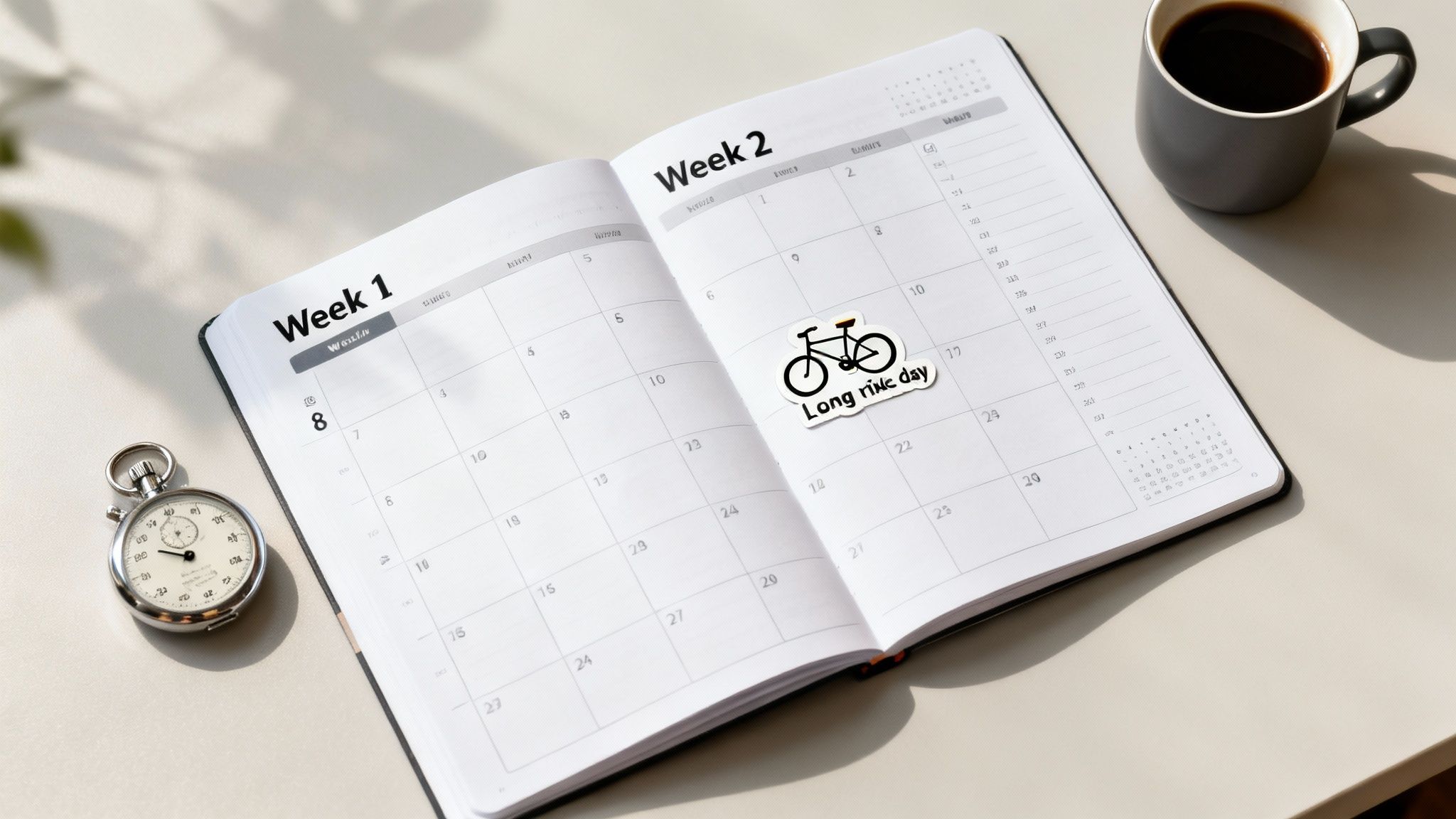
Alright, this is where the fun begins. The schedule below is your road map, a flexible guide designed to build your fitness one ride at a time. I can't stress this enough: the focus here is on time spent in the saddle, not how far or fast you go. It's a classic rookie mistake to chase speed right away. Trust me, building your endurance base first is a much smarter, more effective approach.
Think of each ride as having a specific job. Your weekday rides are all about consistency—just keeping your legs turning over. The weekend ride? That’s your long day, where you'll gradually build the stamina that truly makes a difference.
How Hard Should You Be Working?
Forget about complicated heart rate zones or pricey power meters for now. We're going to keep it simple and use what's called the Rate of Perceived Exertion (RPE) scale. It’s a super intuitive way to gauge how hard you're actually working based on how you feel.
Here’s a quick breakdown:
- Easy (RPE 3–4): You can hold a full conversation without gasping for air. This is your bread-and-butter, base-building pace.
- Moderate (RPE 5–6): Breathing gets deeper. You can still talk, but only in shorter sentences. This is where you start building real cardiovascular fitness.
- Hard (RPE 7–8): You’re pushing it now. Speaking is tough, limited to just a word or two. We’ll sprinkle this in sparingly much later on.
A solid beginner plan usually runs for 8 to 12 weeks, focusing on a gradual and safe increase in ride time. The goal is to get out 3 to 4 times a week, with a couple of shorter rides during the week and one longer effort on the weekend. This slow-and-steady build is key. A sudden training spike of more than 10% per week is a known recipe for overuse injuries. This is a widely accepted principle, and you can see a similar philosophy in popular guides like Red Bull's beginner cycling training plan.
Here is a sample schedule designed to get you started. It's built around three rides per week, but feel free to adjust the days to fit your own life. The important thing is getting the rides in.
Sample 8-Week Beginner Cycling Training Schedule
| Week | Workout 1 (e.g., Tuesday) | Workout 2 (e.g., Thursday) | Workout 3 (e.g., Saturday) |
|---|---|---|---|
| 1 | 30 min (Easy) | 30 min (Easy) | 45 min (Easy) |
| 2 | 30 min (Easy) | 35 min (Easy) | 50 min (Easy) |
| 3 | 35 min (Easy) | 35 min (Easy) | 60 min (Easy) |
| 4 | 35 min (Easy) | 40 min (Easy) | 65 min (Easy) |
| 5 | 40 min (w/ 2x5 min Moderate) | 40 min (Easy) | 70 min (Easy) |
| 6 | 45 min (w/ 2x7 min Moderate) | 45 min (Easy) | 75 min (Easy) |
| 7 | 45 min (w/ 3x5 min Moderate) | 45 min (Easy) | 80 min (Easy) |
| 8 | 45 min (Easy) | 45 min (Easy) | 90 min (Easy) |
This simple yet effective schedule is your roadmap. But remember, it's just a guide. Listen to your body, take an extra rest day if you feel run down, and most importantly, have fun with it. That’s what cycling is all about.
Fueling Your Rides with Simple Nutrition and Hydration
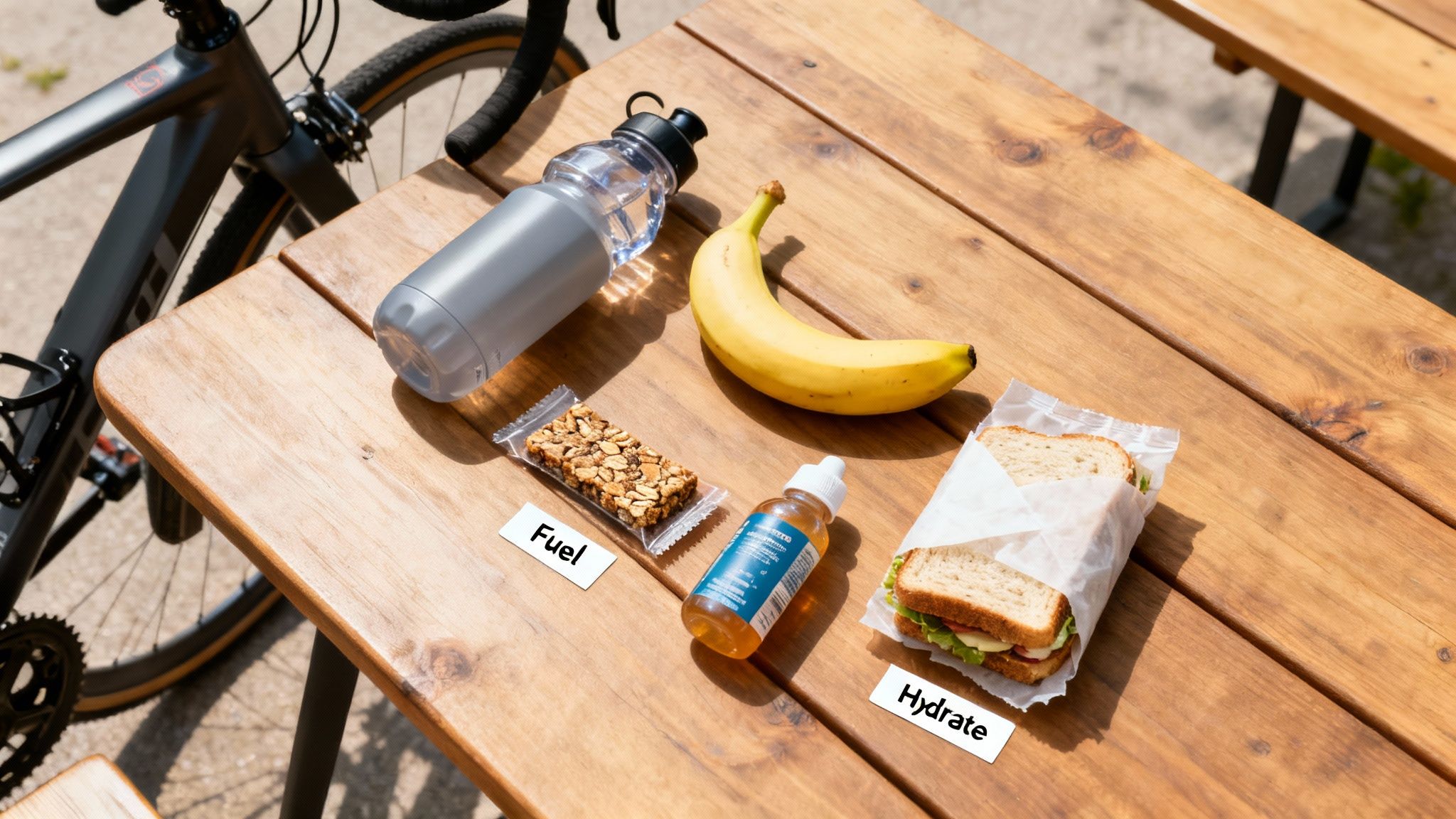
Think of your body like a high-performance engine. Even the most finely-tuned machine won't get you far without the right fuel. When you’re just starting out, what you eat and drink is every bit as important as the time you spend on the bike.
The good news? You don’t need a degree in sports science or a cupboard full of complicated supplements to get it right. Smart cycling nutrition is all about timing and simplicity. It's about giving your body the energy to ride strong and recover well, a habit that becomes absolutely critical as your rides get longer and more demanding.
What to Eat Before Your Ride
The meal you have before a ride is all about topping off your energy stores for the work ahead. The main goal here is to fill up your glycogen levels—that’s the go-to fuel your muscles burn—without making your stomach angry.
Try to eat a carb-focused meal about 1-2 hours before you head out. This isn't the time for a big, greasy breakfast or anything super high in fiber. Heavy foods take a long time to digest and can lead to some serious discomfort once you're in the saddle. Instead, you want simple, easily digestible carbs.
A few of my favorite go-to options are:
- A bowl of oatmeal with a sliced banana.
- A piece of toast with a smear of jam or honey.
- A small smoothie made with fruit and a bit of yogurt.
These choices give you a quick energy release that’s ready for your muscles right when you start pedaling.
Hydration and Fueling During Your Ride
For any ride clocking in under 60 minutes, plain water is generally all you need. The real secret to hydration isn't chugging a huge bottle right before you clip in; it's about sipping water consistently all day long. Start your rides well-hydrated, and you’ll be in a much better place.
But once your rides start pushing past that one-hour mark, you need to think about on-bike fuel. This is when your body starts burning through its stored glycogen. If you run out, you'll experience the dreaded "bonk" or "hitting the wall"—a sudden, complete loss of energy. It’s no fun.
To keep that from happening, aim to take in 30-60 grams of carbohydrates per hour on longer rides.
Don't overcomplicate this. You don't need fancy gels just yet. Simple, real food works great. A banana, a couple of dates, or a basic granola bar are all fantastic options that are easy to carry and even easier to digest on the move.
Post-Ride Recovery Fuel
What you eat after the ride is just as crucial as what you eat before it. The 30-60 minutes right after you get off the bike is often called the "recovery window." Think of your muscles as sponges during this time, ready to soak up everything they need to repair and rebuild.
The perfect recovery snack or meal has a mix of protein and carbohydrates. Carbs restock those glycogen stores you just burned through, while protein provides the amino acids needed to repair tiny muscle tears.
A classic post-ride drink for a reason is chocolate milk—it has a nearly perfect carb-to-protein ratio for recovery. Other great choices include Greek yogurt with berries or a simple meal of chicken and rice. Taking this step seriously kickstarts your recovery, making sure you feel strong and ready for your next ride.
Training Beyond the Bike with Recovery and Strength Work
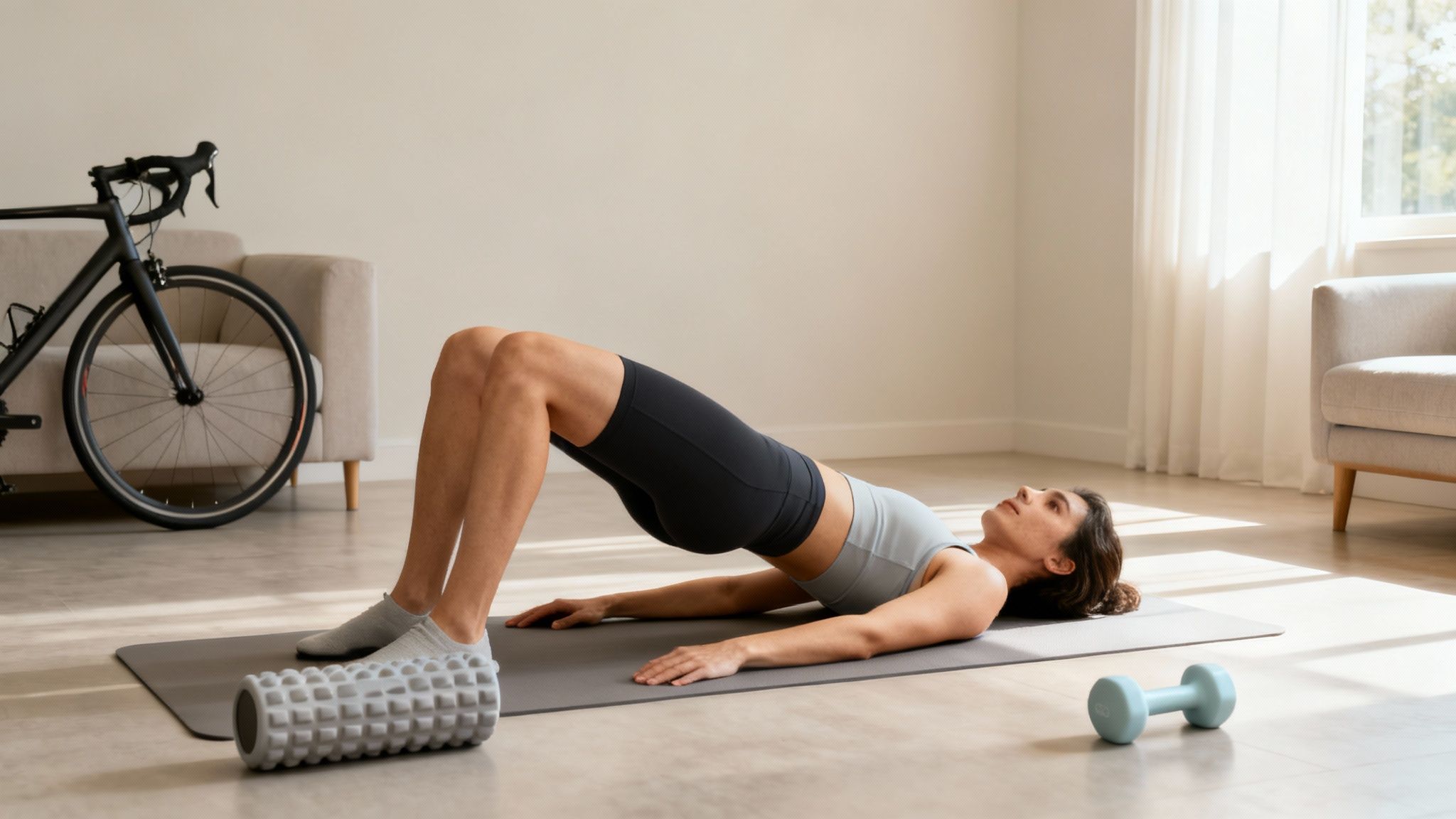
It’s easy to think that getting faster on the bike is all about logging more miles. But some of the most important gains happen when you’re not even pedaling. Building a resilient, well-rounded body is the secret sauce, and that happens through smart recovery and strength work.
Think of it this way: your muscles don't get stronger during the ride. They get stronger when they repair and rebuild afterwards. That's why scheduled rest days and aiming for 7-9 hours of quality sleep every night are completely non-negotiable. Skipping them is a shortcut to burnout, not progress.
Build Your Engine with Cross-Training
Giving your cycling muscles a break doesn't mean you have to be glued to the couch. Cross-training is a fantastic way to boost your cardiovascular fitness while preventing the mental fatigue that can come from doing the same thing day in and day out. It also engages different muscle groups, which is key for creating balance and avoiding overuse injuries.
Try weaving one of these into your weekly routine on a non-cycling day:
- Swimming: You can't beat this for a zero-impact workout that builds lung capacity and gives your upper body some much-needed attention.
- Yoga or Pilates: These are incredible for improving flexibility, core stability, and balance—all things that make you more comfortable and powerful on the bike.
- Brisk Walking or Light Jogging: A simple, accessible way to keep your aerobic fitness simmering without pounding on your joints.
This strategy isn't just for beginners. Take a look at advanced athletes, and you'll see the same principles at play. For instance, anyone following a serious Ironman training plan is constantly balancing swimming, cycling, and running to build that complete, holistic fitness.
Your body adapts and gets stronger during recovery periods, not during the workout itself. Treat your rest days with the same importance as your ride days.
Foundational Strength for Power and Injury Prevention
You don’t need a fancy gym membership to build the strength that matters for cycling. A few key bodyweight exercises, done just 2-3 times a week, can make a huge difference in your power output and help prevent those all-too-common aches in your lower back and knees.
The goal is to focus on the engine of your pedal stroke: your core, glutes, and legs.
Essential At-Home Strength Moves:
- Plank: A classic for a reason. It builds the core stability you need to hold a strong, efficient position on the bike. Try holding for 30-60 seconds.
- Glute Bridge: This move specifically targets and activates your glutes—the powerhouse muscles for a strong pedal stroke. Aim for 12-15 repetitions.
- Bodyweight Squat: The perfect exercise for all-around leg strength. It directly translates to your pedaling motion, so focus on great form for 10-15 reps.
Making these simple habits part of your routine will make every minute you spend on the bike more powerful, comfortable, and ultimately, more fun.
Seeing Your Hard Work Pay Off: Tracking Progress and Celebrating Milestones
Sticking with a training plan is all about putting one foot in front of the other, or in our case, one pedal stroke after another. Watching those small, consistent efforts build into real fitness gains is one of the best parts of the journey. But how do you actually see it happening?
The Right Tools for the Job
You don’t need a dashboard full of intimidating analytics to see how far you’ve come. For most beginners, a simple and free app like Strava is perfect. You can run it on your phone or sync it with a basic fitness tracker. If you’re curious about how to get your devices talking to each other, our guide on connecting Fitbit and Strava is a great place to start.
Don't get bogged down in every single data point. Instead, keep an eye on a few key indicators that truly matter when you're starting out:
- Time in the Saddle: Can you ride for 75 minutes now, when 45 minutes felt like a marathon a month ago? That’s a massive victory.
- Speed on a Set Course: Pick a favorite local loop you can ride regularly. Watching your average speed on that same route creep up over a few weeks is an undeniable sign you're getting stronger.
- The "Hill Test": Remember that climb that had you gasping for air in week one? When you can suddenly pedal up it without feeling like your lungs are on fire, that’s pure, real-world progress.
Don't forget that tracking your progress is more than just looking at numbers. It's about giving yourself credit for the work you're putting in. Seeing tangible proof that your effort is paying off is the best motivation there is.
From Data Points to Lasting Memories
Celebrating your achievements is just as crucial as logging the miles. The numbers are great, but it’s the feeling of accomplishment that really fuels you for the long haul.
Make it a habit to reward yourself for hitting your goals. Stuck to the plan for a whole month? Grab those new cycling gloves you’ve been eyeing. Finished your first 50km ride? That absolutely calls for a celebratory dinner. These little rituals turn hard work into happy memories.
For those truly special rides, you can create something that lasts a lifetime.
A service like RoutePrinter allows you to take the GPS data from a monumental ride—like your first charity event or that epic solo adventure—and turn it into a beautiful, minimalist art print. It transforms the squiggly line on your screen into a piece of art for your home or office, a constant reminder of what your dedication and sweat really built.
Common Questions from New Cyclists
Jumping into a new cycling plan always stirs up a lot of questions. That’s perfectly normal. From mysterious aches to confusing gear choices, let's clear the air on some of the most common things new riders wonder about.
How Do I Deal with Saddle Soreness?
Ah, the dreaded saddle sore. Let's tackle this one first because it's easily the most common complaint from anyone new to cycling. The good news? It's almost always temporary.
Your body just isn't used to sitting on a narrow saddle for extended periods. That initial discomfort is your soft tissue adapting to the new pressure. This is exactly why the early weeks of the training plan feature shorter rides—it’s all about letting your body adjust gradually.
But if the pain is sharp, or if it just won't go away, don't try to tough it out. That could signal a bigger issue, like a poor bike fit or a saddle that just isn't right for your body shape.
A Few Tricks to Tame the Discomfort:
- Padded Shorts Are a Must: Don't even think about skipping these. A quality pair of cycling shorts with a good chamois (the pad) is your best friend. They’re built to cut down on friction and add cushion right where you need it most.
- Check Your Saddle Position: Is it too high? Tilted too far forward? A saddle that's even slightly off can cause a world of pain. A quick adjustment at your local bike shop can be a game-changer.
- Get Out of the Saddle: Every 10-15 minutes, just stand up on the pedals for a few seconds. It gives you a quick break, gets the blood flowing again, and makes a surprisingly big difference.
A little tenderness when you're starting out is one thing. Sharp, persistent pain is your body waving a red flag. Pay attention to it.
How Fast Should I Be Going?
It’s so easy to get fixated on your average speed, but honestly, it’s the last thing you should worry about right now. Your main goal is to build a solid aerobic base. That means spending consistent time on the bike at a comfortable, conversational pace.
Think about it: speed is affected by everything. The wind, the hills, the road surface—so much is out of your control. Chasing a certain number on your bike computer is a surefire way to get discouraged or, worse, push yourself too hard and burn out.
Just focus on the time and effort targets in the training plan. The speed will come on its own as you get fitter. I promise.
When Should I Think About Upgrading My Gear?
The cycling world is a rabbit hole of shiny, expensive toys. It's tempting to think you need the best of everything from day one, but you absolutely don't. A safe bike that fits you, a helmet, and those padded shorts we talked about are all you need to get going.
Master the basics first. The engine (that’s you!) is always more important than the bike. Once you've been riding consistently for a few months and you're sure this is a hobby you want to stick with, then you can start thinking about upgrades.
A Smart Upgrade Path for Beginners:
- Clipless Pedals and Shoes: This is the upgrade that makes the biggest difference in how you ride. Being clipped in gives you a much more powerful and efficient pedal stroke.
- Better Tires: You'd be amazed at what a new set of tires can do. They can make your bike feel faster and more comfortable, and they can significantly reduce your chances of getting a flat. It’s a cheap upgrade with a huge payoff.
- A Professional Bike Fit: Before you even dream of a new bike, invest in a pro fit for the one you have. An expert can adjust it perfectly to your body, making it feel like a whole new machine.
Sometimes, a big goal—like tackling a tough local climb—is the perfect motivation to treat yourself. If you're looking for some reward ideas that go beyond typical gear, we put together a guide with some fun suggestions on unique gifts for cyclists.
How Do I Know the Plan Is Working?
Your progress won't always be a straight line up. Some days you'll feel amazing, and others you'll feel like you're pedaling through mud. That's cycling.
The key is to look for the long-term trends. Can you ride longer today than you could a month ago? Does that one hill on your usual loop feel just a little bit easier? Those are the real signs you're getting stronger.
After a solid 8–12 week block of consistent training, it's pretty common for new riders to see their sustainable power jump by 5–15%. Using a tool like Strava to track your rides makes it easy to see this progress, turning what was once a tough ride into a milestone you can be proud of.
When you hit that first big goal, don't just let it get lost in your ride history. Celebrate it! With RoutePrinter, you can turn the GPS data from your proudest ride into a beautiful piece of art for your wall—a constant reminder of what you've accomplished. Design your personal achievement poster today.