How to Fuel During a Marathon - A Practical Runner's Guide

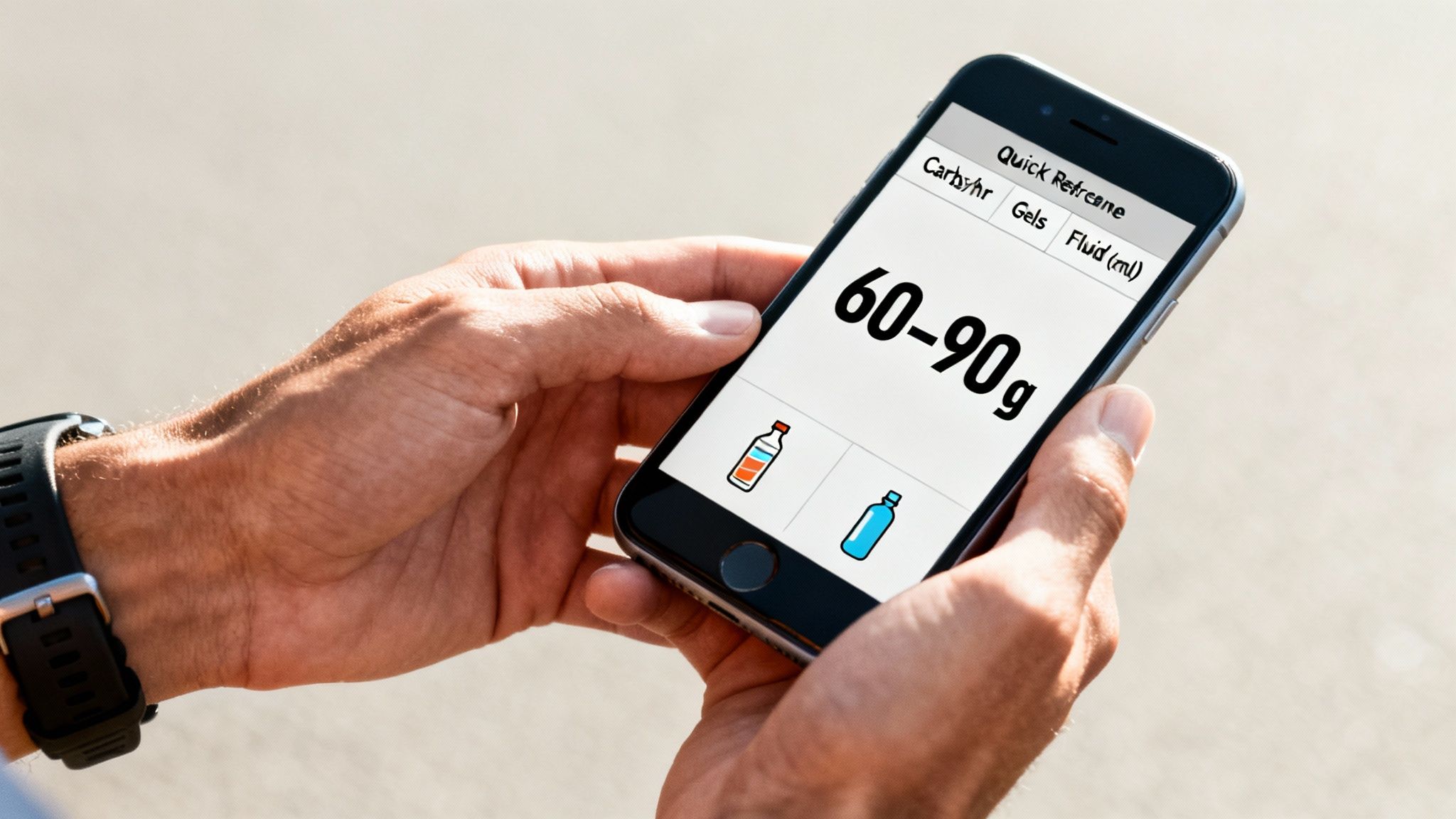
When you're out there on the course, your main job—besides putting one foot in front of the other—is to consistently take in 60-90 grams of carbohydrates every hour. This isn't just a suggestion; it's the lifeline that keeps your energy stores topped up and helps you dodge the dreaded "wall," giving you the power you need to finish strong.
Your Marathon Fueling Plan at a Glance
Let's get right to it. Fueling for 26.2 miles is all about giving your body a steady drip of carbs and fluids. While your pre-race meals are certainly important, what you do during the race itself is often the difference between a new personal best and a long, painful shuffle to the finish. If you're also training for shorter races, our guide on what to eat before running a 10k has some great tips that can help.
Why Most Runners Get It Wrong
Here's a hard truth: most runners dramatically underfuel during a marathon. It’s one of the most common mistakes I see.
A fascinating study that tracked real marathoners found that the average runner only consumed about 35 grams of carbs per hour. That's barely one gel's worth of energy, and it's miles away from the 60-90 grams per hour that sports science tells us is ideal for events lasting over 2.5 hours.
What’s more, the research showed that runners who managed to hit that 60-gram target were significantly more likely to break the 3-hour barrier. This isn't a coincidence. It's proof that proper fueling is a massive performance enhancer.
A Starting Point for Your Fueling Strategy
To help you build a solid plan, I've put together a quick-reference table. It provides a simple breakdown of your hourly targets based on your goal finish time. Think of it as your cheat sheet for race day.
Key Takeaway: Treat this table as your starting point, not the final word. These numbers are a solid guideline, but nothing beats testing and tweaking things on your long runs to figure out what works perfectly for your body.
This table provides a fantastic baseline. As we go, we'll dive deeper into the details so you can customize these numbers and build a fueling strategy that feels like second nature on race day. Remember, your nutrition plan is just as critical as your training plan.
Marathon Fueling Targets by Goal Finish Time
This quick-reference guide shows recommended hourly carbohydrate, fluid, and sodium intake based on your target marathon finish time.
| Goal Time | Carbs Per Hour (g) | Gels Per Hour (Approx.) | Fluid Per Hour (mL/oz) | Sodium Per Hour (mg) |
|---|---|---|---|---|
| Sub 3:00 | 80-100+ | 3-4 | 500-750 mL / 17-25 oz | 500-700 |
| 3:00-3:30 | 70-90 | 3 | 500-750 mL / 17-25 oz | 500-700 |
| 3:30-4:00 | 60-80 | 2-3 | 400-600 mL / 13-20 oz | 400-600 |
| 4:00-4:30 | 50-70 | 2-3 | 400-600 mL / 13-20 oz | 400-600 |
| 4:30+ | 40-60 | 2 | 300-500 mL / 10-17 oz | 300-500 |
Use these numbers to start mapping out what you'll carry and what you'll plan to grab at aid stations. Getting this right is a game-changer.
Why Your Body Needs Fuel During a Marathon
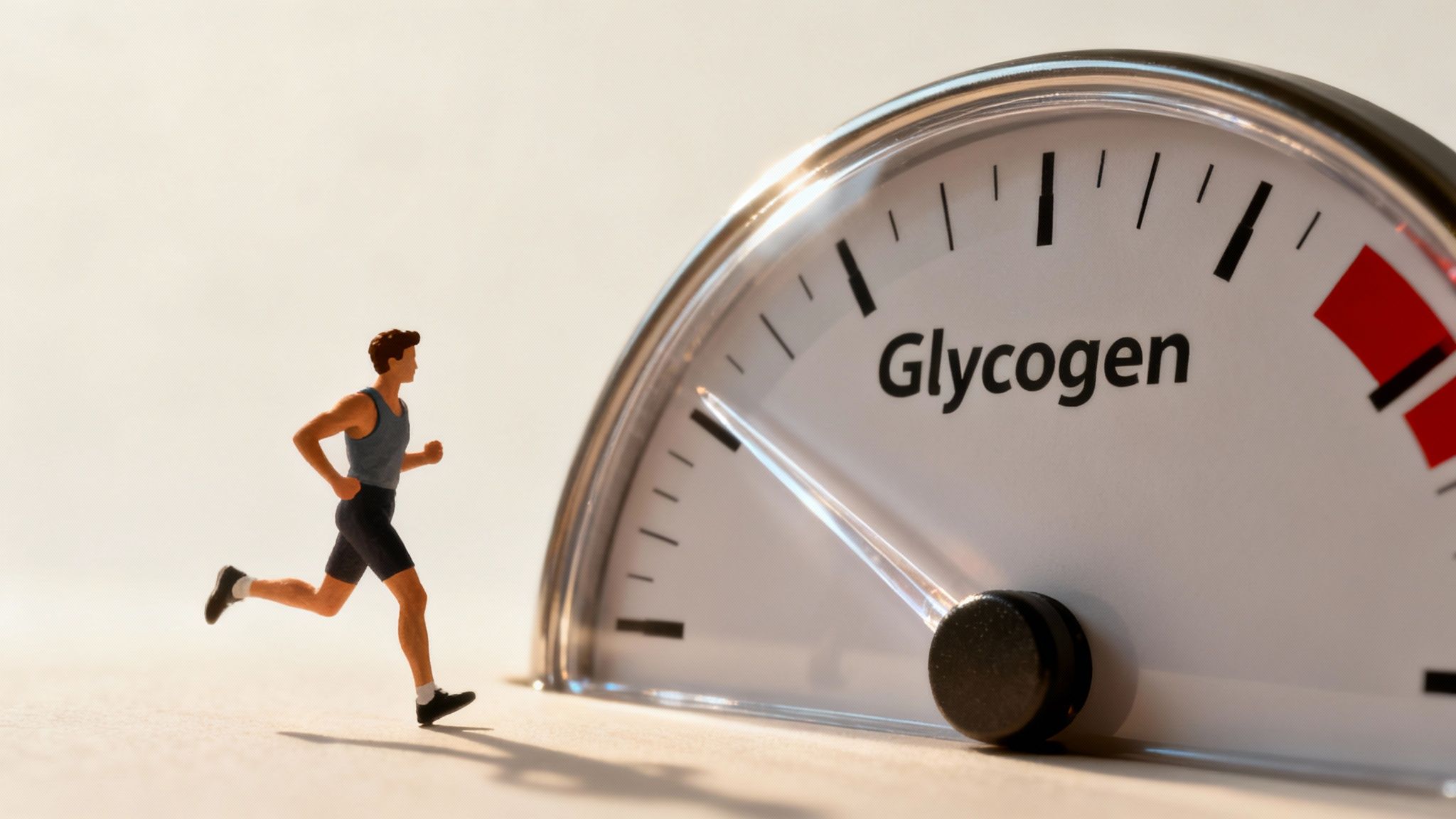
Ever wondered why that big pre-race pasta dinner just doesn't seem to last the full 26.2 miles? It comes down to a simple, hard truth: your body’s built-in fuel tank is surprisingly small. Getting a handle on this is the first real step to nailing your race day nutrition.
Think of your muscles and liver as holding a small, high-performance gas tank filled with a sugar called glycogen. This stuff is your body’s most readily available, high-octane fuel for running hard. But here’s the catch—even when you’re completely carbo-loaded, that tank only holds about 2,000 calories worth of glycogen.
That might sound like plenty, but the average runner torches about 100 calories per mile. Do the quick math, and you'll see your glycogen stores are likely running on fumes right around mile 20. This is exactly when most runners hit the dreaded "wall."
The Glycogen Cliff and the Famous Wall
When your glycogen runs out, your body is forced to switch to its backup generator: fat. And while you’ve got plenty of fat to burn, converting it to usable energy is a much slower, less efficient process. It’s like your car suddenly sputtering and switching from premium fuel to sludge mid-race.
This metabolic shift is what causes that sudden, dramatic drop in pace and overwhelming fatigue. Your legs turn to lead, your mind gets foggy, and every step feels like a massive effort. This isn't a failure of fitness; it's just an empty fuel tank.
Hitting the wall is a physiological event, not a mental weakness. It's your body slamming on the brakes when its primary fuel is gone. Consistent in-race fueling is the only way to avoid it.
This is where your mid-race fueling plan comes in. By taking in easily digestible carbs from gels, chews, or drinks, you’re constantly trickling a little fuel back into the system. This spares your limited glycogen stores, pushing that wall further and further down the course—ideally, past the finish line.
Why Carbs are King at Race Pace
Your body is always burning a mix of carbs and fat, but the intensity of your run completely changes the ratio.
- At lower efforts, like a walk or a very easy jog, your body is great at burning fat for energy.
- As you ramp up to marathon pace, your demand for quick energy skyrockets. Your body starts screaming for carbohydrates because they can be converted into fuel much, much faster than fat.
The harder you run, the more you depend on a steady stream of carbs. If you don't provide it, your body has no choice but to slow down. It's a simple energy budget: you start with a set amount, and every mile you run makes a withdrawal.
Fueling Is Also Gut Training
Practicing your fueling strategy on long runs does more than just help you dial in your timing. It actually trains your digestive system. Just like your leg muscles, your gut can adapt and get stronger at handling the stress of digesting food while you’re running.
When you take fuel during training runs, you teach your stomach and intestines how to absorb carbs on the move without rebelling. This adaptation is your best defense against the gastrointestinal (GI) issues—cramping, nausea, bloating—that can absolutely ruin a race.
Skipping this practice means you're asking your gut to do something new and difficult under the extreme stress of a marathon. The result? A fueling plan that backfires, leaving you not just out of energy but also dealing with a very unhappy stomach. Learning how to fuel during a marathon is as much about training your gut as it is about managing your energy.
Creating Your Personalized Fueling Strategy
Alright, you get the "why" behind fueling. Now for the fun part: building a plan that actually works for you. This is where the theory meets the road. We’re moving beyond general advice to craft a practical strategy you can rely on when the miles get long.
A solid race day plan comes down to knowing your numbers, picking the right fuel, and practicing until it’s second nature. The absolute cornerstone of this plan is hitting your hourly carbohydrate target, which usually lands somewhere between 60-90 grams per hour.
Nailing this is the single biggest thing you can do to sidestep the dreaded wall and hold your pace all the way to the finish line.
Calculating Your Personal Carb Needs
That 60-90 gram window is a great starting point, but let's dial it in. Your ideal number really depends on your pace, body weight, and just how much your stomach can handle. It makes sense, right? A bigger, faster runner is burning through fuel at a much higher rate than a smaller runner holding a more conservative pace.
Here’s a simple way to find your starting target:
- For a 4:00+ marathon: Aim for the lower end of the scale. Start with ~60 grams of carbs per hour.
- For a sub-4:00 marathon: You'll need more gas in the tank. Target the higher end, somewhere around 75-90 grams per hour.
- For elite/advanced runners: Some seriously trained guts can handle over 100 grams an hour, but that level of tolerance is built over years of specific training.
Don't get bogged down in the numbers. Just pick a target in that range and treat your long runs as your personal science lab. See how you feel. This is how you learn what your body truly needs.
Expert Insight: Here's a hard truth: having a plan and actually executing it are two different things. Research shows many runners fall short on race day. One fascinating study from Runner's World found marathoners intended to take in 26 grams of carbs per hour but only managed 22 grams—a 16% shortfall. Why? It often comes down to runners leaving 20-30% of a gel behind in the packet, something that doesn't happen with sports drinks.
Choosing Your Fuel Gels, Chews, and Drinks
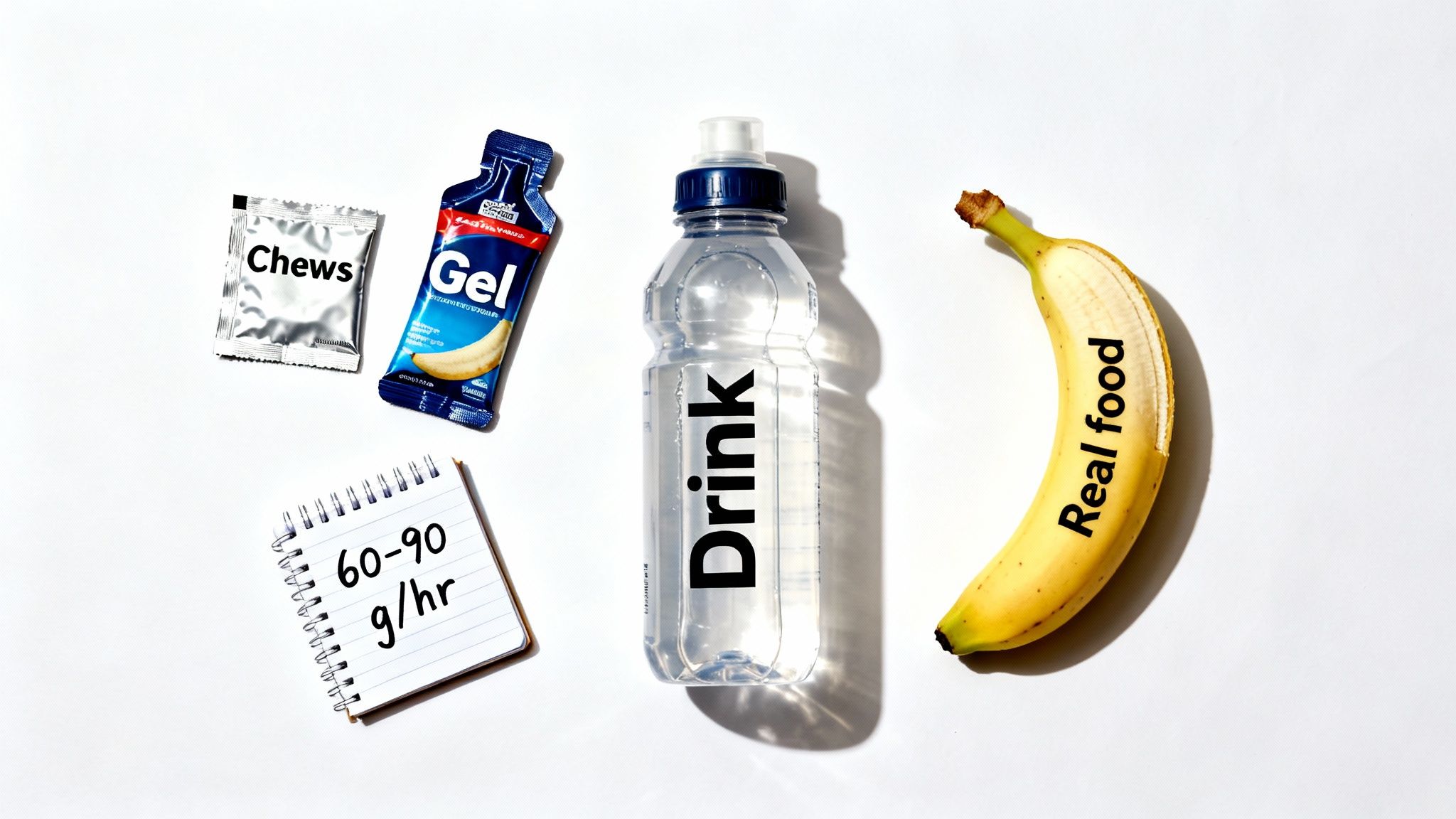
Once you’ve got your hourly carb goal, it's time to decide what you'll be eating. The options can feel endless, but most products fall into three main buckets: gels, chews, and drinks. Each has its place, and honestly, most experienced runners use a mix of all three to get the job done.
Energy Gels They're the go-to for a reason. Gels are lightweight, easy to stuff into a pocket, and designed to be absorbed quickly. With most packing 20-25 grams of carbs, they make the math of hitting your hourly target pretty simple.
Energy Chews Think of these as performance-grade gummy bears. For many runners, the texture feels more like real food, which can be a huge mental win deep in a race. They're also easier to portion out, letting you take in smaller amounts of fuel more frequently.
Sports Drinks Never forget the carbs in your bottle! A good sports drink delivers a one-two punch of hydration and energy, often with 15-20 grams of carbs for every 8 ounces. It's tough to get all your fuel from liquids, but they're an excellent supplement to your gels and chews.
Comparing Marathon Fuel Types Gels vs Chews vs Drinks
Choosing your fuel is a personal decision, and what works for one runner might not work for another. Texture, flavor, and ease of use all play a big role. Here’s a quick breakdown to help you compare the most popular options.
| Fuel Type | Pros | Cons | Average Carbs | Best For |
|---|---|---|---|---|
| Gels | Fast-acting, easy to digest, portable | Can have a sticky texture, requires water | 20-25g per packet | Quick energy boosts and hitting high carb targets |
| Chews | Good texture, easy to portion, less messy | Slower to consume, can be tough in cold weather | 4-8g per chew | Sustained energy and runners who dislike gel texture |
| Drinks | Provides hydration and fuel simultaneously | Can be hard to get enough carbs from drinks alone | 30-60g per bottle | Hot days and runners with sensitive stomachs |
Ultimately, the best fuel is the one you can consistently stomach for 26.2 miles. Mix and match during your training runs to find the combination that keeps your energy levels stable and your stomach happy.
Sample Fueling Schedules
So, what does this look like in practice? A good plan isn't just about what you take, but when you take it. The golden rule is to start early (around the 45-60 minute mark) and stay on a consistent schedule.
Here are a couple of real-world examples to get you started:
A Fueling Plan for a 3:45 Marathoner (Goal: 75g Carbs/Hour)
- Mile 5 (~45 mins): 1 Maurten Gel (25g carbs) with water.
- Mile 9 (~1 hr 25 mins): 1 sleeve Clif Bloks (50g carbs) eaten over the course of a mile, with water.
- Mile 14 (~2 hrs 15 mins): 1 Maurten Gel (25g carbs) with water.
- Mile 18 (~3 hrs): 1 sleeve Clif Bloks (50g carbs), again, eaten gradually with water.
- Mile 22 (~3 hrs 40 mins): 1 Maurten Gel (25g carbs) for that final push home.
A Gut-Friendly Strategy for Sensitive Stomachs (Goal: 60g Carbs/Hour)
- Every 20 Minutes: Take a few sips of a high-carb sports drink (like Maurten 320 or Skratch Superfuel).
- Mile 8 (~1 hr 15 mins): Have 2-3 energy chews (16-24g carbs) with water.
- Mile 16 (~2 hrs 30 mins): Another 2-3 energy chews (16-24g carbs) with water.
- Mile 22 (~3 hrs 30 mins): Consider switching to flat cola for a caffeine and sugar boost to the finish.
Of course, lugging all this fuel and fluid is a challenge of its own. If you need some ideas, check out our guide on how to carry water when running, which covers everything from simple handhelds to full-on hydration vests.
How to Practice Your Fueling Strategy
You can have the most scientifically perfect marathon fueling plan on paper, but it’s completely worthless if it blows up in your face on race day. This is why practice isn't just a good idea—it's non-negotiable. Think of your long training runs as your personal science lab, the place where you turn theory into a rock-solid, real-world strategy.
The whole point of this is to "train your gut." Seriously. Just like your quads and hamstrings adapt to the demands of running, your digestive system can be trained to handle and process carbs while you're on the move. Skipping this step is a recipe for disaster.
Start Small and Build Consistency
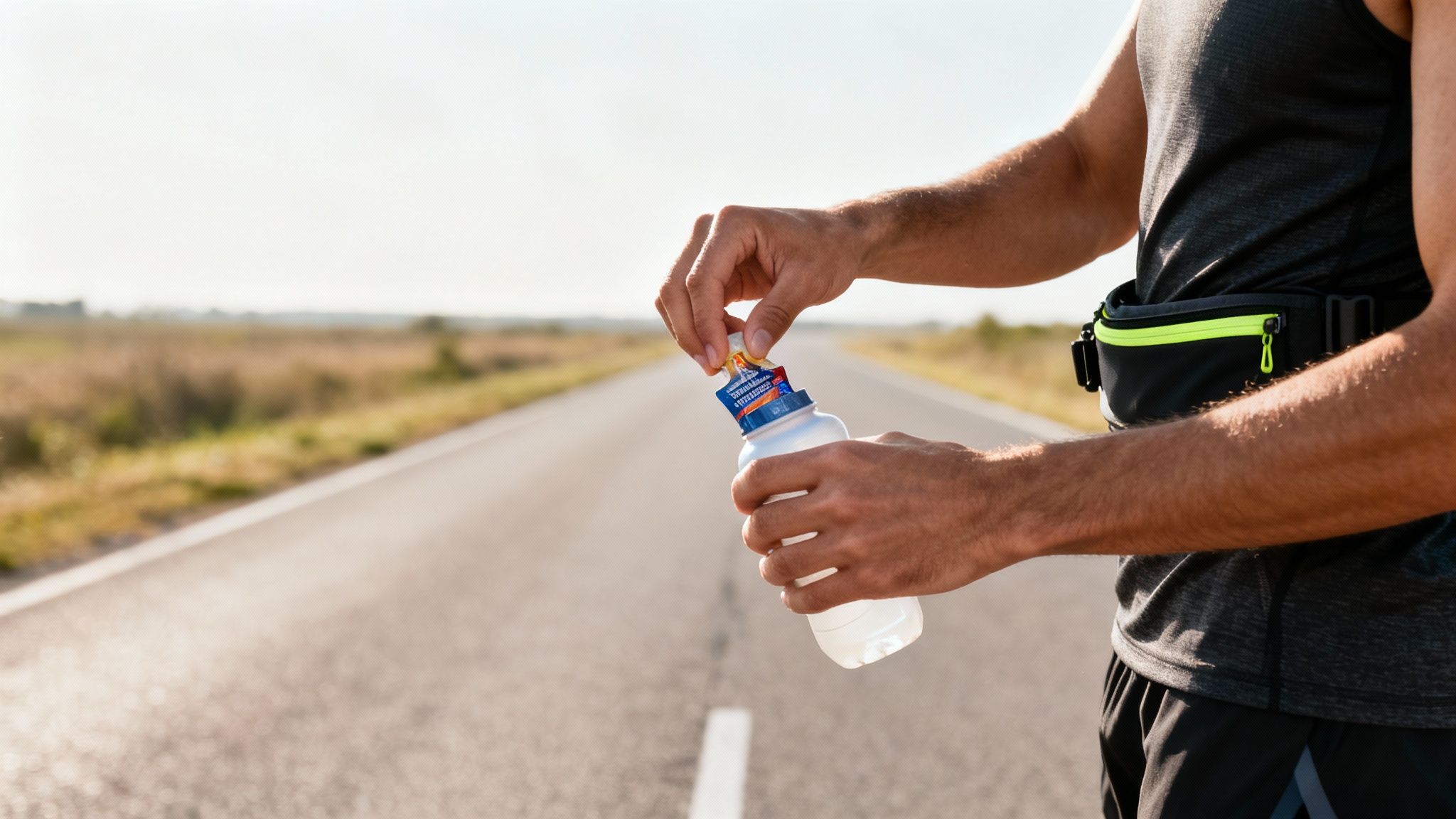
You didn't jump straight into a 20-miler, so don't try to slam 90 grams of carbs an hour on your first attempt. Start this process early in your training block. On any run that goes longer than 75-90 minutes, try taking just one gel or a handful of chews and see how your stomach feels.
From there, you can slowly dial up the amount of fuel you take during your progressively longer runs. This gradual approach gives your gut the time it needs to adapt, which dramatically cuts down your risk of race-derailing GI issues. The end goal is to make fueling feel as natural and automatic as tying your shoes.
For a great plan that maps out your long runs, check out our 14-week marathon training schedule. It’s the perfect blueprint for building up your mileage and layering in your fueling practice.
Simulate Race Day Conditions
Your long runs are the full dress rehearsal for the main event. To get the most out of them, you need to mimic race day as closely as possible.
- Fuel at Race Pace: Fumbling with a gel packet is a totally different ballgame when you're running at your goal marathon pace versus a casual jog. Practice it.
- Time Everything: Hit "start" on your watch and begin the clock. Take your first fuel around the 45-60 minute mark, and then stick to your planned intervals (e.g., every 40-45 minutes) like your race depends on it—because it does.
- Practice with Water: Always take gels with water, never on their own. Practice grabbing a cup from a friend or looping back to a stashed water bottle to get used to the motions of an aid station.
Why Practice Matters: An optimized fueling plan is what separates a good race from a great one. Researchers found that ideal fueling can shave 0.4% off world-record-level times. More importantly, while an unfueled runner hits the wall around 20 miles, taking just five gels can result in a 7.75% faster pace. Practice turns this science into your reality. Learn more about the science behind marathon energy modeling.
Master the Logistics of Fueling
Knowing what fuel to take is half the battle. Knowing how you're going to carry and consume it all is the other half. Your long runs are the perfect time to nail down these practical details.
Carrying Your Fuel Figure out your preferred method for stashing your nutrition.
- Running Belts: Many have handy loops designed specifically for gels.
- Shorts Pockets: Some running shorts are amazing, with dedicated gel pockets or a secure zippered pouch.
- Hydration Vests: For those longer self-supported runs, a vest gives you tons of space for fuel, fluids, and your phone.
Aid Station Practice Race day aid stations are chaotic. The simple act of grabbing a cup of water without stopping or splashing it everywhere is a skill worth practicing. A great trick is to grab the cup, pinch the rim to create a V-shape, and sip from the spout you've made. Try it out!
Keep a Fueling Log
After every long run where you practice fueling, take two minutes to write down what happened. This information is pure gold for tweaking your plan. It doesn’t need to be fancy—just the basics.
| Variable to Track | Example Note |
|---|---|
| What You Ate (Pre-Run) | "Oatmeal with banana 2 hours before." |
| Fuel Type and Timing | "Gel at 45 min, chews at 1:30, gel at 2:15." |
| How You Felt | "Energy felt great until mile 16, then a slight dip." |
| Stomach Issues? | "No cramps, but felt a little bloated after the chews." |
This simple loop of trying, noting, and adjusting is how you build a bulletproof strategy. When you're standing on that starting line, your plan for how to fuel during a marathon won't be a hopeful guess—it'll be a proven routine you can execute with complete confidence.
Solving Common Race Day Fueling Problems
Even after months of dialing in your nutrition, race day has a funny way of throwing a wrench in the works. The adrenaline, the crowds, the sheer intensity—it can all conspire against even the most well-practiced fueling strategy. Think of this as your troubleshooting guide for when things go sideways, so you can adapt on the fly and keep pushing toward that finish line.
The number one thing that tanks a runner’s race is, without a doubt, a rebellious stomach. We’ve all been there or seen it happen. It’s no surprise that studies show anywhere from 30% to 50% of us will deal with some kind of GI issue during a race, from annoying bloating to cramps that stop you in your tracks.
If your stomach starts to turn, the first rule is: don't panic. Take a breath, ease off the pace just a bit to let more blood flow back to your digestive system, and simplify what you're putting in.
What to Do When Your Stomach Rebels
When GI distress hits, the goal is to calm things down, fast. That concentrated sugar bomb from a gel is often the main culprit, so a few quick adjustments can make all the difference.
- Sip, Don’t Gulp: Instead of squeezing down a whole gel in one go, try taking tiny sips over a few minutes. Critically, chase it with plenty of plain water. This helps dilute the sugar and makes it much easier for your stressed system to handle.
- Switch to Liquids: If gels suddenly feel like trying to swallow cement, shift your focus to your sports drink. Liquid calories are just easier to absorb and can keep you going without the heaviness of a gel.
- Embrace Aid Station Snacks: Sometimes, a little real food is exactly what your stomach is craving. A few salty pretzels or a piece of an orange or banana from an aid station can be a lifesaver and help reset your palate and your gut.
Here's a mantra I tell every runner: "When in doubt, water it down." Slamming a gel without water when your stomach is already churning is one of the worst things you can do. Always prioritize hydration to help with digestion, especially when things feel off.
Navigating On-Course Mishaps
Beyond gut rot, a dozen other little things can go wrong. A dropped gel or a sudden hatred for the flavor you loved in training doesn't have to be a race-ender. It's all about how you react.
Scenario 1: You Drop a Gel It happens to the best of us. A fumbled handoff, sweaty hands, and there it goes—your next 25 grams of carbs, splattered on the pavement. The fix is simple: always carry one more gel than you think you'll need. If you don't have a spare, no worries. Just adjust your timing and plan to grab an extra sports drink or whatever gel they're offering at the next aid station to make up for the loss.
Scenario 2: You Have Flavor Fatigue Around mile 20, the thought of another super-sweet berry gel can be absolutely revolting. This is "flavor fatigue," and it's very, very real. The best way to beat this is to train with a variety of flavors—maybe a fruity one, a chocolate or coffee one, and a salty-savory option like salted caramel. If you hit that wall, look for pretzels on the course or just switch to your sports drink and plain water for a bit.
Adjusting Your Plan for the Weather
The weather is the one variable you can't control, and it demands you adapt your fueling plan.
On a surprisingly hot and humid day, your hydration and electrolyte needs are going to go through the roof. You absolutely must drink more than you planned. Prioritize those fluids, even if it means slightly cutting back on your carb goal. A happy stomach that can absorb liquid is better than one shutting down from too much sugar and not enough water. Grab two cups at every aid station—one to drink, one to dump over your head.
Conversely, when it's cold, you might not feel thirsty, but you're still losing fluids. This is a sneaky path to dehydration. You have to be disciplined and stick to your hydration schedule. The cold can also turn chews into rocks and gels into sludge, so keep your fuel tucked in a pocket close to your body to keep it warm and pliable. A truly solid plan for how to fuel during a marathon is one that's flexible enough to handle whatever the day throws at you.
Your Marathon Fueling Questions Answered
We’ve dug into the science and laid out the strategies, but I know there are always those nagging little questions that pop up. This is where we tackle them head-on. Think of this as the chat you’d have with a running buddy who’s been through it all before—just straight, simple answers to those last-minute doubts.
These aren't just textbook answers. They're based on a ton of sports science, sure, but also on thousands of real-world miles. The goal is to give you that final piece of confidence before you step up to the start line.
Should I Eat Solid Food During a Marathon?
For most of us running at a true marathon effort, solid food is a huge gamble. Things like pretzels, bananas, or even energy bars demand a lot from your digestive system. When all the blood is pumping to your legs, your gut just isn't equipped to handle that kind of work, which is a classic recipe for cramps, bloating, or an unscheduled porta-potty stop.
Now, that doesn't mean it's impossible. If you're running at a more relaxed pace or tackling an ultramarathon, small bites of real food can work wonders. But here’s the non-negotiable rule: you absolutely must have practiced with it on your long runs. If you haven't tested it in training, grabbing a banana from an aid station on race day is a risk you don't want to take.
How Soon Should I Start Fueling in the Race?
Don't wait. Seriously, don't wait until you feel your energy dip. By that point, you're already behind, and you’ll spend the rest of the race trying to claw your way back. The key is to be proactive, not reactive.
A Proactive Approach: A solid, race-tested strategy is to take your first gel somewhere between 45 and 60 minutes into the race. This gets fuel into your system well before your glycogen stores take a major hit, keeping the tank topped off from the beginning.
Starting your fueling early keeps your energy levels stable and predictable. It’s what prevents those dramatic peaks and crashes that often sabotage runners in the final miles.
Do I Need to Drink Water With Every Gel?
Yes. One hundred percent, yes. This is one of the most important rules of marathon fueling. Always, always wash your gels down with a few sips of water.
Energy gels are incredibly concentrated. If you take one without water, your body has to pull water from elsewhere into your gut just to dilute it enough to be absorbed. This not only slows down the energy delivery but is also a primary trigger for stomach cramps and nausea.
The easiest way to manage this is to time your gels with the aid stations. Plan to take your fuel a minute or two before you hit a water stop, so you can easily grab a cup and wash it down properly. It's a simple habit that will save you a world of GI trouble.
What if the Race Offers a Different Gel Brand?
Ah, the classic race-day curveball. You’ve spent months dialing in your nutrition with one specific brand, only to find out the course is stocked with something completely different.
Remember the golden rule: nothing new on race day. Relying on an unfamiliar gel is a massive gamble. Different brands use different sugar blends (maltodextrin vs. fructose, for example), have different consistencies, and can affect your stomach in wildly different ways.
The safest and smartest move is to be self-sufficient. Pack what you need. Figure out how many gels your plan calls for and carry them with you in a belt, vest, or your pockets. Deciding to just "wing it" with the on-course nutrition can easily derail months of hard training. Stick to what you’ve trained with.
Your marathon is a story of dedication, and your finish is a moment worth celebrating forever. RoutePrinter helps you turn that achievement into a beautiful, personalized piece of art. Commemorate your 26.2-mile journey with a custom race poster that showcases your route, name, and official finish time. Design your unique marathon poster today.