A Guide to the Olympic Triathlon Distance

The Olympic triathlon is the gold standard for many triathletes, a perfect blend of endurance, speed, and strategy. It features a 1.5 km swim (0.93 miles), a 40 km bike (24.8 miles), and a 10 km run (6.2 miles). This iconic format, often just called the "standard distance," is the one you see the pros race every four years at the Olympic Games.
Breaking Down the Olympic Triathlon Distances
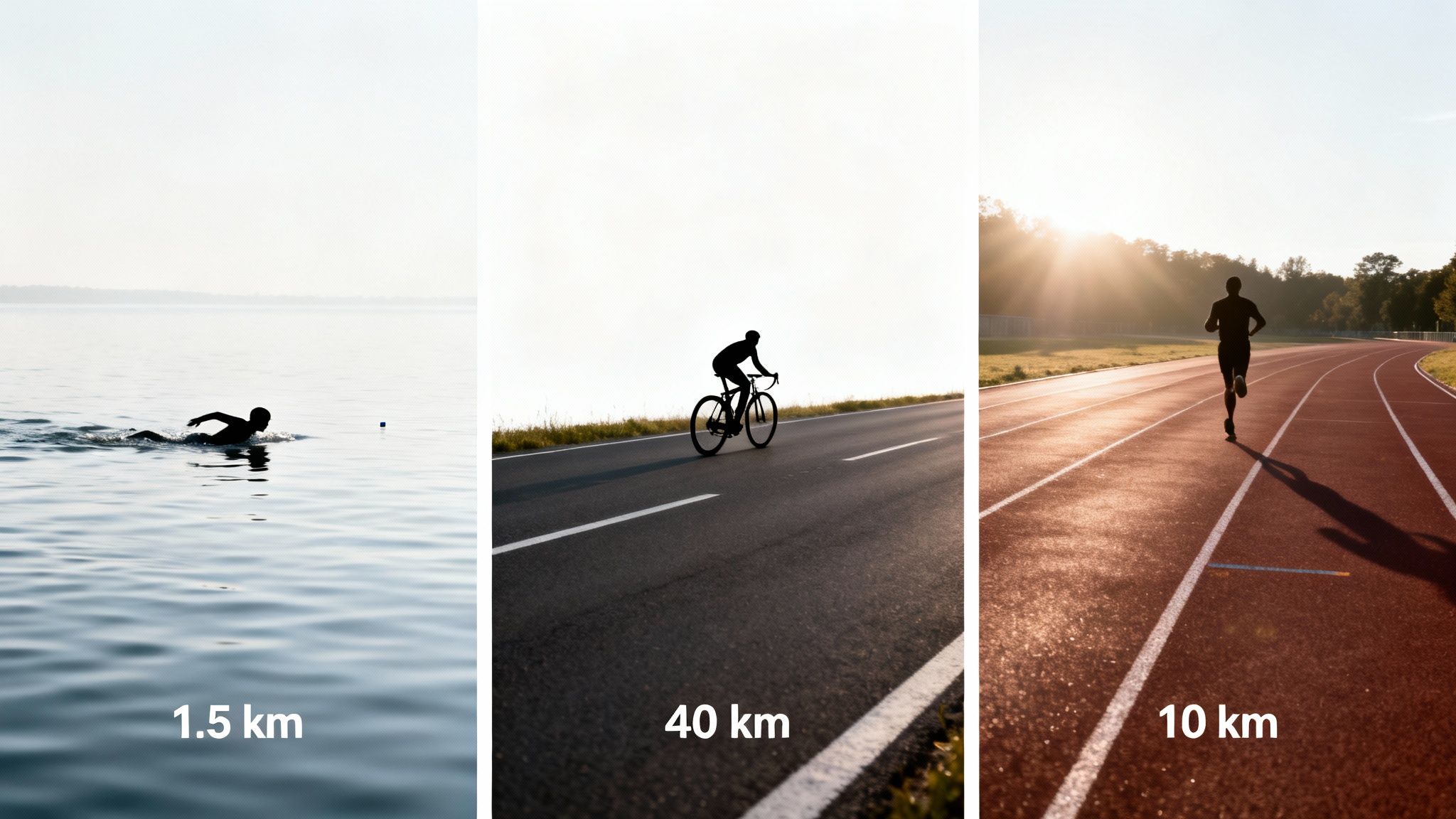
What makes the Olympic distance so compelling is its unique challenge. It’s a true test that demands serious training, yet it’s short enough that the racing is fast, aggressive, and incredibly exciting from the starting horn to the finish line. This balance makes it a fantastic goal for experienced amateurs and a thrilling spectacle at the elite level.
The distances weren't picked at random. Back in the 1980s, race director Jim Thomas and others championed this format because the individual legs—a 1.5 km swim, a 40 km bike, and a 10 km run—were already standard race distances in their respective sports. This smart thinking helped triathlon gain global appeal and eventually a spot in the Olympics. You can read more about the origins of this iconic distance at Triathlete.com.
At its core, the Olympic distance triathlon is a continuous 51.5-kilometer (32-mile) test of versatility. Success requires mastering three different sports and, just as importantly, managing the transitions between them.
So, what does it actually take to complete one? To give you a better sense of the effort involved on race day, let's break down the numbers and what you might expect for finish times.
Olympic Triathlon Distances at a Glance
This table lays out each leg of the race and gives a realistic snapshot of how long it might take you, whether you’re a pro fighting for the podium or a dedicated age-grouper chasing a personal best.
| Discipline | Distance (KM) | Distance (Miles) | Elite Finish Time | Age-Grouper Finish Time |
|---|---|---|---|---|
| Swim | 1.5 km | 0.93 mi | 18-20 minutes | 25-45 minutes |
| Bike | 40 km | 24.8 mi | 50-55 minutes | 1:15 - 1:45 hours |
| Run | 10 km | 6.2 mi | 30-33 minutes | 45-70 minutes |
| Total | 51.5 km | 32.0 mi | ~1:45 - 2:05 hours | ~2:30 - 3:45 hours |
As you can see, the gap between the fastest in the world and the rest of us is pretty significant, but the total distance of 51.5 km remains the same formidable challenge for everyone.
The Story Behind the Standard Distance
Every legendary race has an origin story, and the Olympic triathlon distance is a fascinating one. It wasn’t born from a happy accident but from a deliberate plan in the 1980s. The goal? To take a niche endurance sport and launch it onto the world's biggest athletic stage.
Back then, "triathlon" often meant the grueling Ironman. While those races are the stuff of legend, their epic length made them nearly impossible for television audiences to follow. The sport's visionaries knew they needed something shorter, faster, and far more exciting to captivate spectators from the starting horn to the finish line tape.
Forging an International Standard
The mission was clear: design a race that was a genuine test of athletic prowess but also packaged perfectly for broadcast. This led to the creation of the International Triathlon Union (ITU) in 1989, which we know today as World Triathlon. This new governing body was instrumental in shaping the sport for international competition.
The ITU championed the 1.5 km swim, 40 km bike, and 10 km run format. These distances were strategically chosen because they were already well-established benchmarks in each individual sport, lending immediate credibility to the new combined event. This "standard distance" hit the sweet spot, demanding both raw speed and deep endurance.
The gamble paid off. Triathlon made its spectacular debut at the Sydney 2000 Olympics, showcasing the standard Olympic distance and a draft-legal format that has defined elite racing ever since. You can dive deeper into triathlon's incredible Olympic history over at Tri247.com.
The debut at the Sydney 2000 Olympics was a landmark moment, cementing the 51.5 km distance in sports history and inspiring a new generation of athletes worldwide.
That moment didn't just put the sport on the map; it solidified the Olympic distance as the premier format for elite, draft-legal racing, shaping professional competition for decades.
Navigating Each Leg of the Race
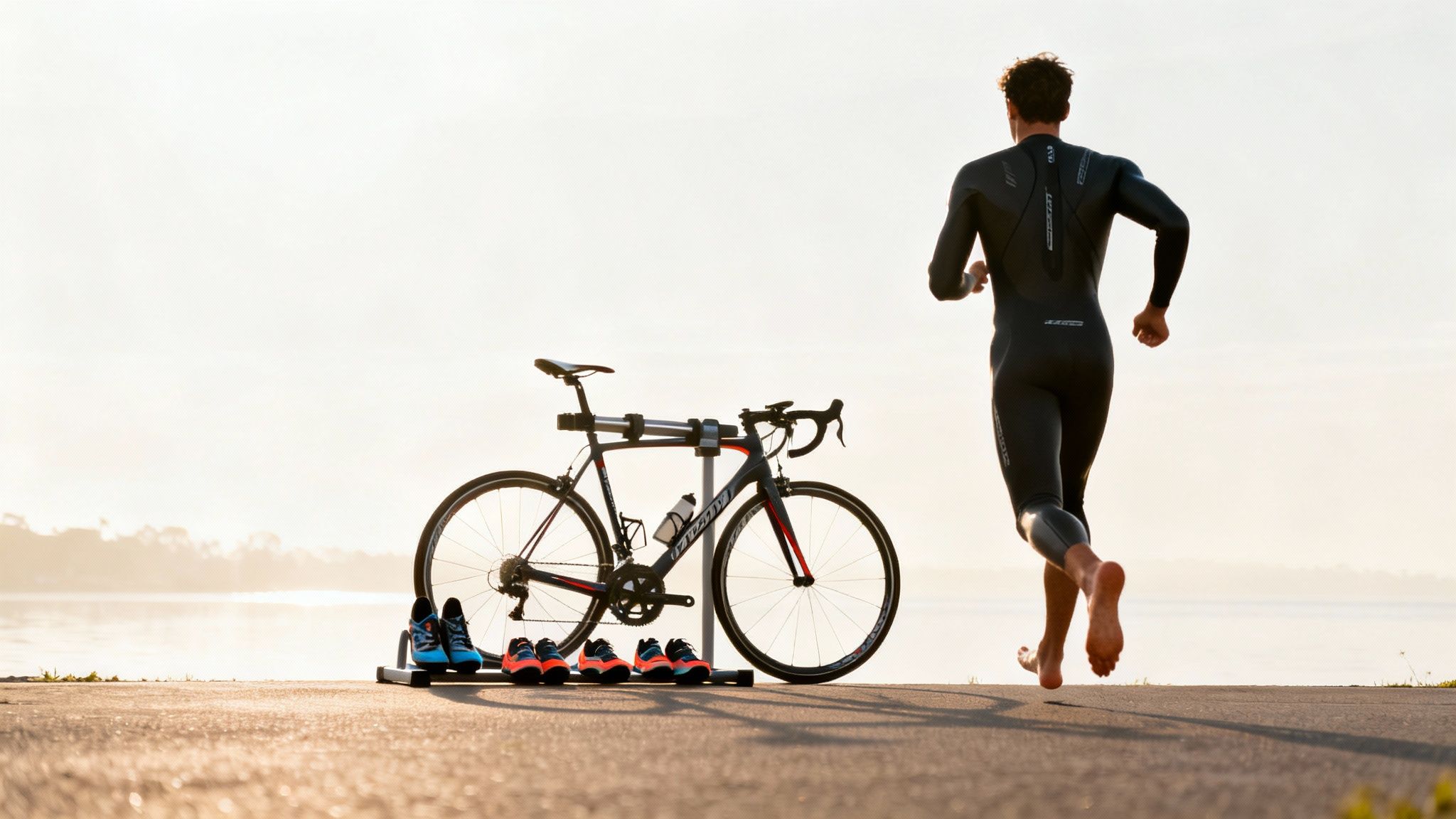
Finishing an Olympic triathlon isn't just a test of raw endurance—it's about smart execution across three completely different disciplines. Each leg throws unique challenges your way and requires a solid strategy to manage your energy and get the most out of your performance. Let’s break down what to expect, piece by piece.
The 1.5 km Open Water Swim
The race kicks off with a 1.5 km (0.93-mile) swim, which is often a chaotic but thrilling experience. You're not in a calm, marked pool lane anymore; you're in open water with hundreds of other athletes all vying for position. The biggest rookie mistake is going out too fast and burning out before you even see your bike.
Your top priorities here are simple: find a comfortable, sustainable rhythm and swim in a straight line. That second part is harder than it sounds. You’ll need to practice "sighting"—lifting your head briefly to spot a buoy or landmark. Getting this down in training makes it second nature on race day, saving you a ton of energy you’d otherwise waste swimming off-course.
The 40 km Bike Leg
Once you’re out of the water and through the first transition (T1), it's time for the longest part of the day: the 40 km (24.8-mile) bike. How you approach this leg depends entirely on the race rules, which can change the dynamic completely.
- Draft-Legal (Elite Racing): In pro races like the actual Olympics, athletes are allowed to draft, which means riding in another cyclist's slipstream to conserve energy. This makes the bike leg feel like a high-speed game of chess, where tactics and pack positioning are everything.
- Non-Drafting (Age-Group Racing): For the rest of us, most races are non-drafting. You have to keep a specific distance—usually around 10-12 meters—from the rider in front of you. This turns the bike into a pure individual time trial against the clock.
In a non-drafting race, your focus should be on holding a steady, consistent effort. This is also your best window to get in fuel and hydration for the run ahead, without the jarring impact you’d have while running.
The 10 km Run to the Finish
The final stretch is the 10 km (6.2-mile) run, and it's where you find out what you really have left in the tank. Running a fresh 10k is tough enough, but doing it after a hard swim and bike is a whole different ballgame. Your legs will likely feel heavy and unresponsive—what triathletes lovingly call "jelly legs."
The secret is to start the run conservatively. Your pace for the first mile or two should feel noticeably easier than your normal 10k pace. This gives your body a chance to adapt from cycling to running. From there, concentrate on maintaining good form and a quick, light cadence, saving just enough for a strong push across that finish line.
Conquering the Olympic triathlon distance requires more than just fitness; it requires a race plan. By breaking the event down into manageable segments and focusing on discipline-specific tactics, you can turn a daunting challenge into an achievable goal.
Comparing Triathlon Race Distances
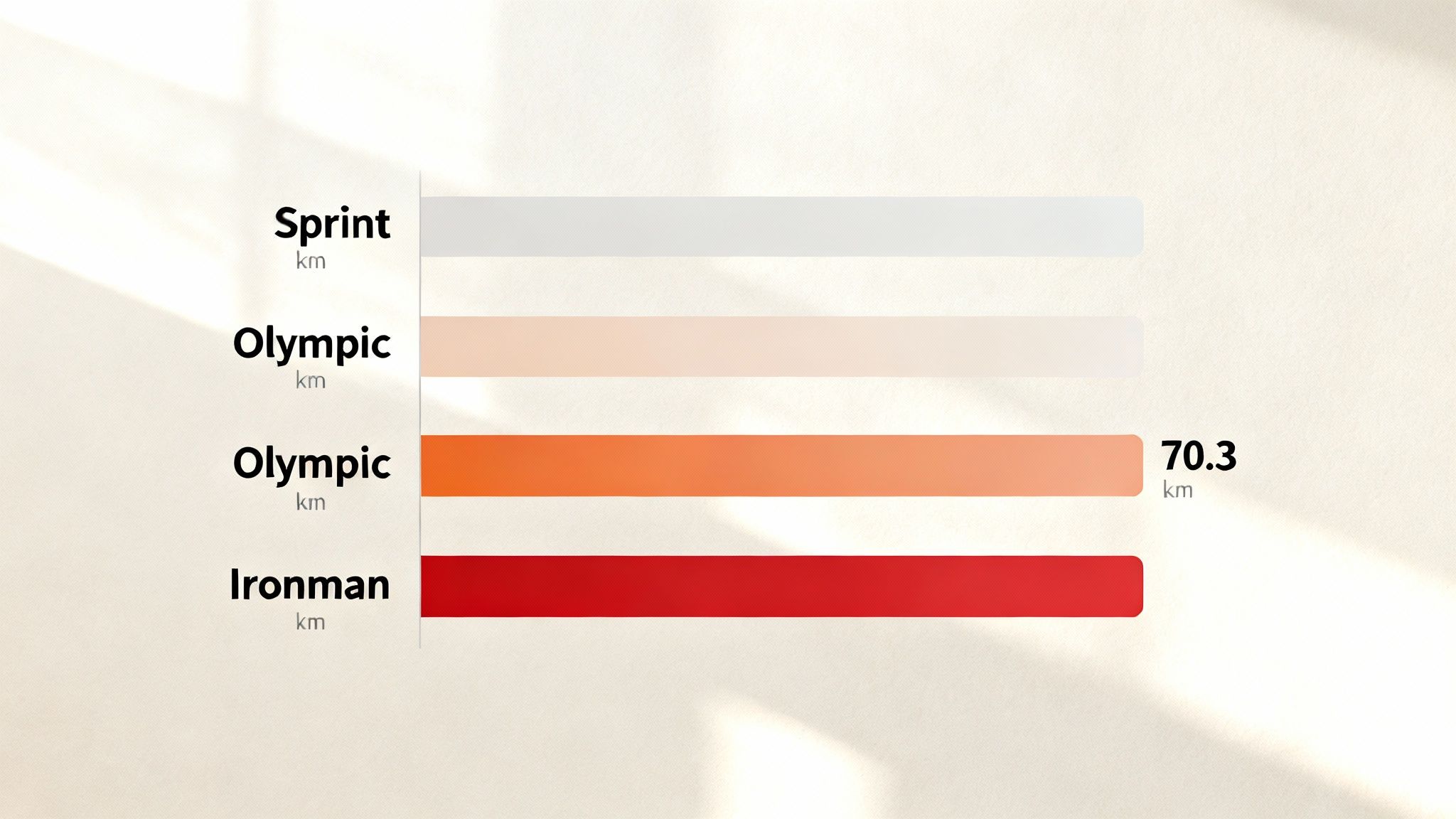
To really get a feel for what makes the Olympic triathlon distance so special, it helps to see how it fits into the broader world of triathlon. I like to think of the different race formats as gears on a bike—each one serves a unique purpose, from the explosive power needed for a Sprint to the grinding endurance required for an Ironman.
The Olympic distance? It’s that perfect sweet spot right in the middle.
It's a serious test of stamina, demanding far more than a Sprint, but it also requires a level of tactical speed that you just don't see in the ultra-endurance races. This blend of speed and endurance is what makes it one of the most exciting and competitive formats out there.
How The Olympic Distance Stacks Up
The easiest way to understand the differences is to see the numbers laid out next to each other. Every jump in distance is a huge leap, not just in mileage but in the training, nutrition, and mental strategy it takes to cross the finish line.
The table below breaks it down, showing just how much the challenge escalates from one race to the next.
Triathlon Distances Compared
| Race Type | Total Distance (KM) | Swim | Bike | Run |
|---|---|---|---|---|
| Sprint | 25.75 km | 0.75 km | 20 km | 5 km |
| Olympic | 51.5 km | 1.5 km | 40 km | 10 km |
| Half-Ironman (70.3) | 113 km | 1.9 km | 90 km | 21.1 km |
| Full Ironman | 226 km | 3.8 km | 180 km | 42.2 km |
This side-by-side comparison makes it clear why each race attracts a different kind of athlete. For a more detailed look at what it takes to finish these events, check out our complete guide to average triathlon times.
-
Sprint: This is all about raw power and fast-twitch muscle. Think of it as an all-out, red-line effort where every second in transition counts.
-
Ironman: The ultimate test of mental fortitude and pacing. It's a long, long day where success is built on nutrition strategy and sheer grit.
-
Olympic: This is where speed and stamina collide. It's the perfect fusion, demanding a high-intensity effort over a distance that truly tests your conditioning.
The Olympic distance is where endurance meets intensity. It's long enough to require a deep aerobic base but short enough that athletes can maintain a high-octane pace, making it a true test of the complete triathlete.
Your Training Blueprint for Race Day
Tackling an Olympic triathlon isn't about finding a magical, one-size-fits-all plan. It’s about sticking to a few core principles, day in and day out. The real secret is consistency—steadily building up your aerobic base so you can handle the unique demands of all three disciplines.
Think of it like building a house. Each workout is a single brick, and over time, you create a structure strong enough to withstand race day. A good starting point is aiming for 2-3 sessions per week in the pool, on the bike, and on the run. This approach builds fitness far more effectively than cramming everything into a couple of monster workouts on the weekend.
Core Training and Getting Your Gear in Order
If there’s one workout that separates triathletes from swimmers, cyclists, and runners, it's the brick session. This is your dress rehearsal for race day, where you practice two disciplines back-to-back, usually biking right into a run. Brick workouts are where you teach your body to fight through that wobbly "jelly legs" feeling and make your transitions feel like second nature.
The goal isn’t just to get fit in three separate sports. It’s to become an expert at combining them. Brick sessions are the glue that holds your entire race together.
When it comes to gear, you don't need to break the bank right away. Start with the basics and upgrade as you get more invested in the sport.
- Wetsuit: A triathlon-specific wetsuit is a game-changer, giving you a serious boost in buoyancy and keeping you warm in open water.
- Bike: Any reliable road bike will do the trick when you're starting out. You can always add upgrades like clip-in pedals and cycling shoes down the line.
- Running Shoes: This is one area not to skimp on. Go to a specialty running store and get professionally fitted to help keep injuries at bay.
While the Olympic distance is a serious challenge, it's a much more approachable goal than the ultra-endurance events. If you've got your eyes on a bigger prize, you can see how the commitment level jumps by looking at an Ironman training plan.
Got Questions? We've Got Answers
Stepping into the world of Olympic-distance triathlons always brings up a few key questions. Let's break down some of the most common things athletes wonder about as they gear up for race day.
How Long Does an Olympic Triathlon Take?
This is the big one everyone wants to know! The pros are in a league of their own, often finishing a fast course in well under two hours—think somewhere between 1:45 and 2:05.
For the rest of us mortals, a fantastic goal is to finish between 2 hours 30 minutes and 3 hours 30 minutes. If it's your first time out there, remember that just crossing that finish line is a huge win, which might take closer to four hours.
Is Drafting Allowed on the Bike?
This is a critical rule that changes everything. In the pro races you see at the Olympics or on the World Triathlon circuit, the bike leg is draft-legal. This allows athletes to ride in tight packs, saving a ton of energy.
However, for nearly all age-group races, the rules are non-drafting. You have to keep a specific gap—usually 10 to 12 meters—between you and the bike ahead. It turns the bike leg into a pure, individual time trial.
How Much Training Is Required?
Your training schedule really depends on your starting fitness and your race goals. If you're new to the sport, you can build a great base with 6-8 hours of training per week, bumping that up to 8-10 hours as you get closer to the event.
More experienced amateurs aiming for a competitive time often put in 10-15 hours a week.
The real secret isn't just volume; it's consistency. A solid plan will have you doing 2-3 sessions of each sport every week, which helps you build fitness steadily without burning out.
That final 10k run can feel like a marathon after the swim and bike, and it’s a whole different beast than running a fresh 10k. It’s a lot like how the final leg of a half-Ironman is a half marathon—a tough distance all by itself. To get a better sense of that kind of running challenge, you can learn more about what a half marathon distance entails in our guide.
Completing an Olympic triathlon is a massive achievement that deserves to be remembered. At RoutePrinter, we help you celebrate that hard work by turning your race into a piece of custom art. You can create a personalized poster that maps your route and displays your finish time. Design your unique race poster today!