What Is a Half Marathon Distance? Your Guide to 13.1 Miles

So, what exactly is a half marathon? Let's get right to the numbers.
The official, globally recognized half marathon distance is 13.1094 miles, or 21.0975 kilometers. For most runners, it's the perfect sweet spot—a serious endurance challenge that demands respect and training, but without the all-consuming commitment of a full marathon. It’s precisely half of the iconic 26.2-mile marathon distance.
Breaking Down the 13.1-Mile Journey

While 13.1 miles is easy to say, truly appreciating the distance is another thing entirely. Think of it this way: it’s like running from the base of the Golden Gate Bridge to the top of Twin Peaks in San Francisco... and then all the way back. It’s a huge physical and mental effort that requires smart training and a solid race day plan.
This unique balance of challenge and accessibility has made the half marathon the most popular race distance in the world. Its growth has been explosive. At the start of the century, it accounted for just 17% of race finishers, but today, that number has surged to a dominant 30%. Meanwhile, full marathon participation has actually seen a slight decline. For a deeper dive into these trends, the data compiled over at RunRepeat offers some fascinating insights.
To wrap your head around the full distance, it helps to break it down into smaller, more familiar chunks. Seeing how common race distances like the 5K and 10K stack up within the half marathon is a great way to frame your training and race-day pacing strategy.
Half Marathon Distance Breakdown
Here’s a simple table that breaks the total half marathon distance down into more digestible segments. This is a mental trick many experienced runners use—thinking of the race as a series of smaller, achievable goals.
| Segment | Distance in Miles | Distance in Kilometers |
|---|---|---|
| 5K Mark | 3.1 miles | 5 km |
| 10K Mark | 6.2 miles | 10 km |
| 10 Mile Mark | 10 miles | 16.1 km |
| Full Distance | 13.1 miles | 21.0975 km |
Viewing the race this way helps you prepare for the effort. Instead of staring down the barrel of a full 13.1 miles, you can think of it as running a strong 10K, then another, and finally gutting out that last 5K push to the finish line. It makes the entire challenge feel much more manageable.
Why 13.1 Miles Hits the Sweet Spot
The half marathon distance seems to have found a magical sweet spot in the running world, making it one of the most popular and celebrated races you can sign up for. It’s a serious leap from a 5K or 10K, demanding real dedication, but it doesn’t quite consume your life in the way training for a full marathon often does.
This perfect middle-ground is precisely why its popularity has exploded. The secret? It’s a tough test of your physical and mental grit that still feels completely within reach for millions of runners.
A Serious Challenge That Fits Your Life
Let's be honest, training for a full marathon is a massive undertaking, often demanding 16-20 weeks of grueling, high-mileage weeks. A half marathon, on the other hand, is a much more manageable beast. Most runners can get themselves race-ready for 13.1 miles with a solid 8-12 week training plan.
That shorter training window opens the door for people juggling busy jobs, family life, and everything else life throws at them. You still get the incredible satisfaction of working toward a huge goal, but you don't have to kiss your social life goodbye to cross the finish line.
The statistics really drive this point home. Since 2003, the half marathon has been the fastest-growing race distance on the planet. Today, these events attract a massive 30% of all race participants, while the full marathon's share has fallen to just 12%. It's not uncommon to see the half marathon field at a major race weekend be twice the size of the full, which tells you everything you need to know about its appeal. You can dig into more of this data on the half marathon's rise in popularity on Wikipedia.
The Perfect Stepping Stone for Runners
For so many people, the half marathon is the gateway to long-distance running. It's the logical next step after you've nailed a few shorter races, giving you a real taste of what the endurance world is all about.
The half marathon is more than just a race; it’s a milestone. It’s the distance that proves you can push way past what you thought your limits were, building the confidence you need to chase even bigger goals.
This natural progression lets you build your endurance and strength gradually, which is key to avoiding the burnout and injuries that can happen when you jump into a full marathon too soon. Here's why it works so well as a stepping stone:
- It teaches you pacing: You can't just sprint a half marathon. Learning to hold a steady, consistent effort over 13.1 miles is a fundamental skill for any distance runner.
- It builds mental toughness: Those last few miles are always a grind. Pushing through that wall forges the kind of mental resilience you'll need for any future race.
- It forces you to learn fueling: Unlike a 10K, most people can't run a half marathon on an empty tank. It’s the perfect distance to start practicing how to take on gels and fluids while on the move.
Conquering the half marathon distance doesn't just give you an incredible sense of accomplishment; it lays the foundation for a lifetime of running.
How Race Courses Are Measured for Accuracy
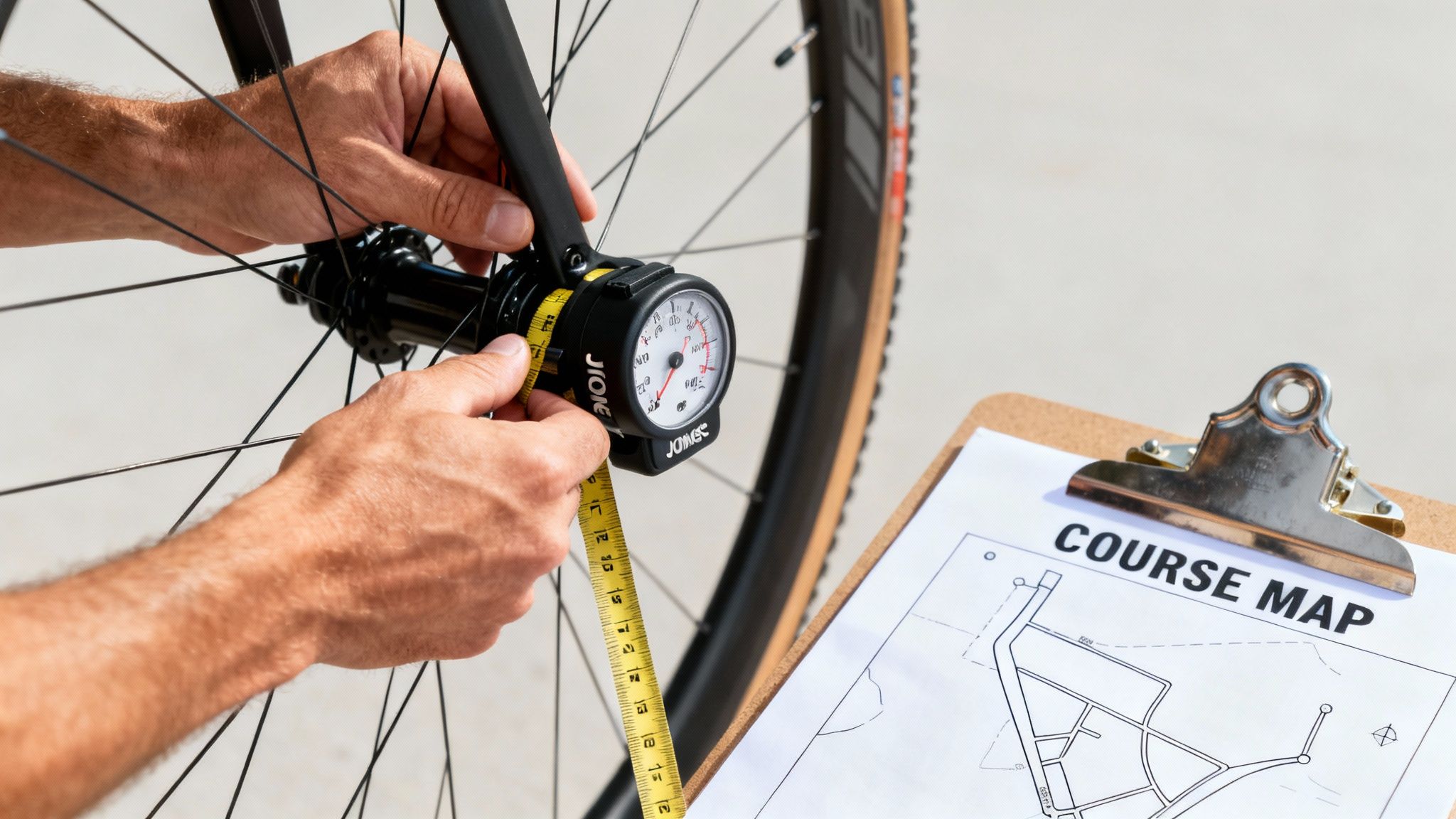
When you toe the line at a certified half marathon, you can bet that the distance is exactly 21.0975 kilometers. This isn't just a close guess; it’s the result of a surprisingly old-school and incredibly precise process that has nothing to do with consumer GPS.
Race organizers can't just plot a route on Google Maps and call it a day. For a race to be officially certified, trained officials have to measure the course following a strict set of international guidelines. This is how they guarantee that every single runner, from the first-place finisher to the last person crossing the line, runs the exact same distance.
The Role of Certification Bodies
This whole process is overseen by major governing bodies like USA Track & Field (USATF) in the United States or the Association of International Marathons and Distance Races (AIMS) on a global scale. Their stamp of approval is what makes a race "official," ensuring your finish time is valid for records or qualifying for other big events. Without it, a race is really just a fun run.
The secret weapon here isn't a satellite, but a brilliantly simple mechanical device called a Jones Counter. It’s a calibrated counter attached to the front wheel of a bicycle, clicking away with stunning precision to measure distance down to the centimeter. An official will ride the course multiple times, taking an average reading to get an almost perfect measurement.
The course is measured along the “shortest possible route” a runner could take. This means hugging the inside of every single turn and running the straightest line possible. It's the most direct, efficient path from start to finish.
Why Your GPS Watch Is Always Wrong
This brings us to one of running's great mysteries: why does my GPS watch always say I ran more than 13.1 miles? The answer is all about the difference between on-the-ground reality and a satellite's best guess.
Your GPS watch works by pinging satellites to plot your position every few seconds, essentially creating a dot-to-dot picture of your run. It struggles to capture smooth curves and can get thrown off by tall buildings or even dense trees that block the signal.
More importantly, you almost never run the "shortest possible route" the certifiers measured. Every little deviation adds up. Here’s where that extra distance on your watch comes from:
- Weaving around other runners, especially in a crowded start.
- Running wide on turns to get around a group or just find some open space.
- Veering off to grab water at an aid station, which is rarely on the perfect race line.
So, when your watch beeps for 13.25 miles at the finish, don't sweat it. The course wasn't long. Just trust the certified measurement and be proud of your effort—your watch simply recorded the actual path you took, which is always a little bit longer than the official half marathon distance.
What 13.1 Miles Looks Like on Race Day
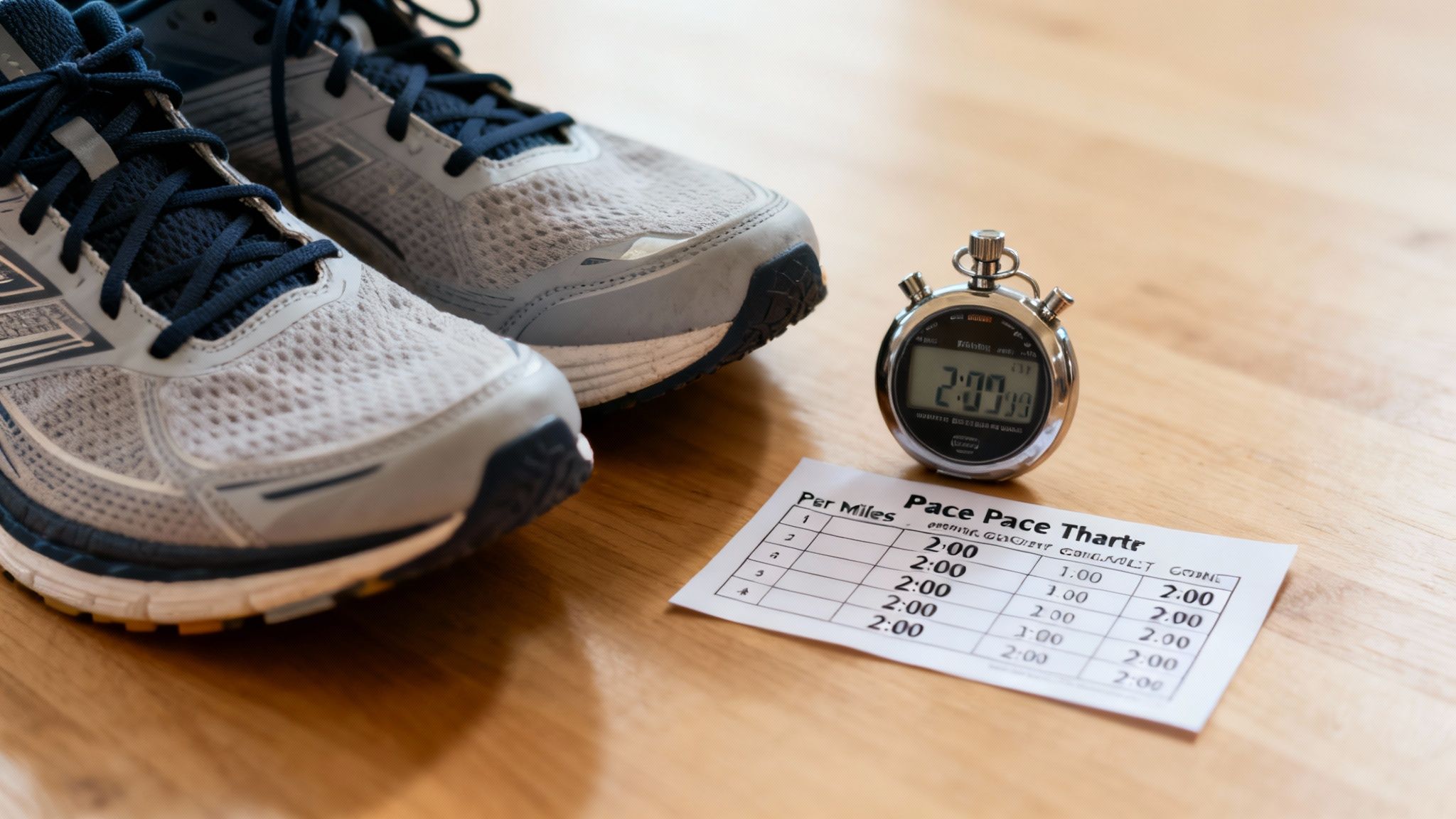
Knowing the official half marathon distance is one thing, but the real fun begins when you start translating that 13.1 miles into a tangible goal. It’s about figuring out the pace you need to hold, feeling it in your legs during training, and seeing that target finish time on the clock as you cross the line.
For many new runners, the goal is simply to finish—and that's a huge accomplishment! But once you get a race or two under your belt, you might start chasing a specific time. Breaking the two-hour mark is one of the most popular milestones for amateur runners. It’s a challenging but achievable goal that demands consistent training and a smart race-day strategy. For more on setting a realistic first goal, check out our guide on beginner half marathon times.
Finding Your Race Day Pace
Pacing is everything in a half marathon. It’s the art of spreading your energy out evenly so you don't burn out too early. We’ve all seen it happen: someone shoots out of the starting corral like a rocket, only to hit a wall and shuffle through the last few miles. That's a classic rookie mistake.
A pace chart is your best friend here. It takes an abstract goal time and breaks it down into concrete, mile-by-mile (or kilometer-by-kilometer) splits. This helps you build that internal clock during your training runs, so your goal pace feels natural on race day.
Half Marathon Pace Chart for Common Goal Times
Find your target pace per mile and per kilometer to achieve your desired half marathon finish time.
| Goal Finish Time | Pace per Mile | Pace per Kilometer |
|---|---|---|
| 1:45:00 | 8:00 min/mile | 4:58 min/km |
| 2:00:00 | 9:09 min/mile | 5:41 min/km |
| 2:15:00 | 10:18 min/mile | 6:24 min/km |
| 2:30:00 | 11:26 min/mile | 7:06 min/km |
| 3:00:00 | 13:44 min/mile | 8:32 min/km |
As you can see, the numbers don't lie. To sneak in just under two hours, you need to hold an average pace of just over nine minutes per mile for the entire 13.1 miles. That’s a steady, honest effort.
Pushing the Limits of Human Endurance
While most of us are focused on our own personal bests, it’s always inspiring to look at what the elites are doing. The world's fastest runners cover the half marathon distance at speeds that are almost hard to believe, constantly redefining what’s humanly possible.
The half marathon is a pure test of speed endurance. It forces an athlete to run at a blistering pace, right on the edge of their threshold, for an hour or more. It’s a masterclass in metabolic efficiency and mental grit.
On the world stage, the 21.0975 km distance has been the backdrop for some truly mind-boggling records. Take Ugandan Jacob Kiplimo, who set a world record of 57:31 in 2021—a time later matched by Yomif Kejelcha. Putting this into perspective reminds us just how much potential is packed into this incredible distance. You can read more about these amazing record-breaking runs to get a glimpse of peak human performance.
Your Training Blueprint for Conquering the Distance
Turning the goal of a half marathon finish into reality all comes down to a smart, structured training plan. Every runner's path is different, of course, but the core principles for tackling 13.1 miles are universal. It’s less about running hard every single day and much more about running smart.
A solid plan is all about balance. Think of it like building a house—you need a strong foundation, sturdy walls, and a solid roof. Each type of workout you do is a different building block, and they all work together to make you a resilient, race-ready runner. The real goal is to show up to the start line feeling strong, not burned out.
The Core Components of Your Training Week
A good training schedule usually revolves around three main types of runs, with plenty of rest and recovery built in. Remember, consistency beats intensity every time, especially when you're building up. Missing a single workout isn't the end of the world, but stringing together weeks of consistent effort is where the magic really happens.
Let's break down the essential workouts that form the backbone of nearly every half marathon plan:
- The Weekly Long Run: This is your bread and butter. Each week, you'll gradually extend one run a little farther to build the raw endurance you'll need to cover 13.1 miles. It teaches your body to become more efficient with its fuel and, just as importantly, builds serious mental grit.
- Speed Work (Like Tempo Runs): Once or twice a week, you'll pick up the pace. A classic example is the tempo run, where you hold a "comfortably hard" effort for a sustained stretch. This trains your body to handle the demands of a faster pace, making your goal race pace feel more manageable on the big day.
- Easy/Recovery Runs: These are short, slow runs at a pace where you could easily hold a conversation. They're crucial for helping your body bounce back from harder workouts while still adding to your weekly mileage and improving your aerobic base without a lot of stress.
A well-designed training plan is your roadmap to the finish line. It’s not just about logging miles; it’s about strategically building strength, speed, and endurance while keeping your risk of injury as low as possible.
Putting It All Together
Beyond just running, a truly complete plan folds in some key non-running activities. Cross-training, like swimming or cycling, is a great way to build your cardio fitness without the constant pounding of running, giving your joints a much-needed break. And most importantly, rest days are non-negotiable. That's when your muscles actually repair themselves and get stronger.
Here’s a glimpse at what a typical week might look like:
- Monday: Rest or cross-training
- Tuesday: Easy run
- Wednesday: Speed work (e.g., tempo run)
- Thursday: Easy run
- Friday: Rest
- Saturday: Long run
- Sunday: Recovery run or cross-training
This kind of structure gives you a repeatable pattern that balances the hard work with crucial recovery. The cornerstone of it all is building your endurance, which is absolutely fundamental for conquering the half marathon. If you want to dive deeper into specific strategies, you can learn more about how to improve running endurance.
By respecting every part of the plan—the hard days, the easy days, and the rest days—you'll put yourself on the best possible path to a strong and rewarding race day.
Commemorate Your Hard-Earned 13.1 Mile Achievement
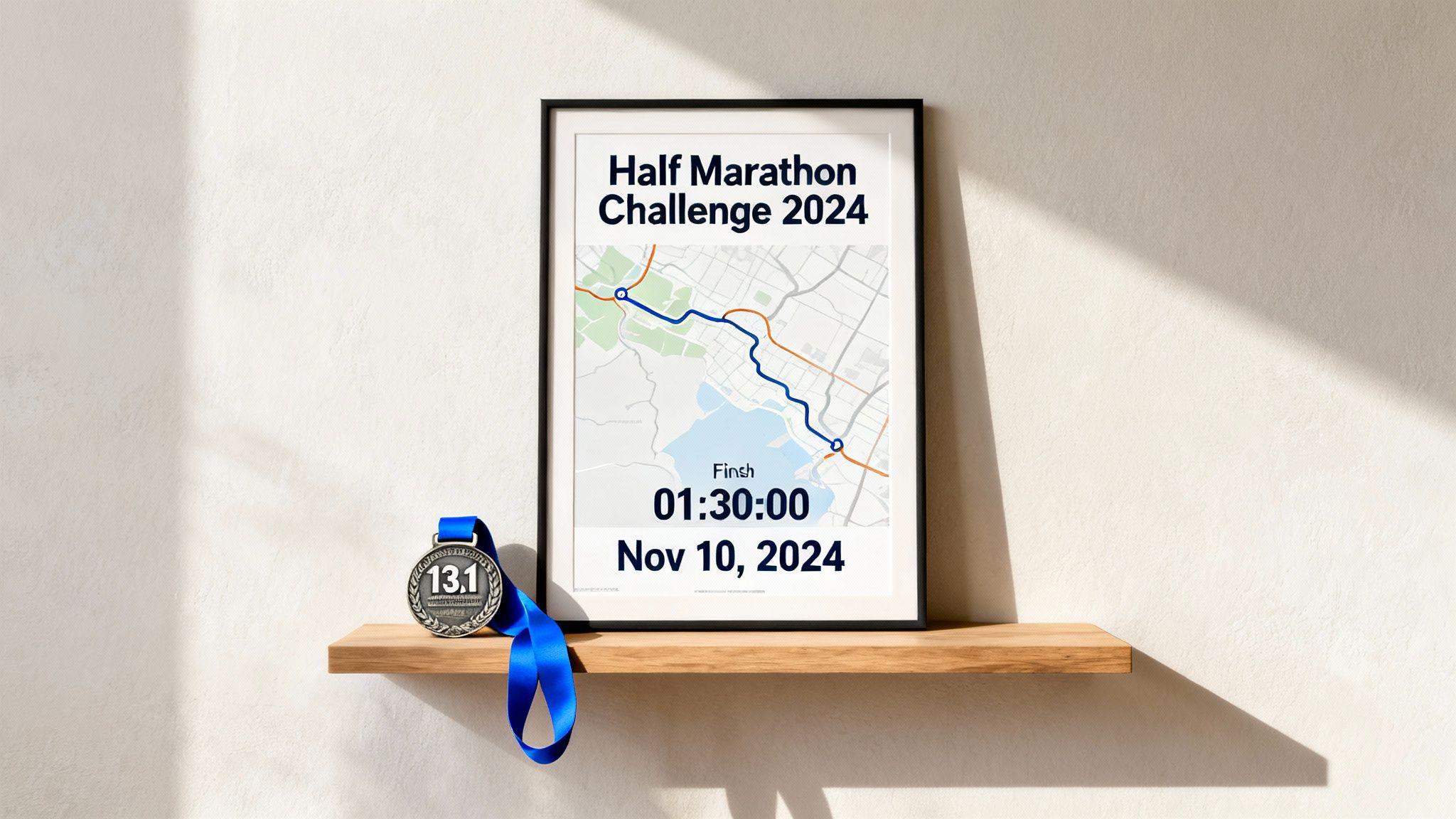
Crossing the finish line after 13.1 miles is a feeling like no other. It’s the payoff for all those early morning runs, grueling training sessions, and moments you pushed through when you wanted to stop. That feeling deserves to be honored long after the finisher's high wears off.
Don't just toss your medal in a drawer. Why not turn that incredible achievement into a piece of art that tells your personal story? A personalized race poster is the perfect way to freeze that moment in time and display your accomplishment with pride. It's more than just a decoration; it's a daily reminder of what you can do when you set your mind to it.
Turn Your Miles into a Masterpiece
Creating a custom memento of your race is a powerful way to celebrate all that hard work. You can design a print that shows the exact course you conquered, highlighting all the details that made the day uniquely yours. This isn't just some generic map—it’s your race, your effort, and your story brought to life.
With a service like RoutePrinter, it's simple to create personalized half marathon posters that include:
- Your exact route map, which you can pull directly from a Strava activity.
- Key race details like the event name, date, and your official finish time.
- A clean, modern design that will look great hanging in your home, office, or gym.
Your half marathon poster is more than just a map; it's a testament to your strength and perseverance. It serves as a constant source of motivation, reminding you of the incredible journey you completed and inspiring you to chase whatever your next big goal might be.
Answering Your Questions About the 13.1 Mile Distance
Even with a solid training plan and pace chart, it's natural to have a few questions pop up about the specifics of the half marathon. Let's tackle some of the most common ones so you can toe the line feeling confident about the 13.1-mile journey ahead.
Getting these details sorted can really shape how you train and what to expect on race day.
Is a Trail Half Marathon the Same Distance?
Yep, officially, it's the exact same 13.1 miles (or 21.0975 km). But that's where the similarities end. A trail half is a completely different beast.
You're dealing with technical singletrack, unpredictable footing, and constant ups and downs. All those natural obstacles mean your finish time will almost certainly be slower than on a paved road. The effort is way higher, but for many, the incredible scenery and rugged challenge are more than worth it.
How Much Will Hills Slow Me Down?
Elevation gain is a huge variable, and its impact is no joke. A pretty reliable rule of thumb is that for every 100 feet of climbing, you can expect to slow down by about 15-20 seconds per mile.
Do the math: a hilly course with 1,000 feet of total elevation gain could easily add 5-10 minutes (or even more) to your finish time compared to a pancake-flat course. Always, always check the elevation profile before you lock in a time goal.
So many runners get tripped up by underestimating hills. The energy you burn going up is never fully paid back on the way down; descents just hammer your quads in a different way. The key to a strong finish on a hilly course is smart, conservative pacing on the climbs.
Can I Walk a Half Marathon?
Absolutely! Walking a half marathon is an incredible feat of endurance, and plenty of people do it. Most events are very walker-friendly and have generous cut-off times, often around four hours. That gives you a buffer to maintain a comfortable 18-minute per mile pace.
If you're planning to walk the whole thing, just double-check the specific race's time limit when you register. A run-walk approach is also an incredibly popular and effective strategy, especially for first-timers.
What About the Run in a 70.3 Triathlon?
The run at the end of a 70.3 triathlon (you'll often hear it called a "Half Ironman") is a standard 13.1-mile half marathon. The catch? You only start that run after you've already finished a 1.2-mile swim and a 56-mile bike ride.
It's a profoundly different challenge. Running on legs that are already screaming from hours of prior effort makes it a much tougher test than a standalone half marathon.
Your race is a story of dedication and strength. Capture that moment forever with a personalized race poster from RoutePrinter. Design your custom print today and turn your hard-earned miles into a piece of art.