Your Complete Ironman Training Plan for Peak Performance

Committing to an Ironman is a serious undertaking, and your training plan is the roadmap that will get you to the finish line. This isn't about just stringing together a bunch of random workouts; it’s a long-term strategy designed to build your endurance, hone your strength, and forge the mental toughness you'll need on race day. The entire goal is to show up at the start line feeling strong, healthy, and ready for anything.
Laying the Foundation for Your Ironman Journey

The decision to train for an Ironman is huge, but the real work begins with a smart, consistent plan. Forget any ideas about cramming for a 140.6-mile race. Success is built on intelligent, gradual progression over many months.
This is where periodization comes in. It’s a proven training concept that breaks your journey into distinct phases, each with a specific goal. This structured approach is your best defense against the two biggest threats to any Ironman campaign: burnout and injury. It ensures you’re building the right fitness at the right time, without overdoing it.
Understanding the Core Training Phases
Your training journey will be broken down into four key stages. Think of them as building blocks, with each one setting you up perfectly for the next.
Let's break down what each phase looks like and why it matters.
Overview of Ironman Training Phases
| Training Phase | Primary Goal | Typical Duration (Weeks) | Focus |
|---|---|---|---|
| Base Phase | Build Aerobic Endurance | 12-16 | Low-intensity, high-volume workouts. Think long, slow, and steady. |
| Build Phase | Increase Intensity & Race Specificity | 8-10 | Introduce race-pace efforts, longer key sessions, and dial in nutrition. |
| Peak Phase | Maximize Race Fitness | 2-3 | Highest training volume and intensity to simulate race day demands. |
| Taper Phase | Recover & Absorb Training | 2-3 | Drastically reduce volume to allow the body to heal and be fresh for the race. |
As you can see, each phase has a clear purpose. Rushing through the Base Phase or skipping the Taper might seem tempting, but it almost always backfires. Trust the process.
The secret to Ironman success isn't found in a single heroic workout. It’s forged in the day-to-day discipline of showing up, following the plan, and trusting the process—even on the days you don't feel like it.
Following a structured program simply works. Studies have shown that a staggering 85% of triathletes who stick to a formal training plan successfully finish their race. It's not magic; it's just smart preparation.
Your commitment to the plan is what turns a massive, intimidating goal into a series of achievable daily steps. It keeps you on track when motivation wanes and gives you the confidence that you've done the work. After crossing that finish line, many athletes celebrate their incredible journey with custom Ironman race posters to remember the course they conquered.
Building Your Week by Week Training Schedule
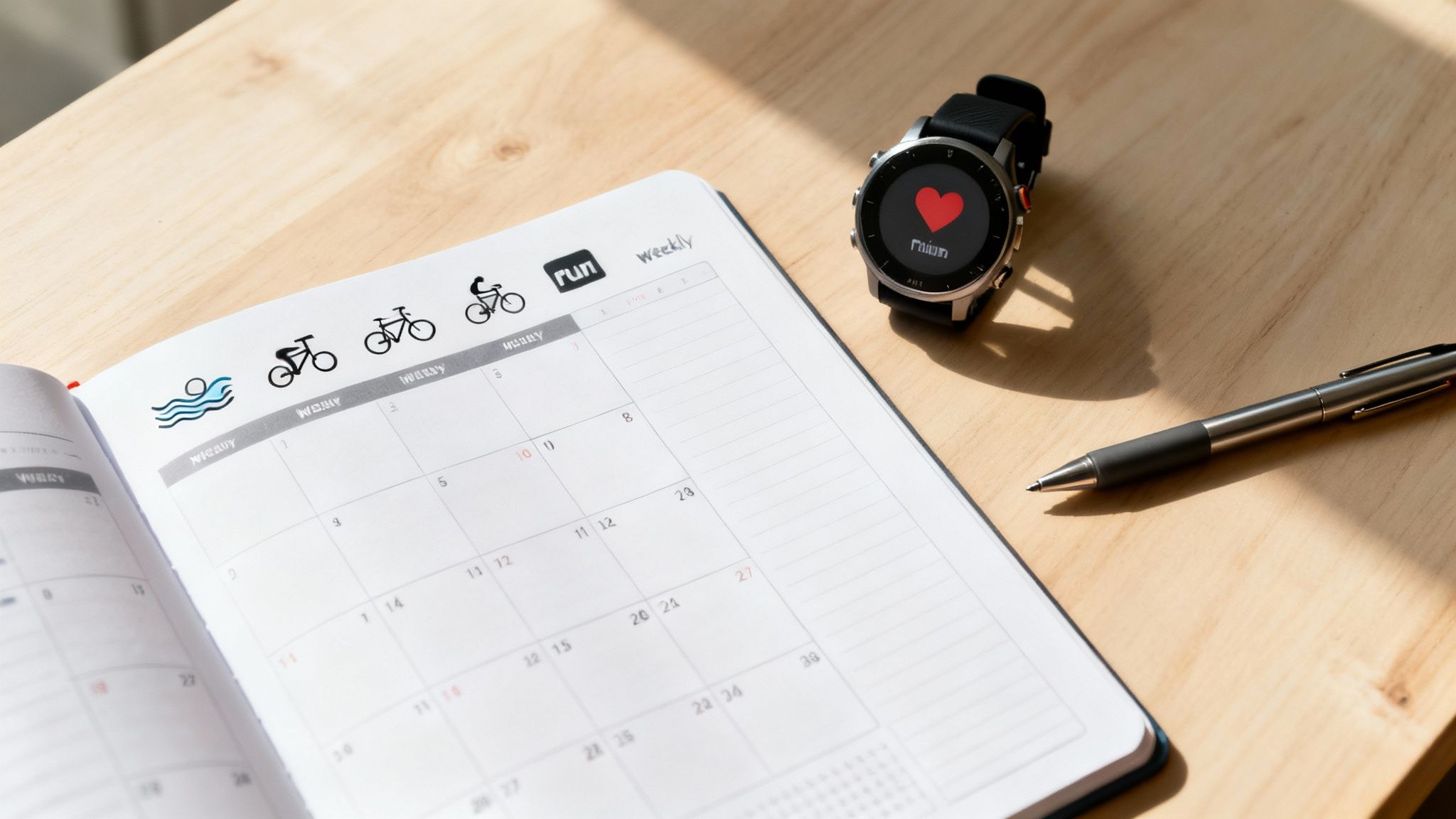
Alright, you understand the big-picture phases of Ironman training. Now it’s time to get down to the nitty-gritty: how do you translate that structure into your actual life?
An effective Ironman plan isn’t about destroying yourself with monster workouts every day. It’s a puzzle. The goal is to carefully piece together workouts, intensity, and recovery in a way that fits your schedule and builds a sustainable rhythm for consistent, long-term fitness.
Your week will hinge on a few key principles: balancing three very different sports, strategically placing your toughest workouts, and—most importantly—prioritizing recovery. A tried-and-true approach is scheduling your longest and most demanding sessions, like the long bike ride and long run, for the weekends when you likely have more time. This frees up your weekdays for shorter, more focused intensity or technique work.
Anatomy of a Training Week
A well-designed week is a microcosm of your entire training plan. It’s a thoughtful blend of different workouts designed to elicit specific adaptations, not just a random collection of swims, bikes, and runs. You'll typically aim for two to three sessions in each sport, plus dedicated time for strength and recovery.
Every workout you do should have a purpose. Here are the main types you'll be scheduling:
- Key Endurance Sessions: These are your bread and butter—the long bike and long run. They are the absolute cornerstone of building your aerobic base and race-day stamina.
- Intensity Sessions: Think shorter, sharper workouts. This is where you build speed and power with things like threshold runs or sweet spot bike intervals.
- Technique Sessions: This is especially true for swimming. These sessions are all about drills to improve your efficiency, which pays huge dividends in saved energy on race day.
- Recovery Sessions: Don't skip these! Easy, low-stress workouts are designed to promote blood flow and help your muscles repair. They are just as critical as your hardest days.
The sheer volume of training can vary wildly. While some top age-groupers might log 700 to 1,000 hours a year, many mid-pack finishers have incredible races training 500 to 700 hours annually. It’s all about quality and consistency. If you want to dive deeper into this, you can learn more about how many hours it takes to conquer Ironman.
The Power of Brick Workouts
One of the most essential—and uniquely triathlon-specific—workouts is the brick session. A brick is simple: a bike ride immediately followed by a run, with almost no time in between. The purpose is to train your body to handle the very real shock of running on "bike legs."
That wobbly, jelly-legged feeling when you first get off the bike isn't in your head. Brick workouts teach your legs how to adapt to the sudden shift in muscle recruitment, making that transition on race day feel far more natural. Start small (a 60-minute bike followed by a 15-minute run) and gradually build from there as you get fitter.
A brick workout isn't just a physical exercise; it's a dress rehearsal for race day. It's where you practice your pacing, test your nutrition, and build the mental confidence that you can run strong after a long ride.
Training Zones: The Language of Intensity
To squeeze the most benefit out of every minute of training, you need to know how hard you should be going. Training zones give you a simple framework for managing your effort, ensuring you push when you need to and, just as importantly, go easy enough on recovery days. These zones are usually based on your heart rate, power (on the bike), or pace.
Here is a classic 5-zone model that works perfectly for endurance training:
| Zone | Intensity Level | Primary Purpose | Feels Like |
|---|---|---|---|
| Zone 1 | Very Light | Active Recovery | A gentle walk; very easy conversation. |
| Zone 2 | Light | Building Aerobic Base | All-day pace; can hold a conversation easily. |
| Zone 3 | Moderate | Improving Stamina | "Comfortably hard"; conversation becomes choppy. |
| Zone 4 | Hard | Increasing Lactate Threshold | Difficult to sustain; can only speak short phrases. |
| Zone 5 | Very Hard | Developing Max Speed | All-out effort; cannot speak. |
Here’s the secret sauce: the vast majority of your training time, around 80%, should be spent in Zones 1 and 2. This is how you build a massive, durable aerobic engine. The other 20% is spent in the higher zones to sharpen your race-specific speed and power.
A Tale of Two Weeks: Base vs. Peak
To see how this all fits together, let’s compare a sample week from the Base Phase with one from the Peak Phase for an intermediate athlete.
Example Base Phase Week (Approx. 10-12 hours)
- Monday: Rest or an easy active recovery swim (Zone 1).
- Tuesday: Bike session focused on smooth pedaling and drills (90 mins, Zone 2).
- Wednesday: Run with a few short, controlled intervals (60 mins, mixing Zones 2 & 4).
- Thursday: Endurance-focused swim (75 mins, Zone 2).
- Friday: Easy spin on the bike to loosen up the legs (60 mins, Zone 1-2).
- Saturday: Long bike ride (3-4 hours, steady in Zone 2).
- Sunday: Long run (90 mins, steady in Zone 2).
Example Peak Phase Week (Approx. 16-18 hours)
- Monday: Rest or an easy active recovery swim (Zone 1).
- Tuesday: Bike with sustained race-pace intervals (2 hours, Zones 3-4).
- Wednesday: Run with longer tempo efforts (75 mins, Zones 3-4).
- Thursday: Open water swim simulation, practicing sighting and pacing (90 mins, race pace).
- Friday: Easy spin followed by a short run off the bike (75 mins, Zone 1-2).
- Saturday: Long bike ride with race simulation efforts built in (5-6 hours, Zones 2-3).
- Sunday: Long run, often structured as a brick after a bike warmup (2.5 hours, Zones 2-3).
See the difference? The Peak Phase isn't just about more time. It's about adding race-specific intensity and more complex workouts, like long bricks, to make sure your body is perfectly primed for the demands of race day.
How to Choose the Right Plan for Your Fitness Level
Jumping into Ironman training without a clear-eyed look at where you're starting from is a recipe for a long, painful day—if you even make it to the starting line. The single most important decision you'll make isn't about gear or race selection; it's picking a training plan that matches your real life and current fitness.
There’s no magic one-size-fits-all plan. What works for a seasoned pro chasing a Kona slot would absolutely crush a first-timer, leading to burnout and injury. On the flip side, a beginner’s plan would leave an experienced triathlete underprepared. Your success hinges on choosing the right path for you.
This requires being brutally honest with yourself. Are you building up from shorter triathlons? A dedicated marathon runner trying something new? Or are you starting with a clean slate? The answer directly shapes the training volume and intensity you can safely handle.
Conducting Your Personal Fitness Audit
Before you even glance at a training calendar, take a minute for a reality check. This isn't about judging your past; it's about setting yourself up for success.
Ask yourself these simple questions:
- What's my endurance background? Have you knocked out a few marathons, century rides, or other triathlons? Any history in one of these disciplines gives you a massive head start.
- How much time can I really commit? Be realistic. A plan that peaks at 18-20 hours a week is a non-starter if you can only find 12 hours between work, family, and life. Honesty here is your best friend.
- What's the goal? Is it just to cross that finish line with a huge smile on your face? Or are you gunning for a specific time or a top spot in your age group? The goal dictates the intensity.
Your answers will point you toward the right starting line. It’s always smarter to begin conservatively and add more if you’re feeling great than to overreach and flame out.
With that in mind, let's look at three proven frameworks for three different types of athletes.
The 30-Week Beginner Plan: Finish with a Smile
This is your roadmap to becoming an Ironman. It's built for the first-timer or any athlete who's new to long-course endurance sports. The philosophy is simple: consistency trumps intensity.
The generous 30-week timeline allows for a slow, steady, and low-risk progression. The main goal here is to build a huge aerobic base, dial in your technique (especially in the water), and get your body used to moving for a very, very long time.
You can expect this plan to feature:
- A Long Base Phase: Most of the plan is dedicated to easy, conversational-pace workouts that build durability without breaking you down.
- Emphasis on Completion: The longest training days are designed to build the mental confidence that you can cover the distance, not to set any speed records.
- Built-in Recovery: You’ll see more rest days and scheduled recovery weeks to let your body adapt and keep injuries at bay.
At its peak, you'll be training around 12-15 hours per week. This plan is all about building the engine and the belief to hear your name called at that finish line.
The 24-Week Intermediate Plan: Chase Your Personal Best
So, you've got a few 70.3 races or marathons under your belt and you're ready to see what you're really made of. This is your plan. Here, the focus shifts from just finishing to finishing strong.
This 24-week framework assumes you already have a solid fitness foundation and are ready for more specific, challenging workouts. While building your aerobic engine is still key, this plan introduces race-pace efforts and higher intensity work much earlier and more often.
You'll start seeing more sessions focused on:
- Tempo and Threshold Work: You'll spend more time pushing at or near your lactate threshold to make your race pace feel easier and more sustainable.
- Smarter Brick Workouts: Your bike-to-run sessions get more complex, often including race-pace intervals right off the bike to simulate race-day fatigue.
- Strategic Volume: Peak training weeks will push into the 15-18 hour range, with a major emphasis on quality over pure junk miles.
This is the perfect plan for the athlete who has already conquered the distance and now wants to optimize their performance. Many athletes who follow this path have already celebrated a major achievement, perhaps even commemorating it with one of our awesome Half Ironman race posters from a previous event.
The 20-Week Advanced Plan: Compete for the Podium
This one isn't for the faint of heart. The intensive 20-week plan is designed for the experienced, competitive age-group athlete who has a deep training history, knows their body inside and out, and is looking to maximize their potential.
The compressed timeline means the ramp-up in volume and intensity is fast and steep. It assumes you're starting with a high level of fitness and are prepared to handle significant training stress. The focus is purely on sharpening the razor's edge.
For the advanced athlete, training is less about building the engine and more about fine-tuning it. It's a game of inches, where small gains in efficiency, pacing, and nutrition can lead to significant time savings on race day.
Workouts are highly specific and demanding, incorporating things like over/under threshold intervals and full-on race simulation days to dial in pacing and nutrition. Peak weekly volume can easily hit 18-22+ hours, requiring a non-negotiable commitment to recovery.
Making the Right Choice
Choosing your plan is the first real step of your Ironman journey. Read through the descriptions again and be honest about which one sounds like you today, not the athlete you hope to be in six months.
Ironman Training Plan Comparison
To make it even clearer, here’s a quick breakdown of the three plans. Use this table to find the best fit for your experience level and goals.
| Athlete Level | Plan Duration | Avg. Weekly Hours (Peak) | Primary Focus |
|---|---|---|---|
| Beginner | 30 Weeks | 12-15 Hours | Building endurance safely and completing the distance. |
| Intermediate | 24 Weeks | 15-18 Hours | Improving race pace and achieving a personal best time. |
| Advanced | 20 Weeks | 18-22+ Hours | Sharpening competitive edge and optimizing performance for placement. |
Ultimately, the best training plan is the one you can stick to. Select the one that feels challenging but doable, and you’ll set yourself up for an incredible journey to that glorious finish line.
Mastering Your Ironman Nutrition and Recovery Strategy
Let’s be honest: the swim, bike, and run workouts are the glamorous part of Ironman training. But they’re only half the story. Those sessions are designed to break your body down. The real magic—the part where you get stronger and faster—happens between those workouts.
Neglecting your nutrition and recovery is the single fastest way to see a perfectly good training plan fall apart. Think of your body as a high-performance engine. You wouldn’t put cheap fuel in a Ferrari, and you wouldn't redline it for months without proper maintenance. Your body deserves that same respect.
Fueling Your Ironman Engine
You simply cannot out-train a bad diet. Endurance training burns a colossal amount of calories, and if you're not replacing them strategically, you’re just digging yourself into a hole. We need to think about two things: what you eat day-to-day and what you consume during your workouts.
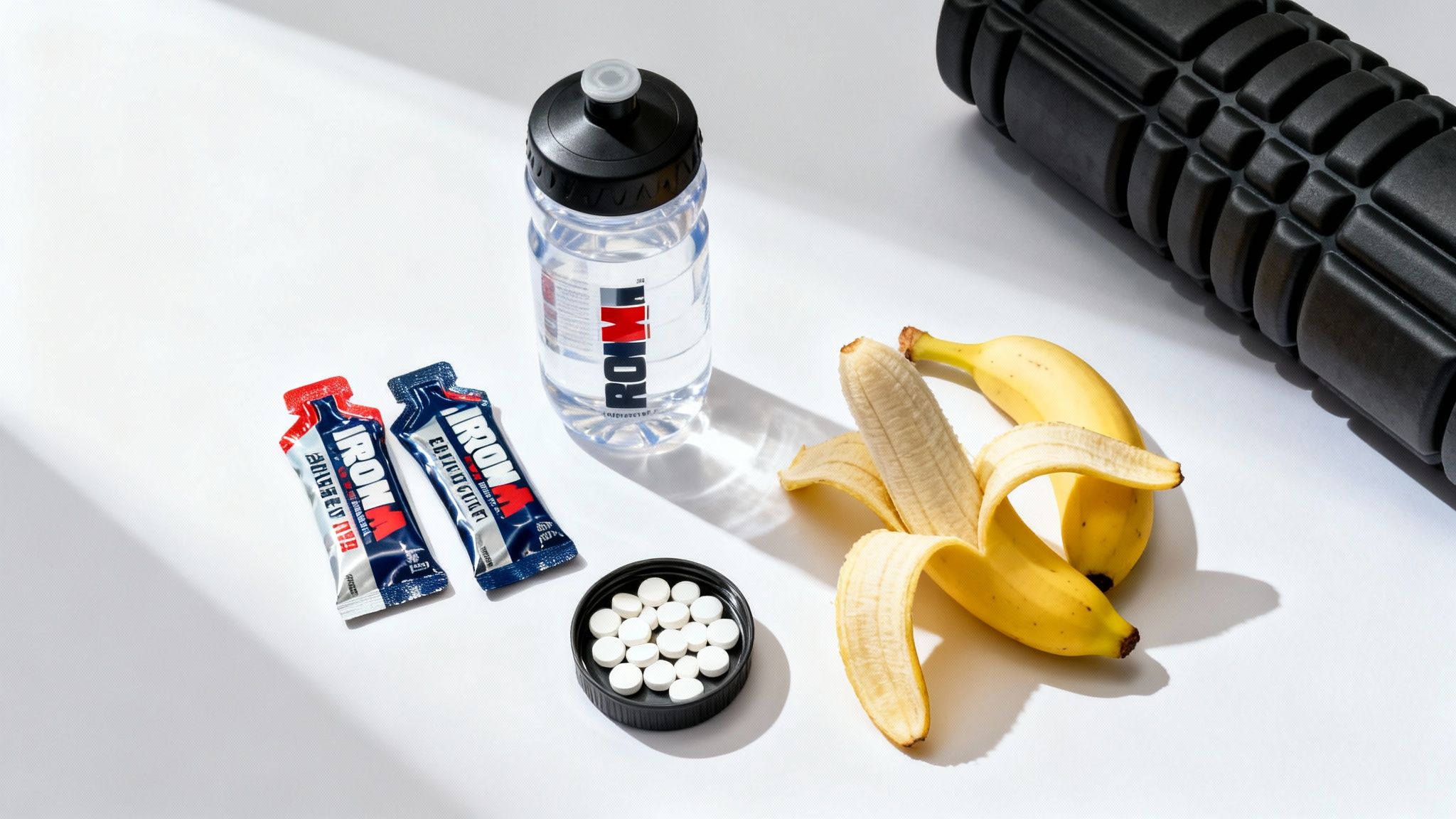
The golden rule here is to practice your race-day nutrition on every single long training day. Your gut needs training just as much as your legs do. For those long bike rides and runs, a solid target is to consume 60-90 grams of carbohydrates per hour. I know, that can sound like a ton, but it's what your body needs to keep the lights on for hours on end.
So, what does that look like in the real world? Here’s how I might fuel a 5-hour ride:
- Hour 1: Bottle of sports drink (25g carbs) + one energy gel (25g carbs). Total: 50g.
- Hour 2: Bottle of sports drink + a small energy bar (40g carbs). Total: 65g.
- Hour 3: Bottle of sports drink + two energy chews (20g carbs each). Total: 65g.
- Hour 4: Bottle of sports drink + another energy gel. Total: 50g.
- Hour 5: Bottle of sports drink + half a banana you stashed in your jersey.
See the mix of liquids, gels, chews, and even real food? Your stomach can get finicky under stress, so experimenting to see what works for you is absolutely critical.
The Art of Intelligent Recovery
Recovery is where your body absorbs all that hard work and adapts. Without it, you’re just piling on fatigue, not building fitness. Good recovery is an active process, not just passive downtime.
Your most powerful recovery tool is completely free: sleep. Aiming for 7-9 hours a night isn’t a luxury—it’s a non-negotiable part of your training schedule. During deep sleep, your body releases the growth hormone it needs to repair all that muscle tissue you broke down.
Recovery isn't a sign of weakness; it's a sign of intelligence. The smartest athletes are the ones who respect rest as much as they respect their hardest workouts. Pushing through fatigue builds injuries, not champions.
Beyond getting enough sleep, a few active recovery techniques can make a world of difference in how you feel the next day. These aren't workouts; they're gentle activities meant to boost blood flow and ease soreness.
- Foam Rolling and Massage: You don't need to spend a fortune. Just 10-15 minutes with a foam roller after a tough session can work wonders on tight quads, hamstrings, and calves.
- Easy Active Recovery: Think of this as "flushing the legs." A super-gentle swim, an easy spin on the bike in Zone 1, or even just a brisk walk helps clear out metabolic waste without adding any real training stress.
- Listen to Your Body: This is the most crucial skill you'll develop. You have to learn the difference between the normal ache of hard training and the warning signs of overtraining—things like a high resting heart rate, persistent soreness, terrible sleep, or just feeling grumpy and unmotivated.
At the end of the day, a successful Ironman plan weaves nutrition and recovery into its very fabric. By fueling your body properly and giving it the time it needs to heal, you’re not just training harder—you’re training a whole lot smarter.
Nailing the Taper and Executing on Race Day
After months of sacrificing and grinding, the finish line is finally coming into focus. This is where all that hard work is supposed to pay off—but only if you play your cards right in these final few weeks.
The taper isn't about hitting the brakes and doing nothing. It’s a very active, calculated process of shedding deep-seated fatigue while holding onto all the incredible fitness you’ve built.
It's a delicate balance that so many athletes get wrong. Some panic and keep training too hard, terrified of losing their edge. Others back off too much and show up on race day feeling flat and sluggish. The real goal is to arrive at that start line feeling powerful, sharp, and absolutely buzzing with energy.
The Two-Week Taper Protocol
Your taper should kick off about two weeks before the race. The guiding principle is pretty straightforward: drastically cut your training volume, but keep small, sharp doses of intensity. This simple trick keeps your muscles and brain firing on all cylinders without piling on any more fatigue.
Here’s a good way to structure it:
- Week 1 of Taper (14 days out): Chop your total training volume by 40-50% from your peak week. So, if your biggest week was 18 hours, you're now aiming for about 9-11 hours. Keep your main intensity sessions in the plan, but make them shorter.
- Week 2 of Taper (7 days out): Cut the volume again, down to about 25-30% of your peak. This week is all about short, snappy workouts and a ton of rest. A 20-minute run with a few fast strides is infinitely more valuable now than a slow, 60-minute slog.
This massive reduction in volume is what finally gives your body the chance to fully repair, refuel, and supercompensate. It feels completely backward, I know, but trust me—this is where you make those final, crucial gains before the big day.
Forging a Bulletproof Race Day Plan
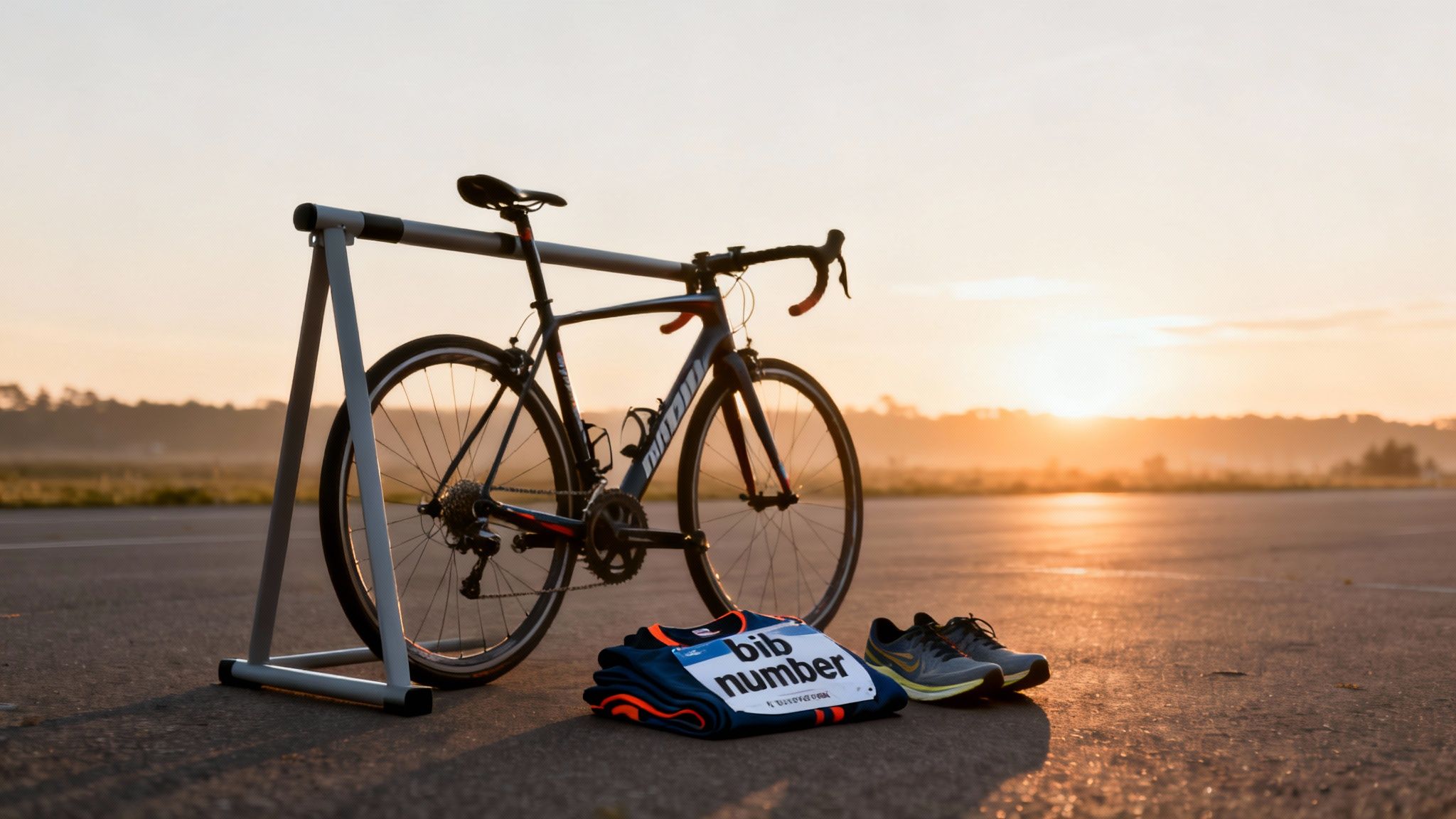
The physical work is pretty much in the bank. Now, it's all about logistics and getting your head in the game. A chaotic race morning can unravel months of perfect training before you even hit the water. Your mission is to eliminate every possible surprise by having a rehearsed plan for everything.
Start with your transition bags. A few days before the race, lay out everything you'll need and pack them with care. Use a checklist so you don’t forget something critical like your race belt, sunglasses, or that specific brand of gel you’ve trained with. The moment you drop those bags off, you should feel a wave of relief, knowing everything is exactly where it needs to be. A cool way to visualize your strategy is by getting a custom map of the course, like this Ironman Florida race poster, to really burn the route into your memory.
The race isn't won in the final, agonizing mile. It's won in the hundreds of small, smart decisions you make all day long. A solid plan frees up the mental space you need to make those calls without panicking.
Your race day blueprint should cover three key areas: pacing, nutrition, and mental strategy. Write it down. Know your target heart rate or power numbers for the bike, know exactly which aid station you'll grab your first bottle from, and have a few go-to mantras for when the going gets tough.
How to Pace the Three Disciplines
Pacing an Ironman is a true art form. The most common rookie mistake—and one that even veterans make—is going out way too hard on the swim or bike. It's a mistake that almost guarantees a long, painful walk during the marathon.
- The Swim: Start easy. Seriously. Let the chaos unfold ahead of you, find some clear water, and settle into a sustainable rhythm you could hold all day. Wasting energy fighting for position in the first 400 meters is completely pointless.
- The Bike: This is where your race is truly made or broken. Ride your own race. Stick to your power or heart rate targets, and ignore the temptation to chase the person who just flew past you. The goal is to hop off that bike in T2 feeling like you could easily ride for another hour.
- The Run: The first 10k of the marathon should feel surprisingly easy. If it doesn’t, you pushed too hard on the bike. Focus on staying cool, nailing your nutrition on schedule, and breaking the marathon down into small, manageable chunks. Walk the aid stations if you have to!
This isn't just for amateurs; the pros live and die by this approach. It’s all about consistency and a smart taper leading to a world-class performance. All that’s left is to execute your plan, trust your training, and get ready for an unforgettable day.
Got Ironman Training Questions? We've Got Answers.
The road to an Ironman is a long one, and you’re bound to hit a few bumps and have questions pop up. It’s totally normal. From what to do when life gets in the way of training to what that weird ache in your knee really means, let's dive into some of the most common questions that come up.
"Help! I Missed a Workout. Now What?"
First off, take a deep breath. One missed workout isn't going to undo months of consistent effort. Life happens. A meeting runs late, you wake up feeling off, or maybe you just don't have it in you mentally. The most important thing is to figure out why you missed it.
If it was just a scheduling issue, let it go and focus on your next session. Whatever you do, do not try to cram two workouts into one day to play catch-up. That's a classic recipe for burnout or, worse, an injury. If you missed the session because you were utterly exhausted, listen to your body. It was probably telling you it needed a rest day anyway. Honor that, recover, and come back stronger for the next workout.
"What Gear Do I Really Need for Long Rides?"
You could easily drop a small fortune on cycling gear, but when it comes to those 5+ hour rides, a few pieces of equipment are absolutely non-negotiable. Forget the fancy aero gadgets for a moment; we're talking about pure comfort and safety.
Here’s your essential long-ride checklist:
- A Quality Bike Saddle: This is probably the most personal—and critical—piece of gear on your bike. The wrong saddle won't just make a ride miserable; it can completely derail your training.
- Padded Bib Shorts: Bad seams and a cheap chamois will lead to chafing and saddle sores you wouldn't wish on your worst enemy. Invest in a great pair. Your body will thank you after hour four.
- Nutrition and Hydration Storage: You’ll need a solid plan for carrying fuel. That means at least two bottle cages and a good way to stash your gels and bars, whether it’s a top tube bag or jersey pockets that are deep enough to hold everything.
The most sophisticated training plan in the world means nothing if you're constantly sidelined. Making smart gear choices isn't just about finding free speed—it's about enabling consistency. When you're comfortable, you can put in the work, day after day.
"Is This Normal Fatigue or an Actual Injury?"
Ah, the million-dollar question every endurance athlete asks themselves. Learning to tell the difference between the standard aches and pains of hard training and the first red flag of a real injury is a skill you have to develop.
Here’s a quick mental checklist I use to figure it out:
| Feeling | Just Fatigue | Potential Injury |
|---|---|---|
| Type of Pain | A dull, general soreness in the muscles. | A sharp, specific, or shooting pain. |
| When It Hurts | Usually fades away after a good warm-up. | Gets worse as you continue the workout. |
| How Long It Lasts | Gone in a day or two after some rest. | Sticks around for several days, even when you rest. |
If you feel a sharp, localized pain that intensifies with activity, stop what you’re doing. That’s your body screaming at you. Normal training fatigue feels more like heavy legs and a general tiredness, not a specific point of pain. When in doubt, always err on the side of caution. Taking an extra rest day is infinitely better than being forced to take a month off.
Celebrate your incredible Ironman journey with a piece of art that tells your story. At RoutePrinter, we turn your hard-earned miles into beautiful, personalized race posters. Commemorate your achievement today at https://www.routeprinter.com.