Your Ultimate 14 Week Marathon Training Schedule for Success

A 14 week marathon training schedule is a fantastic sweet spot for race prep. It gives you enough time to build serious endurance without the burnout that can creep in with longer, 20-week plans. But there's a catch: it's not a "couch to marathon" timeline. To really succeed, you need to show up to week one with a solid running base already in place.
Think of it as laying the groundwork before building the house. The next 14 weeks are about constructing the impressive final structure, but you can't do that on soft soil.
Building Your Foundation for Marathon Success

Jumping into a 14-week plan is a huge commitment, and that first step doesn't happen on day one of the schedule. It happens in the weeks leading up to it. This plan is designed for people who already have a consistent running habit. Your current fitness is the launching pad—the stronger it is, the higher you'll fly.
So, what does that foundation look like? Before you even think about starting, you should be comfortably running three to four times per week. Ideally, you've been doing this for a few months and your weekly total is somewhere in the 15-20 mile range. This isn't just about fitness; it's about preparing your muscles, tendons, and ligaments for the steady increase in mileage and intensity to come.
For a more detailed look at what it takes, our complete guide on how to train for a marathon breaks down the entire process of building that essential base.
What's Your "Why"? Setting a Motivating Goal
Your goal is your North Star. It's what will pull you out of bed for a chilly morning run and keep you going when your legs are screaming on a long run. A goal doesn't have to be a blistering finish time, especially if this is your first marathon.
- First-Timers: Your goal is simple and profound: cross that finish line. Finishing healthy and with a smile on your face is a massive achievement. The real win is conquering the distance.
- Intermediate Runners: Maybe you have a time in mind, like dipping under the four-hour mark. This goal adds a layer of strategy to your training, focusing more on consistent pacing and specific workout efforts.
- Seasoned Vets: You're likely chasing a new personal best (PB). This demands a more aggressive approach, with fine-tuned speed work and a precise race-day strategy.
Understanding the Key Workouts
Every run in a good 14 week marathon training schedule has a purpose. Knowing the "why" behind each workout helps you stay engaged and get the most out of every mile. You'll quickly get familiar with a few core types of runs that form the backbone of your training week.
To make it simple, here’s a quick-reference guide to the key run types you’ll be doing and what they’re meant to accomplish.
Key Training Run Types and Their Purpose
| Run Type | Primary Goal | Typical Effort Level |
|---|---|---|
| Long Run | Build endurance, mental toughness, and teach the body to use fat for fuel. | Easy, conversational pace |
| Easy / Recovery Run | Promote blood flow for recovery, build aerobic base without adding stress. | Very easy, can hold a full chat |
| Tempo Run | Increase lactate threshold so you can run faster for longer. | "Comfortably hard" |
| Intervals | Boost top-end speed and running economy. | Hard to very hard (short bursts) |
Each of these workouts contributes a different piece to the marathon puzzle. The magic happens when you combine them consistently.
Modern training philosophy isn't just about piling on miles. It's about smart, gradual progression. That’s why most effective plans build for three weeks and then incorporate a "cutback" or recovery week. This cycle of stress-and-adapt is what allows your body to get stronger without breaking down. It's about consistency over intensity, every single time.
The Complete 14-Week Marathon Training Schedule

Alright, this is it—your roadmap to conquering 26.2 miles. Below are three different 14-week marathon training schedule options, each built for a different kind of runner.
Remember, consistency trumps perfection every single time. Life happens, and you might need to swap a run here or there. That’s perfectly fine. The real key is to listen to your body, treat your rest days as sacred, and trust the gradual buildup. Each plan is designed to get you to the starting line feeling strong, prepared, and genuinely ready to have a great race day.
Decoding the Training Lingo
Before you dive in, let's quickly break down the key workouts you'll see in the plans. Understanding the why behind each run makes the training so much more effective.
- Rest: Seriously, don't skip these. Your muscles don't get stronger during the run; they rebuild and strengthen on rest days. Think of them as part of your training, not a break from it.
- Cross-Train (XT): This is your secret weapon against burnout and injury. Activities like swimming, cycling, or hitting the elliptical build your engine without the constant pounding of running. Aim for 30-45 minutes of moderate effort.
- Easy Run: The name says it all. You should be able to hold a full conversation without huffing and puffing. If you can't, you're going too fast. This is where you build your aerobic base.
- Tempo Run: I like to call this "comfortably hard." It's a sustained effort that feels challenging but sustainable. A good rule of thumb is a pace you could hold for about an hour if you had to. Tempo runs teach your body to clear lactate more efficiently, letting you run faster for longer.
- Long Run: This is the cornerstone of marathon training. It's not about speed; it's about time on your feet. These runs build muscular endurance, mental grit, and teach your body how to burn fat for fuel. Don't make the classic mistake of racing your long runs!
Now, let's find the plan that fits you best.
Novice Marathon Training Schedule
Is this your first marathon? Is your main goal to cross that finish line with a smile on your face? Then this plan is for you.
We're focusing on building endurance and getting you comfortable with the distance. The schedule gradually increases your mileage to get your body ready for the demands of 26.2 miles without overwhelming it with high-intensity workouts. Forget about your pace for now—just focus on completing each run feeling strong.
My Advice for First-Timers: The real win isn't the time on the clock; it's the accomplishment of finishing. Learn to love the slow, easy long run. It feels counterintuitive, but that's where the magic happens for endurance. It trains your body to become a fat-burning machine, which is exactly what you need on race day.
Weeks 1-4: Building the Base
| Week | Monday | Tuesday | Wednesday | Thursday | Friday | Saturday | Sunday |
|---|---|---|---|---|---|---|---|
| 1 | Rest | 3 miles Easy | XT or Rest | 3 miles Easy | Rest | 6 miles Long Run | Rest |
| 2 | Rest | 3 miles Easy | XT or Rest | 3 miles Easy | Rest | 7 miles Long Run | Rest |
| 3 | Rest | 3 miles Easy | XT or Rest | 4 miles Easy | Rest | 8 miles Long Run | Rest |
| 4 | Rest | 3 miles Easy | XT or Rest | 3 miles Easy | Rest | 6 miles Long Run | Rest |
Weeks 5-8: Increasing Endurance
| Week | Monday | Tuesday | Wednesday | Thursday | Friday | Saturday | Sunday |
|---|---|---|---|---|---|---|---|
| 5 | Rest | 4 miles Easy | XT or Rest | 4 miles Easy | Rest | 10 miles Long Run | Rest |
| 6 | Rest | 4 miles Easy | XT or Rest | 4 miles Easy | Rest | 12 miles Long Run | Rest |
| 7 | Rest | 4 miles Easy | XT or Rest | 5 miles Easy | Rest | 14 miles Long Run | Rest |
| 8 | Rest | 4 miles Easy | XT or Rest | 4 miles Easy | Rest | 10 miles Long Run | Rest |
Weeks 9-14: Peak and Taper
| Week | Monday | Tuesday | Wednesday | Thursday | Friday | Saturday | Sunday |
|---|---|---|---|---|---|---|---|
| 9 | Rest | 5 miles Easy | XT or Rest | 5 miles Easy | Rest | 16 miles Long Run | Rest |
| 10 | Rest | 5 miles Easy | XT or Rest | 5 miles Easy | Rest | 18 miles Long Run | Rest |
| 11 | Rest | 5 miles Easy | XT or Rest | 6 miles Easy | Rest | 20 miles Long Run | Rest |
| 12 | Rest | 5 miles Easy | XT or Rest | 4 miles Easy | Rest | 12 miles Long Run | Rest |
| 13 | Rest | 4 miles Easy | XT or Rest | 3 miles Easy | Rest | 8 miles Long Run | Rest |
| 14 | Rest | 3 miles Easy | 2 miles Easy | Rest | Rest | Rest | MARATHON! |
Intermediate Marathon Training Schedule
If you've got a marathon or two under your belt and you're chasing a specific time goal (like breaking four hours), this is your plan.
We’re dialing things up a notch by introducing structured "quality" workouts, specifically tempo runs. These are designed to raise your lactate threshold, which is a fancy way of saying they help you hold a faster pace before your legs start screaming at you. This plan assumes you're coming in with a solid base of fitness.
How to Nail Your Tempo Runs
A tempo workout isn't just about running hard. It has a specific structure:
- Warm-up: Start with 10-15 minutes of easy jogging to get your muscles ready.
- Tempo Pace: Run the main portion at that "comfortably hard" pace. You should be able to say a few words, but not sing a song.
- Cool-down: Finish with 10-15 minutes of easy jogging to flush out the lactic acid.
So, when the plan says "5 miles w/ 3 @ Tempo," you'll run 1 mile easy, 3 miles at tempo pace, and 1 mile easy to cool down.
Weeks 1-4: Building the Base
| Week | Monday | Tuesday | Wednesday | Thursday | Friday | Saturday | Sunday |
|---|---|---|---|---|---|---|---|
| 1 | Rest | 4 miles Easy | 5 miles w/ 3 @ Tempo | XT or Rest | 3 miles Easy | 8 miles Long Run | Rest |
| 2 | Rest | 4 miles Easy | 5 miles w/ 3 @ Tempo | XT or Rest | 4 miles Easy | 10 miles Long Run | Rest |
| 3 | Rest | 4 miles Easy | 6 miles w/ 4 @ Tempo | XT or Rest | 4 miles Easy | 12 miles Long Run | Rest |
| 4 | Rest | 3 miles Easy | 4 miles w/ 2 @ Tempo | XT or Rest | 3 miles Easy | 8 miles Long Run | Rest |
Weeks 5-8: Increasing Endurance
| Week | Monday | Tuesday | Wednesday | Thursday | Friday | Saturday | Sunday |
|---|---|---|---|---|---|---|---|
| 5 | Rest | 5 miles Easy | 6 miles w/ 4 @ Tempo | XT or Rest | 4 miles Easy | 14 miles Long Run | Rest |
| 6 | Rest | 5 miles Easy | 7 miles w/ 5 @ Tempo | XT or Rest | 4 miles Easy | 16 miles Long Run | Rest |
| 7 | Rest | 5 miles Easy | 7 miles w/ 5 @ Tempo | XT or Rest | 5 miles Easy | 18 miles Long Run | Rest |
| 8 | Rest | 4 miles Easy | 5 miles w/ 3 @ Tempo | XT or Rest | 4 miles Easy | 12 miles Long Run | Rest |
Weeks 9-14: Peak and Taper
| Week | Monday | Tuesday | Wednesday | Thursday | Friday | Saturday | Sunday |
|---|---|---|---|---|---|---|---|
| 9 | Rest | 6 miles Easy | 8 miles w/ 5 @ Tempo | XT or Rest | 5 miles Easy | 20 miles Long Run | Rest |
| 10 | Rest | 6 miles Easy | 8 miles w/ 2x2 miles @ Tempo | XT or Rest | 5 miles Easy | 16 miles Long Run | Rest |
| 11 | Rest | 5 miles Easy | 7 miles w/ 5 @ Tempo | XT or Rest | 5 miles Easy | 20 miles Long Run | Rest |
| 12 | Rest | 5 miles Easy | 6 miles w/ 4 @ Tempo | XT or Rest | 4 miles Easy | 12 miles Long Run | Rest |
| 13 | Rest | 4 miles Easy | 4 miles w/ 2 @ Tempo | Rest | 3 miles Easy | 6 miles Long Run | Rest |
| 14 | Rest | 3 miles Easy | 2 miles Easy | Rest | Rest | Rest | MARATHON! |
Advanced Marathon Training Schedule
This aggressive 14-week marathon training schedule is for the seasoned runner looking to smash a personal best (PB). It’s built on higher mileage, multiple quality workouts per week, and requires a serious commitment.
Only jump into this plan if you have a deep history of running and your body is accustomed to high-volume training. We’re adding a second hard workout—intervals—to really sharpen your speed and efficiency.
Adding Speed with Interval Workouts
Intervals are short, intense efforts that boost your top-end speed and make your goal pace feel easier. For example, a workout like "6 x 800m @ 5K pace" means running 800 meters (two laps on a track) at your current 5K race pace, followed by a slow recovery jog (usually for 400m) before you go again.
- Warm-up: Never skip this. 15+ minutes of easy jogging and some dynamic drills are essential.
- Main Set: Execute the intervals with focus. Keep the "hard" parts hard and the "easy" parts very easy.
- Cool-down: Always finish with 15 minutes of slow jogging to help your body recover.
Weeks 1-4: Building the Base
| Week | Monday | Tuesday | Wednesday | Thursday | Friday | Saturday | Sunday |
|---|---|---|---|---|---|---|---|
| 1 | Rest | 6 miles Easy | 8 miles w/ 5 @ Tempo | 5 miles Easy | Rest | 6 x 800m @ 5K Pace | 12 miles Long Run |
| 2 | Rest | 6 miles Easy | 8 miles w/ 5 @ Tempo | 6 miles Easy | Rest | 8 x 800m @ 5K Pace | 14 miles Long Run |
| 3 | Rest | 7 miles Easy | 9 miles w/ 6 @ Tempo | 6 miles Easy | Rest | 5 x 1000m @ 5K Pace | 16 miles Long Run |
| 4 | Rest | 5 miles Easy | 6 miles w/ 4 @ Tempo | 5 miles Easy | Rest | 4 x 800m @ 5K Pace | 10 miles Long Run |
Weeks 5-8: Increasing Endurance
| Week | Monday | Tuesday | Wednesday | Thursday | Friday | Saturday | Sunday |
|---|---|---|---|---|---|---|---|
| 5 | Rest | 7 miles Easy | 9 miles w/ 2x3 miles @ Tempo | 6 miles Easy | Rest | 6 x 1000m @ 5K Pace | 18 miles Long Run |
| 6 | Rest | 7 miles Easy | 10 miles w/ 7 @ Tempo | 6 miles Easy | Rest | 4 x 1 mile @ 10K Pace | 20 miles Long Run |
| 7 | Rest | 8 miles Easy | 10 miles w/ 2x3 miles @ Tempo | 7 miles Easy | Rest | 5 x 1 mile @ 10K Pace | 16 miles Long Run |
| 8 | Rest | 6 miles Easy | 8 miles w/ 5 @ Tempo | 6 miles Easy | Rest | 6 x 800m @ 5K Pace | 12 miles Long Run |
Weeks 9-14: Peak and Taper
| Week | Monday | Tuesday | Wednesday | Thursday | Friday | Saturday | Sunday |
|---|---|---|---|---|---|---|---|
| 9 | Rest | 8 miles Easy | 10 miles w/ 7 @ Tempo | 7 miles Easy | Rest | 6 x 1 mile @ 10K Pace | 22 miles Long Run |
| 10 | Rest | 8 miles Easy | 9 miles w/ 2x3 miles @ Tempo | 7 miles Easy | Rest | 3 x 1 mile @ 10K Pace | 18 miles Long Run |
| 11 | Rest | 7 miles Easy | 8 miles w/ 5 @ Tempo | 6 miles Easy | Rest | 8 x 800m @ 5K Pace | 20 miles Long Run |
| 12 | Rest | 6 miles Easy | 7 miles w/ 4 @ Tempo | 5 miles Easy | Rest | 4 x 800m @ 5K Pace | 12 miles Long Run |
| 13 | Rest | 5 miles Easy | 5 miles w/ 2 @ Tempo | 4 miles Easy | Rest | Rest | 8 miles Easy |
| 14 | Rest | 4 miles Easy | 3 miles w/ Strides | Rest | 2 miles Easy | Rest | MARATHON! |
How to Make Your Marathon Training Plan Your Own
Think of the training schedules in this guide as a solid framework, not a rigid set of rules you have to follow to the letter. A great 14 week marathon training schedule is one that can adapt to your life. Because let's be real—life happens. A chaotic week at work, a day you feel completely drained, or a run where you feel surprisingly fantastic are all part of the journey.
The real magic happens when you start listening to your body and making smart adjustments. This is how you transform a generic plan into your perfect roadmap to that finish line.
Nailing the Pacing for Your Goal
Pacing is probably the most personal element of any training plan. Words like "tempo" or "easy" are completely relative. What feels "comfortably hard" to someone aiming for a sub-3:30 marathon is going to be a totally different number on the watch than for a runner chasing a 4:30 finish. The goal is to train by effort, not just by pace.
For instance, a tempo run should feel like a pace you could hold for about an hour if you really had to.
- For the 3:30 Marathoner: Their goal race pace is around 8:00/mile. A tempo effort for them will likely land somewhere in the 7:15-7:30 per mile range.
- For the 4:30 Marathoner: Their goal pace is closer to 10:18/mile. Their tempo run will feel just as challenging, but their watch will show a pace around 9:30-9:45 per mile.
See? The feeling is the same, but the numbers are different. If a workout feels way too hard or shockingly easy, don't be afraid to adjust. You’re trying to trigger a specific training adaptation, not just hit a random number.
A Quick Word on "Easy" Runs: If you can't hold a conversation on your easy days, you are going too fast. Period. This is probably the single most common mistake runners make, and it sabotages recovery and holds you back on the workouts that truly matter.
How Many Miles Should You Actually Run?
This is the big question, isn't it? "How many miles per week do I need to run?" The answer is always: it depends. There’s no magic number. In fact, getting obsessed with a weekly mileage total can be a fast track to injury and burnout.
Your goal should be to find the highest mileage you can consistently handle while staying healthy. For one runner, that sweet spot might be 40 miles a week. For another, it could be well over 60.
It’s amazing how different the training logs can look for people who finish with similar times. Data from the Tokyo Marathon showed that runners who finished between 3:15 and 3:30 ran anywhere from 323 to 605 total miles during their training. That’s a huge range! It just goes to show that both lower- and higher-volume plans can get the job done. Consistency and quality almost always win out over raw mileage. For a deeper dive, check out the data-driven insights on marathon training variability from Outside Run.
Before we move on, let's put some numbers to the different paces we've been talking about.
Sample Pace Targets for Different Marathon Goals
This table offers some general guidelines to help you translate effort into actual numbers. Use these as a starting point and adjust based on how you feel.
| Goal Marathon Time | Easy Run Pace (per mile) | Tempo Run Pace (per mile) | Long Run Pace (per mile) |
|---|---|---|---|
| 3:30:00 | 9:00 - 10:00 | 7:15 - 7:30 | 8:30 - 9:30 |
| 4:00:00 | 10:00 - 11:00 | 8:15 - 8:30 | 9:30 - 10:30 |
| 4:30:00 | 11:00 - 12:00 | 9:30 - 9:45 | 10:30 - 11:30 |
| 5:00:00 | 12:00 - 13:00 | 10:30 - 10:50 | 11:30 - 12:30 |
Remember, these are just examples. Your ideal paces will depend on the day, the weather, and how your body is feeling.
Smart Training Adjustments for Masters Runners
With age comes a ton of running wisdom, but it also changes how our bodies recover. Runners over 40, 50, and beyond are absolutely capable of crushing marathons, but it often requires a smarter, more recovery-focused training plan.
If you're a masters runner, here are a few key tweaks to consider:
- Build in More Recovery. As we get older, muscle repair takes a bit more time. Instead of the classic hard/easy day pattern, you might find a hard/easy/easy cycle works much better. Adding that extra recovery day after a tough workout can make all the difference for your next big session.
- Ease into Every Run. Don't be surprised if the first mile or two feels stiff and clunky. It just takes the body longer to warm up. Instead of fighting it, embrace it. Think of that first mile as a built-in warm-up, giving your muscles and joints time to get ready before you ask them to work hard.
- Focus on Quality, Not Just Quantity. You probably don't need to hit the same weekly mileage you did in your 20s. Pour your energy into nailing your key workouts—the long run and your weekly speed session. It’s far better to show up to the start line healthy and maybe 10% undertrained than to be overtrained and nursing an injury.
Fueling Strategies for Endurance and Recovery

You can have the best 14-week marathon training schedule in the world, but it won’t mean a thing if you’re running on an empty tank. Think of food as the other half of your training plan. It's the high-octane fuel that powers every workout, speeds up your recovery, and ultimately gets you across that finish line.
Proper nutrition isn't just a pre-race pasta dinner. It’s a daily commitment that supports every single mile you run, helping you sidestep that dreaded mid-run "bonk" where you hit the wall.
Everyday Eating for Endurance
Your daily diet is the foundation of your performance. When you're deep in marathon training, your body is a furnace, burning through carbs for energy and demanding protein to rebuild tired muscles.
- Carbohydrates Are Your Best Friend: Carbs are your body's preferred fuel source for running. They should make up about 50-65% of your daily calories. Prioritize complex carbs like oatmeal, brown rice, sweet potatoes, and whole-wheat pasta for steady, long-lasting energy.
- Protein Is for Repair: After a tough run, your muscles are broken down and screaming for help. Protein provides the building blocks for that repair process. Make sure you're getting plenty from sources like lean chicken, fish, beans, tofu, and Greek yogurt.
This isn't about getting restrictive; it's about being consistent. By giving your body the high-quality nutrients it needs, you’ll recover faster, feel stronger, and be far less prone to injury. For a deeper dive into building your aerobic base, check out our guide on how to improve running endurance, which connects training with smart fueling.
Mastering Your Long-Run Fueling
Think of your weekly long run as a full dress rehearsal for race day, especially when it comes to what you eat and drink. This is your chance to experiment and figure out what your stomach can handle. What doesn't sit well on a training run will feel ten times worse on race day.
The golden rule is simple: Nothing new on race day. Use your long runs to test everything—from your pre-run breakfast to the exact brand and flavor of energy gel you plan to use. Nailing this down builds massive confidence and helps you avoid any nasty gastrointestinal surprises.
You should start practicing your race-day fueling strategy on any run that lasts longer than 75-90 minutes. Your body only has a limited supply of stored carbs (glycogen), and you need to start replenishing those stores before you run them dry.
When and What to Eat During a Run
A solid starting point is to take in 30-60 grams of carbohydrates per hour after that first hour of running. This can come from a few different places, and the key is finding what you actually enjoy and tolerate.
- Energy Gels: The classic choice for a reason. They're compact, easy to carry, and designed to be absorbed quickly.
- Chews: A great alternative if you prefer something with a more solid, gummy-like texture. They deliver a similar carb punch as gels.
- Sports Drinks: These can be a fantastic all-in-one solution, providing carbs, electrolytes, and hydration simultaneously.
Play around with different brands, flavors, and timing during your long runs. One week, try a gel every 45 minutes. The next, maybe try every 40 minutes. Pay close attention to how you feel. Finding the fueling plan that works for you is a game-changer and a huge step toward a successful marathon.
Staying Injury-Free with Smart Strength Training
The secret to actually enjoying your marathon—and not just surviving it—isn't just about logging miles. It's about building a body that can handle the work. Think of it this way: a 14 week marathon training schedule is designed to systematically push your limits. Without a strong foundation, that stress can easily lead to a breakdown. Smart strength training is your best insurance policy against injury.
And no, you don't need to live in the gym. Just two focused 20-30 minute sessions a week can make a world of difference in your running economy and resilience. Your goal here is to build a strong, stable chassis to support your running engine.
Core and Glutes: The Runner’s Powerhouse
When runners hear "strength training," their minds often jump straight to leg day. But the real source of power and stability comes from your core and glutes. Weakness in this area is a classic recipe for bad running form, especially when fatigue kicks in. That's a fast track to common overuse injuries like IT band syndrome and runner's knee.
We're not talking about complex lifts. Focus on simple, effective movements that build functional strength for running:
- Planks: These are non-negotiable. They build the stability needed to keep your hips from dropping late in a run.
- Glute Bridges: This is how you "wake up" your glutes, making sure they’re firing properly and taking the load off your hamstrings and lower back.
- Bird-Dog: A fantastic exercise for improving balance and coordinating core stability while your limbs are moving—which is exactly what running is.
- Squats and Lunges: The bread and butter for building overall leg strength and improving your hip mobility.
Weaving these into your routine will help you hold your form together when you’re deep into a race and your body is screaming at you to stop. For a more detailed look, our complete guide on how to prevent running injuries dives much deeper into prehab routines.
The Power of Cross-Training
Here's something many runners forget: not all fitness gains have to come from pounding the pavement. Cross-training is an incredible tool for building your aerobic engine without the constant high-impact stress of running. Activities like cycling, swimming, or hitting the elliptical are perfect for this.
These workouts let you boost your cardiovascular fitness while giving your joints and connective tissues a welcome break. This isn't just anecdotal advice, either; the data backs it up.
A fascinating study on marathon training found that runners who strategically cut back on their total running days in the months before a race—replacing them with quality workouts and recovery—actually ran faster. On average, they shaved 3 minutes off their finish times. It's a powerful reminder that more isn't always better; smarter is better. You can explore the full research on marathon training structure here.
Recognizing Early Warning Signs
Finally, the most critical part of staying healthy is learning to listen to your body. Don't be a hero. Pushing through sharp, persistent pain is a terrible idea. You need to learn the difference between the general soreness of hard training and that specific, localized ache that signals something is wrong.
If a little niggle gets worse during a run or is still there the next day, that's a red flag. Taking an extra rest day or swapping a run for a cross-training session is always the smarter choice. It beats being sidelined for weeks, wishing you had listened to that initial warning sign.
Your Race Day Plan and Celebrating Your Achievement
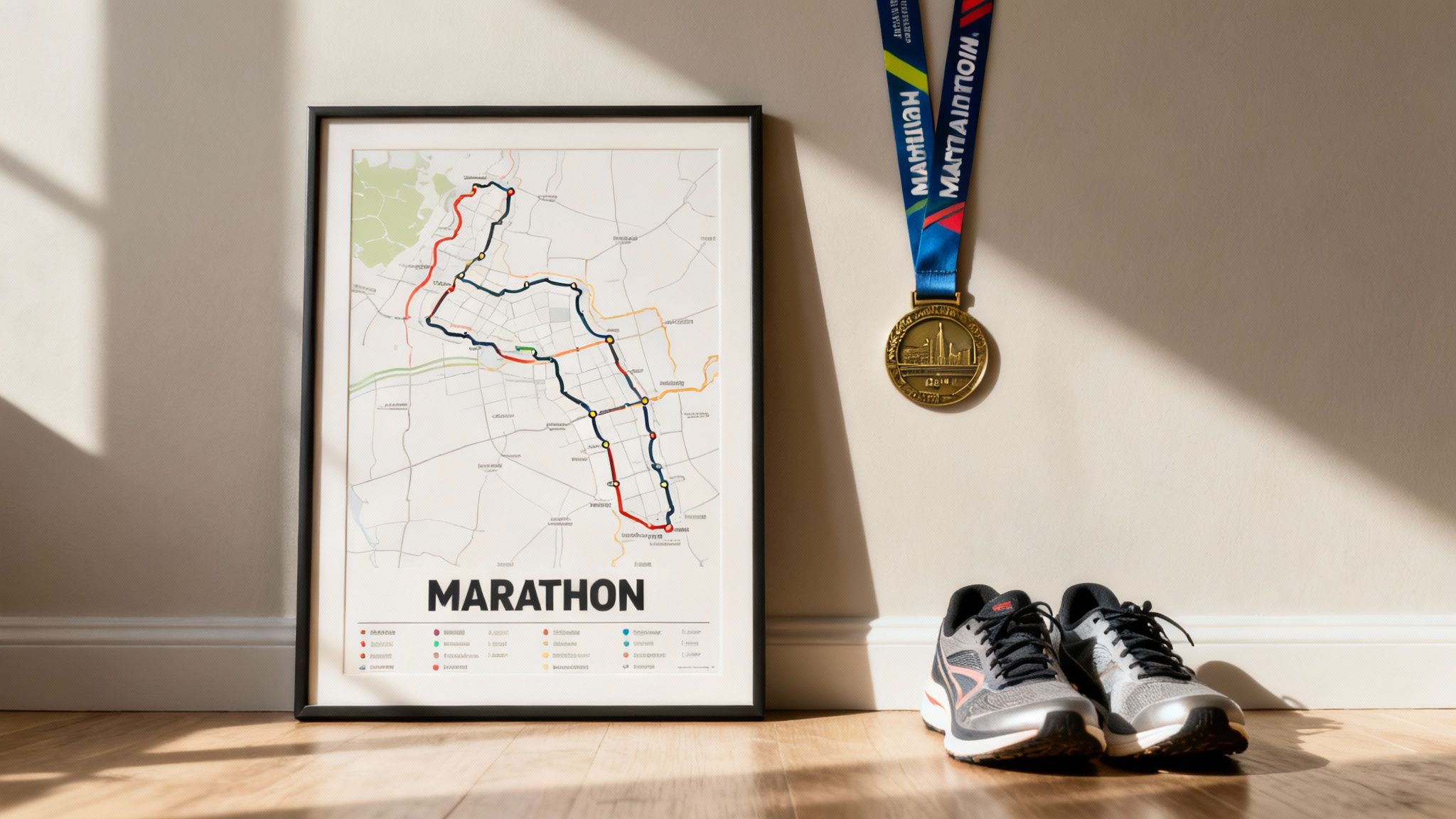
After 14 weeks of pure dedication, the finish line is finally in sight. You put in the miles, trusted the process, and dialed in your nutrition and recovery. Now, it all comes down to race day. The single most important rule to remember? Nothing new on race day.
Seriously. This is not the time to experiment. Stick with the breakfast that fueled your best long runs. Wear the exact shorts, shirt, and socks you've logged dozens of miles in. Execute the fueling strategy you practiced week after week. Trust the work you’ve already done.
This race is so much more than just a few hours on a Sunday morning. It’s the grand finale to a journey that spanned hundreds of miles and countless moments of pushing your limits. An achievement this big deserves to be celebrated and remembered long after the soreness fades.
Your marathon journey is a story of commitment and perseverance. Commemorating it with something tangible turns that fleeting moment into a lasting source of inspiration.
That's where RoutePrinter comes in. We help you turn that incredible race experience into a beautiful piece of art. You can design a personalized poster of your exact marathon route, complete with your name, finish time, and the date you conquered all 26.2 miles.
It’s the perfect way to display your hard-earned accomplishment and keep that powerful memory alive. Don't just finish the race—celebrate it. Create your custom marathon print today.
Got Questions? We've Got Answers
Even with the best 14 week marathon training schedule, you're going to have questions. Let's be honest, training for a marathon is less of a straight line and more of a winding road. Knowing how to navigate the common bumps is what gets you to the starting line healthy and confident.
"Can I Move My Runs Around?"
Life happens, and your training plan needs to bend a little. So yes, you can absolutely switch your running days.
The golden rule here is to never stack your hardest workouts. If you have to move your long run, make sure it’s not on the day right before or after another tough session like your tempo or interval workout. Your body needs that downtime in between to recover and actually get stronger.
"Help! I Missed a Run. What Now?"
First off, don't panic. If you miss an easy, shorter run, the best move is to simply let it go. Seriously. Just move on to the next scheduled workout. Trying to cram it in later or doing two runs in one day is a classic rookie mistake that often leads to injury.
What if you miss one of the big ones, like your long run? If you're feeling good, you can often shift it to another day. But if you're sidelined for a few days because of an illness or a small injury, be smart about your return. Don't just jump back into the plan where you left off. Ease back in gently to see how your body responds.
Crucial Takeaway: Think of rest days as part of your training, not a break from it. They are non-negotiable. This is when the magic happens—your muscles repair, adapt, and build strength. Skipping rest is a fast track to burnout and injury, so embrace it.
Finally, what about running every single day? For marathon training, that's a hard no. Your body needs those dedicated rest days to absorb the workload. Listening to your body and taking your scheduled time off will get you to the race feeling powerful, not worn out.
Your marathon is a story of dedication. Commemorate every mile with a personalized race map from RoutePrinter. It’s the perfect way to turn your incredible achievement into a piece of art that inspires you daily. Design your custom marathon poster today at https://www.routeprinter.com.