Half Marathon Race Day Tips: Nail Your Best 13.1-Mile Performance

You've logged the miles, endured the tough training runs, and now the big day is almost here. But the difference between a good half marathon and a great one often comes down to what happens in the 24 hours leading up to the start and during the 13.1 miles themselves. Success on race day isn't just about fitness; it's about strategy, preparation, and flawless execution when it matters most.
This guide moves beyond generic advice to provide you with a detailed, actionable playbook. We'll cover 8 critical half marathon race day tips that will empower you to perform at your peak. From mastering negative splits and perfecting your nutrition to optimizing your mental game and planning your post-race celebration, each piece of advice is designed to eliminate uncertainty and build unshakeable confidence.
Consider this your ultimate checklist for transforming your hard-earned training into a triumphant race experience. By focusing on these specific strategies, you can avoid common pitfalls and ensure that you cross the finish line feeling strong, accomplished, and ready to celebrate a new personal best. Let's dive into the tactics that will make your race day a resounding success.
1. Start Conservatively and Execute Negative Splits
One of the most powerful half marathon race day tips is to master the art of the negative split. This strategy involves running the second half of the race faster than the first. By starting at a controlled, conservative pace, you conserve precious energy for the challenging later miles, helping you avoid the dreaded "wall" and finish strong.
It's tempting to get swept up in the race-day excitement and start too fast, but this is a classic rookie mistake that often leads to burnout. A negative split strategy is a disciplined approach that prioritizes a strong finish over a fast start. It builds mental confidence as you begin to pass other runners in the final miles, providing a significant psychological boost when you need it most.

How to Implement a Negative Split Strategy
Executing a negative split requires a clear plan, not just a vague intention to "start slow." Here’s how to put it into practice:
-
Break the Race into Segments: Don't think of it as one 13.1-mile effort. Divide the race into three distinct parts with specific pace goals for each. For instance:
- Miles 1-5: Run 10-20 seconds per mile slower than your target goal pace. This is your warm-up and energy conservation phase.
- Miles 6-10: Settle into your goal half marathon pace. You should feel comfortable and in control here.
- Miles 11-13.1: If you feel strong, gradually increase your effort to run slightly faster than your goal pace. This is where you use the energy you saved.
- Study the Course: Analyze the elevation profile beforehand. Plan to ease up on the uphills and use the downhills to your advantage, all while keeping your overall effort consistent with your segment plan.
- Practice in Training: Don't let race day be your first attempt. Incorporate negative split runs into your training, especially during your longer weekend runs, to get a feel for the required pacing and effort. For guidance on setting a realistic pace, you can find more information on beginner half marathon times on Routeprinter.com.
2. Master Your Pre-Race Nutrition and Hydration Strategy
What you consume in the days and hours before the race, and during the event itself, directly fuels your performance. A well-planned nutrition and hydration strategy is one of the most critical half marathon race day tips, ensuring you have the energy to maintain your pace and avoid hitting the dreaded "wall" from glycogen depletion.
The core principle is to top off your energy stores beforehand and maintain them throughout the 13.1 miles. This involves carb-loading in the days prior, eating a familiar pre-race breakfast, and systematically taking in fluids and fuel during the run. Failing to plan this can undo months of hard training, while a successful strategy can be the difference between a new personal best and a painful shuffle to the finish line.
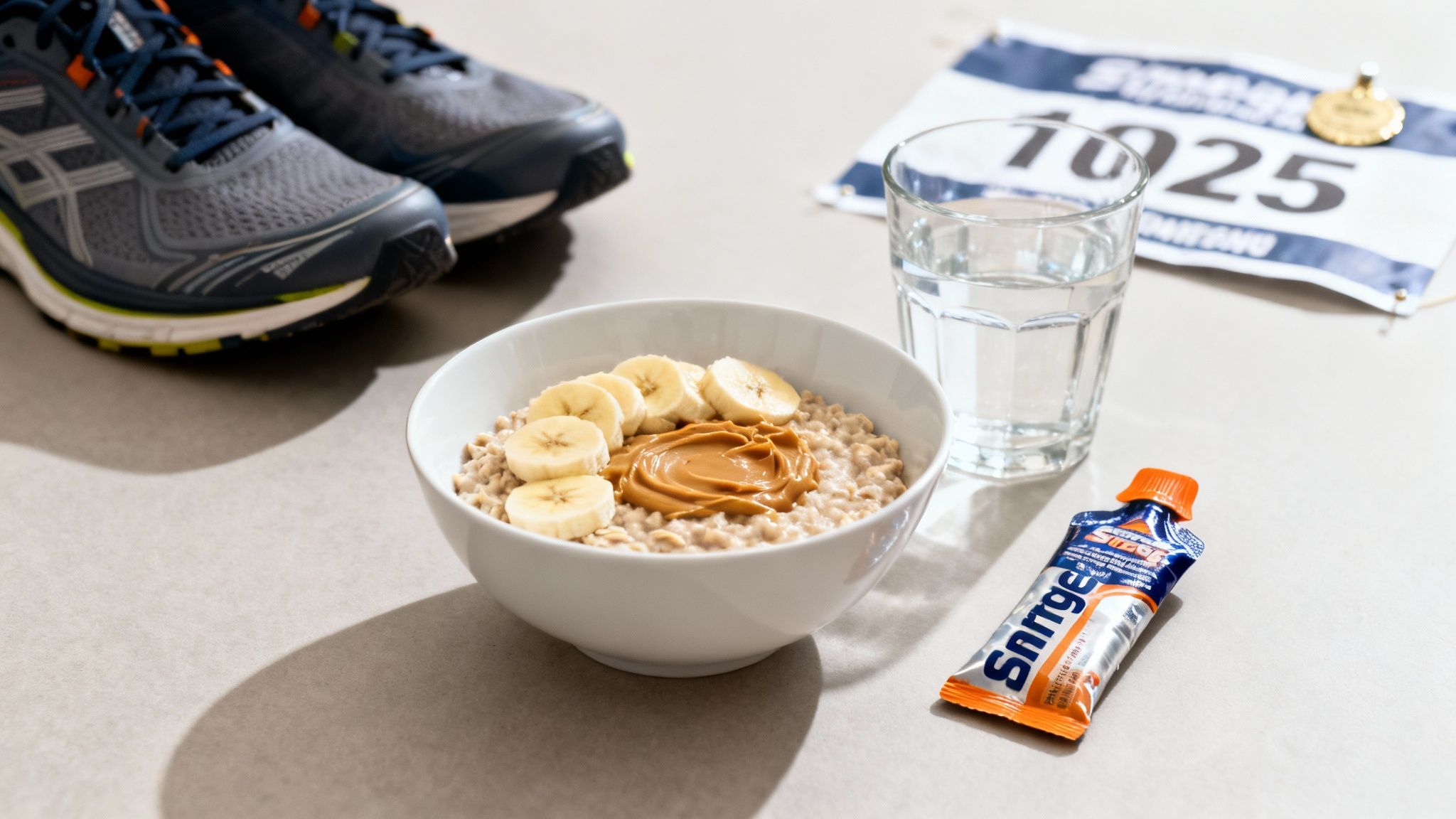
How to Implement a Race-Day Nutrition Plan
A successful fueling plan is one that has been tested and refined during training. Never try anything new on race day. Here’s a framework to build your strategy:
- Practice During Long Runs: Your long training runs are dress rehearsals for race day. Use them to test your exact pre-race breakfast, the timing of your meal, and the specific energy gels, chews, or drinks you plan to use. Aim to consume 30-60 grams of carbohydrates per hour.
- Create a Fueling Schedule: Don't wait until you feel your energy dip. Plan to take your first gel or fuel source around mile 4 or 5 (about 45-60 minutes in) and then another every 4-5 miles after that. Set an alarm on your watch if necessary to stay on track.
- Hydrate Early and Often: Begin hydrating the moment you wake up and sip water consistently. During the race, take fluids at every aid station, even if it's just a small amount. Alternate between water and sports drinks to replenish both fluids and electrolytes. The principles of pre-race fueling are crucial for any distance, and you can discover more about what to eat before a race on Routeprinter.com.
3. Optimize Your Mental Game and Visualization Techniques
Your physical training gets you to the starting line, but your mental game gets you to the finish. One of the most overlooked half marathon race day tips is to dedicate time to mental preparation. Elite athletes like Eliud Kipchoge don’t just train their bodies; they train their minds to stay composed, focused, and confident through every mile. By using techniques like visualization and positive self-talk, you can manage the psychological challenges of the race, push through discomfort, and perform at your peak.
Mental conditioning helps you reframe pain as progress and fatigue as a sign of hard work. It's the inner coach that keeps you going when your legs want to stop. This preparation is especially crucial during the tough middle-to-late miles of a half marathon, where a strong mindset can be the difference between hitting a wall and finding a new gear.

How to Implement Mental and Visualization Strategies
A strong mental game is a skill built through consistent practice, not just wished for on race day. Here’s a framework for building mental resilience:
- Practice Race-Specific Visualization: In the weeks before the race, spend 10-15 minutes, 2-3 times per week, visualizing the event. Close your eyes and mentally rehearse the entire race day experience from start to finish. Picture yourself waking up calm, navigating the starting corral with confidence, running strong through challenging miles, and crossing the finish line with a smile.
-
Break the Race into Mental Segments: Don't think of it as one long 13.1-mile effort. Divide the course into smaller, more manageable "races" with a specific focus for each. For example:
- Miles 1-4: The "Settle In" race. Focus on conservative pacing and finding your rhythm.
- Miles 5-9: The "Stay Strong" race. Concentrate on efficient form and consistent effort.
- Miles 10-13.1: The "Finish Hard" race. Use your saved energy and positive mantras to power through.
- Develop Powerful Mantras: Create 3-5 short, positive phrases to repeat when the race gets tough. Phrases like "strong and steady," "I trained for this," or "push through this moment" can help override negative thoughts. Practice using these mantras during your hard training runs so they become an automatic response to discomfort on race day.
4. Perfect Your Race-Day Clothing and Gear Setup
One of the most foundational half marathon race day tips is to have your entire clothing and gear ensemble dialed in well before you toe the start line. What you wear significantly impacts comfort, performance, and confidence over 13.1 miles. The golden rule is simple yet non-negotiable: nothing new on race day. Testing every single item during your training runs ensures there are no surprise blisters, chafing, or wardrobe malfunctions when it counts.
This principle extends from your high-tech running shoes to the humble pair of socks on your feet. Your race day outfit is your uniform for battle, and it should feel like a second skin. Properly chosen gear made from moisture-wicking fabrics helps regulate your body temperature, prevents painful skin irritation, and allows you to focus solely on your running performance instead of distracting discomfort.
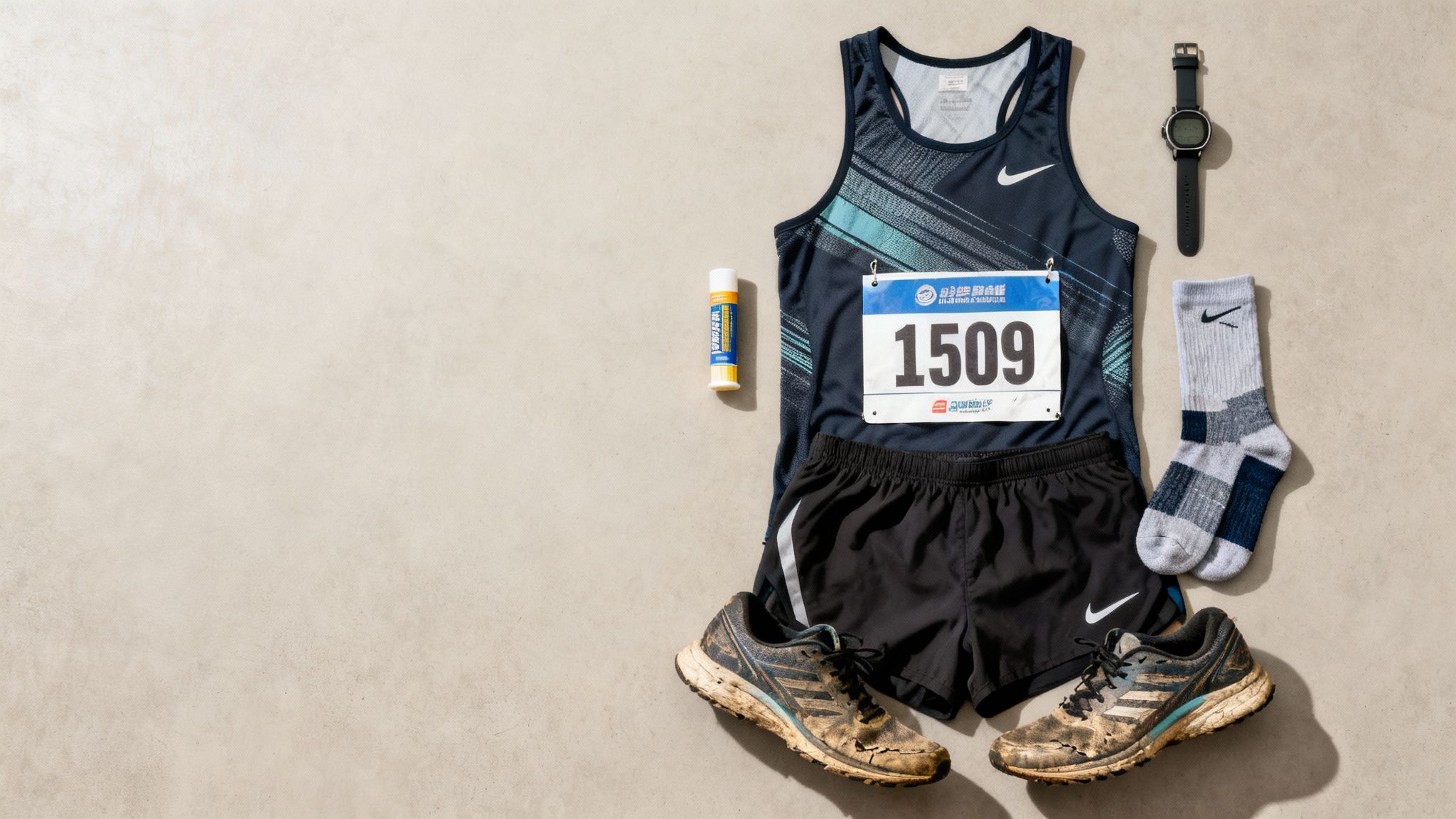
How to Implement a Flawless Gear Strategy
A perfect gear setup is achieved through deliberate testing and planning, not last-minute decisions. Here’s a checklist to ensure your apparel and equipment are race-ready:
- Conduct Full Dress Rehearsals: Use at least two of your longest training runs as complete dress rehearsals. Wear the exact singlet, shorts, socks, shoes, and hat you plan to use on race day. This is the best way to identify potential chafing spots or discomfort at race pace and distance.
- Prioritize Technical Fabrics: Choose materials like polyester or merino wool blends that pull sweat away from your skin. Avoid cotton at all costs, as it absorbs moisture, becomes heavy, and can lead to chafing and a drop in body temperature in cooler weather.
- Plan for the Weather (and Its Opposite): Check the forecast obsessively, but prepare for conditions to be 10-15 degrees different than predicted. A lightweight, disposable layer like a trash bag or an old sweatshirt can be a lifesaver while waiting in a chilly starting corral. You can discard it after you warm up.
- Lay Everything Out the Night Before: Arrange your entire kit, including your race bib (pre-pinned to your shirt), timing chip, anti-chafe balm, and nutrition. This pre-race ritual minimizes morning stress and ensures you don’t forget anything critical.
5. Develop a Comprehensive Warm-Up Routine
One of the most overlooked yet critical half marathon race day tips is implementing a structured warm-up. A proper pre-race routine elevates your heart rate, increases blood flow to your muscles, and primes your nervous system for the effort ahead. Instead of starting cold and using the first mile to get comfortable, a dedicated warm-up reduces injury risk and ensures you're ready to perform efficiently from the moment you cross the start line.
Many runners mistakenly believe standing in the corral is enough of a warm-up, but this is a costly error that can lead to a sluggish start or early muscle strain. A dynamic warm-up protocol signals to your body that it's time to race, allowing you to settle into your goal pace much more smoothly. This deliberate preparation is a hallmark of experienced runners who understand that the race truly begins before the starting gun fires.
How to Implement a Pre-Race Warm-Up
A successful warm-up is a planned sequence, not a random series of stretches. It should be practiced during training so it becomes second nature on race day. Here’s a practical approach:
- Timing is Everything: Arrive at the race venue at least 90 minutes early. Aim to complete your warm-up about 5-10 minutes before your corral is set to start. This keeps your muscles warm and your body ready to go without cooling down for too long.
-
The Three-Part Sequence: A balanced routine includes three key phases performed over 15-20 minutes.
- Easy Jog (10-15 minutes): Start with very light jogging to gradually increase your heart rate and warm your core temperature.
- Dynamic Stretches (5 minutes): Focus on movements that take your joints through a full range of motion. Include exercises like leg swings, walking lunges, high knees, and butt kicks. Avoid static stretching, as it can decrease power output before a run.
- Race-Pace Strides (2-3 minutes): Finish with 4-6 short bursts of running (about 50-100 meters) at your goal half marathon pace. These "strides" activate the specific muscle fibers you'll use during the race, making your goal pace feel familiar from the first step.
- Practice Your Protocol: Rehearse your entire warm-up routine before a few key long runs or tune-up races. This helps you perfect the timing and movements, removing any guesswork and reducing stress on race morning.
6. Execute Strategic Aid Station Management
One of the most overlooked half marathon race day tips is developing a clear plan for aid stations. These crucial stops are more than just water tables; they are strategic opportunities to refuel, hydrate, and mentally reset without losing valuable time or momentum. Efficiently navigating these stations can make the difference between hitting a wall and finishing strong.
A well-executed aid station strategy ensures you get exactly what you need while avoiding chaotic bottlenecks. It turns a potential disruption into a seamless part of your race plan. By preparing in advance, you can maintain your rhythm, stay properly fueled, and keep your focus on the finish line, preventing common race-day fueling errors that derail many runners.
How to Implement Strategic Aid Station Management
A successful approach to aid stations is proactive, not reactive. You need a plan before you even get to the starting line. Here’s how to build one:
- Study the Course Map: Weeks before the race, download the official map and identify the exact location of every aid station. Note the distance between them to plan your fueling and hydration intervals.
- Know What's on the Menu: Contact race organizers or check the event website to confirm precisely what fluids (water, specific sports drinks) and fuel (gels, chews, fruit) will be available. This helps you train with the same products to avoid any race-day surprises.
- Practice in Training: Simulate race conditions on your long runs. Practice grabbing a cup, drinking while moving, and consuming a gel without breaking your stride. This makes the actions feel second nature when you're fatigued during the race.
- Plan Your Approach: As you near a station, move to the side to avoid the main cluster of runners. Aim for the last few tables, which are often less crowded. Make eye contact with a volunteer and clearly signal what you need to ensure a quick and smooth exchange.
- Walk, Don't Stop: If you need to slow down to drink, walk briskly for a few seconds rather than coming to a complete stop. This helps maintain your heart rate and makes it easier to resume your running pace without a jarring transition.
7. Plan Your Post-Race Recovery and Celebration Strategy
Crossing the finish line is an incredible achievement, but your race day strategy doesn't end there. One of the most overlooked half marathon race day tips is having a clear plan for what you'll do immediately after. An effective post-race routine accelerates muscle recovery, minimizes soreness, and ensures you can properly celebrate your accomplishment.
What you do in the first few hours after finishing can significantly impact how you feel for the next few days. By planning your recovery and celebration, you shift from a reactive state of exhaustion to a proactive approach that honors the hard work you put in and sets you up for a faster return to training. It's about maximizing both physical recovery and the well-deserved emotional high.
How to Implement a Post-Race Strategy
A great post-race plan has two key components: immediate recovery actions and a well-earned celebration. Here’s how to structure yours:
-
Prioritize Immediate Refueling: Your body is primed to absorb nutrients right after a hard effort. Aim to consume a snack with a 3:1 or 4:1 ratio of carbohydrates to protein within 30-60 minutes of finishing.
- Examples: A banana with peanut butter, a bagel with turkey, or chocolate milk are all excellent choices.
- Hydration: Sip on an electrolyte-rich drink to replenish what you lost through sweat. Continue hydrating throughout the day.
- Keep Moving Gently: Resist the urge to sit or lie down immediately. Walk slowly for 10-15 minutes to help your heart rate come down gradually and prevent blood from pooling in your legs. This "cool-down" walk is crucial for kick-starting the recovery process.
- Capture and Share the Moment: The finish line is electric. Take photos with your medal, find your supporters, and soak in the atmosphere. Sharing your achievement on platforms like Strava while the emotions are high connects you with your community and solidifies the memory of your success.
- Plan Your Celebration Meal: Arrange to have a satisfying, protein-rich meal within a few hours of the race. This is the time to indulge in your favorite foods while giving your muscles the building blocks they need to repair.
8. Scout the Course and Understand the Terrain
One of the most impactful half marathon race day tips is to eliminate surprises by thoroughly scouting the course beforehand. Familiarizing yourself with the terrain provides a massive psychological and tactical advantage, transforming the unknown into a predictable challenge. Knowing exactly where the hills are, where the aid stations will be, and what landmarks to expect allows you to race with confidence and execute a much smarter strategy.
This preparation turns a reactive race into a proactive one. Instead of being caught off guard by a steep incline at mile 10, you'll have a plan to conserve energy leading up to it and power over it efficiently. Course knowledge empowers you to make strategic decisions on the fly, manage your effort more effectively, and maintain mental composure when the race gets tough.
How to Effectively Scout the Course
Proper course reconnaissance goes beyond a quick glance at the map. It’s about building a mental blueprint of your 13.1-mile journey. Here's how to do it right:
- Study the Official Maps: Download the official course map and, most importantly, the elevation profile from the race website. Identify the location, length, and steepness of all major hills. Knowing the total elevation gain helps you set realistic pace expectations.
- Go Virtual with Google Street View: If you can't physically visit the course, use Google Street View to "run" it virtually. This gives you a visual feel for the surroundings, road conditions, and the severity of inclines that an elevation chart might not fully convey.
- Run Key Sections in Training: If possible, incorporate the most challenging parts of the course, like significant hills or the final few miles, into your long runs. This builds physical and mental preparedness for what's to come.
- Plan for Aid Stations: Note the exact location of all aid and water stations. Plan your nutrition and hydration strategy around them. For instance, knowing a station is right before a big hill allows you to hydrate preemptively. For a deeper understanding of the full challenge, you can learn more about what a half marathon distance entails on Routeprinter.com.
Half Marathon Race-Day: 8-Point Strategy Comparison
| Strategy | Implementation complexity | Resource requirements | Expected outcomes | Ideal use cases | Key advantages |
|---|---|---|---|---|---|
| Start Conservatively and Execute Negative Splits | Moderate — requires pacing discipline and race-day restraint | Low — GPS watch or mile markers, practiced pacing in training | Faster overall finish, reduced late-race fatigue, stronger finish | Runners targeting time improvements or races with variable terrain | Conserves energy, lowers bonk risk, builds late-race momentum |
| Master Your Pre-Race Nutrition and Hydration Strategy | High — individualized planning and testing required | Moderate — specific foods, gels, electrolyte drinks, practice runs | Steadier energy, fewer cramps, improved endurance and mental clarity | Runners prone to energy crashes or with past fueling issues | Prevents energy depletion, supports performance, science-backed |
| Optimize Your Mental Game and Visualization Techniques | Moderate — regular practice and mental rehearsal needed | Low — time for visualization, possible coaching or guided sessions | Reduced anxiety, improved resilience, better pain management | Nervous racers, those needing consistent pacing under stress | Cost-free, transferable skills, enhances focus and confidence |
| Perfect Your Race-Day Clothing and Gear Setup | Moderate — trial-and-error to find ideal kit | Moderate-to-high — technical apparel, broken-in shoes, anti-chafe products | Fewer blisters/chafing, better thermal comfort, stable performance | Runners sensitive to comfort issues or racing in mixed weather | Prevents gear-related problems, improves comfort and confidence |
| Develop a Comprehensive Warm-Up Routine | Low-to-moderate — structured 15–30 minute routine | Low — space and time before start, simple dynamic drills | Faster first miles, reduced injury risk, primed power output | Competitive starters and races that begin at high intensity | Warms muscles, readies nervous system, improves opening pace |
| Execute Strategic Aid Station Management | Moderate — planning station timing and efficient technique | Low-to-moderate — course map, backup fuel, practiced intakes | Consistent fueling/hydration, fewer time losses and digestive surprises | Races with multiple aid stations or uncertain supplies | Maintains energy, minimizes stalls at stations, adaptable |
| Plan Your Post-Race Recovery and Celebration Strategy | Low — simple steps to prepare and follow after finish | Low-to-moderate — recovery snacks, electrolytes, optional compression/ice | Faster recovery, reduced DOMS, improved psychological closure | Frequent racers and those planning quick return to training | Accelerates glycogen and repair, preserves long-term training |
| Scout the Course and Understand the Terrain | Moderate-to-high — time to study maps or run course sections | Low-to-moderate — course maps, elevation profiles, possible travel | Better pacing decisions, fewer surprises, tailored fueling | Hilly, technical, or unfamiliar courses and championship events | Enables terrain-aware strategy, builds confidence, prevents surprises |
Crossing the Finish Line and Beyond
The journey to the half marathon start line is a testament to your dedication, but successfully navigating the 13.1 miles to the finish is where your preparation truly shines. The difference between a good race and a great race often comes down to execution on the day. By internalizing and applying the detailed half marathon race day tips we've covered, you've moved beyond generic advice and armed yourself with a strategic framework for success.
You now have a blueprint to transform months of hard work into a peak performance. This isn't just about running; it's about running smart. It's about turning chaos into control, anxiety into focused energy, and potential into a personal best.
From Preparation to Peak Performance: Key Takeaways
Let's distill the core principles that will carry you across that finish line feeling strong and accomplished. Remember these crucial pillars of your race day strategy:
- Trust Your Plan: Your race day is not the time for experimentation. From your conservative start and negative split strategy to your practiced nutrition at aid stations, your success hinges on executing the plan you've meticulously developed and tested during training.
- Control the Controllables: You can't control the weather or the crowds, but you can control your gear, your warm-up, your pacing, and your mindset. Focusing on what is within your power, like perfecting your clothing choices and mastering your mental game, is the foundation of a confident race.
- Run with Your Head, Then Your Heart: The early miles are about discipline and patience, holding back even when you feel fantastic. The later miles are where you draw on your mental fortitude and the "why" behind your run. A smart race is a blend of strategic thinking and resilient spirit.
Turning Your Achievement into Lasting Inspiration
Crossing that finish line is a powerful, fleeting moment. The flood of relief, pride, and exhaustion is an experience you'll want to remember forever. Each of the tips provided, from scouting the course to planning your post-race celebration, is designed to make that moment as meaningful as possible. You didn't just run 13.1 miles; you conquered a specific route, with its unique challenges and triumphs, on a specific day. That is an accomplishment worth celebrating and remembering.
Your race map tells a story of perseverance. It's a visual record of every hill you climbed, every corner you turned, and every mile marker you passed. Honoring this journey provides a powerful source of motivation for your next athletic endeavor, reminding you of what you are capable of achieving. As you recover and reflect, think about how you can commemorate this significant milestone.
Ready to celebrate your incredible achievement? Turn your triumphant race route into a beautiful, minimalist art print with RoutePrinter. It's the perfect way to commemorate your hard work and keep the inspiration from your half marathon journey on display for years to come. Design your custom race map poster today at RoutePrinter and give your finish line moment a permanent place in your home.