Beginner Half Marathon Times - A Realistic Guide for Your First Race

Alright, let's get right to it. You're gearing up for your first half marathon, and the big question on your mind is, "What's a realistic finish time?"
For most runners tackling the 13.1-mile distance for the first time, a fantastic goal to aim for is somewhere between 2 hours 25 minutes and 2 hours 45 minutes. This isn't some arbitrary number—it’s a solid benchmark that proves you put in the hard work and had the grit to conquer the course.
What Is a Realistic Half Marathon Time for a Beginner?
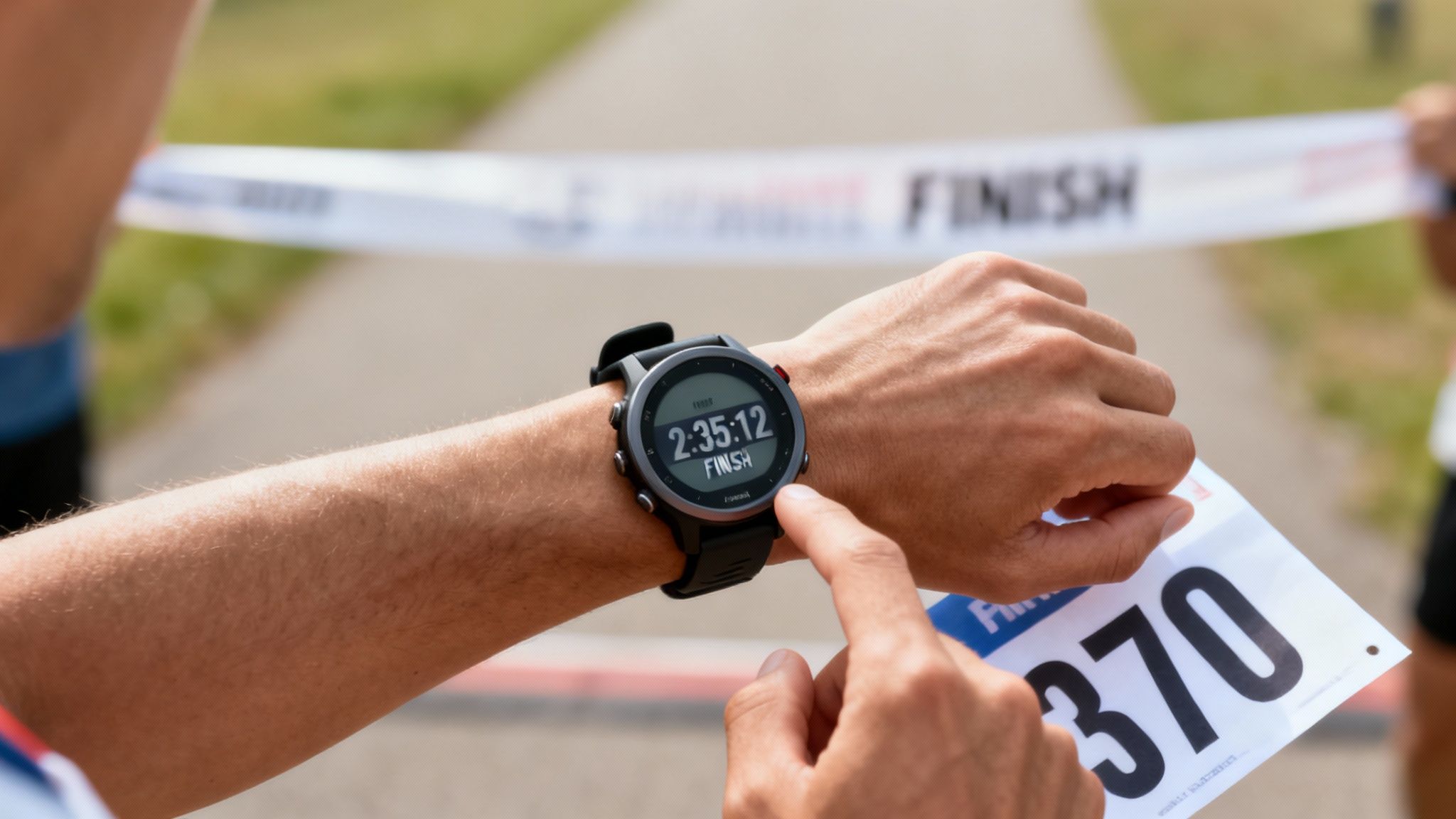
Think of that 2:25 to 2:45 window as your home base for setting a personal goal. Let’s be clear: the real victory is crossing that finish line, period. But having a general time in mind helps you train with purpose and set a target that is both challenging and—more importantly—achievable.
This guide will give you an honest, no-fluff look at what to expect on race day. We'll break down what a "good" time really means for a beginner, because your final time is about so much more than just speed. It’s a reflection of your training, your current fitness, and how well you manage your energy on the day.
Setting Your Expectations with Data
To ground this in reality, let's look at the numbers. According to a Vitesse Running analysis of half marathon times, beginner runners between the ages of 20 and 50 typically finish their first race between 2 hours 25 minutes and 2 hours 43 minutes. That range is a perfect snapshot of a comfortable, sustainable pace for someone new to this distance.
Knowing these benchmarks helps take the pressure off. It’s a reminder that you don’t need to be a world-class athlete to have an incredible and successful race day.
The goal for your first half marathon isn’t to break records—it’s to finish feeling strong and proud of your accomplishment. Your time is just one part of that story.
A Quick Guide for Different Age Groups
While the general range is a great starting point, it's helpful to see how finish times can vary by age. A runner in their 20s might have a different physiological starting point than someone in their 50s, but smart, consistent training is the great equalizer.
This table offers a simple summary of what you might expect based on your age bracket.
Quick Guide to Beginner Half Marathon Times by Age
| Age Group | Average Beginner Finish Time | Approximate Pace Per Mile |
|---|---|---|
| 20-39 | 2:20 - 2:40 | 10:41 - 12:13 min/mile |
| 40-49 | 2:30 - 2:50 | 11:27 - 12:58 min/mile |
| 50+ | 2:40 - 3:00+ | 12:13 - 13:44+ min/mile |
Remember, these are just averages to help you frame your goals. Your unique fitness background, how consistently you train, and the race day conditions will all play a huge role in your final time. We’ll dive deeper into all those factors throughout this guide.
Where Do You Fit In? A Realistic Look at Half Marathon Times
Before you can set a goal that feels right for you, it helps to get a lay of the land. When you first start Googling "average half marathon time," the numbers you see might seem a little intimidating. That's because those big, overall averages lump everyone together—the person running their very first race, the dedicated hobbyist, and the elite athlete who does this for a living.
It's a bit like comparing a teenager's first time driving the family car to a Formula 1 driver's qualifying lap. Both are huge accomplishments, but they're playing entirely different games. Seeing the overall average isn't meant to discourage you; it just shows you what's possible after years of hard work and consistent training.
Why Experience Changes the Numbers
So, why is there such a big gap between a typical beginner's time (somewhere in the ballpark of 2:30-2:45) and the overall average? It all comes down to experience. The more races people run, the faster they tend to get.
An intermediate runner, for example, is often focused on breaking the two-hour barrier. A more advanced amateur might be chasing a time closer to 1:40. In big race datasets, these faster finish times are far more common than first-timer results, which pulls the overall average way down.
That’s exactly why you shouldn't measure your starting line against someone else’s finish line. Your first race is about one thing: celebrating the incredible accomplishment of running 13.1 miles.
Your first half marathon is a victory lap for all the hard work you've put in. The clock is just a small part of the story; finishing strong and feeling proud is the real prize.
The Official "Average" Times
Just for context, what are those overall averages we've been talking about? A huge analysis of over 124,000 race results found that the average half marathon finish time, across all runners, is about 1:50:15. That's a speedy 8:25 per mile pace. If you're a data nerd, you can dig into more detailed breakdowns of these half marathon statistics to see how things change.
When you split it by gender, the picture becomes even clearer:
- Average Male Finish Time: 1:43:33
- Average Female Finish Time: 2:00:12
Think of these numbers as long-term inspiration, not a day-one expectation. For now, the only numbers that matter are the ones that reflect where you are today. By focusing on a realistic beginner half marathon time, you’re setting yourself up for an amazing, positive, and successful race day.
Remember, every single person posting those fast times had a first race. Today, your journey is the only one that counts.
How Age and Gender Influence Your Finish Time
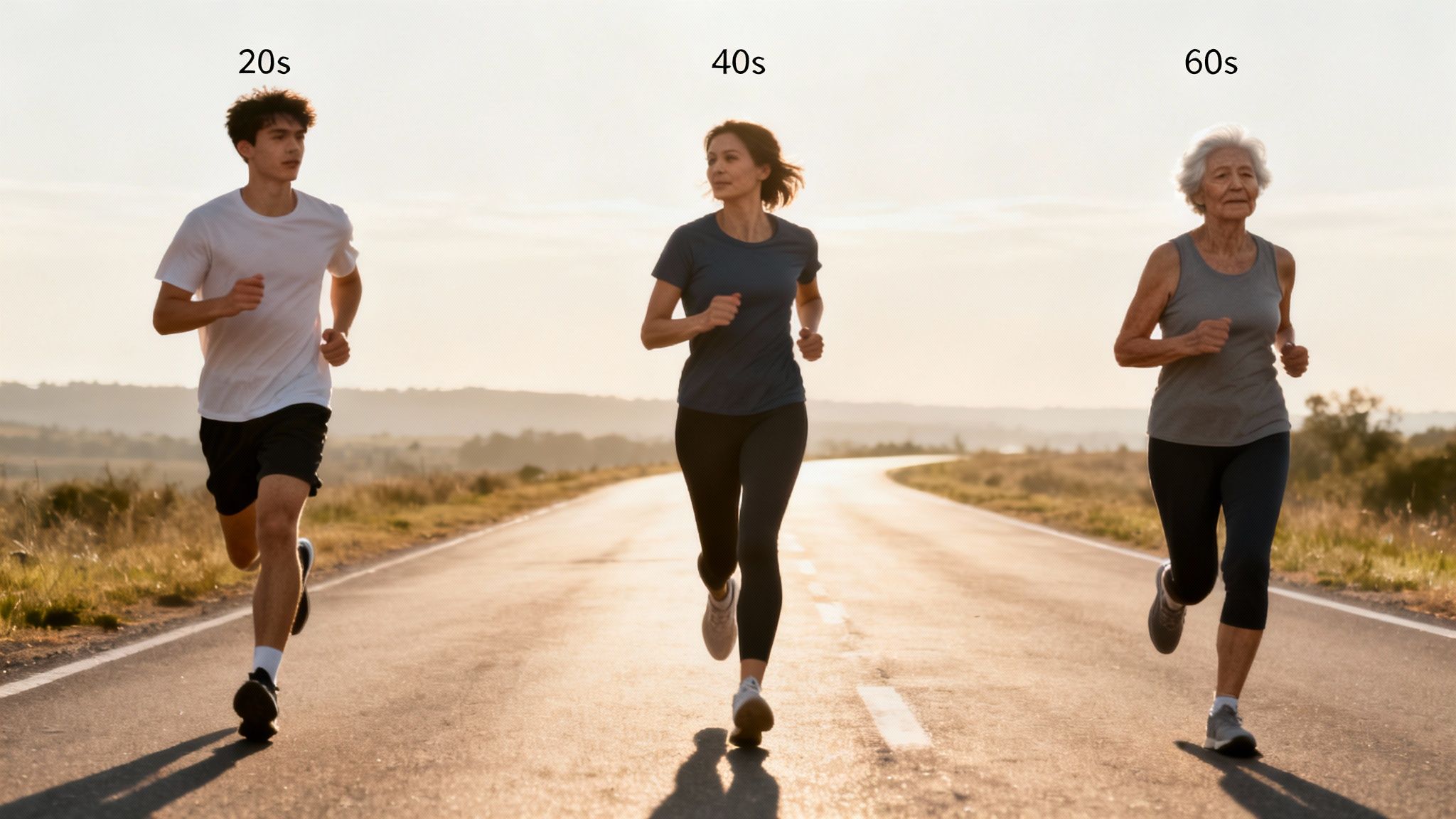
While your training plan is the blueprint for success, your own physiology—specifically your age and gender—plays a huge role in how you'll perform on race day. Knowing this isn't about setting limits. It’s about setting smarter, more personal goals that work with your body, not against it.
Comparing yourself to a runner in a completely different demographic doesn't make much sense. A man in his 20s has a different physiological starting line than a woman in her 50s, and that’s perfectly normal. The real goal is to understand where you're starting from so you can truly appreciate every bit of progress you make.
Why Do Times Vary Between Genders?
If you look at race results, you'll notice that, on average, men tend to log faster half marathon times than women. This has nothing to do with effort or willpower—it comes down to basic physiological differences.
Men typically have a higher percentage of lean muscle mass, along with larger hearts and lungs. This biological advantage means their bodies can deliver oxygen to their muscles more efficiently, which is a massive plus for endurance sports. This is often measured by something called VO2 max, the maximum amount of oxygen you can use during hard exercise.
Think of a high VO2 max as having a bigger, more fuel-efficient engine. It helps you hold a faster pace for longer. While everyone can improve their VO2 max with training, these baseline differences help explain the gap in average finish times.
Race data from the UK, for example, shows this clearly. The average half marathon time for men is around 1:55:26, while for women, it’s closer to 2:11:57. These are just averages, of course, and you can see a more detailed breakdown by age in this Women's Health article on running times.
How Age Shapes Your Pace Over Time
Age is the other major factor that influences your running potential throughout your life. Most runners find their peak performance for long-distance events like the half marathon somewhere in their late 20s to early 40s. By then, they’ve often built a solid aerobic base and have good muscular strength.
As we get into our 40s, 50s, and beyond, our bodies naturally change. We start to see a gradual decline in muscle mass and a drop in that peak VO2 max. This is a completely normal part of aging—it just means your engine runs a bit differently. You might need a longer warm-up or an extra day to recover.
But this absolutely does not mean your best running days are behind you. Smart and consistent training can do wonders to counteract these age-related shifts, keeping you strong and fast for decades. It just means shifting your strategy, maybe adding more strength training, and learning to celebrate different kinds of personal bests.
To see how these trends play out over a shorter race, check out our guide on the average 10K time.
The Key Factors That Define Your Race Day Performance
While average times based on age and gender give you a decent ballpark, they don't tell the whole story. The truth is, your final finish time comes down to a handful of crucial factors that are almost entirely within your control.
Think of it this way: your potential is a recipe. Demographics might suggest the type of dish you're making, but it's your training, mindset, and race-day strategy that are the real ingredients. Getting a handle on these variables is incredibly empowering because it shifts your focus from what you can't change to what you can.
Training Your Engine: Consistency and Mileage
The single biggest lever you can pull to influence your half marathon time is training consistency. Dipping in and out of running—a few times one week, then taking the next week off—simply won't build the deep endurance you need to cover 13.1 miles comfortably. Your body is an amazing adaptation machine, but it needs a regular signal to get stronger.
For most beginners, aiming for three to four runs per week is the sweet spot. This schedule is frequent enough to stimulate your muscles, heart, and lungs to adapt, but it also gives you enough recovery time to avoid burnout. If you're wondering how to dial that in, our guide on how many times a week you should run is a great place to start.
Just as important is the total volume of running you do each week. You have to patiently prepare your legs to handle the distance. A great target for a first-timer is to gradually build your weekly mileage to a peak of around 25-30 miles per week. This volume, anchored by a weekly long run, is what builds the physical and mental fortitude to cross that finish line with a smile.
Your long run is the dress rehearsal for race day. Every one you complete is like a deposit into your endurance bank—an account you'll be drawing from heavily when you hit the later miles of the race.
The Course and Conditions: The Uncontrollables
Let's be clear: not all half marathons are created equal. The race course itself can have a massive impact on your finish time. A pancake-flat race through a city is a completely different challenge than a beautiful but hilly course through the countryside.
It helps to break down these external factors:
- Elevation: Hills are the great equalizer. They force you to work harder against gravity, which naturally slows you down. As a rule of thumb, for every 100 feet of climbing, you can expect to add about 20-30 seconds to your mile pace. Over a full half marathon, a hilly course can easily add 10-15 minutes to your time compared to a flat one. That's not a reflection of your fitness—it's just physics.
- Weather: Never underestimate Mother Nature. Running on a hot and humid 75°F (24°C) day will feel exponentially harder than running on a cool, crisp 50°F (10°C) morning. When it's hot, your body diverts precious energy to cooling itself down, leaving less available for running fast.
The best approach is to do your homework. Study the course map and check the weather forecast in the days leading up to the race, then adjust your expectations. Finishing a tough, hilly race in 2:45 can be every bit as impressive as running 2:30 on a flat course.
The Pillars of Performance: Nutrition, Hydration, and Sleep
You can follow the best training plan in the world, but if you ignore the fundamentals of recovery, you'll be leaving performance on the table. Think of nutrition, hydration, and sleep as the foundation upon which your training is built.
Nutrition and Hydration: Food is fuel, plain and simple. In the weeks before your race, prioritize a balanced diet full of complex carbs to ensure your muscles are fully stocked with glycogen. And remember, hydration is a full-time job, not just something you do on race morning.
Sleep: This is where the real magic happens. While you sleep, your body gets to work repairing muscle tissue and releasing growth hormone, which is vital for building fitness. Getting a consistent 7-9 hours of sleep per night is arguably the most powerful recovery tool you have.
By taking these controllable factors seriously, you set yourself up for a strong, successful, and—most importantly—enjoyable race day.
Building Your Personal Half Marathon Pacing Strategy
Alright, you've got a handle on what can affect your race time. Now for the fun part: turning all that knowledge into a solid, personal plan for race day. This is where we move from theory to action and build the pacing strategy that will get you across that finish line with a smile on your face.
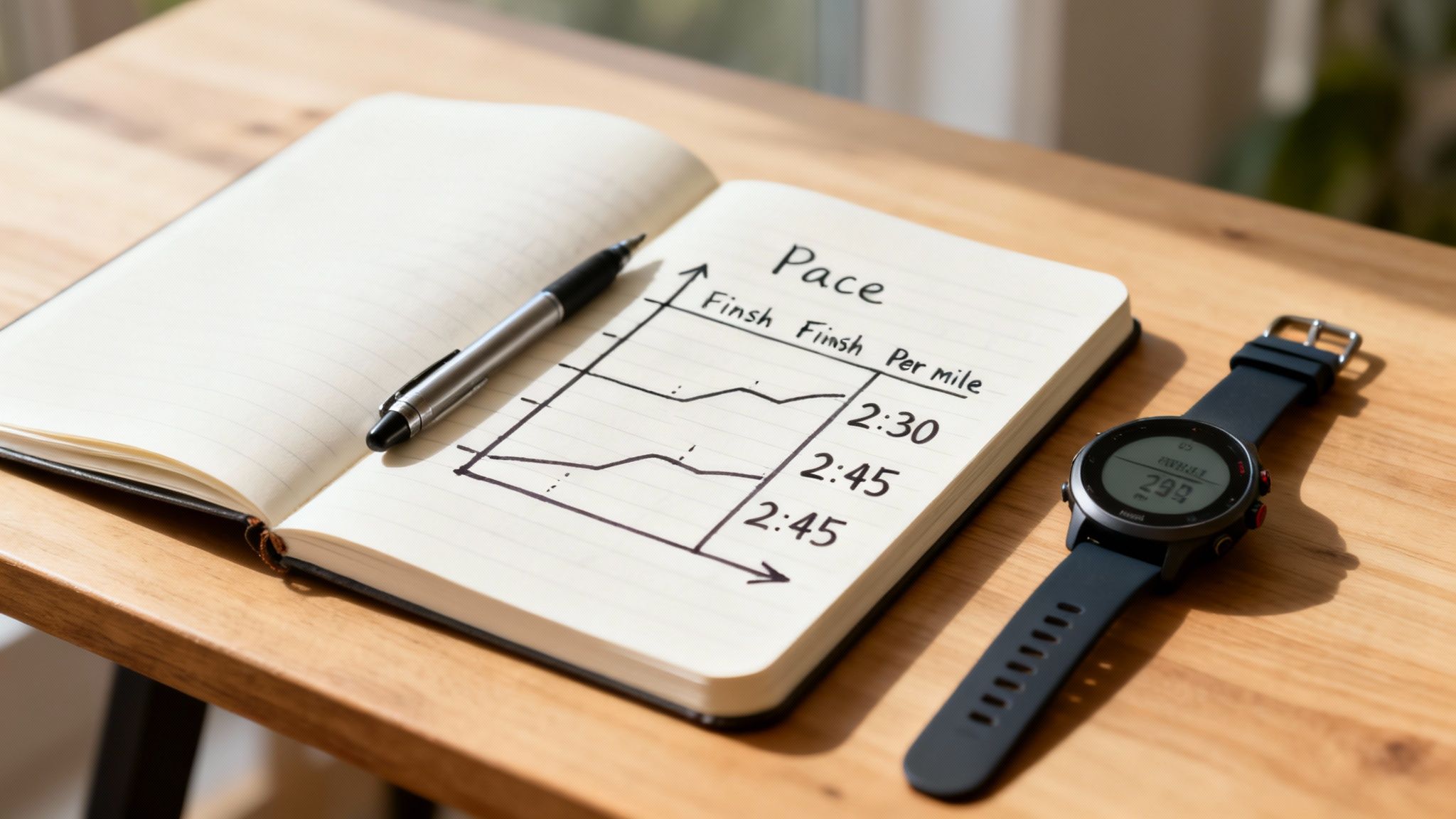
Honestly, creating a smart pacing plan is the single best thing you can do to avoid the classic beginner mistake: going out way too fast. The starting line is electric with adrenaline, and it’s incredibly easy to get swept up in the excitement, only to hit a wall by mile eight. A good strategy is your insurance policy against that dreaded burnout.
Using Past Races to Predict Future Success
The most reliable way to set a realistic half marathon goal is to look at how you've performed over a shorter distance. A recent 5k or 10k race is a fantastic predictor of what you can pull off for 13.1 miles, giving you a real-world snapshot of your current fitness.
Don't have a recent race result? No problem. Just do a "time trial" during one of your training runs. Run a 5k or 10k at a consistent, hard effort—as if you were actually racing—and use that time as your baseline. Trust me, this data is far more valuable than a wild guess.
Once you have that time, you can plug it into a race time equivalency calculator online. These tools use proven formulas to estimate your potential half marathon time. They aren't crystal balls, but they give you a much more realistic starting point for setting your goal.
Choosing the Right Pacing Strategy
With a goal time in mind, the next question is how you'll actually run the race. While there are a few common pacing strategies, one is the clear winner for first-timers.
- Positive Split: This happens when you run the first half faster than the second. It’s almost always a sign of starting too fast and fading hard. Avoid this at all costs.
- Even Split: This is where you run every mile at roughly the same pace from start to finish. It’s a very efficient approach used by experienced runners but can be tough for a beginner to nail perfectly.
- Negative Split: The gold standard for elites. You run the second half of the race faster than the first. It takes incredible pace control and a deep well of energy.
For your first half marathon, the safest and most effective strategy is a conservative start. Aim to run the first 2-3 miles about 15-20 seconds per mile slower than your overall goal pace. This saves crucial energy, lets your body warm up properly, and sets you up for a strong, confident finish.
Your Pace Chart for Common Goal Times
To pull off your strategy, you need to know your numbers. What exact pace do you need to hold to hit your goal? This chart breaks it down for some of the most popular beginner half marathon times. Find your target and get familiar with your goal pace.
Half Marathon Pace Chart for Popular Goal Times
Use this chart to find the average pace per mile and per kilometer you need to maintain to hit your target half marathon finish time.
| Finish Time Goal | Pace per Mile (min:sec) | Pace per Kilometer (min:sec) |
|---|---|---|
| 2:20:00 | 10:41 / mile | 6:38 / km |
| 2:25:00 | 11:04 / mile | 6:52 / km |
| 2:30:00 | 11:27 / mile | 7:06 / km |
| 2:45:00 | 12:35 / mile | 7:49 / km |
| 3:00:00 | 13:44 / mile | 8:32 / km |
Think of this chart as your cheat sheet. Practice running at your goal pace on your training runs so it feels second nature on the big day. This builds not only your physical endurance but also the mental confidence you'll need to succeed. And while this guide is all about the half, a similar strategic approach is just as critical for longer races; you can learn more about how to train for a marathon in our other guides.
When you combine a realistic goal with a smart, conservative pacing strategy, you put yourself in the best possible position to have an incredible race. The point isn’t just to finish—it's to finish feeling strong, proud, and maybe even a little excited for your next challenge.
Celebrating Your First Half Marathon Finish
Crossing that finish line for the first time is a feeling you’ll never forget. It’s the grand finale to weeks, maybe even months, of disciplined training, early mornings, and pushing past your limits. That moment is a massive personal victory, and it deserves to be celebrated in a way that truly captures what you accomplished.
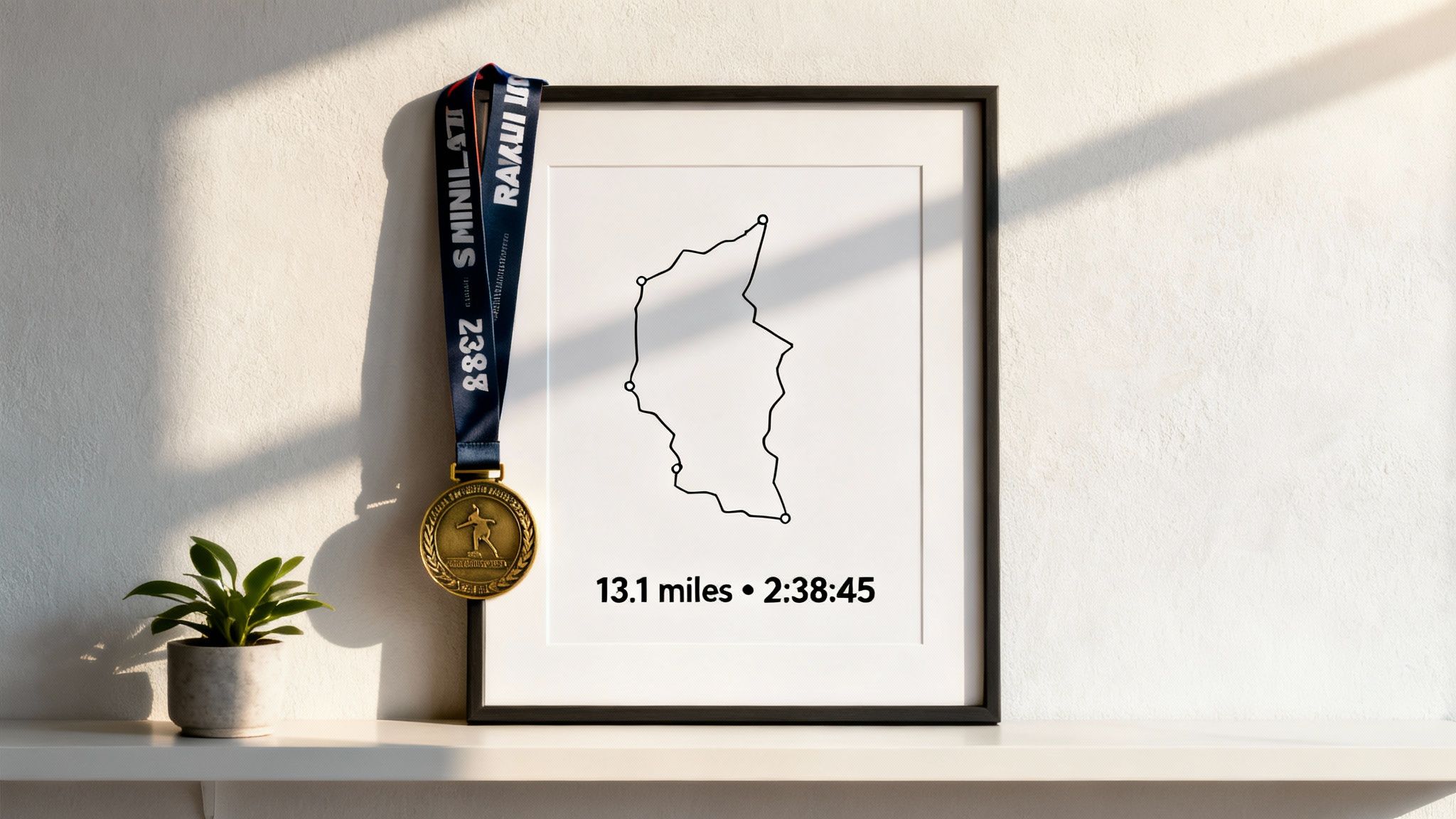
Your finisher's medal is a fantastic token of that day, but turning your hard-earned time into a piece of personal art creates a powerful, everyday reminder of your strength and dedication.
From Digital Result to Timeless Art
Your finish time is so much more than just numbers on a screen. It’s a story. It’s the story of every run in the dark, every workout you didn’t want to do but did anyway, and every drop of grit you scraped together on race day. Capturing that story gives you a permanent source of pride.
Think about turning that digital result from your running app into something tangible. Imagine a clean, minimalist poster that beautifully lays out the actual map of the course you ran. It’s not just a map; it's a visual record of the ground you covered, one step at a time.
Services like RoutePrinter are brilliant at creating these kinds of stunning keepsakes. You can personalize a print with the details that make the achievement all yours:
- The event name and date to lock in the memory.
- Your official finish time displayed for all to see.
- The exact 13.1-mile distance you conquered.
This takes your race data and elevates it from a simple entry in an app to a sophisticated piece of art. It’s a way to honor the entire journey—from a beginner with a bold idea to a certified half marathoner with a finish time to prove it.
Hanging a custom race poster in your home or office is about more than just remembering one day. It’s a celebration of the whole process—the commitment, the progress, and the resilient person you became along the way. It’s a daily testament that you can do hard things.
Answering Your Top First-Timer Questions
Stepping up to your first half marathon is a huge deal, and it’s natural to have a million questions swirling around in your head. Let's cut through the noise and tackle the big ones. Think of this as a final Q&A session with your coach to calm those pre-race nerves.
Getting these basics sorted will help you trade anxiety for confidence, so you can focus on what matters: running your race and soaking it all in.
What’s a Realistic Pace for a Beginner?
If you're wondering what to aim for, a great starting point is a pace somewhere between 11:00 and 12:30 per mile. This isn't just a random number; it's a strategic sweet spot. It's a comfortable, sustainable pace that helps you manage your energy and avoid hitting the dreaded wall.
Sticking within this range puts you on track to finish under 2 hours and 45 minutes, which is a fantastic and totally respectable goal for your first 13.1-miler. The real win is finishing strong and feeling proud of what you've accomplished, and this pace is your ticket there.
Is It Okay If I Walk During the Race?
Okay? It's more than okay—it's one of the smartest things you can do! Forget any idea that walking is "giving up." Many seasoned runners intentionally use a run-walk method to conserve energy and actually improve their finish times.
Taking planned walk breaks right from the start helps your body conserve fuel, gives your muscles a quick reset, and can dramatically reduce your chances of getting injured. You'll often finish faster and feel way better than if you had tried to gut out a continuous run.
So, don't wait until you're exhausted to take a walk break. Build it into your plan from mile one. A simple strategy like running for nine minutes and walking for one can be a complete game-changer, especially when you hit those challenging later miles.
How Much Should I Be Running Each Week?
When it comes to training, consistency is everything. To build the endurance needed for 13.1 miles, you'll want to gradually increase your weekly running volume until you're hitting a peak of about 25-30 miles a few weeks before the race.
The key here is "gradually." A slow, steady buildup gives your body time to adapt and get stronger, minimizing the risk of injury. The single most important workout in your plan is that final long run—getting at least 10 miles under your belt a week or two before race day is the ultimate confidence booster. It proves to you, without a doubt, that you're ready to conquer the full distance.
Your first half marathon is an incredible achievement—a story of every early morning and every tough mile you pushed through. Why not celebrate that journey? Commemorate your hard work with a personalized race poster from RoutePrinter. You can turn your race map, distance, and official finish time into a stunning piece of art that reminds you of what you can accomplish. Create your custom race print today at RoutePrinter.com.