What Is a PR in Running: Unlock Personal Records and Chase Your Best

If you’ve ever hung around a group of runners, you've almost certainly heard the term PR. It’s the holy grail of racing, the number that fuels countless early-morning runs and tough workouts.
So, what exactly is it? A PR, which stands for Personal Record, is simply your fastest-ever time for a specific race distance. Whether it’s a 5K, half marathon, or the full 26.2 miles, your PR is your personal gold standard.
Understanding Your Personal Best in Running

Think of a PR as more than just digits on a stopwatch; it’s the physical proof of your hard work, dedication, and smart race-day strategy all coming together. It's your own personal finish line tape, a moment captured in time that says, "This is the best I've ever been."
This brings up a critical point: a true PR isn't just any fast run. You might crush your 5K pace on a random Tuesday morning, but that amazing effort on your GPS watch doesn't technically count. An official record is earned in the structured environment of a sanctioned race, where the course is accurately measured and the timing is verified. It's this official validation that gives a PR its weight and makes it a universally recognized achievement in the running world.
What Makes a PR Official
Having a PR to chase gives every training run a deeper sense of purpose. It transforms a simple workout into a stepping stone toward a clear, measurable, and deeply personal goal. For a time to be considered a legitimate PR, it generally has to tick two key boxes:
- It happened at an official race event. The time needs to be from an organized race, not a casual training session or a solo time trial on your favorite route.
- The distance was verified. The race course must be accurately measured, ideally certified by a governing body, to guarantee you actually ran the full distance.
Imagine you’ve run three marathons with finish times of 3:43:19, 3:37:27, and 3:38:12. In this scenario, your marathon PR is proudly 3:37:27. Each new race is a shot at beating that number. You can dig deeper into the nuances of running PRs and PBs on MarathonHandbook.com.
Learning the Lingo of Running Records
Spend any time around runners, and you'll quickly pick up on the shorthand we use to talk about our achievements. Getting a handle on these key terms is part of joining the conversation and celebrating each other's progress.
The two big ones you’ll hear constantly are PR and PB. Don't get tripped up—they’re just two ways of saying the exact same thing.
- PR (Personal Record): This is the go-to term in the United States. It’s your absolute fastest time ever for a specific race distance. Think of it as your running magnum opus.
- PB (Personal Best): In the UK, Canada, and Australia, you’ll hear PB. It means the very same thing—your all-time best for that distance.
So, if a runner from Chicago is talking about her marathon PR and a runner from London mentions his marathon PB, they’re both sharing the proudest moment of their 26.2-mile running career.
Other Milestones That Matter
While your all-time best is the ultimate goal, other benchmarks help tell the full story of your running journey. They add context and celebrate progress along the way.
Think of these terms as different chapters in your running story. Your PR might be the headline, but other records show your grit on a tough course, your progress through a single season, or how you stack up against your peers.
Another key term is SB, which stands for Season's Best. This is your fastest time for a distance within the current calendar year or a specific training cycle. It’s a brilliant way to track short-term progress, especially when you're coming back from an injury or building up fitness for a big goal race. If you're curious about how your times compare, you can see how the average 10K time breaks down for different groups.
Beyond your own times, you’ll often hear about other kinds of records being broken on race day:
- Course Record: The fastest time ever run on that specific race course by anyone, period. This is the time the elites are chasing.
- Age Group Record: The best time for a specific age bracket (like 40-44 female) at that particular event. Winning your age group is a huge accomplishment!
- Unofficial Bests: These are the milestones you hit in training—your fastest mile on the track or a speedy loop at the local park. They aren’t official, but they are fantastic indicators that your training is paying off.
How Your Running PR Is Officially Validated
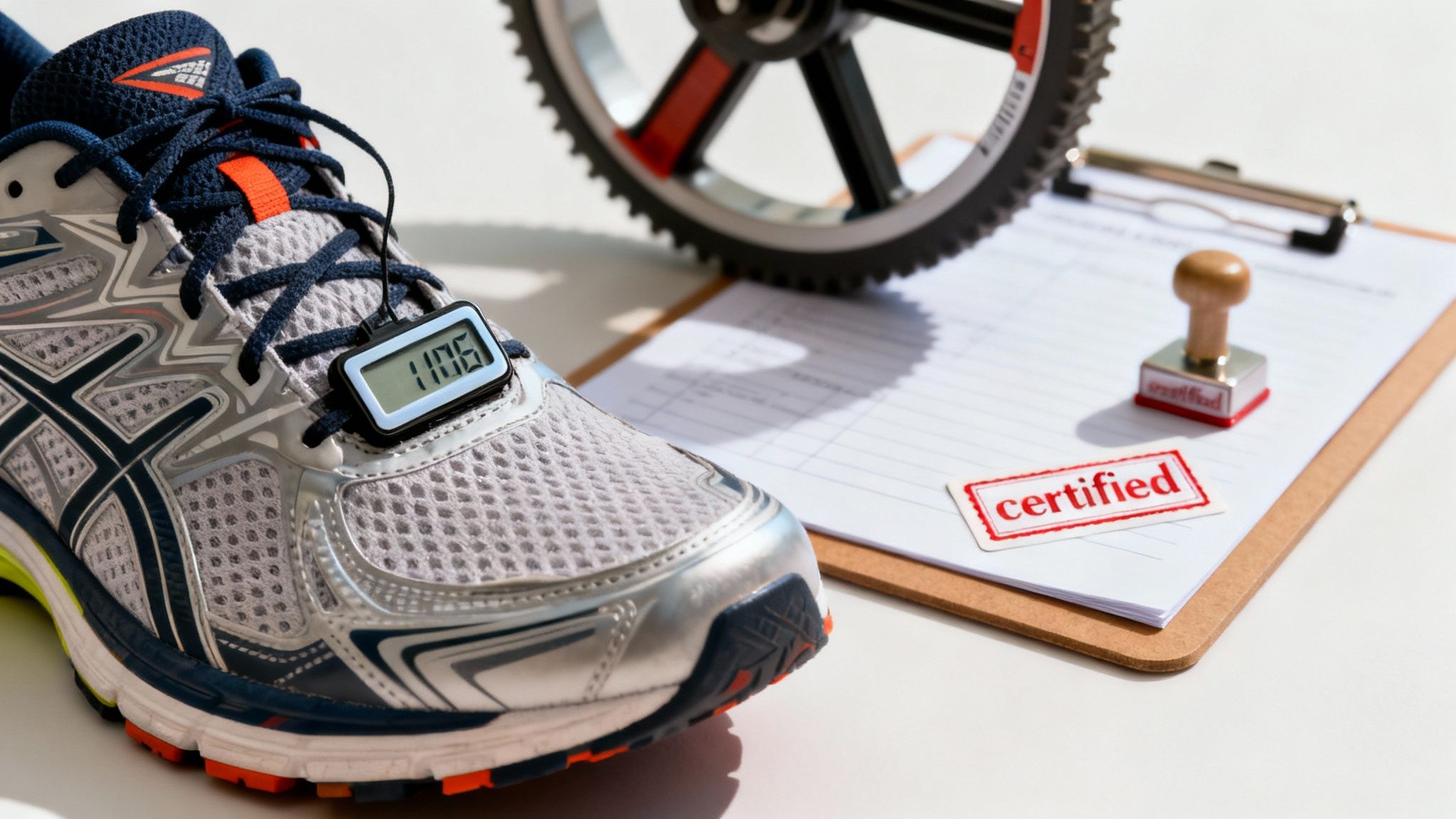
So, what’s the difference between a great training run and an official, set-in-stone Personal Record? It really comes down to two key things: accurate timing and a certified course. Without those, even a blistering pace is just a fast run, not an official PR.
Think of it like this: an official PR is a universally recognized benchmark. It allows you to fairly compare your performance against others and measure your progress over time. It’s the difference between guessing the length of a room and using a laser measure—one is a good estimate, the other is a verifiable fact.
Chip Time Versus Gun Time
When you line up for a race, especially a big one with thousands of runners, you'll hear about two ways your time is recorded. Knowing the difference is key to understanding your real performance.
- Gun Time: This is the old-school method. The clock starts the moment the starting gun fires and stops when you cross the finish line. This is what's used to determine the overall race winners.
- Chip Time: This is your personal race time. It starts the second the timing chip on your bib or shoe crosses the starting mat and ends the moment you cross the finish mat.
For most of us, Chip Time is the true measure of a PR. If you're starting in the middle of a massive crowd, it could take you minutes just to get to the start line after the gun goes off. Chip time erases that waiting period and reflects how long it actually took you to run the race.
The Importance of Course Certification
The other half of the official PR equation is the course itself. To be considered legitimate, the race distance has to be spot-on. No "close enough" allowed.
This is where official governing bodies like USA Track & Field (USATF) step in. They use incredibly precise measurement methods to certify that a 5K is exactly 5 kilometers, not a few feet short. Running on a certified course means your effort is comparable and your PR is undeniable.
Even training on a treadmill has its own quirks for tracking distance accurately, which is why figuring out how to sync Strava for treadmill runs can be so helpful for consistent training data.
The Real Journey to Setting a New PR
The road to a new PR is almost never a straight line. It's a journey filled with incredible highs, frustrating lows, and countless learning moments that ultimately shape who you are as a runner. Grasping this messy, human side of chasing your best time is what keeps you lacing up for the long haul.
A classic debate in running circles is what to do with your very first race at a new distance. Is that automatically your PR? Well, technically, yes. The first time you cross the finish line of a 10K, that time becomes your official 10K Personal Record.
But a lot of runners see it differently. For them, that initial finish isn't the ultimate goal but simply the baseline. It’s the starting point. The real PR, the one that feels earned, comes after months of dedicated training, smart race-day execution, and pushing through adversity.
Embracing the Breakthrough Phenomenon
Improvement in running rarely happens in a straight, predictable line. You don't just shave off a few seconds with every race. More often than not, performance comes in waves—long periods of grinding it out, followed by a sudden, massive leap forward. That's the magic of a breakthrough.
A breakthrough is that one race where everything just clicks. All those early mornings, tough workouts, and disciplined recovery days finally converge. You don't just beat your old PR; you absolutely shatter it, by minutes instead of seconds, and cross the finish line feeling stronger than you ever imagined.
Chasing a PR is about trusting the process. The real victory isn't just the final time on the clock, but the resilience and discipline you build while navigating the inevitable plateaus and celebrating the hard-earned breakthroughs.
This kind of non-linear progress happens at every level, even among the elites. One fascinating analysis of world-class 5K runners revealed their lifetime bests didn't come from steady, year-over-year gains. Instead, their PRs came from explosive jumps, averaging 16 seconds of improvement in a single season—and even more when they were breaking major time barriers. You can discover more insights about these performance jumps on Science of Running.
Understanding this cycle is crucial. When progress feels slow and you hit a plateau, don't get discouraged. That plateau is often just the foundation you're building for your next great leap.
Actionable Strategies for Your Next PR

Chasing a new personal record is what turns running from a simple hobby into a focused mission. The first, most crucial step? Pick one single goal race. Spreading your energy across too many events just dilutes your efforts. When you dedicate your training to a specific day on the calendar, you give yourself real clarity and purpose.
Once you’ve got a race circled, it's time to bring structured workouts into the mix. While easy miles are great for building your aerobic base, real speed and strength are forged in those focused sessions. Remember, consistency beats intensity every time. Simply showing up for your planned runs week after week will deliver far better results than a few heroic, all-out efforts that leave you burnt out.
Foundational Training and Race Day Tactics
To truly build the speed and endurance a new PR demands, you need to integrate a few key workout types into your schedule. These are the sessions that teach your body to run faster for longer. For a comprehensive look at building a full training cycle, our guide on how to train for a marathon breaks it all down.
- Interval Training: Think short, intense bursts of fast running followed by recovery periods. This is how you build top-end speed and boost your aerobic capacity.
- Tempo Runs: This is all about sustained effort at a "comfortably hard" pace. Tempo runs train your body to clear lactate more efficiently, which is the secret to holding a faster pace over a longer distance.
On race day, all that hard work comes down to smart execution. Pacing is everything—going out too fast is the classic mistake that sabotages countless PR attempts. Start conservatively and aim for a "negative split," which just means running the second half of the race slightly faster than the first. And don't forget to practice your fueling during training runs so there are no surprises when it counts.
Why Every PR is Worth Celebrating
Let’s be honest: hitting a new PR isn’t just about the number on the clock. It’s the physical proof of all those early morning runs, the disciplined training, and the mental grit you poured in for weeks or even months. That’s an achievement that deserves a victory lap.
Celebrating these moments is what keeps the fire lit for the next starting line. It’s how we turn a fleeting feeling of success into lasting motivation.
The running world has some fantastic traditions for marking these milestones. Some of us are collectors, saving every race bib and medal. Others create custom race posters to hang on the wall—a daily reminder of what we can accomplish. And of course, in our connected world, sharing that new PR on a platform like Strava lets your friends and community cheer you on, creating a powerful sense of shared victory.
Ringing in a New Record
If you’ve ever finished a big race, you’ve probably seen or heard it: the PR bell. Placed strategically near the finish line, this bell is there for one reason—for you to ring loud and proud.
Ringing that bell is a simple, joyful, and incredibly satisfying way to announce to the world, "I did it." It’s a public declaration that all the sweat and sacrifice was worth it.
Celebrating a PR isn't just about the data. It's about connecting the tangible result—a faster time—with the powerful emotional reward of knowing you pushed your limits and won. You're honoring the entire journey.
This spirit is a huge part of what makes running so special. Just look at the NYC Marathon, where 18% of its 56,000 runners recently hit a new PR. That’s a massive number of people chasing down their personal bests. You can dive deeper into the running industry’s growth on langleven.com.
Frequently Asked Questions About Running PRs
Even after you get the basic idea of a PR, a lot of specific questions tend to pop up out on the road and at the finish line. Let's clear up some of the most common ones that runners ask when they're chasing a new personal best.
Can a Training Run Count as a PR?
It's an amazing feeling to smash a goal time on your GPS watch during a training run—and you should absolutely celebrate that! But when we're talking about an official PR, it has to be set during an organized race on a certified course.
This isn't about being picky; it's about ensuring the distance is precise and the conditions are fair for everyone. That official validation is what gives a true Personal Record its weight.
Is My First Race an Automatic PR?
Technically, yes! The moment you cross the finish line of your first official race at any distance, you've set your PR for that event. It's the first mark in your running history book.
That said, many runners look at that first time as a baseline. The "real" PR, in their minds, is the one they earn after a dedicated training cycle aimed at smashing that initial time.
A quick note on timing: Always go by your Chip Time for your official PR. This is the time recorded from when you physically cross the starting line to when you cross the finish line. In a big race, it can take minutes just to get to the start, so chip time reflects your actual performance, not how long you waited in the corral.
Turn that hard-earned PR into a piece of art you can see every day. RoutePrinter designs beautiful, personalized race posters that tell the story of your greatest running moments. Design your custom poster today and celebrate your journey.