Your Ironman 70.3 Training Plan For Beginners

So you've decided to take on an Ironman 70.3. Fantastic. Committing is the first, and often hardest, part. Most beginner-friendly training plans will run anywhere from 12 to 24 weeks, and you should probably budget for about 8 to 12 hours of training each week. This isn't a random timeframe; it's designed to let you build a solid endurance base first, then layer on intensity without getting sidelined by injuries.
Your Journey to the Ironman 70.3 Finish Line
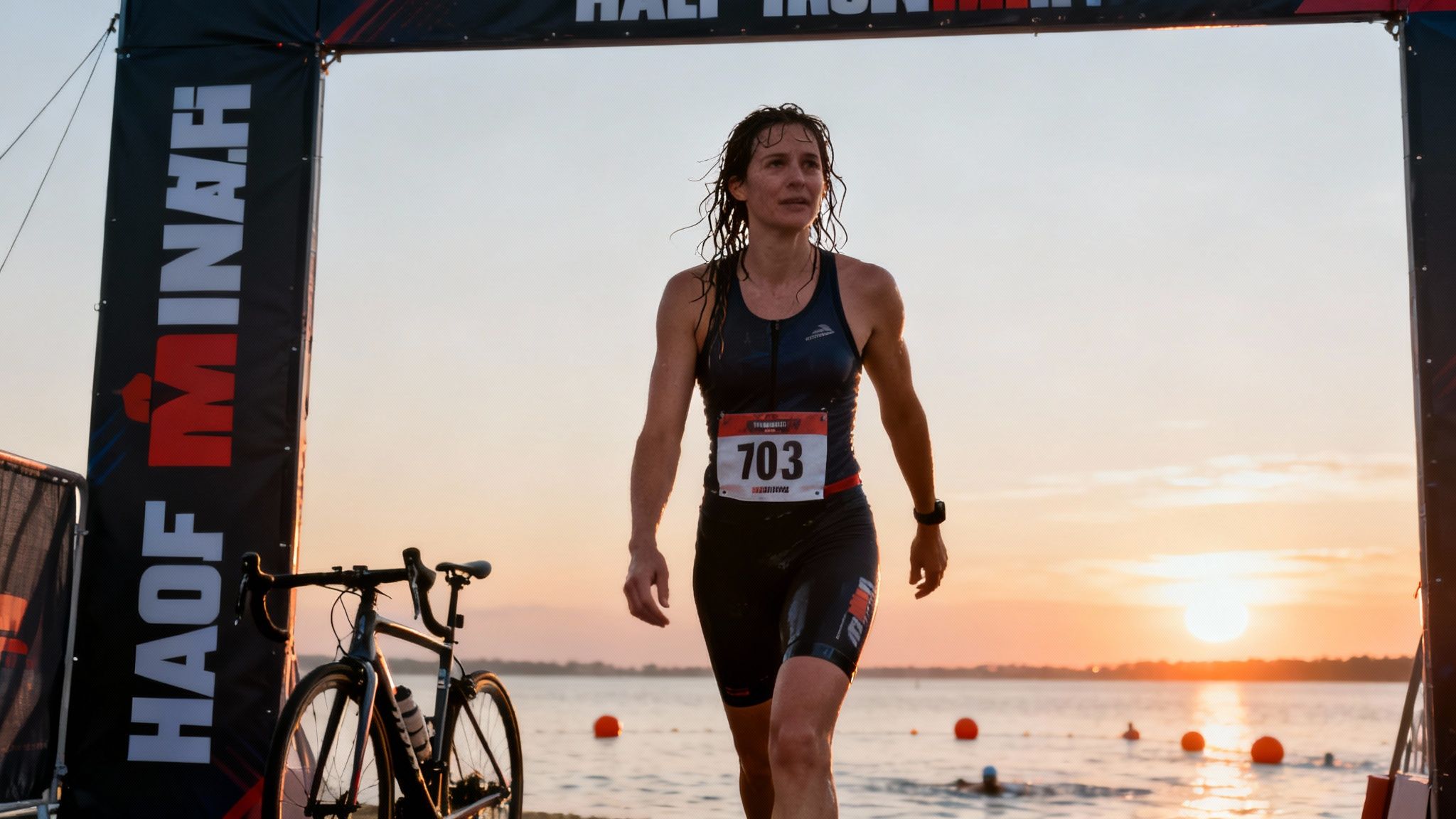
Let's be honest, staring down 70.3 miles—a 1.2-mile swim, a 56-mile bike, and a 13.1-mile run—can feel completely overwhelming. It's easy to get stuck in that "what have I gotten myself into?" phase. This is where so many aspiring triathletes stop, paralyzed by the sheer scale of it all. This guide is here to break down that wall of intimidation and give you a clear, step-by-step path forward.
We're going to cut through the noise and get right to the practical stuff. You’ll learn how to methodically build your endurance engine, figure out the right time to add speed work without breaking down, and dial in your nutrition so you can go for hours. This journey is as much a mental game as a physical one, and we've built this plan to address both.
What to Expect From This Guide
Think of this less as a rigid set of instructions and more as a strategic playbook for your first half Ironman. We’ll walk through the entire training process in logical phases, so you're not just blindly following a schedule—you'll understand the "why" behind every swim, bike, and run.
Here's a quick look at what we'll cover:
- Progressive Training Phases: We'll start with building a strong aerobic base and gradually move into sharpening your race-specific fitness. You'll see exactly how each block of training sets you up for the next.
- Actionable Weekly Schedules: I'll show you what a real training week looks like, complete with sample workouts you can tweak to fit your own schedule and ability.
- Nutrition and Fueling Simplified: We’ll demystify endurance fueling. You'll learn the fundamentals for training and, critically, how to practice and perfect a race-day nutrition strategy that actually works for you.
- Race Week and Taper Strategy: The final weeks are crucial. I'll explain how to properly rest and sharpen up so you show up to the start line feeling strong, not exhausted.
The real objective here isn't just to survive the day and crawl across the finish line. It's to have a race you can feel genuinely proud of—to enjoy the process and finish with enough in the tank to celebrate what you've accomplished.
This guide gives you the framework and the knowledge to turn that massive 70.3-mile goal into a structured, rewarding, and totally achievable adventure. Let's get to it.
Building Your Endurance Engine: The First 8 Weeks

The first two months of your journey to the Ironman 70.3 finish line are, without a doubt, the most important. They're also the most misunderstood. This is your base-building phase, and the mission is simple: build a massive aerobic engine. Speed is not the goal here. Durability is.
Think of it like laying the foundation for a house. You can't build a strong structure on shaky ground. In the same way, you can't layer on race-specific speed and intensity without a solid aerobic base. This entire phase revolves around consistent, low-intensity training that teaches your body to become a fat-burning, oxygen-processing machine.
This slow-and-steady approach also hardens your muscles, tendons, and ligaments, making them resilient to the demands of triathlon training and dramatically cutting your risk of injury later on. Every easy swim, every bike ride at a conversational pace, and every relaxed run is a deposit into your endurance bank account.
The Magic of Training Easy
I get it—it feels completely backward to train slowly when you've got such a huge race on the calendar. But trust me, this is where the real physiological magic happens. Training at a low intensity, what coaches often call Zone 2, triggers some incredible adaptations inside your body.
- You grow more mitochondria. These are the tiny "powerhouses" in your cells that produce energy. More mitochondria literally means you have a bigger engine to work with.
- You build a bigger network of capillaries. Your body creates more of these tiny blood vessels to shuttle oxygen-rich blood to your working muscles, improving efficiency.
- You become a better fat-burner. By staying at a low intensity, you teach your body to tap into its massive fat stores for fuel, saving your limited glycogen (carbs) for the hard efforts on race day.
These are the changes that make you a true endurance athlete, and they simply don't happen when you're gasping for air. They are cultivated over hours and weeks of steady, controlled effort. This is precisely why a smart ironman 70.3 training plan for beginners is so heavily focused on this foundational work upfront.
The Big Picture: For these first eight weeks, your goal isn't to get fast; it's to become tireless. Focus everything on consistency and completing your workouts at an easy, repeatable effort. The speed will come, but only after this foundation is firmly in place.
What Your First Four Weeks Should Look Like
Let’s get practical. For most people just starting out, a good target is two to three sessions in each sport every week. It's crucial to space them out to give your body time to recover and adapt—that's when you actually get stronger.
The time commitment here is more manageable than you might think. Across a full 20-week plan, most beginners will train between 8 to 12 hours per week. This initial eight-week base phase will be on the lower end, probably around 8 to 10 hours per week, all at that deliberately low intensity. As we'll see later, the volume and intensity will ramp up as you move into the "build" and "race-specific" phases of training.
To give you a clearer picture, here is a sample schedule for the first few weeks.
Sample Base Building Weekly Schedule (Weeks 1-4)
This table shows a typical training week during the initial base-building phase, emphasizing frequency and low intensity.
| Day | Workout 1 (AM) | Workout 2 (PM) / Notes | Focus |
|---|---|---|---|
| Monday | Rest Day | Active recovery like a short walk | Recovery and Adaptation |
| Tuesday | Swim (30-45 min) | Technique and breathing focus | |
| Wednesday | Bike (60-75 min) | Steady, conversational pace | |
| Thursday | Run (30-40 min) | Strength & Mobility (20-30 min) | Easy effort; focus on consistent cadence |
| Friday | Swim (30-45 min) | Endurance focus; minimal stopping | |
| Saturday | Bike (90-120 min) | Longest ride of the week; practice fueling | |
| Sunday | Run (45-60 min) | Longest run of the week; very easy pace |
Remember, this is just a template. The key is consistency and keeping the intensity in check.
The Only Gear You Truly Need to Start
It's easy to get overwhelmed by all the high-tech gear in triathlon, but you absolutely do not need it all to get started. Focus on the bare essentials to get you through this first phase.
- For the Swim: All you need for the pool is a comfortable swimsuit, a pair of goggles that don't leak, and a swim cap. If and when you decide to hit the open water, a triathlon-specific wetsuit is a game-changer for warmth and buoyancy.
- For the Bike: You don't need a fancy triathlon bike. Any road-worthy bike will work perfectly fine. A helmet is non-negotiable, and a good pair of padded bike shorts will quickly become your best friend.
- For the Run: Your single most important investment is a good pair of running shoes from a specialty running store. Getting properly fitted can make a world of difference and is one of the best ways to prevent common overuse injuries. Our guide on how to improve running endurance touches on just how critical the right footwear is.
The goal right now is to build consistent habits with the gear you have. You can always upgrade your equipment down the line as you get more serious about the sport. The best gear is the stuff you actually use.
Layering in Strength and Speed: The Next 12 Weeks
You've put in the time and built a solid endurance foundation. Now, the real fun begins. The next 12 weeks are all about sharpening the tools you've developed, moving from just finishing to performing at your best. This is where we shift focus from pure endurance to building the strength and speed needed to feel strong across all 70.3 miles.
We’ll break this phase down into two key blocks: the Build Phase and the Race-Specific Phase. This is where your ironman 70.3 training plan for beginners gets more focused and purposeful. Instead of just logging miles, we'll start adding structured intensity to make you a faster, stronger, and more efficient athlete. This doesn't mean every workout is a suffer-fest; it just means the hard work gets a lot smarter.
Introducing Intensity the Smart Way
Let's get one thing straight: adding speed isn't about going all-out every time you train. That’s a fast track to burnout. The real secret is using strategic, controlled efforts that trigger new fitness gains without leaving you shattered. It's all about balancing stress with rest.
Modern coaching has largely moved away from the old-school "no pain, no gain" mentality. A much more effective approach is the 80/20 training model. The idea is simple: roughly 80% of your weekly training volume should be done at an easy, conversational pace. Only the remaining 20% is dedicated to moderate or high-intensity work. This method helps prevent overtraining, slashes injury risk, and—most importantly—allows for quality recovery, which is when your body actually adapts and gets stronger.
So, what does this "intensity" look like?
- Tempo Runs: These are sustained efforts at a "comfortably hard" pace, where you can still speak, but only in short, choppy sentences. This is your secret weapon for raising your lactate threshold, which lets you hold a faster pace for longer without blowing up.
- Bike Intervals: We'll start mixing in structured efforts like "sweet spot" work (88-94% of your threshold power) or shorter, punchier VO2 max intervals. These are absolute gold for building real, cycling-specific power.
- Swim Drills & Speed Work: You'll spend more time with tools like pull buoys and paddles to build upper-body strength. We’ll also mix in short, fast 50s or 100s to improve your top-end speed and make your race pace feel easier.
Key Takeaway: Think of intensity as the seasoning, not the main course. A small amount, applied strategically, makes the entire meal better. Too much ruins it. Your easy days are just as important as your hard days.
Mastering the Brick Workout
If there's one non-negotiable workout for triathlon, it's the brick session. A "brick" is simply a bike ride immediately followed by a run, with as little downtime as possible between the two.
The first time you hop off your bike and try to run, your legs will feel like jelly. It’s a bizarre, heavy, and uncoordinated feeling that every triathlete knows well. This is completely normal! Brick workouts are designed to train your body and brain to handle that unique transition, so it feels much more natural on race day.
You don't need to go crazy at first. Start small. A simple 60-minute bike ride followed by a 15-minute run is a perfect first brick. As the weeks go on, you'll gradually extend the duration of both, eventually working up to a key session like a 2-hour ride followed by a 30-45 minute run at your target race pace.
How to Measure Your Effort
As intensity becomes part of your routine, you need a reliable way to measure it. Just "going by feel" without any context can lead to going too hard on easy days and not hard enough when it counts. For beginners, there are three great ways to gauge your effort.
1. Rate of Perceived Exertion (RPE)
This is the most straightforward method: you simply rate how hard an effort feels on a scale of 1 to 10.
- RPE 1-3: Very easy. Think warm-up or a recovery walk.
- RPE 4-6: Your endurance pace. You can easily hold a full conversation. This is your 80% zone.
- RPE 7-8: "Comfortably hard." This is your tempo or sweet spot effort. A few words are possible, but not a chat.
- RPE 9-10: Very hard to an all-out sprint. You can only hold this for very short bursts.
RPE is fantastic because it teaches you to listen to your body—an invaluable skill.
2. Heart Rate (HR)
A heart rate monitor gives you objective data, allowing you to train in specific "zones." It takes some of the guesswork out of RPE, though it can be influenced by things like heat, caffeine, or stress. Most of your training will be in Zone 2 (your easy, aerobic zone).
3. Power (Cycling)
For the bike, a power meter is the gold standard. It measures your actual work output in watts and isn't affected by wind, hills, or how you're feeling. While it’s more of an investment, it completely removes the guesswork from your bike training. For anyone serious about structuring their rides, digging into a good cycling training plan for beginners can be a game-changer.
There’s no single "best" method. Many experienced athletes use a combination of all three. Start with RPE, and if you want more data, add a heart rate monitor to your kit.
Smart Progression and Recovery
Over these 12 weeks, the goal is to gently and consistently increase the training stress on your body. A time-tested and safe way to do this is to build your training load for three weeks, followed by one "recovery" or "de-load" week.
During a recovery week, you'll cut your total training volume by 40-50%. Workouts become shorter and easier. This isn't a week off—it's an active recovery week where your body gets the chance to absorb all your hard work and come back stronger. Trust me, skipping these recovery weeks is one of the fastest ways to hit a wall with overtraining or injury.
Above all, listen to your body. If you’re feeling constantly wiped out, your motivation disappears, or your resting heart rate is higher than normal, it’s a clear signal to back off. Smart recovery is what turns hard work into real fitness.
How to Fuel Your Half Ironman Training
Think of your nutrition as the fourth discipline of triathlon. It’s not an exaggeration. You can log hundreds of hours of perfect training, but if your fueling plan falls apart on race day, so will your performance. This isn't about getting bogged down in complex diets; it’s about learning to give your body the right fuel, at the right time, so you can perform, recover, and avoid that dreaded race-day bonk.
Your fueling strategy really breaks down into two separate but equally important parts. First, there's what you eat every single day to support your training load. Second, there's what you're putting into your body during the actual workouts. Nail both, and you're setting yourself up for success in your ironman 70.3 training plan for beginners.
Eating to Recover and Perform
As the weeks go by and your training volume climbs, your body's need for energy is going to skyrocket. So many beginners make the classic mistake of under-eating, and it's a fast track to fatigue, poor recovery, and nagging injuries. The goal here isn't to obsessively count every calorie, but to understand the basic building blocks your body needs.
- Carbohydrates are your best friend. For endurance athletes, carbs are the high-octane fuel your body prefers. Keep your energy stores (called glycogen) topped up by focusing on complex carbs like oatmeal, sweet potatoes, brown rice, and whole-grain pasta.
- Protein is for repair. Every tough workout creates tiny micro-tears in your muscles. Protein is what your body uses to patch them up and build them back stronger. Make sure you’re getting a solid source of lean protein—think chicken, fish, beans, or tofu—with every meal.
- Don't fear the fat. Healthy fats from things like avocados, nuts, seeds, and olive oil are essential. They play a huge role in everything from hormone production to taming inflammation, which is a big deal when you're training hard.
Look, don’t overthink your daily plate. A good rule of thumb is to fill half of it with carbs, a quarter with protein, and a quarter with veggies, with some healthy fats mixed in. Consistency over perfection is the name of the game.
Fueling on the Go: What to Eat During Your Workouts
Once a workout pushes past that 75-90 minute mark, you’ve got to start putting fuel back in. Your body only has a limited tank of stored carbohydrates, and once it's empty, you hit the wall. Hard. The goal during these long sessions is to trickle in calories to spare your stored energy, not to try and replace every single calorie you burn.
A solid starting point for long workouts is to aim for 30-60 grams of carbohydrates per hour. This is a skill, and just like swimming or running, you have to practice it. Start on your very first long bike ride.
So, what does 30-60 grams of carbs actually look like in the real world?
- One energy gel is usually around 20-25 grams.
- A bottle of a sports drink like Gatorade Endurance can pack 40-50 grams.
- A handful of energy chews (maybe 4-5 of them) will get you about 20-25 grams.
- You can also use real food. Half a banana is about 15g, and a few dates will give you roughly 18g.
Your Saturday long bike rides are the perfect laboratory for this. Start simple: try taking one energy gel every 45-60 minutes and see how your stomach handles it. The bike is the best place to dial this in because your gut is much more settled than when you're bouncing around on a run.
Rehearse Your Race Day Fueling Plan
Here's the golden rule of endurance sports: Never, ever try anything new on race day. Your long training sessions are your dress rehearsals. Use them to figure out exactly what products, flavors, and timing work for you.
Seriously, gut issues are one of the biggest reasons first-timers have a miserable race. Use your brick sessions to really mimic race conditions. Try taking a gel near the end of your long bike, then hop off and run. How does it feel? It can even help to keep a simple log—just a few notes on what you ate and how you felt.
Don't Forget Hydration and Electrolytes
Hydration is every bit as critical as calories. The moment you get dehydrated, your performance plummets. Your heart rate will spike, you'll feel sluggish, and you'll be on the fast track to cramping.
When you're out there for hours, especially in the heat, you're losing more than just water. You're sweating out crucial electrolytes, mainly sodium. Most quality sports drinks have electrolytes built-in. But if you're a plain water person, you'll need to add them back with electrolyte capsules or salt tabs.
Try to drink 16-24 ounces (about 500-750 ml) of fluid per hour as a baseline, and be prepared to adjust that up if it's hot or you're a heavy sweater. This is just one more piece of the puzzle you need to solve during training, not on the starting line.
Nailing Your Taper and Race Day Plan
You've put in months of hard work and dedication, and now it's time for the most important phase of your preparation. The final two weeks before race day aren't about building more fitness. They're about shedding fatigue so you can arrive at the start line feeling sharp, rested, and ready to fly. This is the art of the taper.
A good taper involves a strategic reduction in your training volume while still sprinkling in small doses of intensity. A common mistake I see beginners make is to rest completely, which can leave them feeling flat and sluggish. The goal here is to let your body fully recover and absorb all that training, not to detrain.
This means your long bike rides and runs will get noticeably shorter. However, you'll still want to include brief, controlled efforts at your target race pace. This keeps your body primed and your neuromuscular system firing on all cylinders. Trust the process. The hay is in the barn, as they say.
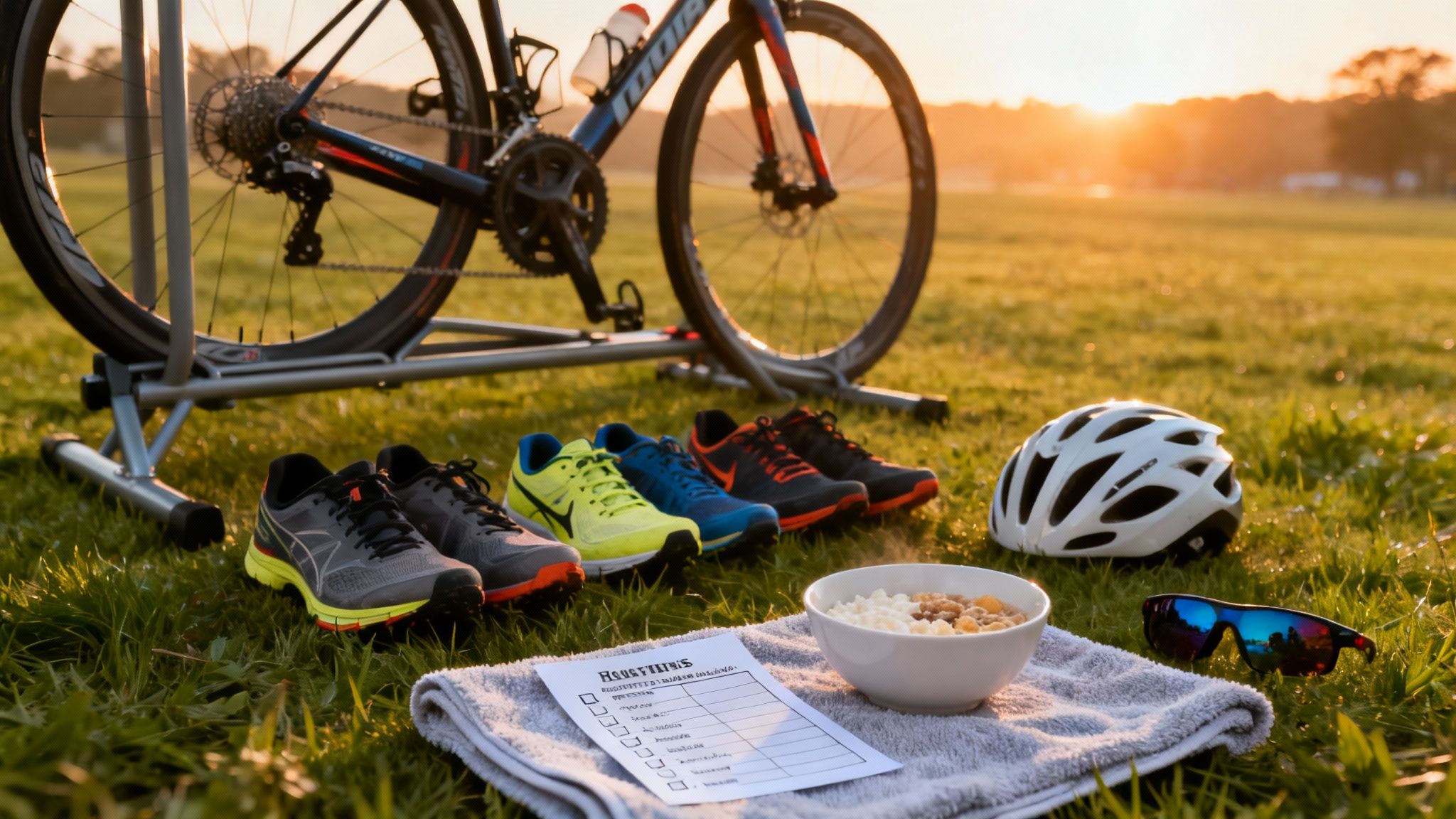
Your Final Week Checklist
The week leading up to the race can feel like a blur of logistics and nervous energy. Having a solid checklist is your secret weapon against last-minute panic, ensuring you don't forget something critical. For an even deeper look, checking out a complete Ironman training plan can offer more detail on this final, crucial phase.
Here’s a practical timeline to keep you organized and calm as the big day approaches.
To keep things simple and stress-free, I've put together a checklist that breaks down the final week. Getting these tasks done early frees up mental energy for you to focus on rest and visualization.
Race Week Essential Checklist
| Category | Task | When to Complete |
|---|---|---|
| Bike & Gear | Final bike tune-up and safety check | Monday or Tuesday |
| Nutrition | Plan and purchase all race-day nutrition | Early in the week |
| Logistics | Review race-day schedule and transition maps | Wednesday |
| Packing | Pack your swim, bike, and run transition bags | Thursday or Friday |
| Rest & Recovery | Prioritize sleep; 8-9 hours per night | All week |
| Hydration | Focus on consistent hydration with electrolytes | All week |
Think of this checklist as your defense against pre-race chaos. By front-loading these tasks, you can spend the last couple of days relaxing and getting mentally prepared.
Executing the Perfect Race Morning
Race morning is absolutely not the time to experiment. You need a simple, repeatable routine that gets you to the starting line feeling prepared and in control. The key is to practice this exact routine before your key long training sessions, so it feels like second nature.
Here’s a walkthrough of what that morning should look like:
- Wake Up Early: Give yourself at least 2.5-3 hours before your swim start. This buys you plenty of time for breakfast and digestion and gets you to the venue without that awful rushed feeling.
- Eat Your Go-To Breakfast: Stick to the exact same meal you’ve been eating before your long weekend workouts. Something simple and carb-focused, like oatmeal or a bagel with peanut butter, is perfect. No surprises!
- Final Gear Check: Before heading out the door, do one last run-through of your gear bags. Double-check for your timing chip, goggles, helmet, and race number.
- Set Up Transition: Get to the transition area with time to spare. Lay out your gear logically—I like to put my helmet and sunglasses on the aerobars, with cycling shoes clipped in or right next to the bike. Your running gear should be neatly arranged on a small towel.
- Warm-Up: About 15-20 minutes before your wave starts, do a light warm-up. Some simple arm swings and a very short jog will do the trick. If you can, get in the water for a few minutes just to acclimate.
Pro Tip: Visualize your transitions. Actually walk the path from the swim exit to your bike rack, and from the bike dismount line back to your spot. Knowing these routes like the back of your hand prevents confusion when your heart rate is soaring and you're not thinking clearly.
The taper and race week are where you convert all that hard-earned fitness into real-world performance. By following a structured plan, you can eliminate stress and set yourself up for an incredible race day.
Common Questions From First-Time 70.3 Athletes
Even with the best plan laid out, you're going to have questions and run into a few hurdles. That's completely normal. Let’s tackle some of the most common worries I hear from athletes gearing up for their first half-Ironman. Nailing these details will do wonders for your confidence.
What Happens If I Miss a Workout?
Life gets in the way. It’s inevitable. You’ll get sick, a project at work will explode, or you'll just be dead tired. Here's the golden rule: if you miss one workout, just let it go and move on.
Whatever you do, don't try to cram two workouts into the next day to "catch up." That’s a one-way ticket to burnout or injury. What really builds fitness is the consistency you string together over weeks and months, not one perfect session.
Now, if you miss a few days in a row because you're sick, be smart about your return. Ease back into things with a couple of shorter, easier efforts before jumping right back into the full-intensity plan.
How Do I Deal With Open Water Swim Anxiety?
For most newcomers, the open water swim is the single biggest source of race-day nerves. The dark water, the lack of a black line on the bottom of a pool, and all those other bodies splashing around you can feel overwhelming. The solution? Get familiar with it, one step at a time.
- Start small. Head to a calm lake or beach and just get comfortable in the shallows. Wade in, get your face wet, and practice breathing to the side just like you do in the pool.
- Buddy up. Never, ever swim alone in open water. Bring a friend to swim with you or have someone paddle alongside in a kayak. This is a non-negotiable safety net that also provides a huge mental boost.
- Learn to sight. This is a critical skill. Every few strokes, you need to practice lifting your head just enough to spot a landmark on the shore—a big tree, a lifeguard stand, whatever. Without this, you’ll swim zig-zags and add a lot of extra distance.
The point isn't to make the fear disappear entirely; it's about learning to manage it. The more you practice in open water, the more you'll trust that you can handle it. Remember, your wetsuit gives you a ton of buoyancy, which is a massive comfort on its own.
Can I Just Wing My Transitions on Race Day?
Please, don't do this. There’s a good reason people call transition the "fourth discipline" of triathlon. A sloppy, panicked transition can easily cost you five to ten minutes and spike your stress levels before you even start the next leg.
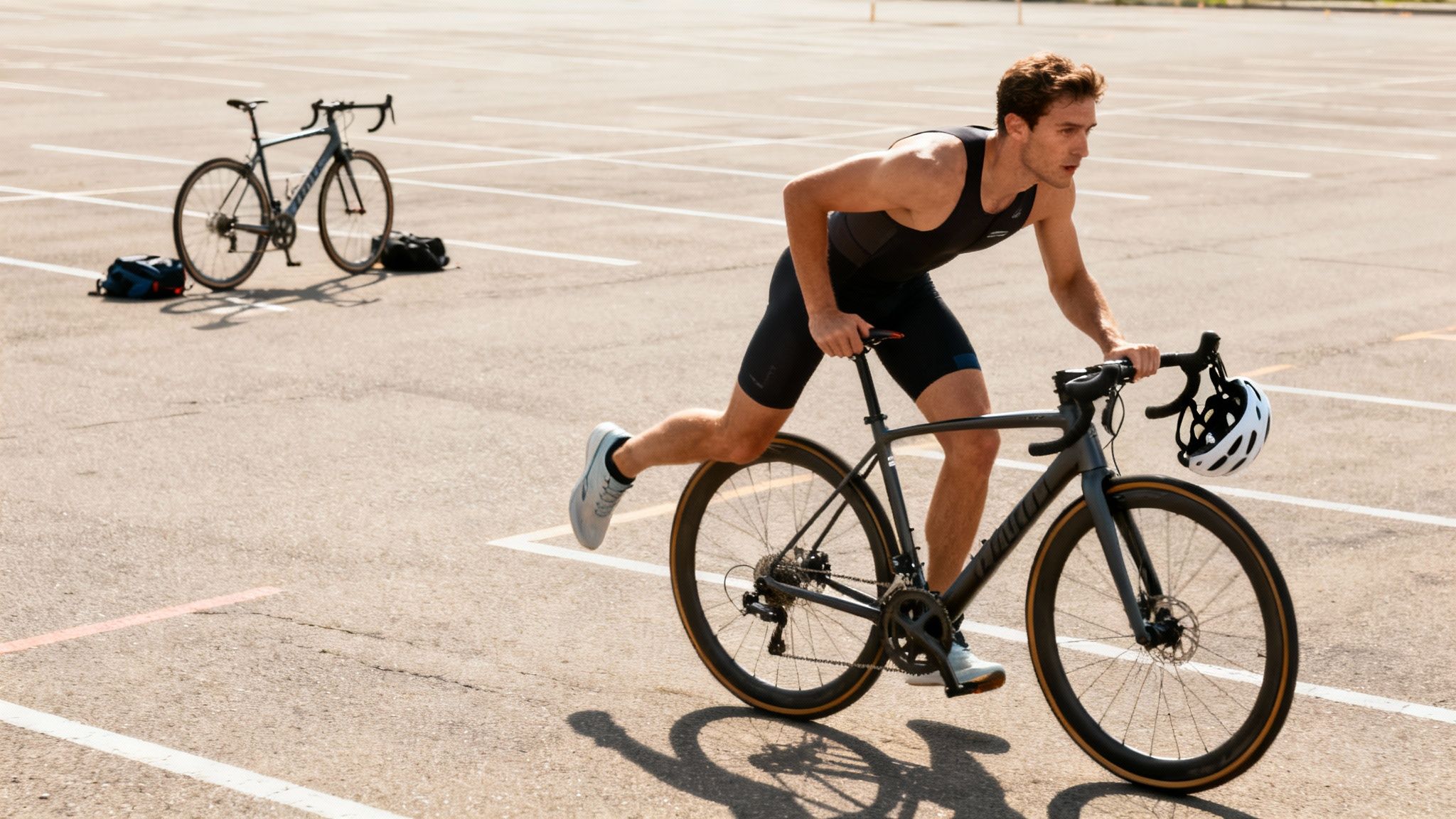
You absolutely need to rehearse your T1 (swim-to-bike) and T2 (bike-to-run) multiple times before the race. Find an empty parking lot or use your driveway to set up a mini transition zone.
Run through the exact sequence of events. Practice jogging from the "swim exit," peeling off your wetsuit, clipping on your helmet before touching your bike, and running with your bike to the mount line. Do the same for T2: dismount, rack your bike, swap your helmet for a hat, change shoes, and head out.
A few dedicated practice sessions build muscle memory, making the whole process feel second nature on race day. Mastering this detail is a huge part of a successful ironman 70.3 training plan for beginners.
An Ironman 70.3 is a massive achievement you’ll want to remember forever. At RoutePrinter, we help you turn those hard-earned miles into a piece of personalized art. Commemorate your race with a custom print of the course, featuring your name and finish time. Design your unique race poster today at RoutePrinter.