Ironman 70.3 Training Plan Beginner

Let's be honest: tackling a 70.3-mile race can feel like a monumental task. The goal of a good training plan isn't to make you a pro overnight. It's to break that huge goal down into small, achievable steps that fit into your life.
For most beginners, this journey will take anywhere from 12 to 24 weeks, with a time commitment of about 8-14 hours per week. You’ll be building up to a 1.2-mile swim, a 56-mile bike ride, and a 13.1-mile run. The secret sauce is structured, gradual progress—not trying to be perfect from day one.
Your Starting Line For The Ironman 70.3
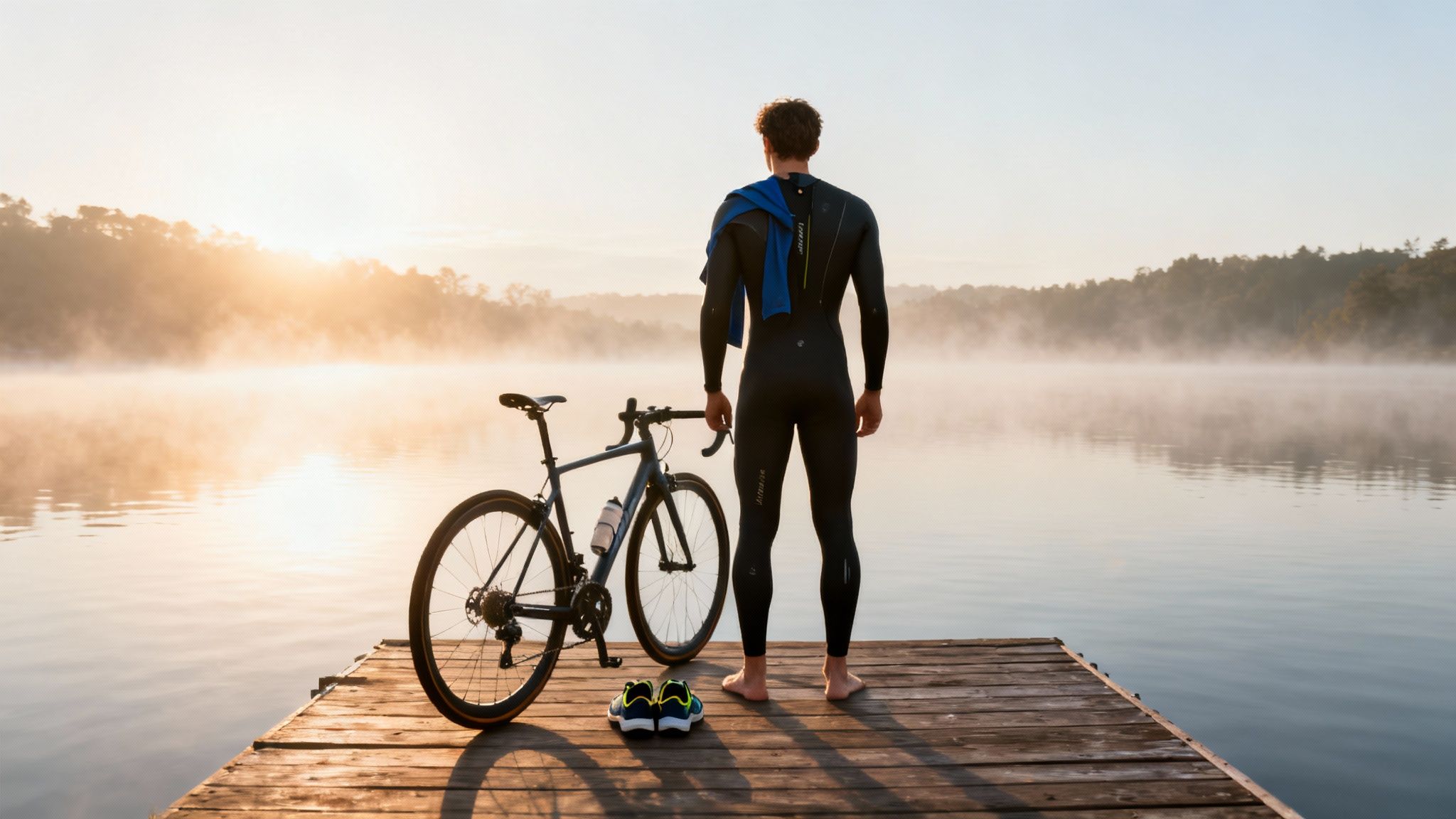
The idea of an Ironman 70.3 is undeniably intimidating, but it's a far more realistic goal than most people think, especially for a dedicated beginner. Yes, the distance is a challenge, but the right approach turns it from a terrifying feat into an incredible adventure.
Forget about the elite athletes finishing in a little over four hours. Your race is about your own growth, the discipline you build, and that amazing feeling of crossing the finish line.
A successful plan isn't about crushing every single workout. It's actually built on a few core principles that will guide you to race day safely and effectively. Think of these as the non-negotiables that will form the backbone of your training.
- Consistency: Just showing up, even for a short session on a busy day, builds fitness and momentum far better than random, all-out efforts.
- Progressive Volume: Your body is amazing, but it needs time to adapt. A smart plan gradually increases the length and distance of your workouts, building endurance without sidelining you with an injury.
- Smart Recovery: This is where the magic happens. Sleep, good food, and actual rest days are when your body repairs itself and gets stronger. Training breaks you down; recovery builds you up.
To give you a clearer picture, here’s a quick overview of what your training will involve.
Beginner Ironman 70.3 Training At A Glance
| Training Component | Beginner Focus | Typical Weekly Commitment |
|---|---|---|
| Swimming | Building comfort and technique in open water | 2-3 hours (2-3 sessions) |
| Biking | Developing aerobic endurance and bike handling skills | 4-7 hours (2-4 sessions) |
| Running | Gradually increasing distance to avoid injury | 2-4 hours (3-4 sessions) |
| Strength Training | Core stability and injury prevention | 1-2 hours (1-2 sessions) |
| Recovery | Active recovery (stretching, foam rolling) and rest | 1-2 dedicated rest days |
This table lays out the core elements, but remember that the exact hours will shift and grow as you move through different phases of the plan.
Understanding Training Phases
Your journey to the finish line won't be a random series of workouts. It follows a structured path broken into distinct phases, each with a specific goal. This methodical approach ensures you're building the right kind of fitness at exactly the right time.
It starts with the Base Phase, where the focus is all about building a solid aerobic foundation with low-intensity, steady workouts. Next, you'll move into the Build Phase, where we start adding more race-specific intensity and increasing the length of your workouts. Finally, you hit the Peak and Taper Phases—your biggest training weeks followed by a strategic drop in volume so you arrive at the start line feeling fresh, not exhausted. While you’re planning, you might also want to look into what to wear for triathlons to get your race day kit sorted.
The biggest mistake I see beginners make is doing way too much, way too soon. A successful Ironman 70.3 is built on months of patient, consistent work—not a few weeks of cramming. You have to trust the process and give your body time to adapt.
What A Typical Training Week Looks Like
Proven plans from coaches and platforms show that beginners thrive on structure. For example, a well-designed 12-week program might start you at 9.5 hours of training and build you up to a peak week of 14 hours. That's a manageable increase of about 47% over the entire plan.
Most weeks will be a mix of 3 swims, 2-4 bike rides, 3-4 runs, and 1-2 strength sessions. In the early stages, the real emphasis is on just getting the work in consistently, not hitting crazy speeds or power numbers.
Building Your Endurance Engine
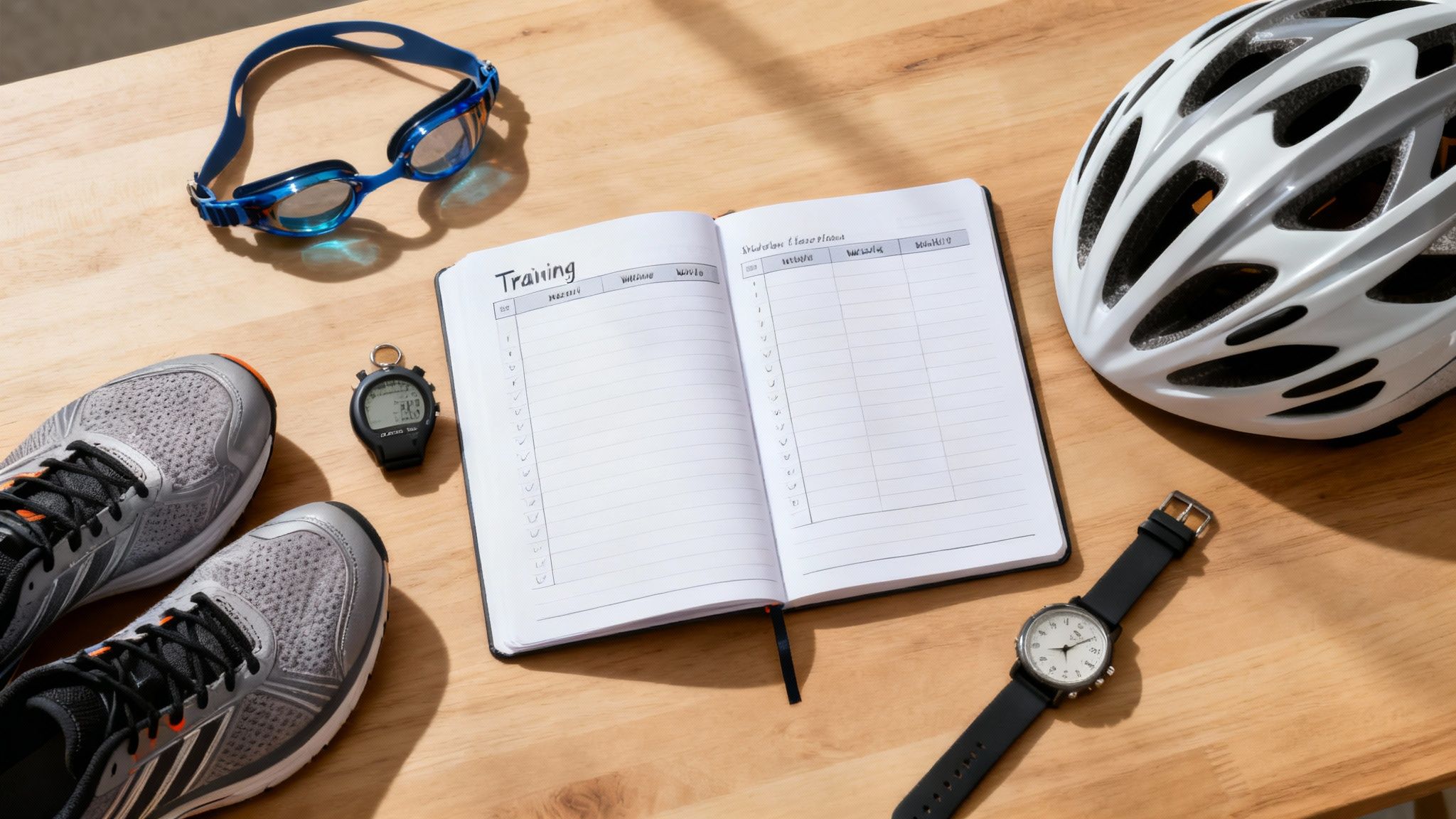
Alright, this is where the real work begins—and where you’ll start to feel your body adapt and transform. An effective ironman 70.3 training plan for a beginner is much more than just logging miles. It's about methodically building a strong, resilient foundation that can actually handle the demands of race day.
The first two phases of any good plan, the Base and Build phases, are the absolute cornerstones of this process. Think of your body like a car engine. You can't just redline it from a cold start; you have to build the engine first. That’s exactly what we're doing here.
The Foundation: The Base Phase
The Base Phase is the longest and, I’d argue, the most important part of your training. Plan on spending a solid 8 to 12 weeks here. The goal is incredibly simple but crucial: build a deep aerobic foundation. This means training your body to become ruthlessly efficient at using oxygen and burning fat for fuel.
The secret weapon for this phase? Spending most of your time in Zone 2. This is a low-intensity, conversational effort. It will probably feel counterintuitive, like you aren't working hard enough, but this is where the physiological magic happens. Training at this lower heart rate builds mitochondrial density and expands your capillary networks—the biological powerhouses that will fuel you for hours on end.
During this phase, consistency crushes intensity every single time. The focus is purely on steady, repeatable efforts across swimming, biking, and running.
- Sample Swim: Think long, continuous swims where you focus on a smooth, relaxed technique rather than chasing the clock. A good example is 3 x 500 meters with short rests, just holding a consistent, easy pace.
- Sample Bike: A long, steady ride of 2-3 hours where you could comfortably hold a conversation the entire time. No sprinting, no hammering. Just turn the pedals.
- Sample Run: A long, slow run where your heart rate stays firmly in Zone 2. You should finish feeling like you could easily keep going for a while longer.
Your motto for the Base Phase should be: "Go slow to go fast later." Rushing this process by peppering in too much intensity is the fastest way to burn out or get injured. Trust that all this low-and-slow work is building a foundation that will support faster efforts down the road.
This period is also the perfect time to really dial in your form, especially in the water. Since the intensity is low, you have the mental and physical bandwidth to concentrate on your swim stroke, cycling posture, and running cadence. Speaking of which, building a solid running base is critical, and you can explore more ways on how to improve running endurance in our detailed guide.
Sharpening the Tools: The Build Phase
Once you’ve built your aerobic engine in the Base Phase, it's time to add some horsepower. The Build Phase, which typically lasts 6 to 8 weeks, is where we introduce intensity and more race-specific workouts. Your body is now prepped and ready to handle harder efforts. These sessions will sharpen your fitness, making you stronger and faster.
This is when you'll really start to feel like a triathlete. The workouts get more challenging and laser-focused on the specific demands of a 70.3 race. While the volume of your long workouts continues to creep up, the key change is the strategic layering of higher-intensity sessions.
Your week will now include workouts designed to push your limits.
- Lactate Threshold Intervals: These are efforts at a "comfortably hard" pace that train your body to clear lactic acid more efficiently. A classic run workout might be 3 x 10 minutes at your threshold pace with 3-minute recovery jogs in between.
- Hill Repeats on the Bike: Find a decent hill and ride up it with a strong, sustained effort, then recover on the way down. This builds serious leg strength and power that pays huge dividends on the bike course.
- Tempo Runs: These are sustained runs at a pace just a touch slower than your threshold. A tempo run teaches your body and mind what it feels like to hold a strong effort for a long time—exactly like you'll need to on race day.
The great thing about the 70.3 is that it's an achievable goal. Most beginner plans average 9-11 hours per week, a far cry from the 20+ hours needed for a full Ironman. This makes it accessible for people with jobs and families. In fact, 70.3 participation surged 15% after 2022, and a staggering 70% of new athletes were first-timers training under 12 hours a week, according to Ironman statistics.
Here’s a sample weekly structure to show you how these two phases look in practice. This isn't a rigid plan to follow, but a framework to illustrate how the workouts are layered.
| Day | Base Phase Focus (Example Week 4) | Build Phase Focus (Example Week 14) |
|---|---|---|
| Monday | Rest or Active Recovery (easy walk) | Rest or Active Recovery (light stretch) |
| Tuesday | Swim: 45 min (technique drills) | Swim: 60 min (w/ threshold intervals) |
| Wednesday | Bike: 60 min (steady Zone 2) | Bike: 75 min (w/ hill repeats) |
| Thursday | Run: 40 min (easy Zone 2) | Run: 50 min (w/ tempo effort) |
| Friday | Strength: 45 min (core & stability) | Swim: 45 min (easy technique) |
| Saturday | Bike: 2.5 hours (long, steady Zone 2) | Bike: 3.5 hours (long ride, w/ race pace efforts) |
| Sunday | Run: 75 min (long, slow distance) | Brick: 2-hour bike followed by a 45-min run |
As you can see, the Build Phase doesn't just increase duration; it strategically adds intensity and race-specific workouts, like that all-important brick session. This progressive structure ensures your body is constantly adapting, getting stronger week by week, and getting you fully prepared for the challenge ahead.
Nailing Your Key Race Day Workouts
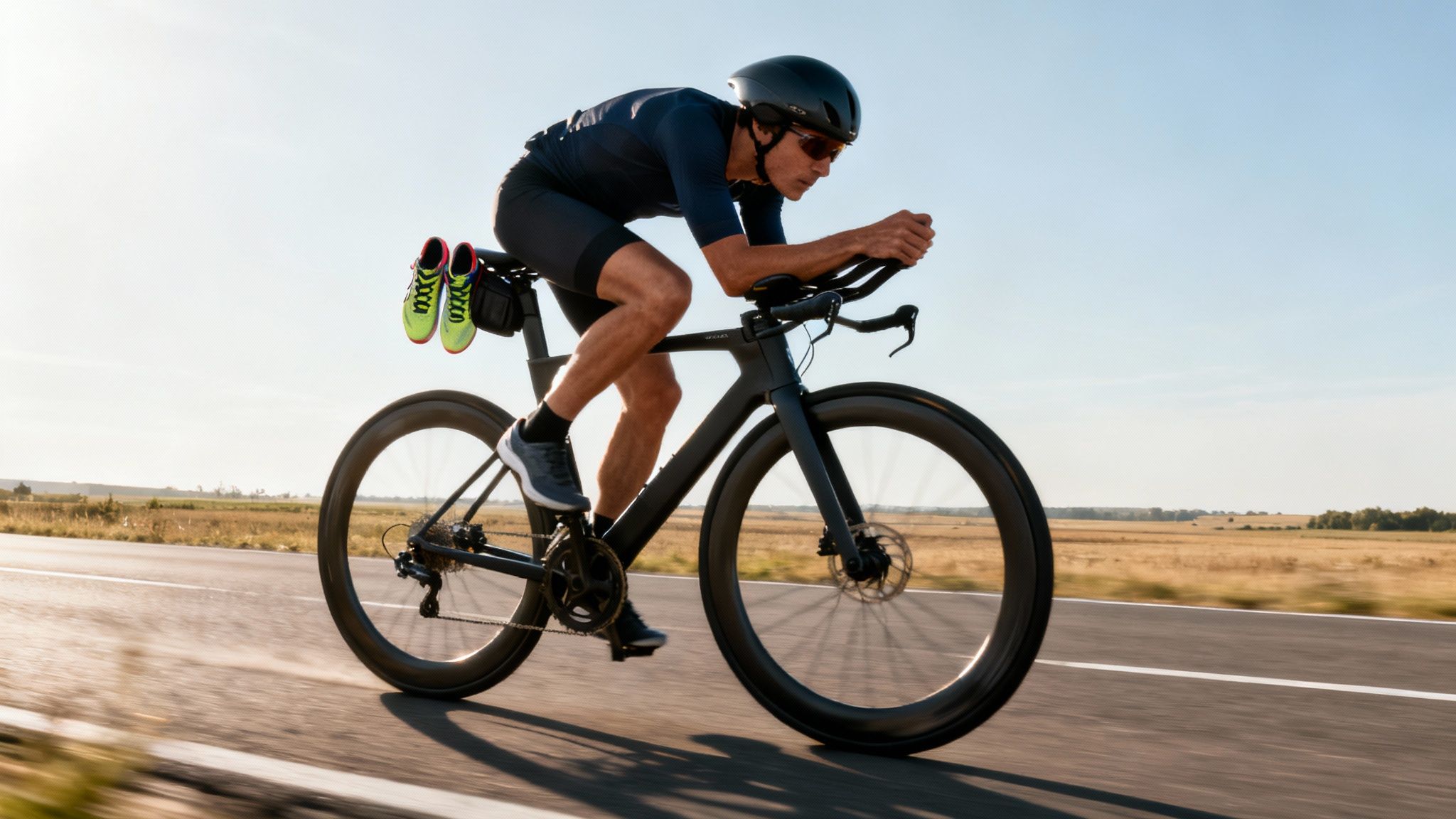
While consistent training across swimming, biking, and running is the foundation, a great Ironman 70.3 performance is really built on a few specific, high-value sessions. These are the workouts that truly simulate the demands of race day, building not just your physical engine but also your mental toughness and nutrition plan.
Think of these as your dress rehearsals. Any good Ironman 70.3 training plan for a beginner will slowly build you up to these key workouts. Let's break down the three you absolutely can't skip: the long run, the long ride, and the brick workout.
Conquering The Long Run
Your Sunday long run is where you earn the right to finish that final half-marathon feeling strong, not just surviving. The main goal here is simple: gradually increase your time on feet. This teaches your body to absorb the impact and handle the duration without falling apart. For a beginner, this slow progression is everything.
You'll want to add no more than 10-15 minutes to your long run each week. This slow and steady approach is your best defense against injury while still giving you all the aerobic benefits. Keep the effort conversational—firmly in Zone 2—for most of the run.
This is also the perfect time to dial in your race day fueling and hydration.
- Hydration Practice: Get used to carrying a handheld bottle or wearing a hydration pack. Practice taking small sips every 15-20 minutes to figure out what your stomach can handle on the move.
- Fueling Practice: Start experimenting with energy gels, chews, or whatever you plan to use. Try taking one every 45-60 minutes and pay attention to how your body responds. Finding a fuel that works without causing gut issues is a massive win.
Your long run isn't about setting a new PB. It's about building durability and practicing your pacing and nutrition. The real goal is to finish feeling like you could have gone a little longer, not to finish as fast as possible.
Dominating The Long Ride
At 56 miles, the bike is the longest part of your day. This makes your weekly long ride the single most important session in your training plan, hands down. It's where you build the deep endurance to not only cover the distance but have enough gas left in the tank to run well off the bike.
Your long ride should slowly build up to, and even slightly past, the full race distance. Many plans will have you peak with rides of 60-70 miles or 4-5 hours in the saddle. Going over-distance like this builds a huge amount of physical and mental stamina.
But it's about more than just logging miles. Your long ride is a laboratory for race day.
- Nutrition and Hydration: This is prime time to perfect your fueling. The goal is to take in 60-90 grams of carbohydrates and 20-30 ounces of fluid per hour. Test out different sports drinks, gels, bars, and even real food to see what your gut tolerates.
- Pacing Strategy: Learn what a steady, all-day effort feels like. A heart rate monitor or power meter is a fantastic tool for this, helping you avoid burning all your matches on the first few hills.
- Aero Position Comfort: If you have aero bars, the long ride is where you get comfortable using them. Practice holding the position for long stretches, coming up only to climb, corner, or give your back a quick stretch.
The All-Important Brick Workout
The "brick"—a bike ride followed immediately by a run—is the secret sauce of triathlon training. It simulates that weird, wobbly "jelly legs" feeling you get in a race and teaches your body how to handle it. This session is absolutely critical for success.
When you're starting out, a brick can be short and sweet. A 45-minute easy bike followed by a 15-minute jog is a great way to introduce the sensation. The initial goal isn't massive volume; it's simply getting your legs used to the quick change.
As your fitness grows, your bricks will get longer and more race-specific.
Sample Brick Workout Progression
| Training Phase | Bike Duration & Intensity | Run Duration & Intensity | Purpose |
|---|---|---|---|
| Early Base | 60 min easy (Zone 2) | 15 min easy (Zone 2) | Introduce the bike-to-run feeling |
| Late Base | 90 min steady (Zone 2) | 25 min easy (Zone 2) | Build transition endurance |
| Build Phase | 2 hours w/ race pace intervals | 30 min at race pace | Simulate race day intensity |
| Peak Phase | 3-4 hours steady | 45-60 min at race pace | Full dress rehearsal for race day |
The numbers don't lie. A solid plan might have you peak with a workout like a 4-hour ride straight into a 60-minute run. This is crucial, especially when you consider that around 40% of beginners struggle with bike endurance and risk missing the 8-hour, 30-minute total race cutoff. Training plans averaging 11 hours per week often include sessions like a 57-minute ride with bursts in Zone 4 to build the power needed to maintain the 16-18 mph average speed required on the 56-mile course. You can dig deeper into this in this guide to Half Ironman training.
If you can master these three key workouts—the long run, the long ride, and the brick—you'll be ready for almost anything the Ironman 70.3 can throw at you. They build your body, train your gut, and give you the confidence you need to cross that finish line.
Fueling, Recovery, and Building a Stronger You
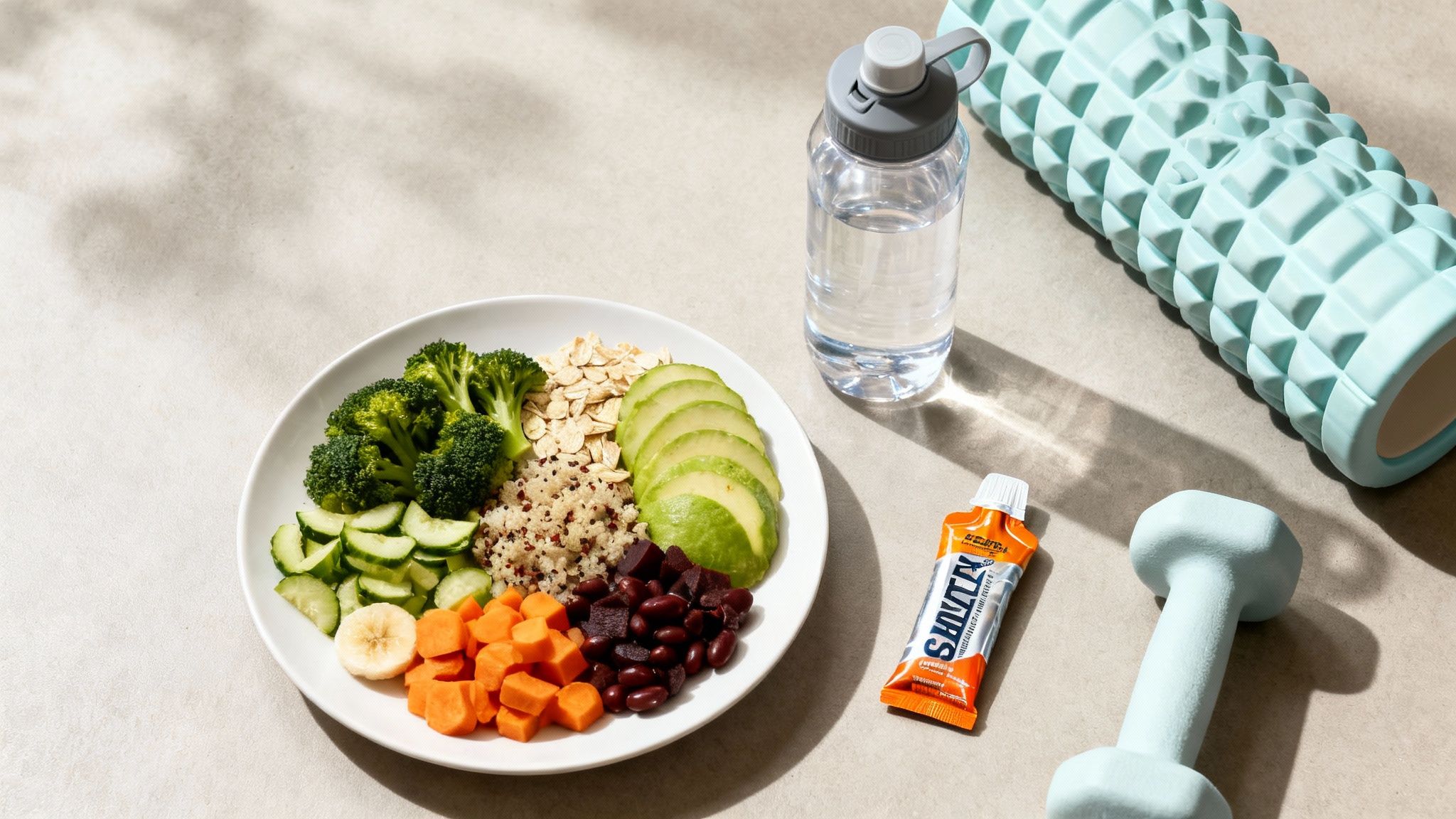
The miles you log in the pool, on the bike, and on the pavement are only part of the equation. Honestly, the real magic happens in the hours between your workouts. Think of it this way: hard training breaks your body down, but smart fueling, dedicated recovery, and targeted strength work are what build it back up, stronger than before.
These three pillars are totally non-negotiable. They're your support system, the unsung heroes that prevent injury, supercharge your performance, and get you to that finish line feeling powerful, not just depleted.
The Fourth Discipline: Nailing Your Nutrition
So many beginners get this wrong. They train hard but accidentally sabotage themselves by not eating enough, leading to constant fatigue and frustrating plateaus. Your food is literally the fuel for your endurance engine—you have to give it what it needs.
For your day-to-day diet, just focus on the good stuff: a solid balance of complex carbs, lean protein, and healthy fats. Before a workout, carbs are your best friend for quick energy. Afterward, you'll want a combo of carbs and protein within 30-60 minutes to restock your energy stores and kickstart muscle repair.
Race-day nutrition, though? That's a whole different beast. You have to practice this relentlessly during your long weekend workouts.
Never, ever try anything new on race day. Your long rides and brick sessions are your dress rehearsals. Use them to dial in your exact fueling and hydration strategy until it’s second nature. Trust me, stomach issues are one of the biggest reasons people DNF (Did Not Finish), and it's almost always preventable with a little practice.
As a general rule, aim to take in 60-90 grams of carbohydrates and about 20-30 ounces of fluids (with electrolytes!) per hour, especially on the bike. This is when your body is primed to absorb fuel. Here’s a basic approach you can start testing:
- Before You Start (1-2 hours): Keep it simple. Something carb-heavy like oatmeal or a bagel with peanut butter is perfect.
- On the Bike: Start fueling about 15-20 minutes into the ride. A mix of sports drinks, energy gels, and chews usually works well. I recommend setting a timer on your watch to beep every 20-30 minutes so you don’t forget to eat.
- On the Run: Your stomach will be a lot more sensitive now. Switch to really easy-to-digest stuff like gels or chews every 45 minutes or so. And definitely grab water at every single aid station you pass.
To give you a clearer picture, here's an example of what a race-day plan might look like. Remember, your job during training is to create and perfect your own version of this.
Sample Race Day Nutrition Plan
| Discipline | Timing | Fueling Goal (Calories/Hour) | Hydration Goal (Ounces/Hour) | Example Fuel |
|---|---|---|---|---|
| Pre-Race | 1-2 Hours Before | 300-400 Calories | 16-20 Ounces | Oatmeal with berries, a bagel with peanut butter, or a sports bar. |
| Bike | Every 15-20 Minutes | 250-350 Calories | 20-30 Ounces | 1 energy gel + sips from a bottle with electrolyte mix. |
| Run | Every 45 Minutes | 150-250 Calories | 16-24 Ounces | 1 energy gel + water from aid stations. |
This is just a template. You might find you prefer chews over gels, or a specific brand of sports drink. The only way to know is to test it out on your long training days.
The Art of Smart Recovery
Here's a secret: you don't get fitter during your workouts. You get fitter when you recover from them. Recovery isn't just about sitting on the couch; it's an active process that deserves your full attention. The most powerful tool for this is completely free: sleep.
Try to get 7-9 hours of quality sleep every night. This is when your body does most of its heavy lifting for muscle repair and adaptation. Skimping on sleep is a surefire way to head straight for burnout.
A few other key practices can make a huge difference:
- Active Recovery: On rest days, a light walk, an easy spin on the bike, or a relaxed swim can help reduce muscle soreness and get the blood flowing.
- Stretching & Mobility: Spend 10-15 minutes after your workouts doing some static stretching. Focus on your hips, hamstrings, and quads. A foam roller can also become your best friend for working out knots and improving flexibility.
- Listen to Your Body: This is crucial. Learn the difference between "I'm tired from a good workout" and the deeper warning signs of overtraining, like persistent soreness, a high resting heart rate in the morning, or a total lack of motivation.
Building a Resilient Body with Strength Training
When time gets tight, strength training is often the first thing to go. Big mistake. This is your secret weapon for staying injury-free and adding power to your swim, bike, and run. You don't need to become a bodybuilder; two simple 30-45 minute sessions a week is all it takes.
Forget about lifting heavy. Your goal is to build stability and fix the common muscle imbalances that plague endurance athletes.
Beginner-Friendly Strength Focus
- Core Stability: A strong core is the foundation for everything. It keeps you streamlined in the water, stable on the bike, and upright on the run. Planks, side planks, and bird-dogs are your go-to exercises.
- Hip Strength: So many running injuries can be traced back to weak hips and glutes. Glute bridges, clamshells, and lateral band walks are non-negotiable.
- Glute Activation: Many of us have "sleepy" glutes from sitting too much. Basic bodyweight squats and lunges are fantastic for waking them up and making sure your most powerful muscles are actually firing when you need them.
By weaving these three pillars into your weekly routine, you’re doing more than just training for a 70.3. You’re building a durable, resilient athlete who can cross that finish line with a huge, well-earned smile.
Your Final Weeks: Peak, Taper, and Race Day Strategy
You’ve put in the months of hard work. You've logged the long miles and built an incredible endurance engine. Now, it's time to put the final polish on all that fitness. The last few weeks of your training aren't about building more fitness—they're about sharpening what you have and showing up to the start line ready to rock.
This final block is a delicate dance between your biggest training sessions (the Peak) and strategically backing off to absorb it all (the Taper). Honestly, nailing this phase is what separates a great race day from a flat, exhausting one.
Reaching Your Peak
Think of your Peak Phase as the grand finale of your training, usually lasting just one or two weeks. This is where you'll hit your highest training volume and tackle your longest, most race-specific workouts. The idea is to give your body one last major stimulus that mimics what it’ll feel like on race day.
Your peak week will probably include your longest swim, bike, and run of the entire plan. A classic peak workout is the "dress rehearsal" brick session—something like a 4-hour bike ride immediately followed by a 60-90 minute run. This isn't just about the physical test; it's your final chance to dial in everything from your nutrition and hydration strategy to your gear and mental game.
Key Takeaway: Your peak week should feel tough, but it shouldn't break you. You're strong and fit from months of training. Trust your body, execute the plan, and focus on recovering like a pro between these last big efforts.
This is also the perfect time to get your head wrapped around the course. Using a tool to visualize the route can be a huge confidence booster.
Here's an example of what mapping out a bike route looks like. You should absolutely do this for your actual race course to get a feel for the elevation and any tricky turns.
Breaking the course down like this helps you see it in smaller, more manageable chunks, which makes the full distance feel way less intimidating.
The Art of the Taper
After you’ve conquered your peak week, it’s time to taper. The taper, which typically covers the last two to three weeks before your race, is easily the most misunderstood—and arguably most important—part of your entire plan. The goal is simple: drastically cut your training volume while keeping a little bit of intensity.
This lets your body fully recover, repair all that micro-damage in your muscles, and top off its energy stores. You’re not losing fitness; you’re absorbing it. For anyone new to the 70.3 distance, a smart taper is a non-negotiable. Most solid plans will cut training volume by as much as 60% over three weeks, a strategy that’s been proven to help you arrive fresh and boost race-day performance. You can discover more about how training phases stack up and dive into the science behind it.
Here’s a simple way to think about your taper week by week:
- Two Weeks Out: Cut your total training volume by about 20-30%. Your long ride and run will feel noticeably shorter, but you might still throw in some short, race-pace intervals to stay sharp.
- Race Week: This week is all about staying loose and feeling fresh. Reduce volume by another 40-50%. Workouts should be very short and include brief "openers"—little bursts of speed just to keep the engine primed and the legs firing.
Your Race Day Blueprint
You did the training. You nailed the taper. Now, all that’s left is to go out there and execute. A simple, conservative strategy is always your best bet for a successful first 70.3.
The Swim: Start easy. Seriously, just find your own space and settle into a comfortable rhythm. Don't waste precious energy fighting for position in the first few hundred meters.
The Bike: This is where you set up your entire race. The golden rule is to start the bike conservatively. It will feel ridiculously easy for the first hour—and that's the whole point. Focus on your nutrition and hydration plan like it's your job, taking in calories and fluids on a strict schedule you’ve practiced.
The Run: Your goal coming off the bike is to find a steady, sustainable pace you can hold. The first mile or two will feel weird (hello, jelly legs!), so just ease into it. Don't be a hero—walk through the aid stations to make sure you get enough fluids and fuel. Breaking the half marathon down into smaller mental chunks, like just running from one aid station to the next, makes it so much more manageable.
Answering Your Biggest Ironman 70.3 Questions
Even with the best training plan laid out, you're going to have questions. That’s a good thing! It means you’re taking this challenge seriously. Let's dig into some of the most common worries I hear from athletes tackling their first 70.3.
Do I Really Need a Super-Expensive Triathlon Bike?
Let's get this one out of the way first: absolutely not. It's easy to get intimidated at the starting line when you see all the high-tech, aerodynamic machines, but your trusty road bike will get the job done just fine.
Many first-timers (and even seasoned athletes) simply add a pair of clip-on aero bars to their road bike. This gives you a more aerodynamic position for the long, flat stretches without dropping thousands of dollars. The real gains come from your engine—your fitness—not the frame.
Focus your budget on what truly matters for a successful race day:
- A reliable bike that has been tuned up and, most importantly, fits you properly.
- Running shoes that you've logged plenty of miles in. Race day is not the time to break in new shoes.
- A wetsuit that fits like a second skin (if the water temperature requires one).
You can't buy your way to a faster finish line. You earn it, mile by mile. I've seen countless athletes on standard road bikes fly past people on five-figure superbikes. Consistent training always beats expensive gear.
How Can I Get Over My Fear of Open Water Swimming?
The open water swim is the source of more pre-race jitters than anything else. I get it. The dark water, the crowd of swimmers—it can be overwhelming. The trick is to demystify it with gradual, controlled practice.
Don't just jump into the deep end. Start in calm, shallow water where you can easily stand up. Just get used to the feeling. Swim a little, stand up, take a breath. This alone works wonders for building confidence.
Never swim alone in open water. Bring a buddy or, even better, find a local triathlon group. There's safety and comfort in numbers. In your training, practice sighting every six to ten strokes—that’s just a quick peek to spot a landmark and make sure you’re swimming straight. By race day, it’ll feel completely automatic. And remember, it's okay to take a break! You can flip over on your back or switch to a breaststroke for a few moments to catch your breath and calm your nerves.
Is it Possible to Train for a 70.3 with a Full-Time Job and a Family?
Yes, you can. It just requires smart planning, discipline, and being open with your family about your schedule. A good beginner plan typically asks for 9-11 hours per week, with a few peak weeks hitting around 12-13 hours. That's manageable for most people.
You'll get good at waking up early, squeezing in a run on your lunch break, or hitting the bike trainer after the kids are in bed. It’s about quality, not just mind-numbing quantity. A focused, 60-minute interval workout is far more effective than a junk-mile, two-hour slog.
Think about it: over 100,000 athletes tackled a 70.3 in 2023. The vast majority aren't pro athletes; they're people with jobs and families, just like you. The average beginner finisher crosses the line in 6 to 8 hours, proving this training volume is effective. If you want to dive deeper into finish times, check out our guide on average triathlon times.
One of the biggest hurdles that trips up 20-30% of beginners is the bike-to-run transition. Your legs feel like jelly! That's why your ironman 70.3 training plan for a beginner will introduce "brick" workouts by week 7—like a long bike ride immediately followed by a short run—to get your body adapted. Pacing is another huge factor; around 10-15% of starters don't make the 8:30 hour cutoff because they burned all their matches on the bike. These structured plans build your endurance progressively, teaching you how to save energy so you can finish strong.
You trained for it, you earned it, now display it. At RoutePrinter, we turn your hard-earned miles into a work of art. Commemorate your incredible Ironman 70.3 achievement with a personalized race poster, beautifully designed to hang in your home or office. Celebrate your finish line moment forever. Create your custom print today.