Half Ironman Training Plan Beginner: Your Ultimate Guide to 70.3 Readiness

So, you've set your sights on a Half Ironman. That's a huge, exciting goal, and you've come to the right place to figure out how to get there. A beginner-friendly training plan is your roadmap for tackling the 70.3-mile race, and it’s all about smart, consistent preparation over 20 to 24 weeks.
Think of your training as a part-time job—one that requires about 8 to 12 hours a week. It’s a serious commitment, but it’s absolutely doable. This guide will walk you through balancing the swim, bike, and run with the equally important strength work and recovery needed to build race-day endurance.
Your Journey To The Half Ironman Finish Line
Signing up for a Half Ironman is a massive step. It's the moment you decide to become a true endurance athlete. The race itself is an impressive feat: a 1.2-mile swim, a 56-mile bike ride, and a 13.1-mile run, all back-to-back. This isn't just about finishing; it's about the incredible sense of accomplishment that comes with it.
Forget about just winging it. Success in a 70.3 comes down to consistency and a smart plan. That 8 to 12 hours per week might sound intimidating, but a good training schedule spreads the work across the three sports, making it much more manageable, even if you're juggling a busy life.
Don't just take my word for it. The data shows that proper planning pays off. According to insights from platforms like ROUVY, a staggering 92% of athletes who finish a Half Ironman in under 12 hours followed a training plan of 24 weeks or longer. It just works.
Half Ironman Beginner Training Commitment Overview
Before you jump in, it's helpful to see what this commitment really looks like. The table below breaks down the typical weekly time investment and the foundational fitness you should have before starting a structured plan.
| Training Component | Typical Weekly Time | Recommended Fitness Base |
|---|---|---|
| Swimming | 1–2 hours (2 sessions) | Able to swim continuously for 30–40 minutes, regardless of speed. |
| Biking | 4–6 hours (2-3 sessions) | Can comfortably complete a 90-minute bike ride. |
| Running | 2–4 hours (2-3 sessions) | Can run for 60 minutes without stopping. |
| Strength/Flex | 1 hour (1-2 sessions) | Basic familiarity with core exercises (planks, bridges) and dynamic stretching. |
| Total Time | 8–12+ hours | A consistent habit of exercising 3–5 times per week for the last few months. |
This isn't about being an expert from day one. It's about having a solid enough foundation to build upon without getting sidelined by injury.
Where Do You Stand? Assessing Your Starting Fitness
It’s crucial to be honest with yourself about your current fitness level before diving in. Having a decent base doesn't mean you need to be a pro in all three sports, but it does mean you can handle the initial training load without breaking down.
Ask yourself these questions:
- Swim: Can I swim for 30-40 minutes straight, even if it's slow?
- Bike: Am I comfortable on a bike for 90 minutes?
- Run: Can I run for a full 60 minutes without walking?
If you can confidently answer "yes" to these, you’re in a great spot to start a formal training plan. If not, no sweat. Just spend a few weeks focusing on your weakest discipline to build up that base before you begin.
Your goal in the beginning is not perfection; it's consistency. Showing up for your workouts, even when they're short and easy, is what builds the aerobic engine required for a Half Ironman.
It's All About The Phases
A good training plan isn’t just a random assortment of workouts thrown into a calendar. It follows a logical, phased progression designed to build you up systematically. This structure is what allows your body to adapt, get stronger, and show up to the starting line feeling powerful and ready—not overtrained and exhausted.
Each phase has a very specific purpose. You'll move from building a solid aerobic base to developing race-specific speed and endurance, and finally, tapering down to rest for the big day. This strategic approach is the secret to avoiding plateaus and making sure every single workout has a purpose.
Your 20-Week Half Ironman Training Roadmap
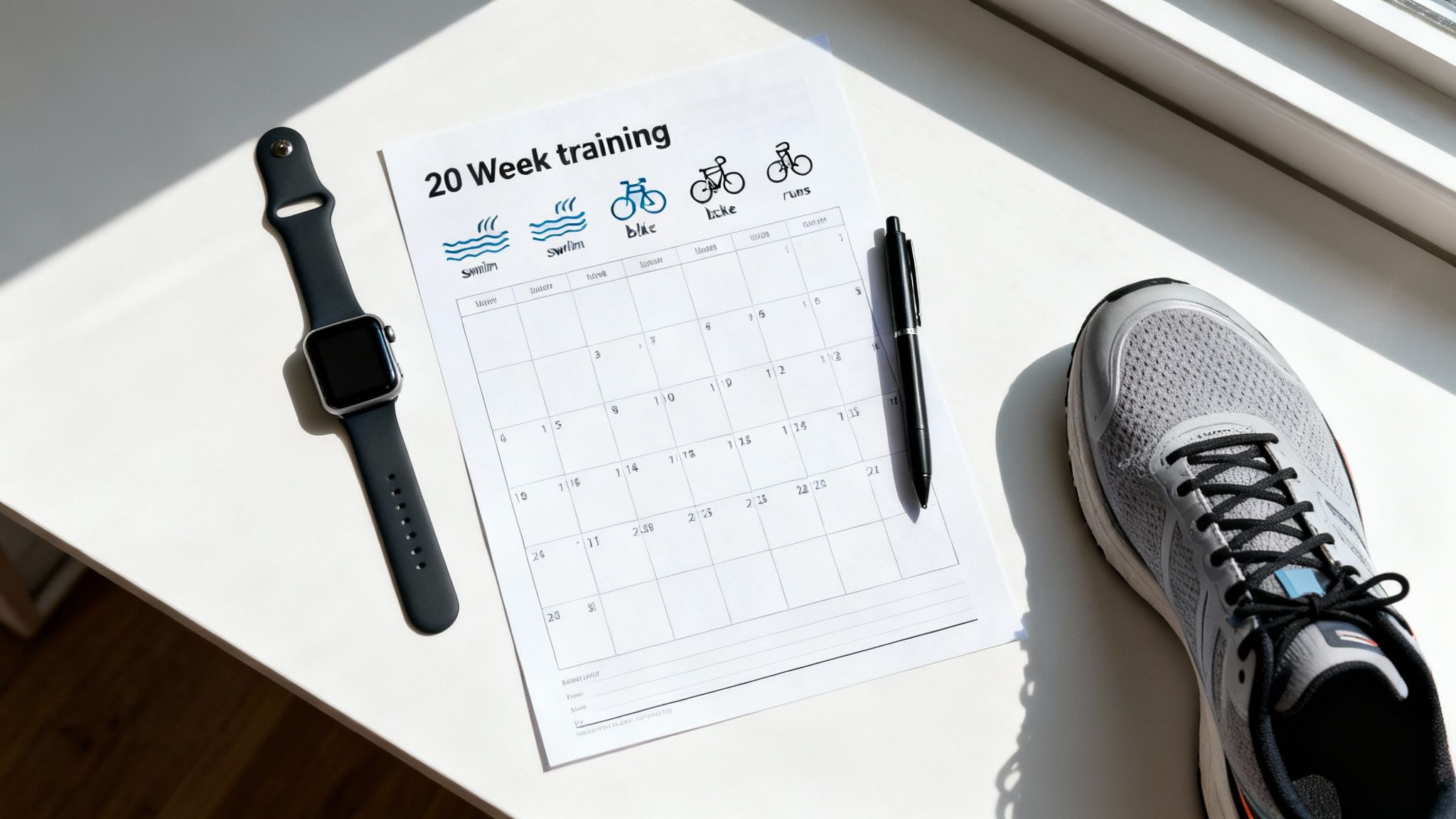
Alright, this is where it all starts to feel real. A solid 20-week plan is the engine that will drive your Half Ironman journey, turning that big goal into small, achievable steps you can tackle every single day.
This schedule is much more than just logging miles. It's a carefully designed progression meant to build your endurance from the ground up, add in race-specific strength, and get you to the starting line feeling confident and, most importantly, healthy.
We've broken this plan into three distinct phases, each with a clear focus. You'll start by building your foundation, then layer on intensity, and finish with a taper that leaves you rested and ready to fly on race day.
Phase 1: Laying the Foundation (Weeks 1-8)
The first eight weeks are all about one thing: building your aerobic engine. Think of it like putting down the foundation for a house—you can't build the walls and roof without a solid, stable base. This is where you develop the ability to go long.
During this phase, almost all of your training will be at a low intensity, what many coaches call Zone 2. This is a truly conversational pace. If you can't chat with a training partner without gasping for air, you're going too hard. It feels almost counterintuitively easy, but this "slow" work is pure magic for building endurance and teaching your body to burn fat for fuel, which is absolutely critical for a 70.3.
Your weekly schedule will be all about consistency.
- Swim: Two sessions a week. One should focus on drills and technique, the other on a longer, continuous swim to build comfort.
- Bike: Two or three rides. A couple of shorter mid-week sessions and one long, steady ride on the weekend that gets a little longer each week.
- Run: Two or three runs, following the same pattern as the bike—shorter mid-week efforts and a long, slow distance (LSD) run on the weekend.
The name of the game here is just showing up. Don't stress about speed. Just put in the time at an easy effort. The speed will come later, I promise.
Phase 2: Building Strength and Speed (Weeks 9-17)
With a solid aerobic base under your belt, it’s time to start sharpening the tools. These next nine weeks are the "build" phase, where we strategically add intensity and workouts that mimic the demands of race day. This is where you’ll really feel your fitness skyrocket.
We’ll begin to introduce workouts that push you out of your comfort zone, like tempo runs and lactate threshold intervals on the bike. These are the sessions that teach your body to hold a stronger pace for longer. Your long rides and runs on the weekend will keep growing, peaking about three to four weeks out from your race.
The real purpose of the build phase is to simulate race day. You're not just getting fitter; you're dialing in your nutrition strategy, building mental toughness, and learning how to manage your effort over several hours.
Here’s what a peak week might look like during this phase:
| Day | Morning Session | Afternoon/Evening Session | Focus |
|---|---|---|---|
| Monday | Rest or Active Recovery | Muscle repair and adaptation | |
| Tuesday | Swim: 2,000m with intervals | Run: 45 min tempo | Building speed endurance |
| Wednesday | Bike: 90 min with threshold sets | Strength: 30 min | Increasing power and core stability |
| Thursday | Run: 60 min easy | Aerobic maintenance | |
| Friday | Swim: 2,500m steady | Endurance and open water simulation | |
| Saturday | Long Bike: 3.5 - 4 hours | Race simulation and nutrition practice | |
| Sunday | Brick Workout: Bike 90m -> Run 45m | Bike-to-run transition efficiency |
This phase is tough, which is why your rest days are non-negotiable. Listening to your body is the key to avoiding burnout and injury.
Phase 3: The Taper and Peak (Weeks 18-20)
You’ve done the work. Now it’s time to reap the rewards. The final two to three weeks are all about the taper. This is where you intentionally cut back your training volume to let your body shed all that built-up fatigue and fully absorb your fitness.
It’s a common rookie mistake to feel lazy or worry about losing fitness during the taper. In reality, the exact opposite is happening. This is when you truly get stronger. You’ll reduce the length of your workouts by 40-60% while keeping a few short, sharp efforts in there to stay primed for race day.
The final week before the race will be very light. Just a few short and easy sessions to keep the legs moving and help manage those pre-race jitters.
Why These Workouts Matter
Knowing the "why" behind your training makes every session more meaningful.
- Long Slow Distance (LSD) Workouts: These weekend epics are the absolute bedrock of endurance. They build your cardiovascular system, strengthen muscles, and are the perfect dress rehearsal for your race-day nutrition and hydration plan.
- Lactate Threshold (LT) Intervals: Done at a "comfortably hard" effort, these intervals push you right to the edge of your sustainable pace. Training here teaches your body to clear lactate more efficiently, which means you can hold a faster pace for longer before your legs start screaming.
- Brick Workouts (Bike-to-Run): A brick is simple: you run immediately after getting off the bike. This is crucial for training your legs to handle the unique jelly-like feeling of running after a long ride. There's no faking it—you have to practice this transition.
By trusting this phased approach, you’re doing more than just checking boxes on a schedule. You are on a smart, sustainable path to becoming a Half Ironman.
Mastering The Swim, Bike, And Run
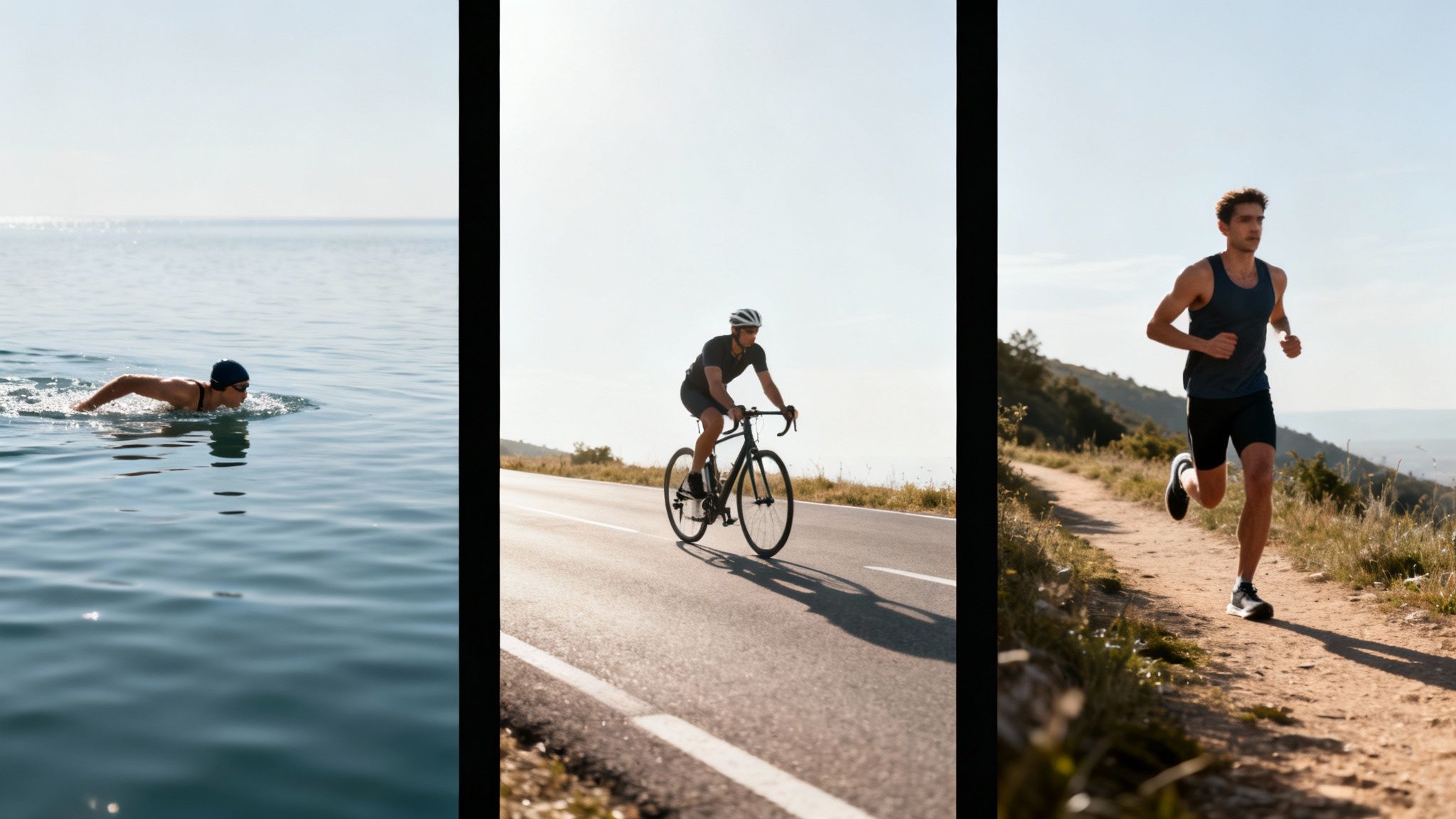
Crushing a Half Ironman is about much more than just putting in the hours. The real progress happens when you start training smarter, not just harder. It's about refining your technique in each discipline, building specific skills, and knowing exactly how to execute when the starting gun goes off. This is where you level up from simply training to becoming a true triathlete.
Let’s get into the nitty-gritty—the drills and race-day strategies that will smooth out your swim, power up your bike, and make your run feel surprisingly strong. These are the details that turn a long, hard day into a race you'll be proud of.
Conquering The Open Water Swim
Let's be honest: for a lot of newcomers, that 1.2-mile open water swim is the most nerve-wracking part of the day. But here's the good news: confidence in the water is a skill you can build, just like any other. Forget about speed for now; our primary goal is getting comfortable and efficient.
It all starts in the pool with drills that have a direct payoff in open water. Sighting, for instance, is absolutely non-negotiable. Get in the habit of lifting your head just enough for your eyes to peek over the water, spot a landmark, and then drop your face back in without missing a beat in your breathing rhythm. Try doing this every 6-8 strokes until it feels second nature.
Another game-changer is drafting. Tucking in behind or just to the side of another swimmer can cut your energy output by up to 30%. Grab a training buddy and practice this in the pool. You'll quickly get a feel for that "sweet spot" where you get all the benefit without constantly bumping their feet.
Here are a few of my go-to pool drills to work into your routine:
- Catch-up Drill: This one forces you to slow down and focus. Keep one arm fully extended out front until the other one completes a full stroke and "catches up" to it. It’s all about developing a long, powerful pull.
- Fist Drill: Ball your hands into fists and swim. It feels weird, but it teaches you to use your forearms as paddles. When you finally open your hands again, you'll be amazed at how much more water you can "feel" and pull.
- Bilateral Breathing: If you're not already, start breathing to both sides (every third stroke is a good rhythm). This not only balances out your stroke but also prepares you to handle anything race day throws at you, from choppy water to a blinding sun.
Dominating The 56-Mile Bike Leg
The bike is where you’ll spend the most time, so efficiency is everything. And it all begins with a professional bike fit. Seriously, don't skip this. It's not a luxury—it's the single best investment you can make to prevent injury, maximize your power, and actually stay comfortable for hours on end.
Once your position is dialed in, it's time to become one with your gears. The goal is to maintain a steady cadence (your pedal speed, in revolutions per minute or RPM) no matter what the road does.
Aim for a cadence somewhere in the 80-95 RPM range on both flats and climbs. The trick with hills is to shift into an easier gear before you start grinding. Keep those legs spinning! This tactic saves precious muscular energy, which you'll be desperate for when it’s time to run. For a deeper dive, check out our guide on building a solid cycling training plan for beginners.
Running Strong To The Finish Line
Running a half marathon after biking 56 miles is a totally different beast. Your legs are going to feel… weird. "Jelly legs" is a common term for it, and it's very real. This is exactly why the brick workout is your secret weapon.
A brick workout—running immediately after a bike ride—is the single most important session in your training plan. It conditions your body and mind for that bizarre bike-to-run transition, so it doesn't feel like a total shock on race day.
These don't have to be monumental workouts. Even a quick 15-20 minute run off the bike is enough to start teaching your neuromuscular system how to adapt. As your race approaches, these sessions become crucial dress rehearsals for everything from your pacing to your nutrition. You'll build the specific muscular endurance needed to run well when you're already fatigued.
The final piece of the puzzle is pacing your run. The biggest rookie mistake is flying out of transition full of adrenaline. Your first mile off the bike should feel almost painfully slow. Give your body a chance to adjust and find its running rhythm. Trust the work you’ve put in, stick to your plan, and you'll have what it takes to cross that finish line with a smile.
Fueling Your Body For Endurance And Recovery
A great training plan will only get you so far. The real magic happens in the kitchen and during your downtime. Fueling and recovery aren't just afterthoughts; they're the bedrock of any successful half ironman training plan for a beginner. Think of it this way: food is the high-performance fuel for your engine, and recovery is the essential maintenance that keeps you on the road.
Let's get one thing straight: this isn't about some crazy restrictive diet. It’s about building a smart, sustainable way of eating that supports the incredible demands you’re placing on your body. You're working harder than ever, and you need to give your body the right building blocks to perform, repair, and come back stronger.
Daily Fueling for the Endurance Athlete
Your everyday nutrition is what lays the foundation for every single workout. When you're deep in a training block, your main job is to eat enough calories, with a laser focus on carbohydrates and protein.
Carbohydrates are your body's go-to energy source. They're what fill up your glycogen stores—the fuel tanks in your muscles and liver—that power you through those long weekend bike rides and runs. Make complex carbs like oats, brown rice, sweet potatoes, and whole grains a non-negotiable part of every meal.
Protein is just as critical for muscle repair and getting stronger. After a tough session, your muscles are full of microscopic tears; protein is what swoops in to rebuild them. Make sure you're getting lean sources like chicken, fish, eggs, tofu, or legumes with each meal to nail this crucial recovery process.
Crafting Your Race Day Fueling Plan
Race day nutrition is a puzzle you have to solve long before you're standing on the starting line. The golden rule is simple: nothing new on race day. This means every long training session from here on out is a full dress rehearsal for your fueling strategy.
On the bike and run, your goal is to drip-feed your body easily digestible carbs to keep from "bonking"—that awful moment when your energy stores completely bottom out.
- Carbohydrate Target: Most athletes do well aiming for 60-90 grams of carbohydrates per hour. This is a solid benchmark for endurance events and provides that steady stream of energy you need.
- Hydration Target: While "drink to thirst" is good advice, you also need to have a plan. A great starting point is 20-25 ounces (about 600-750 ml) of fluid per hour, but you'll need to adjust this based on how hot and humid it is.
- Electrolyte Intake: Make sure your sports drink or gels contain sodium and other key electrolytes. You need to replace what you're losing in sweat to help prevent cramping and keep your system firing correctly.
"Gastrointestinal (GI) distress is one of the top reasons beginners have a bad race day. The only way around it is to train your gut. You have to practice with your chosen gels, chews, and drinks on every long workout to figure out exactly what your stomach can handle."
Pacing the Smart Way
Pacing is the art of managing your energy. I’ve seen it a thousand times: the single biggest mistake a beginner can make is going out way too fast in the swim or on the bike. You're basically writing a check your body can't cash, and it almost always leads to a long, miserable death march on the run.
Your best friends for pacing are your heart rate monitor and your sense of Rate of Perceived Exertion (RPE). In the early stages of training, just focus on keeping your effort in Zone 2. That’s a comfortable, conversational pace where you could chat with a training partner. This is how you build a massive aerobic base without piling on unnecessary fatigue.
As you get closer to race day, you'll start to dial in what your "all-day" pace really feels like. The goal on the bike isn't to break any speed records; it's to conserve as much energy as possible so you can have a strong run. For a deeper dive into building that run-specific stamina, you can learn how to improve running endurance with some targeted strategies.
Recovery Is Part of the Training
Remember this: you don't get stronger during your workouts. You get stronger when you recover from them. Skimping on recovery is the fastest way I know to get injured, burned out, and stuck on a performance plateau.
Treat these recovery methods like they're a scheduled workout. They are non-negotiable.
- Sleep: Honestly, this is your most powerful recovery tool. Aim for 7-9 hours of quality sleep every night. This is when your body does the heavy lifting of hormonal regulation and tissue repair.
- Active Recovery: An easy session like a gentle swim, a slow spin on the bike, or even just a walk can do wonders. It promotes blood flow to tired muscles, helping flush out metabolic waste without adding more training stress.
- Mobility Work: Just 10-15 minutes a day of foam rolling or dynamic stretching can make a huge difference. Focus on key trouble spots for triathletes, like your hips, glutes, and hamstrings, to maintain flexibility and keep common overuse injuries at bay.
Your Essential Gear and Race Day Logistics
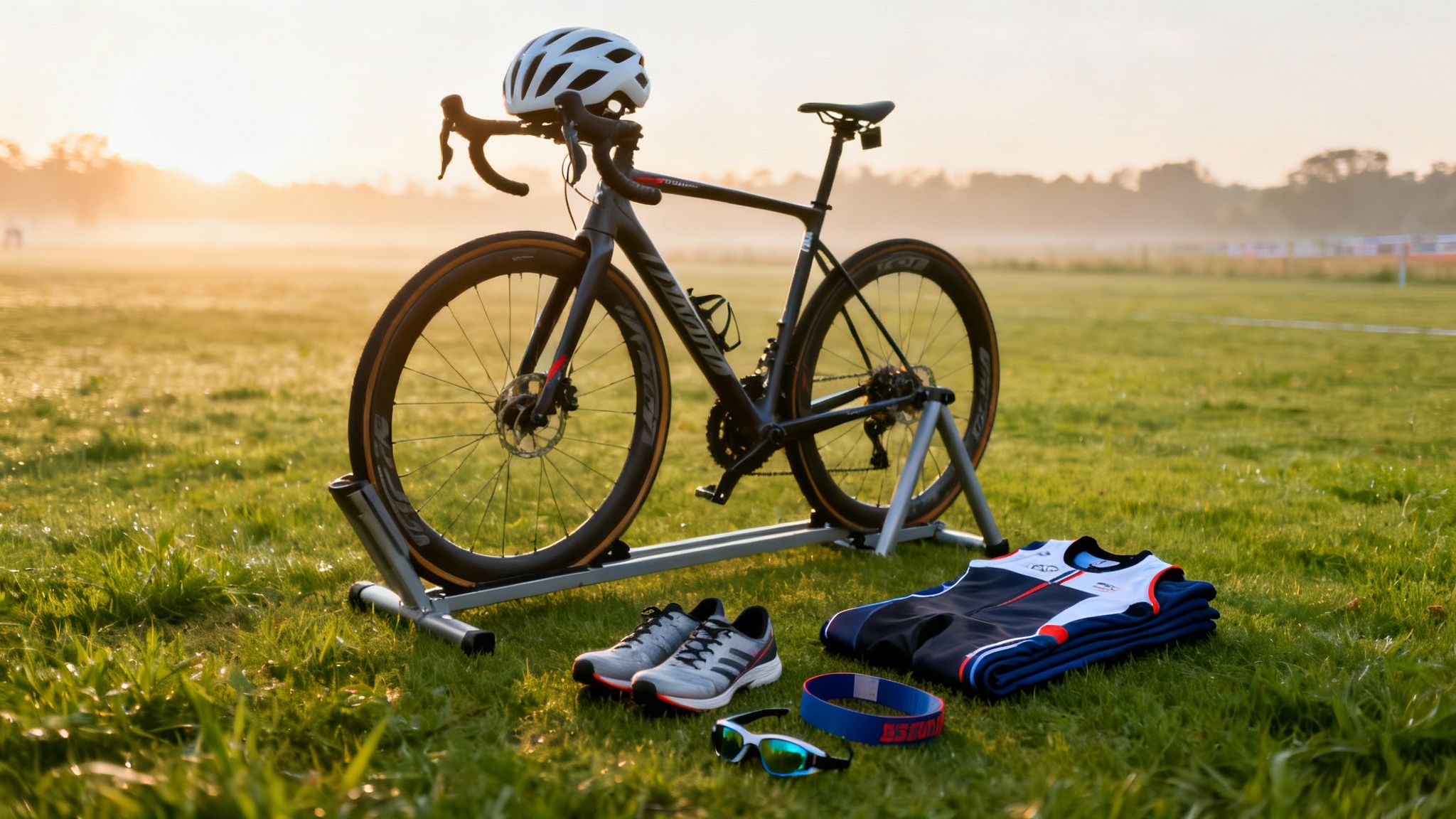
Showing up to the start line feeling confident isn't about luck—it's about preparation. When you have all your gear sorted and a clear plan for race week, you can eliminate a massive amount of stress and just focus on the race itself. This is all about controlling what you can control.
Don't get too caught up in the high-tech, expensive side of triathlon just yet. Your primary goal is to find gear that is reliable and comfortable. You don't need the flashiest bike to cross that finish line with a huge smile on your face.
Beginner Half Ironman Gear Checklist
It's easy to get overwhelmed and overspend when you're starting out. This checklist covers the absolute must-haves to get you through the race safely and comfortably, along with a few things that are nice to have.
| Discipline | Essential Gear | Optional But Recommended |
|---|---|---|
| Swim | Wetsuit (if allowed), tinted goggles, swim cap (usually provided) | Anti-chafe balm, earplugs |
| Bike | Road or triathlon bike, CPSC-certified helmet, cycling shoes & pedals | Clip-on aerobars, bike computer, flat repair kit |
| Run | Well broken-in running shoes, moisture-wicking socks, race number belt | Hat or visor, sunglasses |
| General | Triathlon suit (tri suit), sunscreen, 2 water bottles for your bike | Transition towel, post-race change of clothes |
One of the best early investments you can make is a triathlon suit (or tri suit). You wear it for the entire event—swim, bike, and run—which saves a ton of time and hassle in transition. For a deeper dive into what to wear, our guide on what to wear for triathlons is a great resource.
Nailing Your Race Week Logistics
The final week is less about building fitness and all about getting organized. Your taper should be in full swing, meaning your workouts are getting shorter and less intense. This is crucial for letting your body fully recover and store up energy for the big day.
Lay out all your gear at least two days before you travel. Pack your transition bags and check everything off your list. This simple step gives you a buffer to grab any last-minute items you might have forgotten without panicking.
A classic rookie mistake is the giant pre-race pasta dinner. Instead, stick to a familiar, easy-to-digest meal—something you've eaten many times before a long training day. The goal is to top off your energy stores, not show up to the start line feeling bloated.
Setting Up Your Transition Area
Think of the transition area as your personal pit stop. Get there early on race morning so you can set everything up without rushing. Lay down a small, brightly colored towel to mark your spot—it makes it much easier to find when you're disoriented coming out of the water.
Organize your gear in the order you'll need it.
- T1 (Swim to Bike): Have your helmet upside down with the straps open and your sunglasses already inside. Keep your race number belt unclipped and ready to grab.
- T2 (Bike to Run): Place your running shoes where you can't miss them, with the laces untied or pre-set if you're using elastic ones. Your hat and any final nutrition can be tucked inside a shoe.
Before the race starts, physically walk the flow of transition. Know the path from "Swim In" to your bike, and from your bike to "Bike Out." Do the same for the run. Knowing the layout by heart will prevent you from running in circles when your heart rate is maxed out. Get these details locked down, and you can focus on what really matters: enjoying the incredible race you've worked so hard for.
Got Questions About Your First Half Ironman? We've Got Answers.
Stepping up to your first Half Ironman is a huge undertaking, and it's totally normal for your head to be swimming with questions. Everyone from the back-of-the-packer to the podium contender has wondered, "Am I doing this right?" or "What the heck is a good finish time, anyway?" Let's clear the air and make sure you feel confident that your beginner half ironman training plan is setting you up for success.
It's easy to look at a 20-week plan on a calendar and feel a wave of panic. How will you ever fit it all in? But here’s the secret: you aren't training for a Half Ironman every single day. You're just doing today's workout. Trust that those small, consistent efforts are what build incredible fitness over time.
What's a Good Finish Time for a Beginner?
This is the million-dollar question, isn't it? The honest answer is that a "good" time is whatever time you cross the finish line with a smile on your face. Seriously. For your first 70.3, the real victory is finishing healthy, strong, and proud of what you've accomplished. That experience is something no clock can measure.
That said, it helps to have some benchmarks so you know what to expect. Amateur finish times are all over the map, depending on someone's background and how their training went. A competitive age-group athlete might be shooting for a sub-5-hour finish, while many first-timers are absolutely thrilled to come in between 6 and 7 hours. To put that in perspective, the pros are flying through the course in 3 hours 50 minutes to 4 hours 5 minutes. It just shows the incredible range of the sport. You can always explore average triathlon times to see the full spectrum.
Your only competition in your first Half Ironman is yourself. Focus on executing the race you trained for, managing your nutrition, and soaking in the experience. The time on the clock is just a number; the journey is the real prize.
Can I Get Away with Skipping Strength Training?
I get it. When you're already juggling three sports, the last thing you want to do is go to the gym. It’s so tempting to trade that strength session for a little more time on the bike or an extra hour of sleep. But trust me on this: that's a huge mistake.
Strength training is the glue that holds your endurance together. Just one or two 30-minute sessions a week focusing on your core, glutes, and hips will pay you back tenfold. Think of it as your injury-prevention insurance policy. A strong core keeps you stable and powerful on the bike, strong glutes protect your knees during the long run, and mobile hips help you avoid all those classic overuse aches and pains. Don't skip it.
How Do I Know If I'm Overtraining?
Learning to listen to your body is one of the most important skills you'll develop as an endurance athlete. Overtraining isn't just feeling tired after a hard workout; it's a deep, persistent fatigue that a single rest day can't fix. Your body is waving a red flag.
Be on the lookout for these classic signs:
- Lingering Soreness: Your muscles are still aching days after a workout that shouldn't have been that hard.
- High Resting Heart Rate: You notice your morning heart rate is consistently 5-10 beats per minute higher than your normal baseline.
- The "Blahs": You start dreading workouts you used to look forward to.
- Junk Sleep: You're exhausted but find yourself tossing and turning or waking up frequently.
If you start ticking these boxes, hit the brakes. Take an extra rest day or two. It is always, always smarter to show up to the start line slightly under-trained than to be overtrained, burnt out, or injured. Your training plan is a guide, not gospel.
Celebrate your incredible achievement with a custom race poster from RoutePrinter. Turn your hard-earned miles into a piece of art that commemorates your Half Ironman journey. Design your personalized print today.