Your Ultimate Beginner 70.3 Training Plan to Conquer Race Day

So, you’ve decided to take on a 70.3 triathlon. That’s a huge goal—a 1.2-mile swim, 56-mile bike, and 13.1-mile run—and one that’s absolutely within your reach with the right approach. It can feel a little overwhelming at first, but the secret is breaking that massive challenge down into small, manageable steps.
The cornerstone of any successful training plan, especially for a first-timer, is consistency over intensity. We're focused on getting you to the starting line healthy and the finish line strong, which means building your endurance methodically over several months. This isn't about crushing every workout; it's about smart, structured progress that balances training with the recovery your body needs.
Your 70.3 Journey Starts Here
This plan is built specifically for beginners. We're going to build a powerful aerobic base without the burnout that often sidelines enthusiastic athletes who do too much, too soon.
The philosophy is simple: steady, consistent effort is way more powerful than a few heroic, all-out sessions. Think of it as a journey where smart training and injury prevention are your top priorities. You don't need to be a superhuman to earn that finisher's medal. You just need a solid plan.
Understanding The Time Commitment
Let's be realistic—training for a 70.3 is a significant time investment. You should plan on dedicating between 8 and 12 hours per week to training. For most beginners, a 20-week timeline is the sweet spot.
This allows for a gradual, safe build-up. We'll structure it in phases, starting with an eight-week base-building phase to develop your aerobic engine at an easy, conversational pace. After that, we’ll move into a six-week build phase where we'll start adding some race-specific intensity. You can explore other Half Ironman training plans to see how common this proven structure is.
This kind of gradual adaptation is the secret sauce for long-term success in endurance sports. It gives your body time to adjust and get stronger without breaking down.
The goal isn't just to finish. It's to arrive at the starting line feeling confident, healthy, and genuinely prepared. This plan is your roadmap to not only surviving race day but actually enjoying the incredible accomplishment you've worked so hard for.
To give you a bird's-eye view of what to expect over the next few months, here’s a quick summary of the training plan's structure.
Beginner 70.3 Training Plan At A Glance
| Training Phase | Duration (Weeks) | Primary Focus | Average Weekly Hours |
|---|---|---|---|
| Phase 1: Base Building | 8 | Aerobic endurance, consistency, technique | 8-10 |
| Phase 2: Build | 6 | Race-specific intensity, building strength | 10-12 |
| Phase 3: Peak | 4 | Race simulation, peak fitness | 11-13 |
| Phase 4: Taper & Race | 2 | Recovery, sharpening, race prep | 4-6 |
This table shows how your focus and training volume will shift as you get closer to race day, ensuring you're perfectly primed for the starting line.
Essential Gear Without The Hype
Getting started in triathlon doesn't mean you need to empty your bank account on the fanciest gear. Focus on the fundamentals. You can always upgrade later if you get hooked on the sport.
Here’s a no-nonsense list of what you truly need:
- Swim: A comfortable swimsuit is a given. You'll also need a good pair of goggles that don’t leak (this is a big one!) and a bright swim cap for visibility. If you’re swimming in open water, a triathlon-specific wetsuit is a must-have for warmth and buoyancy.
- Bike: You don't need a pro-level time trial bike. A standard road bike in good working condition is perfect for a beginner. The non-negotiables are a helmet, a couple of water bottles, and a simple flat tire repair kit (with the knowledge of how to use it!).
- Run: Your most important investment. Go to a specialty running store and get properly fitted for a pair of running shoes that match your gait. Seriously, don't skimp here—the right shoes are your best defense against injury. A few pieces of comfortable, moisture-wicking clothing will make those long runs far more enjoyable, too.
That's it. This basic gear will get you through every training session and all the way across the finish line.
The Four Phases Of Your Training Plan
A successful beginner 70.3 training plan isn't just a 20-week slog. It’s a smart progression, carefully laid out to build your fitness from the ground up, add strength when you're ready for it, and then ease off so you hit the start line feeling powerful, not just worn out.
Think of it less like a marathon sprint and more like four distinct chapters, each with its own mission. Breaking your journey down this way makes the whole thing feel way less intimidating. It also guarantees you're doing the right kind of work at the right time, which is the real secret to getting fit without getting hurt.
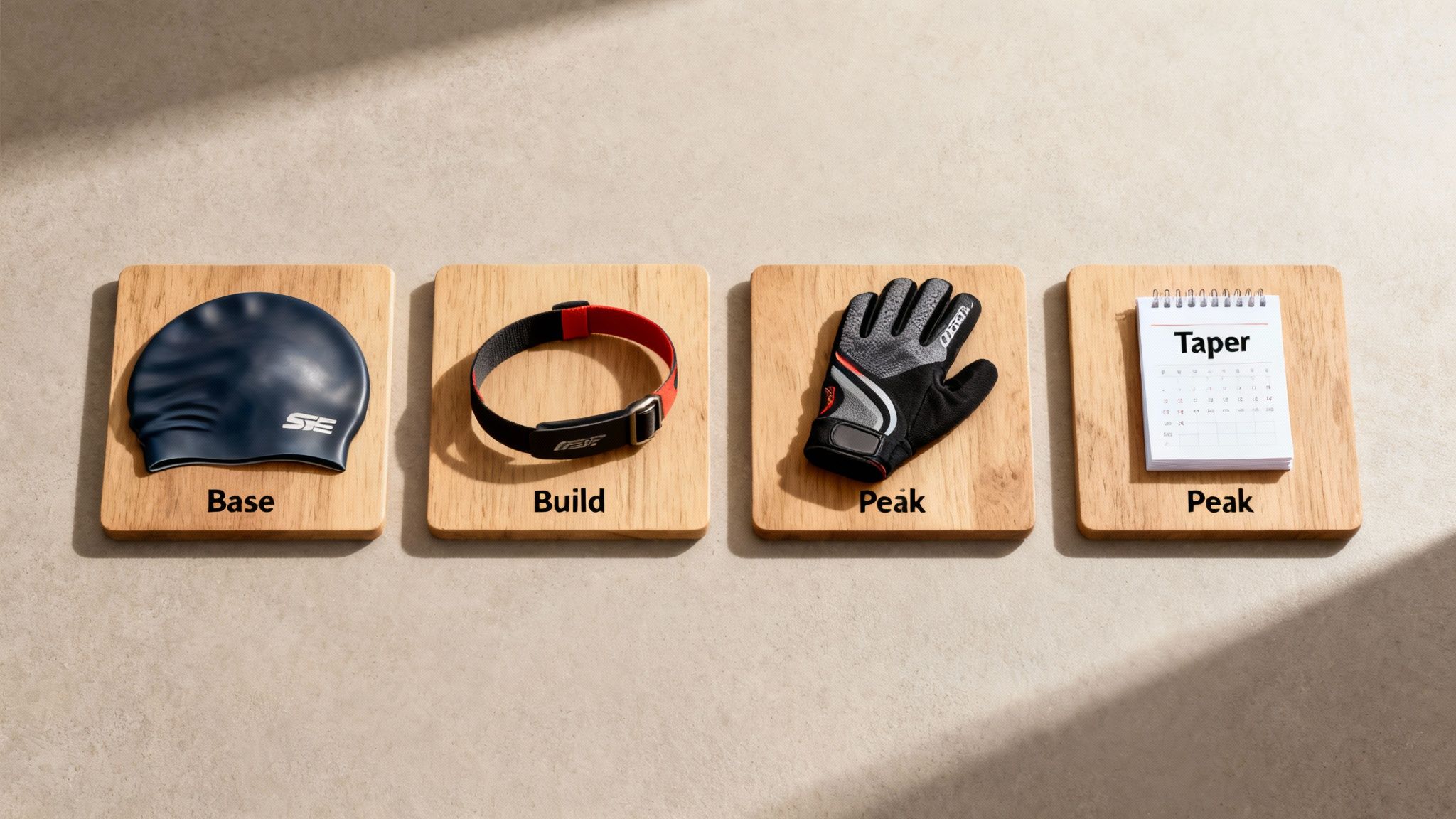
Let’s pull back the curtain on each phase so you know what you're doing and, more importantly, why you're doing it.
Phase 1: The Base Building Phase (Weeks 1-8)
This is the bedrock of your entire race. For the first eight weeks, your one and only job is to build a rock-solid aerobic base. That means lots of low-intensity, steady effort across swimming, biking, and running.
The biggest mistake I see beginners make is going out way too hard, way too soon. You have to fight that urge. During the base phase, almost all of your training should be done at a conversational pace. If you can't chat with a friend during your runs and bike rides, you're going too hard.
This low-and-slow approach teaches your body to get really good at burning fat for fuel—a skill that’s absolutely essential for a long day like a 70.3. We're not trying to set speed records here. We're building the endurance engine that will power you through all the tough stuff to come.
Your focus for these weeks is simple:
- Consistency is king. Just show up. Aim to complete 80-90% of your scheduled workouts. That’s a huge win right now.
- Focus on form. Use this time to drill good technique, especially in the pool. A single session with a swim coach or just watching some YouTube videos can pay off big time down the road.
- Build volume slowly. Gradually increase your total training time each week. A good rule of thumb is to add about 10% more volume for three weeks, then take an easier recovery week.
Think of it like pouring the foundation for a house. You wouldn't rush it, because you know the whole structure depends on it. A strong aerobic base supports all the speed and intensity you'll pile on later.
Phase 2: The Build Phase (Weeks 9-14)
Okay, the foundation is set. Now it’s time to start putting up the walls. This six-week build phase is where we start sprinkling in some race-specific intensity and upping the overall training load. The workouts get a little tougher and a lot more focused.
You’ll start doing efforts at your goal race pace, which helps your body and mind get used to what the 70.3 will actually feel like. This is when your fitness really starts to sharpen as you mix in things like tempo runs, bike intervals, and longer, more challenging swim sets. You'll start to feel like a triathlete.
For example, a bike workout might go from a simple 90-minute easy spin to a session that includes a few 10-minute blocks at your target 70.3 effort. It’s a game-changer for preparing your body for that sustained push on race day.
Your weekly volume will continue to climb, probably peaking around 10-12 hours per week. It’s a definite step up, but that base you built earlier makes it all manageable. If you ever get the itch to go even longer, this same structured approach is key—you can see how it applies to the full distance in our comprehensive Ironman training plan guide.
Phase 3: The Peak Phase (Weeks 15-18)
This is it. The four-week peak phase is where all your hard work starts to come together. We’re going to push you to your highest level of fitness with the longest and most race-specific workouts of the entire plan.
The main event of this phase is your big weekend endurance sessions. You'll tackle your longest bike rides (getting up to 50-60 miles) and your longest runs (up to 12-13 miles). And most importantly, you'll become an expert at the brick workout—that’s a bike ride followed immediately by a run.
Brick workouts are non-negotiable. They train your legs to handle that bizarre "jelly legs" feeling you get when you hop off the bike and try to run. If you haven't practiced it, that transition can be a real shock on race day.
Here's what this phase is all about:
- Race Day Rehearsal: Use your long brick sessions to mimic the race. Practice your nutrition and hydration strategy exactly as you plan to on the big day. No surprises.
- Maximum Volume: Your training will hit its highest point, likely around 11-13 hours per week. It's tough, but you're ready for it.
- Building Bulletproof Confidence: Grinding through these long workouts does wonders for your mental game. When you finish a 50-mile ride and then knock out a 45-minute run, you'll know without a doubt that you can do this.
Phase 4: The Taper and Race Phase (Weeks 19-20)
After all that work, it’s finally time to rest. The taper is easily one of the most critical—and most butchered—parts of a training plan. For these last two weeks, you’ll dramatically cut back your training volume. This gives your body the time it desperately needs to recover, repair, and soak up all the fitness you’ve built.
Cutting back feels weird. I get it. You might feel antsy or worry that you're losing fitness. The exact opposite is happening. The taper is where the real magic happens. It lets the fatigue melt away so you can show up to the start line feeling fresh, sharp, and buzzing with energy.
You’ll still swim, bike, and run, but your workouts will be way shorter. We'll keep a few short, sharp efforts in there just to keep the engine primed, but the overall workload will drop by 40-60%. You have to trust the process. A good taper can boost your performance by up to 3%, and on race day, that adds up to minutes, not just seconds.
How To Structure Your Training Week
Alright, you understand the training phases, but how do you actually cram all this swimming, biking, and running into a real-life week? This is where the rubber meets the road. The secret to sticking with a plan isn’t just having the workouts written down—it’s about arranging them so they work with your life, not against it.
A smart weekly schedule is your best defense against burnout and injury. Think about it: scheduling your hardest run the day after your longest bike ride is like trying to build a house on a foundation that's still wet. It’s just asking for trouble.
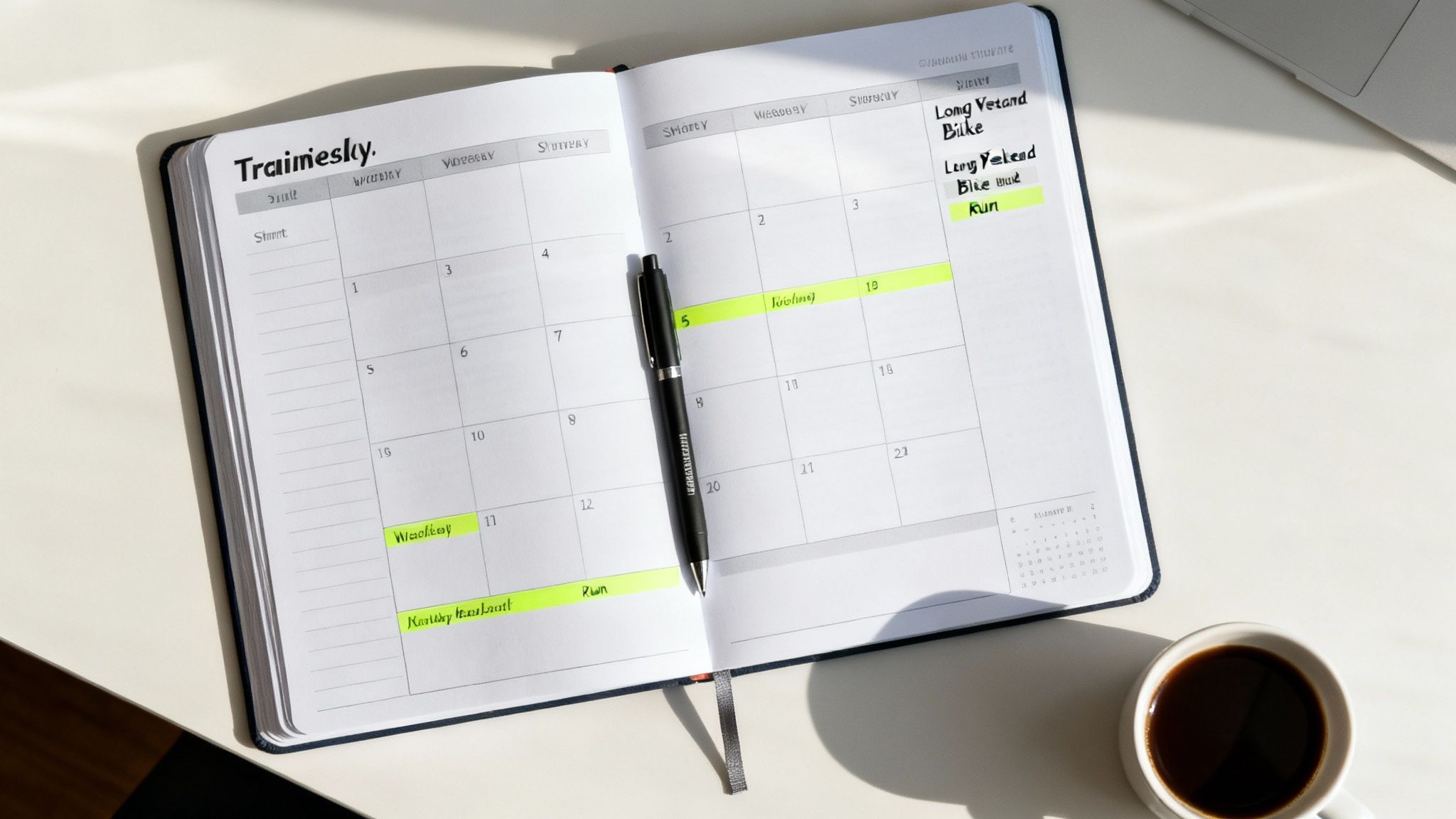
The idea is to find a rhythm that feels predictable and eventually becomes second nature. Let’s look at a practical way to set this up.
The Weekday And Weekend Split
For most of us working a typical Monday-to-Friday job, the best approach is beautifully simple: keep the weekday workouts shorter and sharper, and save the long endurance stuff for the weekend. This is the most efficient and sustainable way to manage the training load.
- Weekdays (Monday-Friday): This is your time for quality over quantity. Think of a 60-minute swim packed with technique drills, a 45-minute run where you focus on holding a specific pace, or a 75-minute indoor bike session with structured intervals.
- Weekends (Saturday-Sunday): Welcome to endurance-building headquarters. Your long bike ride and long run live here, simply because they demand the most time and will take the most out of you.
This split lets you build serious fitness without showing up to work on Tuesday feeling like you’ve already run a marathon. It’s a model that works for the long haul.
A Sample Week From The Build Phase
To show you what this looks like in practice, here’s a snapshot from a typical week in the Build Phase (around week 12). At this point, you’re getting seriously fit and balancing endurance with some real intensity.
| Day | Workout | Duration & Focus |
|---|---|---|
| Monday | Rest or Active Recovery | 30-45 mins. This is non-negotiable. An easy walk or some light stretching is all you need. |
| Tuesday | Swim | 60 mins. Work on drills and build stamina with longer, steady swimming intervals. |
| Wednesday | Bike (Indoor Trainer) | 75 mins. This is a great day for intervals at your goal 70.3 effort to build power. |
| Thursday | Run (Tempo) | 45-60 mins. After a good warm-up, lock in for 20-30 minutes at a "comfortably hard" pace. |
| Friday | Swim | 45 mins. A lighter day in the pool focused on technique. The goal is to feel fresh for the weekend. |
| Saturday | Long Bike Ride | 3 - 3.5 hours. Ride at a steady, aerobic pace and start dialing in your race day nutrition. |
| Sunday | Long Run | 90 mins. The goal here is an easy, conversational pace to build endurance on already-tired legs. |
See the logic? The two toughest sessions—the long bike and long run—are separated by almost a full week, giving your legs plenty of time to bounce back. The Friday swim is intentionally light so you go into your big weekend feeling strong, not sluggish. This is training smart.
The Unbreakable Rule Of The Rest Day
Life will inevitably get in the way. You'll get slammed at work, a kid will get sick, or you’ll just wake up feeling totally wiped out. The great thing about a plan is that it provides a framework, but you have to give yourself grace. If you miss a workout, just let it go. Don't try to cram two sessions into one day to "catch up." Just get back on track with the next scheduled workout.
But there is one day you must protect at all costs: your rest day. It’s tempting to see it as a buffer day or a chance to squeeze in a missed session. That’s a classic beginner mistake.
Rest isn't a reward; it's a core component of your training. You don't get stronger during your workouts. You get stronger when your body repairs and adapts afterward. Skipping rest days is the fastest way I’ve seen athletes head toward injury and burnout.
There's a reason we're so insistent on this structure. The data is pretty clear—some reports show that only 23% of first-time age-group triathletes manage to finish a half-ironman without following a structured plan. If you want to dive deeper, you can learn more about the importance of structured training on thirdcoasttraining.com. A good plan isn't just about logging miles; it's about making every single mile count.
Fueling Your Body And Mastering Recovery
Here’s a hard-earned truth every seasoned triathlete knows: your workouts are only as good as your recovery. Training actually breaks your body down. It's the nutrition and rest between sessions that build you back up, stronger than before. Getting this right isn't just a side project; it's the engine that will power your entire journey to that finish line.
You simply can’t out-train a bad diet. For anyone tackling a 70.3, food is fuel, plain and simple. Your daily eating habits should be built around two superstars: carbohydrates for energy and protein for muscle repair.
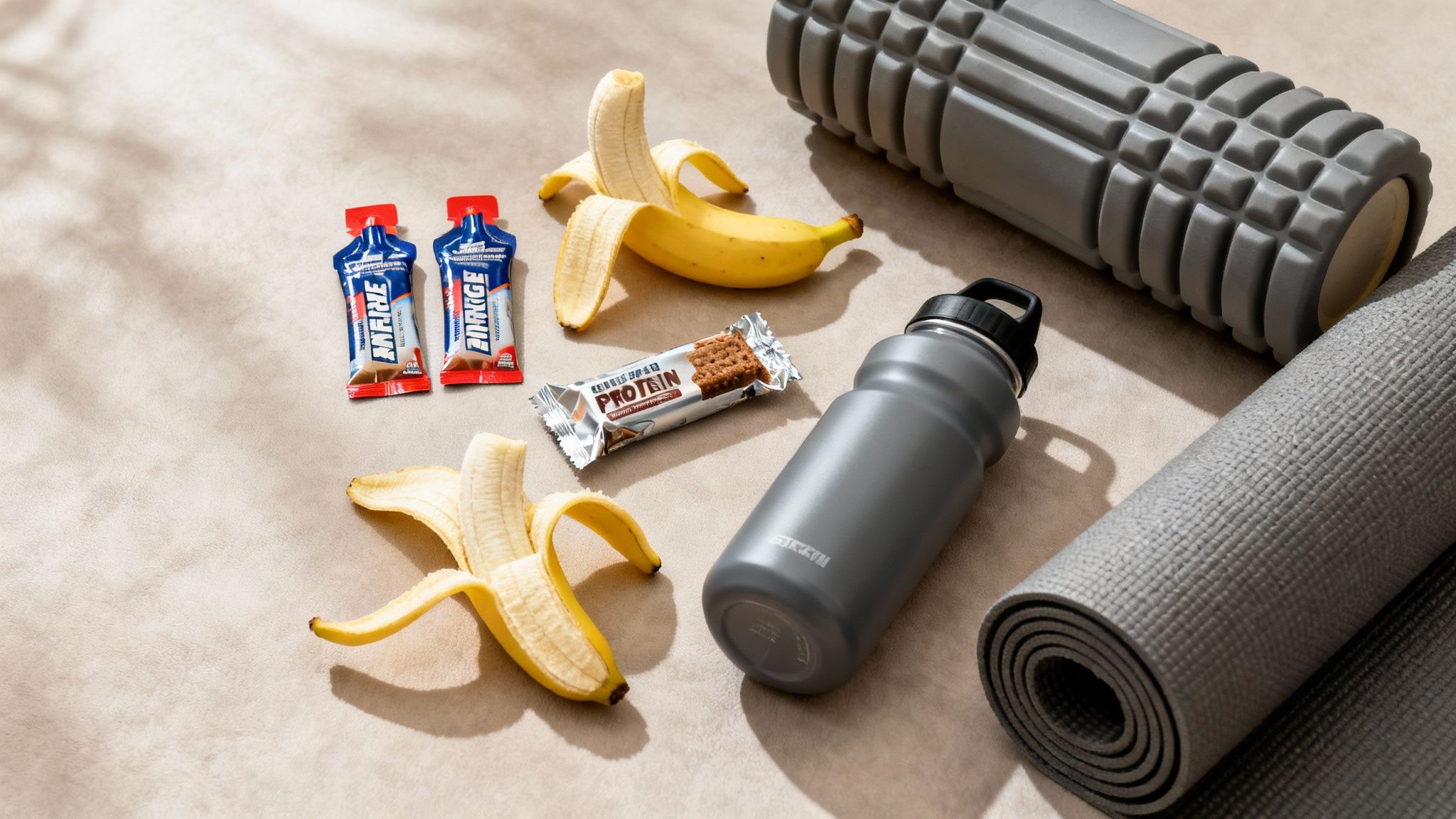
This isn't about being restrictive or going on some crazy diet. It's about consistently giving your body the high-quality materials it needs to perform and adapt. Think of complex carbs like oats, brown rice, and sweet potatoes as the slow-burning logs that keep your energy levels steady all day long.
Nailing Your Workout Nutrition
As you get deeper into the plan and those weekend sessions get longer, dialing in your workout nutrition becomes absolutely critical. This is your dress rehearsal for race day—a chance to figure out what works so there are no gut-wrenching surprises when it matters most.
The strategy is pretty straightforward and breaks down into three key windows.
- Before: Get a carb-rich, easy-to-digest meal in your system 2-3 hours before any workout longer than 90 minutes. A classic bowl of oatmeal with a banana or a bagel with peanut butter is perfect. This tops off your energy tanks before you head out the door.
- During: Once you're working out for more than 75 minutes, you've got to start refueling on the go. The general rule of thumb is 30-60 grams of carbs per hour. This is where energy gels, chews, or sports drinks become your best friends. For a 3-hour bike ride, that might mean packing 2-3 gels and having a sports drink in your bottle.
- After: That "recovery window" you hear about is legit. Try to get a mix of carbs and protein into your system within 30-60 minutes of finishing a tough session. This refills your depleted energy stores and kickstarts the muscle repair process. Something as simple as chocolate milk or a protein shake with a piece of fruit does the trick perfectly.
Think of your body like a car. You wouldn't start a long road trip with an empty tank and expect to get very far. Fueling before, during, and after your workouts is just as essential.
Recovery Is More Than Just Sleep
While getting 7-9 hours of quality sleep a night is the single most powerful recovery tool you have, recovery isn’t just about lying down. Active recovery strategies can make a huge difference in how quickly your body bounces back and feels ready for the next workout.
This is all about helping your muscles repair, cutting down on soreness, and keeping yourself mobile. Don't skip these simple but incredibly effective habits.
- Foam Rolling: Spend 10-15 minutes a few times a week rolling out major muscle groups like your quads, hamstrings, and calves. It’s a fantastic way to release muscle tightness and get the blood flowing.
- Stretching: Focus on gentle, static stretching after your workouts when your muscles are already warm. This helps improve your flexibility and can seriously reduce your risk of injury.
- Active Recovery: An easy 30-minute spin on the bike or a short, relaxed swim on a rest day can do wonders. These low-intensity sessions boost blood flow to your muscles, helping to flush out metabolic waste without adding any real training stress.
Making these habits part of your routine is what separates smart training from just hard training. For a deeper dive into staying healthy, our guide on how to prevent running injuries has practical tips that apply across all three sports. Taking care of your body is the only way to guarantee you’ll make it to the starting line feeling strong and ready.
Your Race Day Logistics And Mental Game Plan
After months of training, it all comes down to this one incredible day. The secret to a great race isn't just about being fit; it's about executing your plan when it counts. Let’s trade those pre-race jitters for the quiet confidence that comes from knowing you’re completely prepared.
A successful race day actually starts the week before. This is where you pivot from hard physical training to sharp mental and logistical prep. The goal is to get so organized that you barely have to think on race morning, saving all that mental energy for the course itself.
Your Essential Race Week Checklist
Seriously, don't be that person scrambling to find their gear the night before. Start laying things out and checking them off a list a few days in advance. A calm mind is a fast mind, and organization is step one.
- Gear Check: Lay out everything you need for the swim, bike, and run, plus both transitions. I mean everything. Use a checklist and physically touch each item as you pack it: wetsuit, goggles (and a spare pair!), bike, helmet, cycling and running shoes, your race kit, and all your nutrition.
- Course Recon: Get your hands on the course maps and study them. If you can, drive the bike and run courses. Make a mental note of the big hills, any tricky turns, and where the aid stations are. Knowing what’s coming is a massive advantage.
- Transition Tour: When you go to packet pickup, take a slow walk through the transition area. Find the swim-in, bike-out, bike-in, and run-out points. Visualize your path from the water to your bike rack and from your rack to the run exit. This mental rehearsal is gold.
Nailing these logistics early frees you from that last-minute panic. This isn't just fluff; it's a critical part of your beginner 70.3 training plan that turns a potentially chaotic morning into a smooth, controlled start.
Mastering Your Transitions
There's a reason people call transitions the "fourth discipline" of triathlon. A messy transition can easily cost you several minutes and a whole lot of stress. Get out to your driveway or a local park and practice T1 (swim-to-bike) and T2 (bike-to-run) until they feel like second nature.
Set up your gear just like you will on race day. Go through the motions of coming out of the "water," stripping your wetsuit, clipping on your helmet, grabbing your bike, and running to the mount line. Then practice the reverse: racking your bike, popping off your helmet, swapping shoes, and heading out for the run. The more you rehearse, the smoother it gets.
Remember, smooth is fast. Fumbling with your helmet or wrestling with your shoes burns precious energy. A calm, practiced transition sets a positive tone for the next leg of the race.
The Mental Game And Pacing Strategy
Your mindset on race day is just as powerful as your legs. A 70.3 is a long, challenging day, and breaking it down mentally makes it far more manageable. Don't think about all 70.3 miles at once.
Just focus on the very next thing. In the water, just swim to the next buoy. On the bike, focus on getting to the next aid station. This approach keeps you present and prevents you from feeling overwhelmed.
Pacing is probably the single biggest key to success for a first-timer. The classic mistake? Going out way too hard on the bike because the adrenaline is pumping. You have to keep it in check.
Here’s a simple mantra to live by on race day:
- Swim Easy: Think of the swim as a long warmup. Settle into a comfortable, sustainable rhythm. Don't waste energy fighting for a few seconds here.
- Bike for Show: This is where you ride at a controlled, conservative effort. Your job on the bike is to methodically take in your fuel and hydration. You should get off the bike feeling strong and ready to run, not totally gassed.
- Run for Dough: The real race starts when you lace up your running shoes. If you paced the swim and bike correctly, you'll have the energy to finish that half marathon strong, picking off all the people who burned their matches too early.
Trust your training, stick to your plan, and soak in the incredible experience you've worked so hard for.
Got Questions? We've Got Answers for First-Time 70.3 Athletes
Stepping up to your first 70.3 is a massive, exciting goal. But let's be honest, it also brings up a ton of questions. You've got the training plan, but it’s all the little "what ifs" that can keep you up at night.
Think of this as your go-to FAQ. We've compiled the most common concerns we hear from athletes just like you, with straight-up answers to help you train smart and avoid those classic rookie mistakes.
How Fit Do I Need to Be Before Starting?
You don't need to be a seasoned pro, but jumping into this 20-week plan without a solid foundation is a recipe for injury and burnout. Before you hit "start" on Week 1, you should feel pretty comfortable with a certain baseline.
Can you confidently handle these workouts?
- Swim: 1,000 meters (or yards) without stopping.
- Bike: A steady 60- to 90-minute ride.
- Run: 45 to 60 minutes of continuous running.
If that sounds like you, you're ready to roll. If you're not quite there, no sweat. Just spend the next 4-6 weeks building up your consistency in each discipline. A little prep work now will pay off big time later.
Are Brick Workouts Really That Important?
In a word: absolutely. A brick workout—a bike ride followed immediately by a run—is your secret weapon for a successful 70.3. It's the only way to truly prepare for that bizarre, wobbly "jelly legs" feeling you get running off the bike.
There's no need to go crazy with these right away. Start weaving them into your training during the "Build" phase, usually about 8-10 weeks before your race.
Start small. A 60-minute bike followed by a quick 15-minute run is a perfect way to introduce your body to the feeling. It teaches your muscles and your mind what's coming.
Aim for one brick session a week as you get closer to the race. This consistent practice is what makes the difference between a strong run finish and a long, painful shuffle.
What Are the Biggest Race-Day Blunders for Beginners?
All those months of dedication can go sideways with a few simple, avoidable mistakes on the big day. We've seen it happen time and time again.
Here are the three big ones to watch out for:
- Going out way too fast. Your adrenaline will be pumping, but torching your energy on the bike is the number one rookie error. It guarantees a miserable half marathon. Be patient and hold back in the beginning.
- Trying new nutrition. Race day is not the time to experiment with a new gel or sports drink. Your long training days are your dress rehearsals. Test everything—and I mean everything—in training and stick to what you know works.
- Panicking in transition. Fumbling with gear or forgetting where you racked your bike can add minutes and a huge dose of stress. Practice setting up your T1 (swim-to-bike) and T2 (bike-to-run) until it becomes second nature.
Avoiding these pitfalls will make your race experience infinitely better. To get a better feel for pacing, it's helpful to check out some data on average triathlon times to see how a smart strategy leads to a successful day.
Celebrate your incredible achievement with a custom race poster from RoutePrinter. Turn your hard-earned miles into beautiful, lasting art that commemorates your 70.3 finish. Design your personalized race poster today!