What Is a Good Marathon Time? A Guide to Your Personal Best

So, what is a good marathon time? It’s a tricky question because the answer isn’t a single number. It’s all about your personal journey, your experience, and what you’re hoping to achieve.
For most people running for the love of it, finishing under 4 hours and 30 minutes is a phenomenal result—that’s faster than the global average. But "good" is a huge spectrum, stretching from an elite runner breaking the tape around 2:05 to a first-timer crossing the finish line with a triumphant smile after more than 5 hours.
Defining a Good Marathon Time for Every Runner
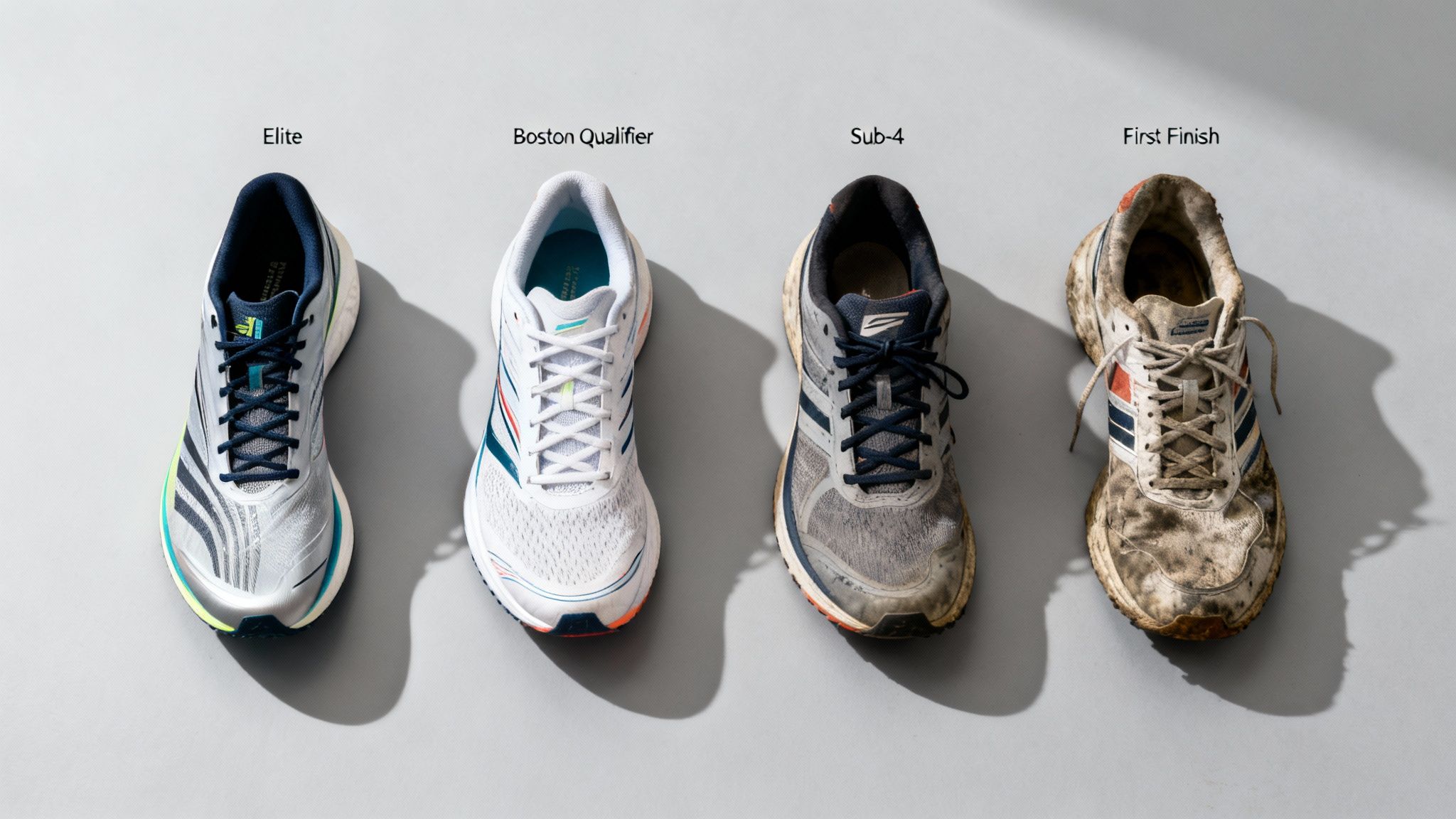
Asking "what is a good marathon time?" is a bit like asking what makes a good painting—it really depends on who you ask and what you're measuring. When it comes to conquering 26.2 miles, there's a huge range of what success looks like, and every single finish is built on months of dedication and pure grit.
Instead of getting hung up on one magic number, it’s much more helpful to think in terms of performance tiers. Each level has its own definition of "good," reflecting completely different goals and commitments.
The Spectrum of Marathon Success
At the very top of the pyramid are the world-class elites. These are the pros who chase times that were once considered physically impossible. Just a step below them, you'll find the incredibly dedicated age-group runners gunning for a prestigious Boston Marathon Qualifying (BQ) time. Nailing a BQ is a massive achievement and often seen as the gateway to a more competitive level of amateur running.
Then you have what is perhaps the most celebrated milestone for a huge part of the running community: breaking the four-hour barrier. Seeing 3:59:59 on the clock is a testament to months of smart, structured training and puts you way ahead of the average runner.
A sub-4-hour marathon is an excellent goal for many runners, as only about 30% of finishers worldwide manage to achieve it. This time requires an average pace of roughly 9 minutes and 9 seconds per mile (or 5:41 per kilometer).
And finally, there's the goal that matters most of all: simply crossing that finish line. For a first-timer, any finish is a great finish. It’s the powerful culmination of a long journey, proving to yourself that you can push through physical and mental barriers you never thought possible.
Marathon Performance Benchmarks At a Glance
To put all this into perspective, let's look at the numbers. This table breaks down the different performance levels to help you see where various finish times land on the spectrum of marathon achievement. Use it to find where you fit and to set goals that truly inspire you.
| Performance Level | Men's Time | Women's Time | Who This Applies To |
|---|---|---|---|
| World Class | Sub 2:05:00 | Sub 2:18:00 | Professional, elite athletes competing for prize money. |
| Boston Qualifier | Sub 3:00:00 (varies by age) | Sub 3:30:00 (varies by age) | Serious, competitive amateur runners meeting strict qualifying standards. |
| Sub-4:00 Marathon | Sub 4:00:00 | Sub 4:00:00 | Dedicated recreational runners who follow a structured training plan. |
| Average Finisher | 4:20:00 | 4:45:00 | The statistical midpoint for most marathon participants globally. |
| First-Time Finisher | 4:30:00+ | 5:00:00+ | Anyone brave enough to take on their first 26.2-mile race. |
No matter where you fall on this chart, every marathon finish is a huge win. The time on the clock is just one part of a much bigger story of your effort and perseverance.
The Elite Standard and World Record Progression

To really understand the full range of marathon times, it helps to start at the very top. Looking at what the pros do isn't about comparing ourselves to them—it's about appreciating the absolute limits of human endurance. These athletes are constantly redefining what's possible, pushing the boundaries with every race.
The marathon world record has an incredible history, marked by legendary runners who shattered barriers once thought unbreakable. The story of its progression, from Spiridon Louis’s win at the first modern Olympics in 1896 to today's hyper-focused athletes, is one of pure grit and science. Seeing how far they've come gives us an inspiring backdrop for our own running journeys.
The Modern Era of Marathon Records
Today’s elite marathoners are playing a different sport altogether. They hold paces for 26.2 miles that most of us would be thrilled to maintain for a single mile. The once mythical two-hour barrier isn't just a dream anymore; it’s the target, and every major marathon is a potential stage for a new piece of history.
So, what’s behind this relentless chase for speed? It's a combination of things all coming together at the right time:
- Specialized Training: These athletes live and breathe running. Their training is meticulously planned to fine-tune every part of their physiology for peak performance.
- Technological Advances: Let's be honest, the "super shoes" have changed the game. The introduction of carbon-plated footwear has demonstrably improved running economy, helping athletes go faster for longer.
- Ideal Race Courses: It’s no accident that records are often set in the same places. Marathons in Berlin, Chicago, and London are famous for their flat, fast courses designed to give runners the best shot at a personal—or world—best.
What’s considered a "good" time in the elite world is always changing. Just a few years ago, a sub-2:05:00 for men was the gold standard. Now, the bar has been raised to an almost unbelievable level.
Benchmarking Against the Best
In October 2023, the running world was left speechless when Kelvin Kiptum clocked a mind-boggling 2:00:35 at the Chicago Marathon, smashing the previous men's world record. His run shows just how fast the sport has become.
To put that into perspective, a time around 2:04:00 might not even crack the top-100 all-time list anymore. Meanwhile, the Boston Marathon qualifying time for men aged 18-34 is a sub-3:00:00, a huge goal for any serious amateur. When you consider that the median finish time for major marathons is often well over four hours, it really drives home what a massive achievement a sub-4-hour finish is for most runners.
If you're curious, you can explore more about the evolution of marathon world records and see just how dramatically these times have tumbled over the decades.
Finding Your Personal Best With Key Performance Factors
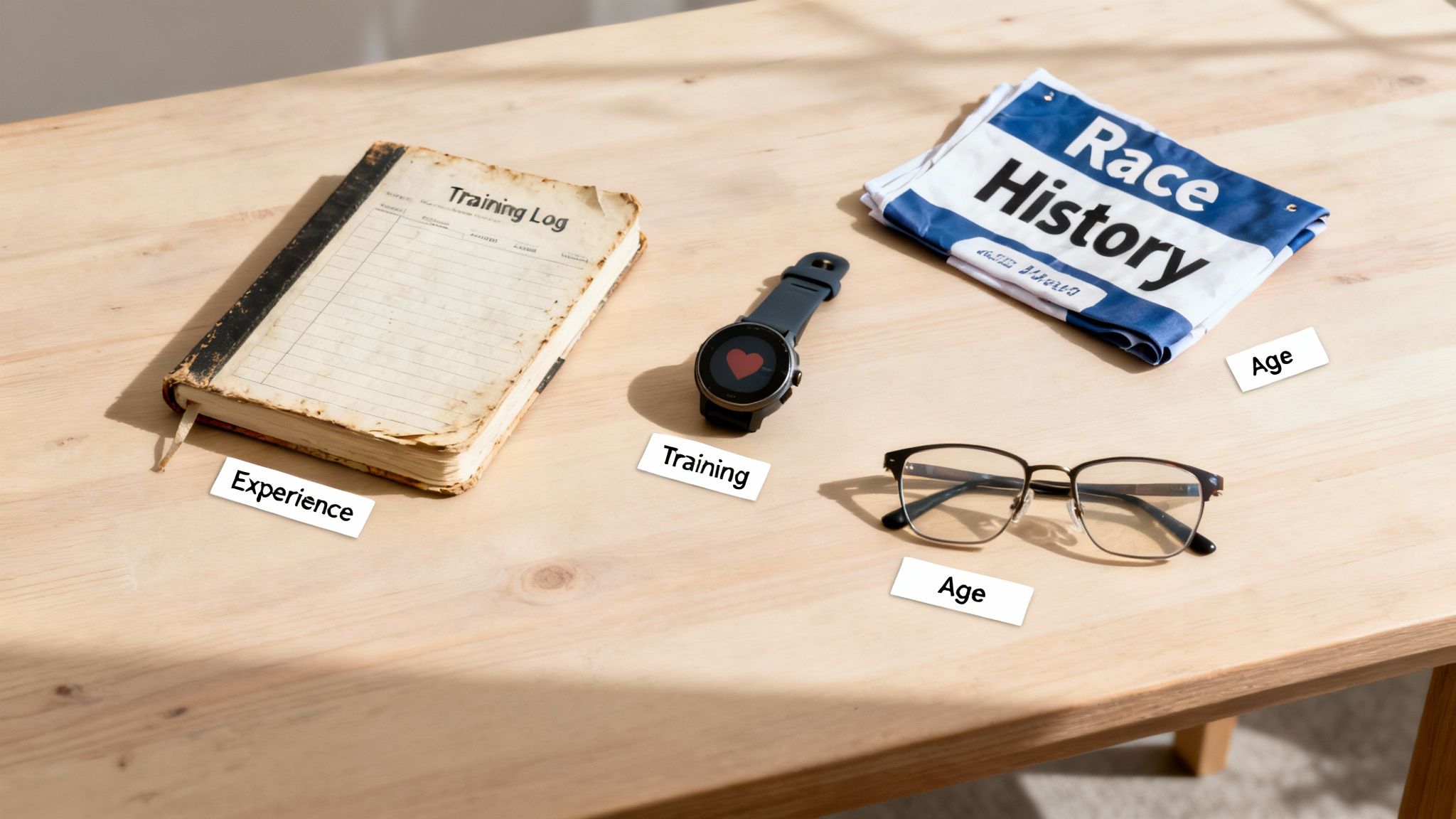
While it's fun to look at world records, the real answer to "what's a good marathon time?" is deeply personal. Your best time is shaped by a mix of factors unique to you. Honestly, comparing yourself to an elite runner—or even the person who started next to you—completely misses the point of your own journey.
Think of it this way: your running potential isn't a factory model. It's a custom build. The engine, the suspension, the fuel system... all these parts come together to determine performance. For runners, those parts are your age, gender, running history, and the training you put in.
Your Age and Gender
Biologically, age and gender are two of the biggest factors in a marathon. Most of us hit our peak endurance potential in our late 20s and 30s. After that, key metrics like our VO2 max (the maximum oxygen your body can use) begin a slow, natural decline.
This is exactly why age-graded results are so useful. They reframe your performance by comparing you to your direct peers. It levels the playing field. For instance, data shows that the performance gap between the average male and female marathoner is often around 11%.
So, a 4:30:00 marathon for a 55-year-old woman is a phenomenal achievement—a testament to her fitness and dedication. But for a 28-year-old man who's been running for years, that same time might just be a starting point for his next goal. Context is everything.
Your Running Experience and Training
How long you've been lacing up your shoes and how you’ve prepared for the 26.2 miles are huge pieces of the puzzle. A runner's body doesn't adapt in weeks; it adapts over years, slowly building the rock-solid aerobic base needed to go the distance.
Your training commitment directly shapes your race-day potential. A good plan isn't just about logging miles. It's about teaching your body how to burn fuel efficiently, manage fatigue, and push through the mental grit required to finish strong.
For most first-timers, the number one goal is simply to finish feeling good. Their "good" time is the one that gets them across that line with a smile. On the other hand, a seasoned runner with ten marathons under their belt might be laser-focused on chipping away at their personal best, even if it's just by a few minutes.
The training elements that have the biggest impact on your finish time are pretty universal:
- Weekly Mileage: More consistent mileage builds a more powerful aerobic engine. Simple as that.
- Workout Variety: Mixing in speed work, tempo runs, and long runs makes you a more resilient, well-rounded runner.
- Consistency: Sticking to your plan day in and day out is where the real magic happens.
Ultimately, your success is measured on your own terms. Figuring out how to train for a marathon in a way that fits your life is the first step toward setting a goal that's both challenging and right for you. Your race is against your own clock, nobody else's.
How Race Day Conditions Can Make or Break Your Marathon Time
So you’ve put in the months of training, and your fitness is at its peak. That's fantastic, but it's only half the story. The stopwatch is brutally honest—it doesn't factor in that brutal headwind you fought for the last 10k or the hill that felt like a mountain at mile 22. But you should.
Think about it this way: two runners with the exact same ability toe the line on the same day. One is running a flat, fast course in perfect, cool weather. The other is grinding it out on a hilly route where the sun decided to beat down unexpectedly. It's not crazy to think the second runner might finish 15 minutes slower, even though their effort was probably much, much harder. This is why context is everything.
The Course Profile: Not All 26.2 Miles Are Created Equal
A marathon is a marathon, right? Not quite. The route itself plays a huge role in your potential finish time. Courses like the Chicago or Berlin Marathons are famously flat and fast for a reason—they are literally designed for setting personal records.
On the flip side, you have legendary courses known for their unforgiving hills, like Boston's infamous Heartbreak Hill. Tackling a course like that demands a completely different race strategy and will almost always lead to slower times across the board.
A relentless series of inclines forces your body to work harder, recruiting different muscles and spiking your heart rate. Even small, gradual climbs add up over the distance, draining energy that you’ll desperately need in the final miles.
Weather: The Ultimate Wild Card
You can control your training, your nutrition, and your gear, but you can't control the weather. It’s the one variable that can throw a wrench into even the most perfect race plan.
What are we up against?
- Heat: As the temperature climbs, your body has to work overtime to cool itself down. It sends more blood to the surface of your skin, which means less blood and oxygen are available for your hard-working muscles. Your heart rate skyrockets, and you’re forced to slow down.
- Humidity: This is heat's evil twin. When the air is thick with moisture, your sweat can't evaporate properly, which is your body's primary cooling mechanism. You can overheat much faster, your performance plummets, and the risk of dehydration goes way up.
- Wind: Ever felt like you were running in place? A strong headwind is like running with a parachute strapped to your back. You burn a ton of extra energy just trying to hold your pace.
Knowing how these factors come into play helps you set smarter, more realistic goals for the day. If you're hunting for a fast time, you might want to look at races known for their favorable conditions. For some ideas, you can check out a list of the best spring marathons that often provide a great shot at a PR.
In the end, a good performance isn't just about the number on the clock. It’s about the effort you gave and the conditions you overcame to get there.
Setting an Ambitious Yet Achievable Marathon Goal
Alright, you now know how much things like age, experience, and the race course itself can shape your finish time. So, how do you take all that knowledge and turn it into a smart, personal race plan? It's time to set a goal that’s exciting enough to get you out the door for those tough training runs but realistic enough that you won't burn out chasing it.
Instead of just pulling a dream number out of thin air, a far better approach is to look at established benchmarks. A perfect example is the Boston Marathon qualifying (BQ) times. For serious amateur runners, hitting a BQ is the gold standard, and these times give us a fantastic window into what dedicated, structured training can achieve.
Benchmarking Against Competitive Standards
For many runners, a truly "good" time is one that gets them into a prestigious race. At Boston, women in the 18-34 age group need to run faster than 3:30:00, while a runner in the 60+ age group needs a 4:00:00. This tiered system is a great reminder that performance naturally evolves over a lifetime of running.
Looking at the bigger picture, of the roughly 1.5 million people who finish a marathon each year, the average time hovers somewhere between 4:20 and 4:30. Dig a little deeper, and the numbers get even more interesting. Only about 10-15% of men break the 3:30 barrier, and just 20% of women manage to dip under the four-hour mark. If you're a woman or a first-timer who finishes under 3:45, you're in truly exceptional company. You can discover more insights about global marathon times to see where you stack up.
Using Your Current Fitness to Predict Your Time
The single best way to set a realistic goal is to anchor it to your current fitness level. Thankfully, you don't have to guess. There are some great tools out there to help you connect the dots.
- Race Time Calculators: Online tools like VDOT calculators are brilliant for this. You plug in a recent race result—from a 5k, 10k, or half marathon—and they predict what you’re capable of over 26.2 miles. It’s a data-driven way to see what your shorter-distance speed might translate to in terms of endurance.
- Pace-Based Training Runs: Listen to your body during training. If you can hold your goal marathon pace for a 10-mile run in the middle of a hard training week and it feels challenging but doable, that’s a fantastic sign. Of course, building that fitness requires a plan, and our 14-week marathon training schedule is designed to get you there.
Think of it this way: if you recently ran a half marathon in 2:00:00, most calculators would estimate your marathon potential to be somewhere around 4:10:00 to 4:15:00. Suddenly, you have a solid, evidence-based starting point, not just a wish.
Breaking Down Your Goal Into Manageable Splits
Once you've landed on a target time, the real magic happens when you break it down into per-mile or per-kilometer paces. This little trick transforms a massive, intimidating goal into a simple, repeatable task: just hit your split, one mile at a time. A pace chart becomes your most trusted friend on race day.
The table below breaks down the average pace you'll need to maintain for some of the most common marathon finish time goals. It's a simple way to see exactly what's required to hit your number.
Marathon Goal Times and Required Pacing
| Finish Time Goal | Pace per Mile (min:sec) | Pace per Kilometer (min:sec) |
|---|---|---|
| Sub 3:30:00 | 8:00 | 4:58 |
| Sub 3:45:00 | 8:35 | 5:20 |
| Sub 4:00:00 | 9:09 | 5:41 |
| Sub 4:15:00 | 9:44 | 6:02 |
| Sub 4:30:00 | 10:18 | 6:24 |
Seeing your goal broken down like this makes it feel much more achievable. All you have to do is lock into that pace and hold on.
Celebrating Your Achievement Beyond the Finish Time

Once you cross the finish line after 26.2 grueling miles, it’s so easy to fixate on that final number on the clock. But a truly good marathon time is one that tells the story of your personal journey—the early alarms, the runs in the pouring rain, and the sheer grit you developed along the way.
Every single finish is a massive accomplishment. Whether you sprinted, jogged, or walked that final stretch, you’ve done something most people will only ever dream of. The real victory is in the commitment it took to just show up at the starting line.
Honoring the Entire Journey
It’s so important to see your success as more than just a number. Your marathon is a story of personal growth, and that story deserves to be celebrated. It’s about honoring the discipline you built day in and day out, not just how you performed on one specific morning.
The most meaningful measure of a marathon is the distance you traveled within yourself, from the first day of training to the moment you crossed the finish line. That transformation is the real personal best.
This shift in perspective is everything. It lets you appreciate the full weight of what you've done. You didn’t just run a race; you pushed past your limits and found a strength you never knew you had.
Turning Your Triumph into a Lasting Memory
One of the best ways to honor all that hard work is by creating a tangible reminder of what you accomplished. Don't let that medal and bib collect dust in a drawer—turn your achievement into a piece of art that tells your unique story.
A personalized race poster that maps your exact route, complete with your name, date, and finish time, can be a powerful keepsake. It’s more than just decoration; it's a daily source of motivation and a tribute to your incredible dedication. It proudly declares that you are a marathoner, and that is an achievement worth celebrating forever.
Common Questions About Marathon Times, Answered
Let's cut through the noise and tackle some of the most common questions runners have about marathon times. This should help you set realistic goals and see where you stand in the big picture.
Is a 4 Hour Marathon a Good Time?
Breaking four hours in the marathon? That's a huge accomplishment. For most everyday runners, it's the gold standard—a goal that signals serious dedication.
Consider this: the average marathon finish time worldwide sits somewhere between 4 hours and 20-30 minutes. Finishing under four hours puts you well ahead of the curve and is a time that earns a lot of respect from fellow runners. It doesn't happen by accident; it takes a solid training plan and smart race-day execution.
What’s a Good Marathon Time for a Beginner?
If it’s your first marathon, the number one goal should be to cross the finish line healthy and with a smile on your face. That's it. Most first-timers finish somewhere between 4 hours and 30 minutes and 5 hours and 30 minutes.
Honestly, a "good" time for your debut is any time you feel proud of. Forget the clock for a bit and focus on learning how to pace yourself and fuel properly over 26.2 miles. Just finishing is the real victory.
So many new marathoners make the mistake of just doubling their half marathon time to set a goal. The back half of a marathon is a totally different beast. Your best bet for a first race is to be conservative and aim for a strong, steady finish.
How Much Can I Improve My Marathon Time?
This really comes down to where you're starting from. If you're a newer runner who just finished your first marathon without much structured training, you could see massive gains—potentially shaving off 30 to 60 minutes on your next attempt with a focused plan.
But for a seasoned runner who's already quite fit, progress looks different. They might have to fight tooth and nail just for a 5 to 10-minute personal best. The secret to getting faster, no matter your level, is consistency, smart training (think speed work and long runs), and making recovery a top priority. Do that, and the progress will come.
No matter what the clock says, every marathon finish line represents a story of grit and dedication worth celebrating. At RoutePrinter, we help you turn that story into a beautiful, personalized race poster that honors every mile. Commemorate your amazing achievement today at https://www.routeprinter.com.