What is a Boston Qualifying Time: Your Guide to BQ Standards

For many marathoners, those two little letters—BQ—represent the ultimate goal. A Boston Qualifying time, or BQ, is the specific marathon finish time set by the Boston Athletic Association (B.A.A.) that you need to hit just to be able to apply for the Boston Marathon.
These time standards are broken down by age and gender, creating a fair but challenging benchmark for runners everywhere. Hitting your BQ doesn’t automatically get you in, but it’s the essential first step that proves you have the speed to compete at one of the world's most legendary races.
What a Boston Qualifying Time Truly Represents

A BQ is so much more than just a set of numbers on a stopwatch. For thousands of dedicated runners, it's a rite of passage. It’s the culmination of months, sometimes years, of disciplined training, early mornings, and pushing through limits you never thought you could break.
Achieving a BQ elevates you. It’s a signal to the global running community that you’ve reached a new level of performance, placing you in a select group of athletes capable of meeting the high standards of the world’s oldest annual marathon.
The Purpose of BQ Standards
So, why have these tough standards in the first place? The B.A.A. created the BQ system to preserve the historic prestige and competitive spirit of the race. Since 1897, Boston has been a proving ground for runners. Toeing that famous start line in Hopkinton means you've earned it by hitting a time tailored to your age and gender.
These standards are designed to keep the field elite while still being an attainable dream. You can learn more about the evolution of these standards in scholarly articles about the race.
The system really serves a few critical purposes:
- Maintains Race Quality: It fills the course with serious, well-prepared runners who can handle the notoriously challenging Newton Hills.
- Manages Field Size: With far more hopefuls than available spots, the BQ is the first and most important filter.
- Upholds Prestige: The sheer difficulty of qualifying is what makes earning a spot a bucket-list accomplishment for so many.
A BQ is your key to the application process, not a guaranteed entry. Think of it as earning a 'ticket to the lottery'—you’ve proven you belong, but you still need your number called.
The Official BQ Standards for Your Age Group
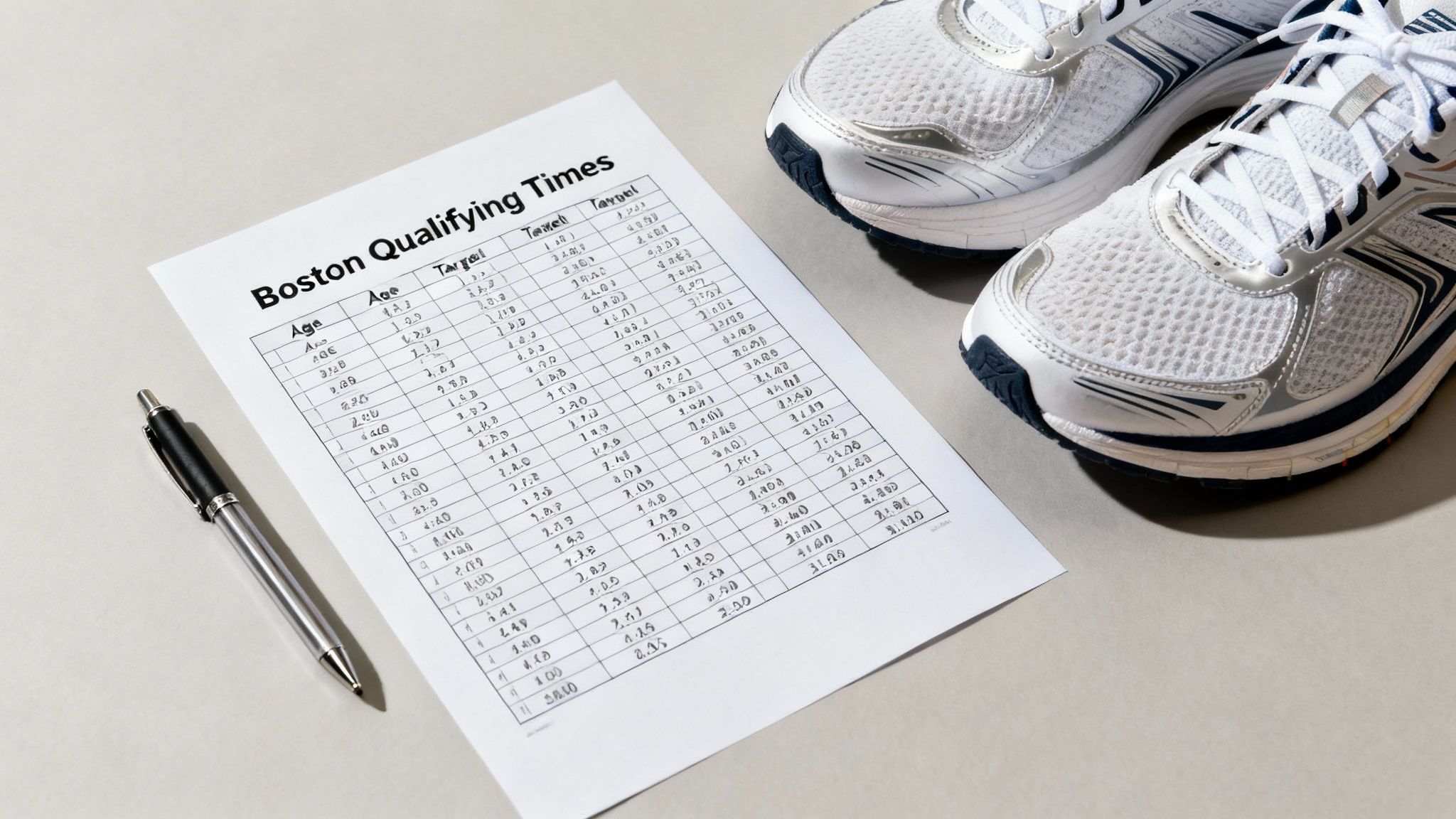
Alright, this is where the dream gets a number. A Boston Qualifying (BQ) time isn't some arbitrary finish line; it’s a carefully calibrated standard that shifts with your age and gender. This system acknowledges a simple truth: our athletic performance naturally evolves over a lifetime.
To find your personal target time, you just need to find your bracket in the chart below. One crucial detail to remember: your age group is based on how old you'll be on the day of the Boston Marathon, not the day you run your qualifying race. For runners with birthdays between their qualifier and Boston, that can make a big difference.
Boston Marathon Qualifying Standards
The times below are the minimum you need to run to even be eligible to apply. Think of hitting your BQ as earning a ticket to get in the registration line—it doesn't guarantee you a spot, but you can't get in line without it.
| Age Group | Men | Women | Non-Binary |
|---|---|---|---|
| 18-34 | 3 hrs 00 min 00 sec | 3 hrs 30 min 00 sec | 3 hrs 30 min 00 sec |
| 35-39 | 3 hrs 05 min 00 sec | 3 hrs 35 min 00 sec | 3 hrs 35 min 00 sec |
| 40-44 | 3 hrs 10 min 00 sec | 3 hrs 40 min 00 sec | 3 hrs 40 min 00 sec |
| 45-49 | 3 hrs 20 min 00 sec | 3 hrs 50 min 00 sec | 3 hrs 50 min 00 sec |
| 50-54 | 3 hrs 25 min 00 sec | 3 hrs 55 min 00 sec | 3 hrs 55 min 00 sec |
| 55-59 | 3 hrs 35 min 00 sec | 4 hrs 05 min 00 sec | 4 hrs 05 min 00 sec |
| 60-64 | 3 hrs 50 min 00 sec | 4 hrs 20 min 00 sec | 4 hrs 20 min 00 sec |
| 65-69 | 4 hrs 05 min 00 sec | 4 hrs 35 min 00 sec | 4 hrs 35 min 00 sec |
| 70-74 | 4 hrs 20 min 00 sec | 4 hrs 50 min 00 sec | 4 hrs 50 min 00 sec |
| 75-79 | 4 hrs 35 min 00 sec | 5 hrs 05 min 00 sec | 5 hrs 05 min 00 sec |
| 80 and over | 4 hrs 50 min 00 sec | 5 hrs 20 min 00 sec | 5 hrs 20 min 00 sec |
Note: These standards are for the 2026 Boston Marathon. The B.A.A. can and does update them, so always check the official source for the year you're targeting.
Seeing your number in black and white makes it real. Now you can pick a goal race, build a smart training plan, and turn a vague ambition into a concrete, measurable goal.
Your Boston Qualifying time is your official "net time" or "chip time." This means the clock starts when you cross the starting line, not when the gun goes off. It’s a huge relief for runners stuck in the back of a crowded start corral.
The Method Behind the Marathon Madness
So, why do the times change every five years? The Boston Athletic Association (B.A.A.) isn't just picking numbers out of a hat. The standards are designed around the realities of human physiology. As we get older, things like our max heart rate and muscle mass naturally decline, and that has a real impact on marathon potential.
The BQ standards reflect this by getting more generous as you move into older age groups. This tiered system keeps the challenge tough but fair across an entire running career. For example, the 30-minute difference between the men's and women's standards in the 18-34 age group shrinks to just 15 minutes by the 70-74 bracket, which shows how performance curves can change over time.
At the end of the day, these times are meant to set a high bar. They are designed to be difficult, motivating runners to chase down their very best performance. But as you’ll see, just squeaking by with your qualifying time might not be enough to get you to Hopkinton.
Why Your B.Q. Time Might Not Be Enough
Here's the harsh reality that catches a lot of runners off guard: just hitting your qualifying time doesn't guarantee you a spot on the starting line in Hopkinton. Think of it less like a ticket and more like an invitation to apply.
It's a classic case of supply and demand. The Boston Marathon is the unicorn of the running world, and far more people qualify each year than there are bibs available. To keep the field manageable, the Boston Athletic Association (B.A.A.) doesn't just open the floodgates. Instead, they rank everyone by how much they beat their standard and accept runners from the top down until the race is full.
This process creates something runners have come to dread: the "cut-off" time.
Understanding the Cut-Off Time
The cut-off is the actual time you needed to get into the race. It’s the difference between your official BQ standard and the time of the very last runner accepted. It’s not a number the B.A.A. picks in advance; it’s determined entirely by the applicant pool each year.
Imagine there are 30,000 spots. If 40,000 qualified runners apply, the B.A.A. simply accepts the fastest 30,000 people. If the last person they let in was five minutes and 29 seconds under their BQ standard, then the cut-off for that year becomes 5:29. Anyone slower than that—even if they still beat their BQ—is out of luck. This floating target makes an already tough goal even more elusive.
For the 2025 Boston Marathon, the competition was fiercer than ever. A record 36,406 qualified runners threw their hats in the ring. The result? A staggering cut-off of 6 minutes and 51 seconds, the toughest it's been since 2019. You can dive deeper into Boston's evolving qualification landscape on marathonhandbook.com.
How Rolling Registration Works
To manage the application frenzy, the B.A.A. uses a rolling registration system that gives the fastest runners first dibs. The window typically opens for a week in September and is tiered to reward speed.
- Days 1-2: Open to runners who crushed their BQ by 10 minutes or more.
- Days 3-4: Open to those who beat their BQ by 5 minutes or more.
- Day 5: Opens to all other qualified runners, provided there are spots left.
This system means if enough super-fast runners sign up in the first few days, the race could fill before everyone else even gets a chance to register. It’s a clear signal that just squeaking by with a BQ is a risky bet.
The modern reality of Boston is that your real goal isn't just your BQ time; it’s your BQ time minus several minutes. Aiming for a significant buffer is the safest strategy to avoid disappointment.
Building that kind of cushion takes smart, dedicated training. To get a better handle on setting up a plan for this kind of goal, take a look at our complete guide on how to train for a marathon. Today, targeting a time well under your standard isn’t just ambitious—it’s a necessary part of the journey.
So You Got Your BQ Time. Now What?
Nailing your Boston Qualifying time is a massive achievement, but it's really just the first hurdle. Now comes the part where you have to use that time to actually get into the race. The registration process has its own quirks and rules, and knowing them inside and out is crucial.
Let’s get the two biggest rules out of the way first, because they're non-negotiable. First, your BQ has to come from a race run within the official qualifying window. This window usually opens in early September of the year before the race you're trying to enter. Second, the marathon course itself must be certified by a national governing body like USA Track & Field (USATF) or its international equivalent.
Why a Certified Course Is a Deal-Breaker
What’s a “certified course,” you ask? Think of it as a guarantee of legitimacy. It means an official has painstakingly measured the route to ensure it's exactly 26.2 miles—not a foot shorter. This is how the Boston Athletic Association (B.A.A.) ensures a level playing field for everyone.
Before you even book your travel for a potential BQ race, do your homework and confirm it's certified. Most races shout this from the rooftops, often listing their USATF certification number right on their website. If you don't see it, email the race director. It would be heartbreaking to run the race of your life only to find out it doesn't count for Boston.
A certified course ensures the integrity of every Boston Qualifying time. It’s the B.A.A.’s way of making sure a 3:05 marathon in California is the same challenge as a 3:05 in Texas, which is fair to every runner chasing that unicorn.
A Runner's Guide to the Registration Portal
With a certified time from the right qualifying window in your pocket, you’re ready for registration week. This typically kicks off in mid-September. The whole show is run through the B.A.A.'s online portal. Here's a quick look at what you’ll need to do:
- Gather Your Proof: Have everything ready. You’ll need the name and date of your qualifying marathon and your official finish time (chip time). Critically, you'll also need a link to the official results page where they can see your name and time.
- Fill It Out Carefully: The application will ask for all your personal details plus the info about your BQ. Double-check everything. A simple typo could lead to a major headache or a delayed application.
- Know Your Tier: As you know, registration is tiered. The fastest runners get to apply first. Make sure you submit your application during the correct window based on how much faster you were than your official BQ standard.
- Submit and Wait: Once you hit submit, the B.A.A. team gets to work verifying every single application. This isn't automatic. They manually check that your time is real and that the course was certified.
Just remember, submitting your application is not a guarantee you're in. It just gets your name in the hat with all the other qualified runners. Your final acceptance hinges on where you fall relative to that year's final cut-off time, which isn't announced until after registration closes. It’s a nail-biting process, but it’s designed to be as fair as possible.
Don't Have a BQ? Other Ways to Get to the Start Line
Chasing that coveted Boston Qualifying time is the classic path to the start line in Hopkinton, but it's far from the only one. What if your passion for the race is bigger than your current PR? Or what if you want your 26.2 miles to have an even greater impact?
The Boston Athletic Association (B.A.A.) gets it. They've created several other ways to earn a bib, recognizing that a runner's heart and dedication can't always be measured by a stopwatch.
Running for a Greater Cause
By far the most well-known alternative is the Boston Marathon Official Charity Program. This is your chance to turn a personal running goal into a massive philanthropic achievement. The program partners with a curated list of non-profits, allowing a set number of runners to gain entry by fundraising for an incredible cause.
And the impact is huge. For the 2025 race, runners in the program raised a jaw-dropping $50.4 million.
To get a charity bib, you commit to a fundraising minimum, which usually sits in the range of several thousand dollars. It’s a different kind of marathon—one that involves rallying support from your community—but it adds a profound layer of purpose to every single training run.
When you run for a charity, your race becomes bigger than yourself. Every tough mile, every early morning, is fueled by the cause you're supporting. That's a powerful kind of motivation when you hit the Newton hills.
Tour Operators and Official Partners
For many runners, especially those coming from outside the United States, navigating race weekend logistics can be a headache. That's where official tour operators and race partners come in. The B.A.A. works with a select group of companies that offer all-inclusive race packages.
These bundles take the stress out of planning and typically include:
- A guaranteed race bib, letting you bypass the BQ scrum entirely.
- Hotel accommodations, often close to the finish line or other key race weekend spots.
- Travel arrangements, which can sometimes include flights or local transport.
- Exclusive perks like pre-race dinners or special meet-and-greet events.
Yes, these packages come at a premium price, but they offer a seamless, worry-free way to experience the race. You can put all your energy into your training and soaking up the incredible atmosphere of Boston on Marathon Monday.
At the end of the day, whether you get there with a lightning-fast qualifying time or a heart full of passion for a cause, earning a spot in the Boston Marathon is something to be incredibly proud of. These alternate paths ensure that the dream of chasing that unicorn down Boylston Street is alive and well for every dedicated runner.
Celebrating Your BQ as a Monumental Achievement
Let's get one thing straight: earning a Boston Qualifying time is a massive accomplishment, whether you make the final cut-off or not. It represents thousands of miles logged, countless early mornings, and a level of unwavering discipline most people can only imagine.
This milestone is so much more than a number on a results page. It's physical proof of your dedication. It tells the story of pushing through grueling training blocks and finding the mental toughness to go past your limits on race day. That kind of effort deserves to be honored.
Memorializing Your Hard Work
Celebrating your BQ is essential. It helps solidify the memory and turns that fleeting moment at the finish line into a lasting source of pride. You didn't just run a marathon; you hit an elite standard that most runners only ever dream of.
How you choose to commemorate it is completely personal, but it should match the scale of what you just did. Here are a few ideas to get you started:
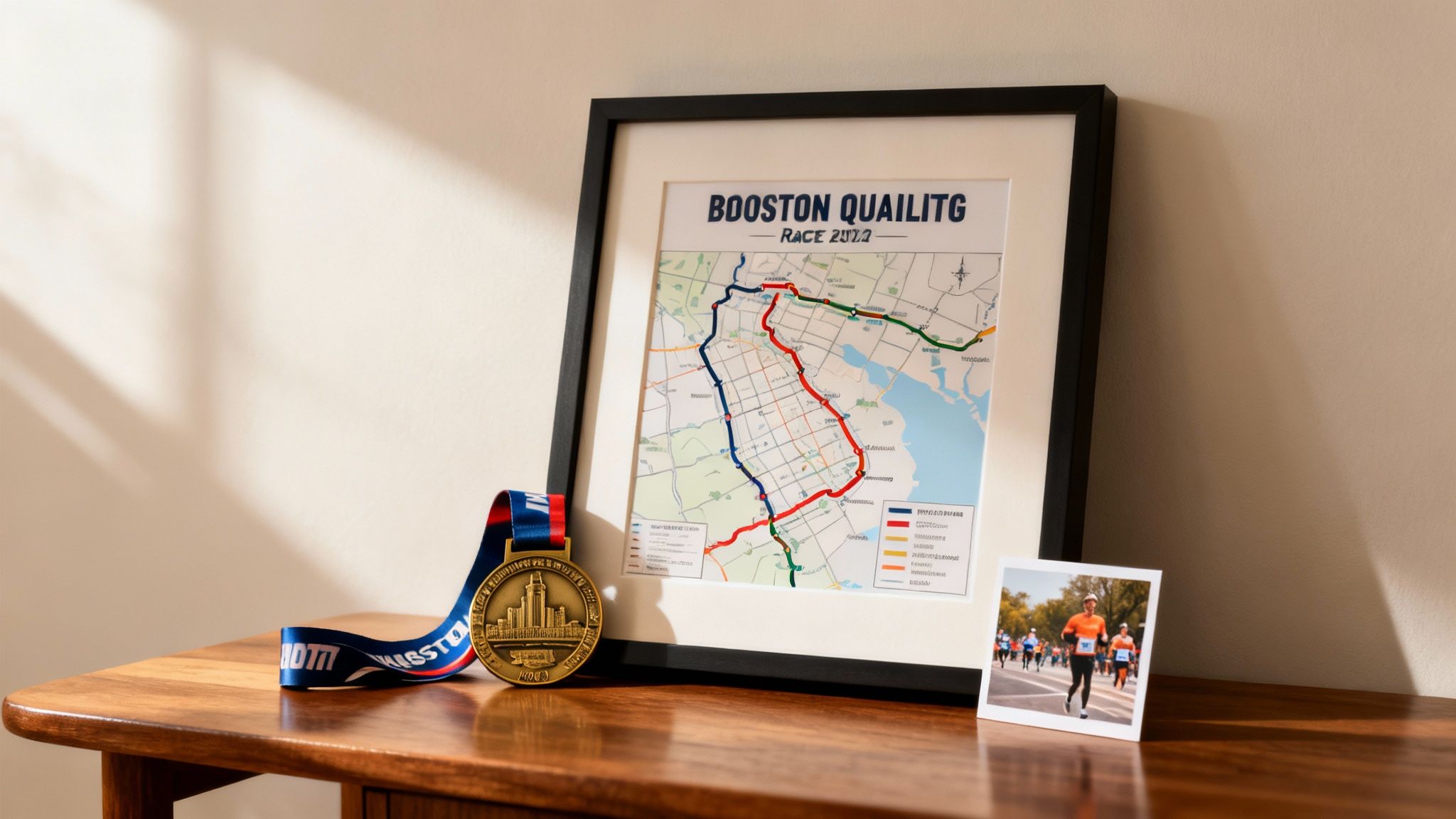
- Frame Your Gear: Create a shadow box with your race bib, that hard-earned medal, and a favorite photo from the day.
- Get the Photos: It's worth investing in professional race photos that truly capture the emotion of your finish.
- A Celebratory Meal: Gather the friends and family who put up with your training schedule for a special dinner. They were part of this, too.
A Boston Qualifying time is a benchmark of excellence in amateur running. It’s a testament to your commitment and a powerful reminder of what you are capable of achieving when you set a goal and chase it relentlessly.
Turning Your Achievement into Art
One of the coolest ways to celebrate is by creating a tangible reminder of the exact route you conquered. A performance like that deserves more than a social media post—it deserves a place on your wall.
Services like RoutePrinter allow you to immortalize your race with a beautiful, custom map of the course, complete with your name, date, and official finish time. To learn how you can immortalize your BQ on an official Boston Marathon poster, you can explore different design options that turn your hard work into a piece of art.
This transforms your achievement into a daily source of inspiration, perfect for your home or office. It’s a constant reminder of the finish line you fought so hard to cross and the perfect fuel for whatever your next big goal might be.
Common Questions About Qualifying for Boston
Even after you get your head around the standards and the infamous cut-off, the whole Boston Marathon qualifying process can still feel a bit tangled. Let's tackle some of the most common questions runners have, so you can focus on your training with total clarity.
Can I Use a Half Marathon Time to Qualify?
This is a big one, but the answer is a firm no. Your qualifying time has to come from a single, full marathon that you completed on a certified course.
Unfortunately, times from any other race distance—whether it's a half marathon, a 10K, or even the marathon leg of an Ironman triathlon—won't count. The B.A.A. is looking for proof you can handle the full 26.2 miles in one go.
Does My BQ Guarantee Entry into the Race?
This is probably the most heartbreaking part of the process for many runners: hitting your BQ time doesn't automatically get you a spot on the starting line in Hopkinton.
Think of your qualifying time as the key that gets you through the first door—it makes you eligible to submit an application. But because so many people apply, the final "cut-off" time is what really matters. This is the margin you have to beat your standard by, and it's what ultimately decides who gets in.
How Long Is My Qualifying Time Valid?
Your BQ has a shelf life. It’s only valid for the next Boston Marathon. You can't bank a great time and use it a few years down the road.
You have to run your qualifying marathon within a specific window set by the B.A.A. for the race year you're targeting. This window usually opens in early September, giving you about 19 months to nail that time.
Does the BAA Use Gun Time or Chip Time?
Good news here! The Boston Athletic Association (B.A.A.) uses your net time, which most runners know as chip time.
This is the actual time it takes you to run from the starting mat to the finish line, which is a huge relief if you’re stuck in a slower corral at a big race. Getting this right is a huge part of chasing a personal best. For a deeper dive into the nuances of race timing, check out our guide explaining what a PR is in running.
Celebrate your hard-earned marathon finish with a personalized race poster from RoutePrinter. Visit RoutePrinter to turn your race into art.