Conquer Your First Relay Team Triathlon - A Practical Guide

A relay team triathlon is the perfect way to get a taste of the multi-sport world without having to master—and train for—all three disciplines at once. It’s simple: the traditional swim, bike, and run are broken up into individual legs, with a different teammate taking on each one. This makes the whole event feel more like a team sport and a lot less intimidating.
Finding The Right Teammates For Your Relay
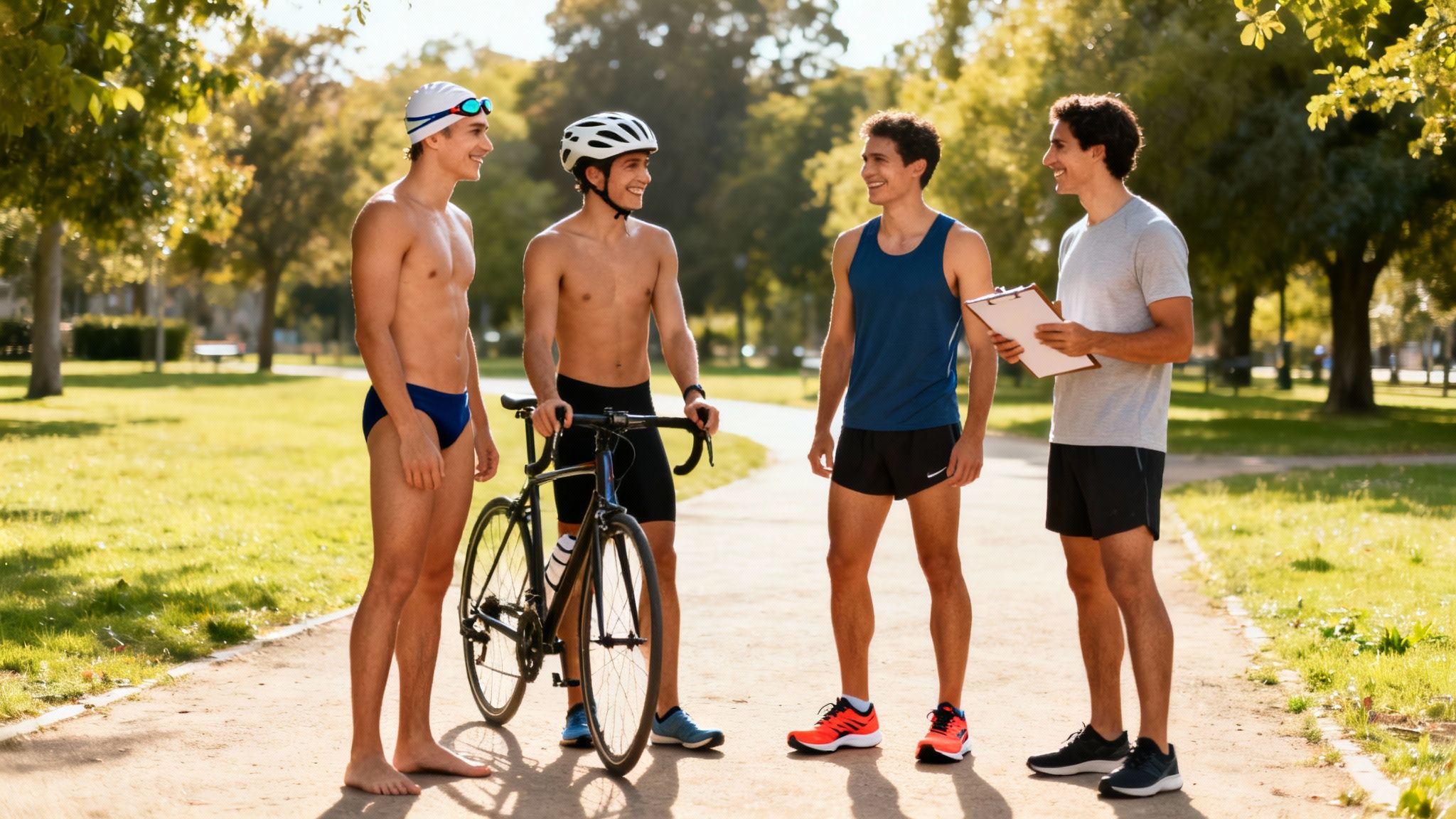
The secret to a great relay team isn't just pure speed; it's about good chemistry and having the same finish line in mind. So, your first step is to figure out what kind of team you want to be. Are you gunning for a spot on the podium, or are you just looking to have an awesome day out with friends?
Once you know that, you'll know where to look. Honestly, your best bet might be people you already know. Think about friends from your running club, your weekend cycling group, or even that person you always see in the fast lane at the local pool. They're all prime candidates.
Balanced Team Versus Specialist Team
One of the first big strategic decisions you'll make is how to build your roster. Do you get a crew of three well-rounded athletes, or do you hunt down a specialist for each leg?
- Balanced Team: This is when you find three people with similar fitness levels and dedication. The big win here is that everyone is usually on the same page with training, which often leads to a more relaxed, fun-first vibe.
- Specialist Team: This is the classic "super team" approach. You find a fish for the swim, a powerhouse for the bike, and a speedster for the run. This model is usually more competitive, but the real challenge is making sure everyone’s expectations are aligned, since specialists can be pretty serious about their leg.
For instance, a specialist team might bring on a former college swimmer who can put you way ahead of the pack from the start. A balanced team, on the other hand, might just be three buddies who all run 10ks and want to try something new together.
Setting Clear Expectations From The Start
The quickest way for any team to fall apart is a mismatch in expectations. Before you even think about hitting that "register" button, sit down and have an honest chat about goals and commitment. It doesn't need to be a formal contract, but it'll save you a lot of headaches later.
Your team's success is defined on your own terms. Whether that's hitting a specific time or just finishing with smiles, getting on the same page about what "success" means is the most important step you'll take.
This conversation should cover a few key things. Talk about how much time each person can realistically put into training, agree on a budget for registration and gear, and, most importantly, decide on your main goal for the race. Is it to compete or just to complete?
The relay format has blown up in popularity precisely because it’s so flexible. Relays have made triathlons way more accessible, with some data suggesting that around 30% of all triathletes now compete on teams. People love teaming up with family or friends to break the distance into manageable chunks. If you're curious, you can discover more insights about triathlon participation statistics.
Making It Official: Race Registration and Logistics
Alright, you've got your team. Now it’s time to get your names on the start list. Registering a relay team is a little different than signing up for a solo race, but it’s nothing you can’t handle. The best way to tackle it is to nominate a "team captain" to be the point person for the initial sign-up and payment.
Before your captain even clicks the "Register" button, get all your ducks in a row. They’ll need everyone's full name, date of birth, emergency contact info, and probably t-shirt sizes. Trust me, having all this ready at the start saves you from a mad scramble against the registration page's timeout clock.
Securing Your Spot and Nailing the Team Name
On the race website, look for the "Relay Team" category. The captain will handle the first part: registering the team, paying the entry fee, and coming up with a team name. This is where the fun starts. Go for something that captures your team's spirit, whether you're serious competitors like "The Chain Gang" or just in it for laughs with something like "Three Left Feet."
After the captain sets up the team, the registration system will typically fire off invitation links to the other members. Each person needs to click that link to officially join the roster and sign their own waiver. It is absolutely critical that everyone does this right away. Many races have firm deadlines for finalizing rosters, and an incomplete team could even be disqualified before you start.
Don't make the rookie mistake of thinking the captain handles everything. Every single teammate has to log in, join the team on the official race portal, and sign their own event waiver. No exceptions.
Getting a Handle on Relay-Specific Logistics
The online forms are just the first step. A relay has its own unique set of logistical challenges you need to plan for. First up is packet pickup. Dig into the race rules—some events demand the whole team show up with photo IDs, while others are more relaxed and let one person grab the race bibs and swag for everyone. Figure this out weeks in advance to avoid a last-minute panic.
Then there's the most important piece of gear you'll share: the timing chip. Think of it as your team's baton. It’s usually on an ankle strap that the swimmer has to physically hand off to the cyclist, who then passes it to the runner inside the transition zone. Decide ahead of time who’s picking up the chip and who’s responsible for making sure it's strapped securely to the swimmer's ankle before the starting gun goes off. It’s these small details that can make or break your race-day experience.
Putting Together a Winning Training Plan
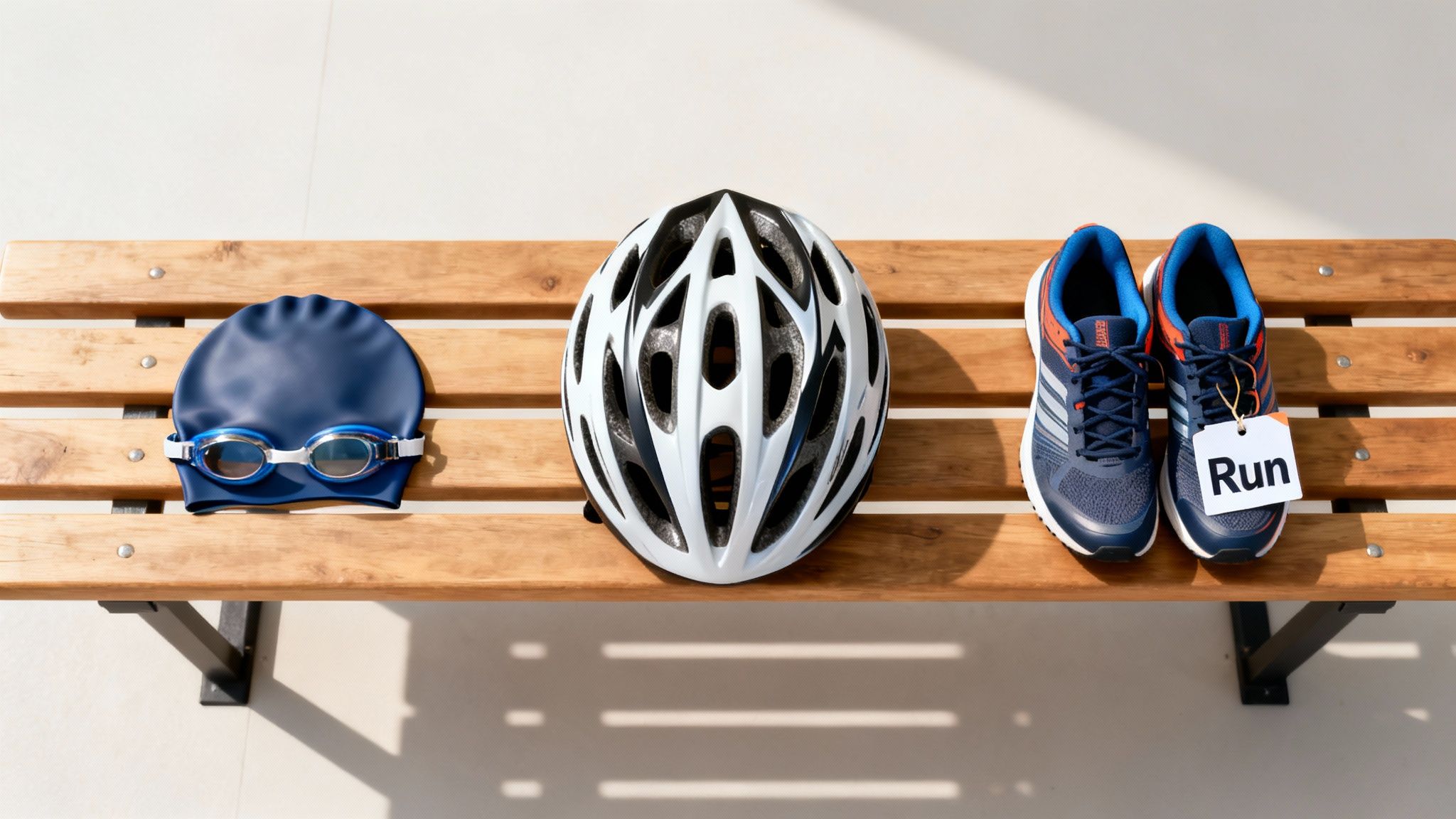
When you're training for a relay, you can throw the traditional triathlon training playbook out the window. Your focus isn't on juggling three sports at once; it's about making sure three individual athletes come together to create one seamless performance.
The magic of a relay team triathlon is that each person gets to go all-in on their specialty. This is a huge advantage. Your swimmer can live in the pool, honing their stroke and open-water sighting. Your cyclist can obsess over climbing repeats and aerodynamics.
And your runner? They can focus purely on speed and stamina without having to worry about so-called "brick" workouts. This is critical, as they’ll be waiting around for a while on race day. Their training should include workouts that mimic running on legs that feel tired, even if that "fatigue" is just from the long wait and a few warm-up sprints. If your runner is looking for an edge, there's some great advice on how to improve running endurance that can be easily adapted for the relay dynamic.
Train Apart, Win Together
Most of your training will happen separately, but that doesn't mean you should be strangers. A team group chat is your best friend here. It's the perfect place to share a post-workout selfie, complain about a tough session, or simply check in and offer a bit of encouragement.
Little things go a long way in building that team bond. Maybe the cyclist and runner head down to the lake to cheer on the swimmer during an open-water practice. It’s a small gesture, but it builds real camaraderie and gives everyone a feel for the energy you'll have on race day.
To give you a clearer picture, here’s a breakdown of what each person's training focus might look like:
| Sample Relay Training Focus By Discipline |
| :--- | :--- | :--- | :--- |
| Discipline | Primary Focus | Key Workouts | Recommended Frequency |
| Swimmer | Open-water endurance, sighting, and pacing | Long-distance steady swims, interval training (e.g., 4 x 400m), open-water simulation | 3-4 sessions/week |
| Cyclist | Sustained power output, hill climbing, and pacing strategy | Tempo rides, hill repeats, long endurance rides (over-distance) | 3-4 sessions/week |
| Runner | Race-pace endurance, negative splits, and running on "cold" legs | Interval runs (e.g., 8 x 800m), tempo runs, simulated race start after a long wait | 3-5 sessions/week |
This table illustrates how specialization allows each team member to dig deep into the specific demands of their leg, a luxury a solo triathlete just doesn't have.
The One Thing You Must Practice Together: Transitions
If there's one joint practice session that is absolutely non-negotiable, it's the hand-off. The exchange of the timing chip is the physical link between each leg of your race. A fumbled hand-off is a rookie mistake that can cost you precious time and add a ton of stress.
Think of the transition as the fourth discipline of your relay. A clean, practiced exchange can shave anywhere from 30 seconds to over a minute off your final time. It's the easiest speed you'll find all day.
Getting this right is simple. Just get together once or twice before the race to run through the motions.
- Find an open space that can act as your "transition zone."
- Have the incoming athlete run in, call out their teammate's name, and practice undoing the timing chip strap.
- The outgoing athlete then needs to get a feel for strapping it on quickly and securely before taking off.
Run through this drill a few times until it feels automatic. You’ll be shocked at how much smoother it gets with just a little practice. This small time commitment builds the muscle memory needed to eliminate chaos on race day, ensuring your team is ready for a strong, united finish.
Mastering The Relay Transition Zone
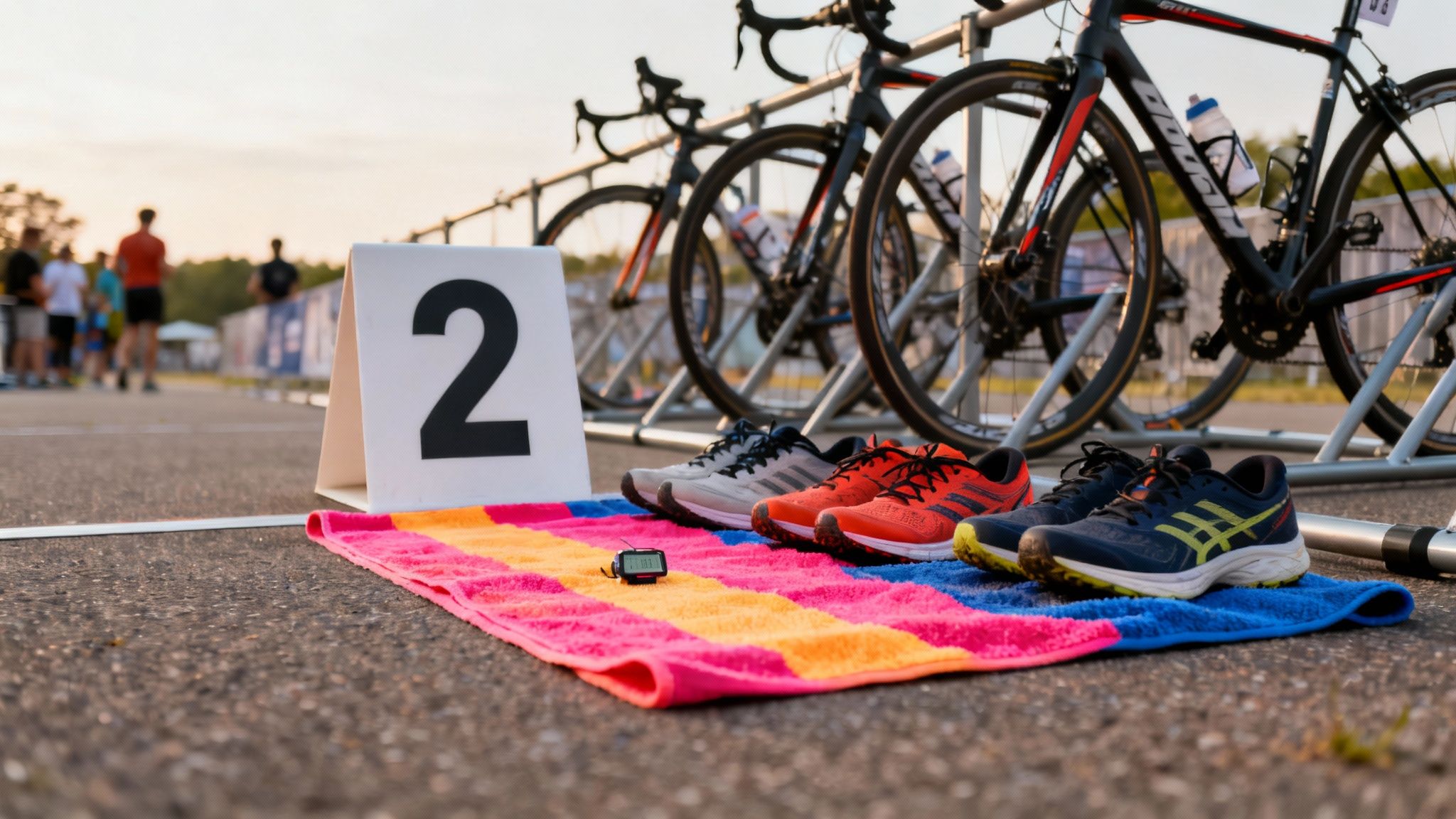
The transition zone is the chaotic, high-energy heart of any triathlon. For a relay team triathlon, it’s where the race can be won or lost. Honestly, you should think of it as the fourth discipline. A clean, practiced hand-off can shave a full minute or more off your total time. A fumbled exchange? That just adds stress and undoes all the hard work your teammate just put in.
Your first mission on race morning is to get the lay of the land. Walk the entire flow of the transition area as a team. Pinpoint the "Swim In," "Bike Out," "Bike In," and "Run Out" chutes. Most importantly, find the designated relay pen or exchange zone. This is your home base, and you need to know exactly where it is.
Setting Up For Success
Here's where relay teams have a massive advantage: simplicity. You only need the gear for the next athlete. This minimalist approach is your secret weapon against the usual transition chaos.
When you rack the bike, create a landmark so your swimmer can find it instantly. You're looking for one bike in a sea of hundreds, so make it stand out. A small, obnoxiously bright towel draped over the handlebars is a classic trick for a reason—it works.
Lay out only the absolute essentials for the upcoming leg:
- For the Cyclist: Place the helmet upside down with the straps open. Put sunglasses inside the helmet. Cycling shoes can either be clipped into the pedals (for the advanced move) or placed neatly right where their feet will go.
- For the Runner: Have running shoes ready, preferably with elastic laces for a quick slip-on. The race belt, with the number already attached, should be unclipped and ready to grab. A hat or visor can be tucked into the shoes.
A clean setup means the cyclist isn't tripping over the swimmer’s wetsuit. Every second you save by not fumbling with gear is a second gained on the course.
The golden rule of transition is simple: Organize for speed, not for comfort. Your spot should be a model of efficiency, with every piece of equipment placed exactly where it needs to be for a quick grab-and-go.
The Art Of The Hand-Off
The hand-off is a coordinated dance that boils down to communication and practice. The whole exchange hinges on one thing: the timing chip, which is almost always on a Velcro ankle strap.
Here's the key responsibility breakdown: the incoming athlete is responsible for ripping it off their ankle, and the outgoing athlete is responsible for getting it on securely. Practice this!
A seamless hand-off looks something like this: The incoming athlete starts yelling their teammate's name or race number as they get close to the exchange zone. This is the cue for the waiting athlete to get into position, facing the flow of traffic so they can see their teammate approaching.
Once the chip is on, the next person is gone. A classic rookie mistake is for the incoming athlete to just stop dead and gasp for air right in the middle of the exchange pen, blocking everyone. Don't be that person. As soon as your job is done, clear the area immediately so other teams have room. A little situational awareness goes a long way in keeping the transition zone flowing and avoiding penalties. Your team's race depends on nailing these little details.
Executing Your Race Day Game Plan
You've put in the long hours of training and practiced your handoffs until they're second nature. Now comes the final piece of the puzzle: executing a flawless race day. A well-thought-out plan is what separates a chaotic, stressful morning from a smooth, enjoyable experience where you can focus on the fun.
It all starts the moment the alarm clock blares. Race day is absolutely not the time to try that new energy gel or a different breakfast. Each of you should stick to your tried-and-true pre-race meal—whatever has powered you through your toughest training sessions without upsetting your stomach. For the cyclist and runner, who might be waiting a while, having a small, easy-to-digest snack planned for about an hour before their leg is a pro move.
Arrival and Final Checks
Get to the race venue early. No, earlier than that. We recommend arriving 90-120 minutes before the swim start. This buffer is your best friend—it absorbs any surprise traffic, parking nightmares, or that last-minute realization that someone forgot their goggles.
Once you’re there, head to the transition area as a team to claim and set up your spot. Laying everything out together ensures you’re all on the same page.
Then, it's time for one last individual gear check.
- Swimmer: Is your wetsuit on, cap in hand, and goggles ready? Most importantly, is that timing chip strapped securely to your ankle?
- Cyclist: Give those tires a final pump to the right pressure. Is your helmet clipped and sitting on your handlebars, ready to grab and go?
- Runner: Is your race number pinned to your shirt or, even better, a race belt? Are your shoes laid out with any gels or water you plan to carry?
This final once-over isn't just about logistics; it’s a mental confidence booster. With everyone's gear good to go, the cyclist and runner can head off for a light warm-up while the swimmer makes their way to the start line.
Pacing Each Leg for a Strong Finish
Pacing is where a relay team can either gain a massive advantage or completely fall apart. Discipline is everything here. It's so tempting for the swimmer, jacked up on race day adrenaline, to go out like a shot from a cannon. This is a classic rookie mistake. The goal isn't to be the first person out of the water; it's to exit feeling strong and execute a clean handoff.
The cyclist faces a similar test. Your job is to settle into a powerful but sustainable effort you can hold for the entire ride, not just the first 10 miles. You're the engine of the team, and you need to deliver the runner to T2 without being totally gassed.
Finally, the runner has the trickiest job of all. You’ve been waiting, maybe for hours, and your muscles are cold. A proper warm-up is absolutely non-negotiable. Your goal is to ease into your race pace, build on it, and if you have anything left, empty the tank in that final mile. It can be helpful to know where you stand, so check out these average triathlon times to see how different pacing strategies work across various distances.
The best relay teams operate like a well-oiled machine. Each member executes their part of the plan perfectly, trusting that their teammates will do the same. It's about individual execution for a collective victory.
Supporting Each Other and Crossing the Line
The race isn't over for the swimmer and cyclist once the runner is on the course. You've now officially been promoted to the support crew! Figure out a couple of good spots along the run course to post up and cheer. There's nothing like hearing a familiar voice screaming your name to give a runner a huge mental lift when they're deep in the pain cave.
And most importantly, plan your finish line moment. You'll need to check the race rules, but many events are happy to let the entire team join the runner for the last hundred feet. Figure out a meeting spot just before the finishing chute. Running across that line together is the ultimate celebration of your shared hard work—a memory you'll never forget.
Celebrating Your Team's Achievement

Crossing that finish line—ideally all together—is the moment you've been working toward. The combination of exhaustion, relief, and pure adrenaline is something you’ll never forget, and it absolutely deserves a proper celebration. Don't just collect your medal and go your separate ways. The post-race party is where the memories are made.
Often, the best celebrations are the simplest. Plan a post-race brunch or hit up a local brewery to refuel and relive every moment of the day. This is your chance to laugh about the near-miss in the transition zone or marvel at your swimmer’s incredible pace.
Creating a Lasting Memento
Finisher medals and race shirts are great, but a unique keepsake for your relay team triathlon can make the memory even more special. Custom team shirts with your witty name and the race date are always a fantastic choice. You'll wear them with pride for years.
Another incredible way to commemorate the day is to turn your collective effort into a piece of art. The physical journey you just completed—that specific swim course, bike route, and run to the finish—tells a powerful story. A personalized memento can capture that story in a way a medal just can't.
Your relay race is more than a few hours of hard work; it’s the result of all the training, planning, and teamwork that came before. Find a way to honor the entire journey, not just the finish line.
Immortalize Your Route and Results
Imagine a sleek, modern poster on your wall that maps out the exact course you conquered as a team. It's a fantastic way to create a permanent, visual reminder of what you accomplished.
Services now make it easy to transform your race data into a stunning piece of art. You can create a custom race map poster that displays:
- The exact swim, bike, and run routes.
- Your official team name and the race date.
- Each team member’s name alongside their individual split times.
This turns a fleeting moment into a tangible piece of art that every teammate can hang at home or in the office. It becomes a stylish, daily reminder of your shared victory. If you need more inspiration, check out some of the best gifts for triathletes for other creative ways to celebrate your big finish.
At RoutePrinter, we specialize in turning your hard-earned miles into beautiful, minimalist art. Create a personalized race poster today and give your team a keepsake that truly honors your incredible relay triathlon achievement.