How to Recover from a Marathon - Your Ultimate Post-Race Guide

You crossed the finish line. The emotional high is incredible, but that's just the start of the next leg of your journey. Your first 72 hours are the most critical phase of marathon recovery, setting the stage for how quickly and safely you bounce back from the monumental task of running 26.2 miles.
Your First 72 Hours: The Foundation of Marathon Recovery
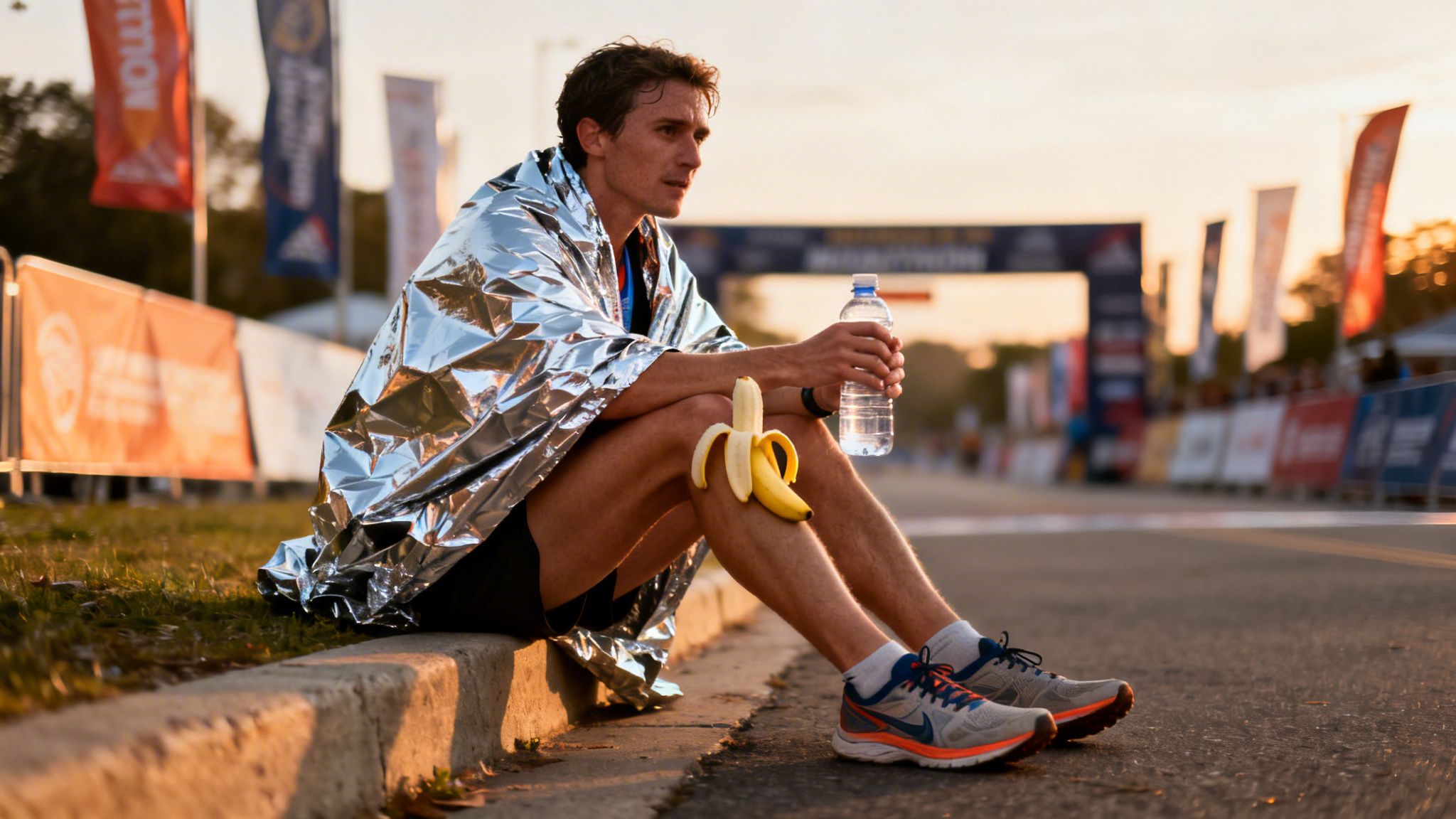
You just pushed your body to its absolute limit, so now the focus has to shift from performance to repair. Everything you do in these initial hours and days directly impacts inflammation, muscle soreness, and your overall timeline for feeling human again.
This isn't about just sitting on the couch and waiting it out. Think of it as active, intentional recovery. Your goals are simple but non-negotiable:
- Replenish: Get those depleted energy stores and fluids back in your system.
- Repair: Give your screaming muscles the building blocks they need to heal.
- Reduce: Calm down the inflammation and swelling to keep soreness in check.
The Golden Hour Post-Race
Those first 60 minutes after someone hangs a medal around your neck are incredibly important. Your body is like a sponge, ready to absorb nutrients, and your actions here can give you a massive head start on the healing process.
First thing's first: keep moving gently. It’s so tempting to just collapse in a heap, but stopping abruptly can cause blood to pool in your legs, making you feel dizzy or lightheaded. A slow, 10–15-minute walk lets your heart rate come down gradually and helps start flushing out all the metabolic junk from your muscles.
Next up, get some fuel in you. Within 30-60 minutes, you need a snack that has a 3:1 or 4:1 ratio of carbohydrates to protein. This is the magic formula for restocking glycogen and kicking off muscle repair. Simple, easy-to-digest options are your best bet—think chocolate milk, a banana with some peanut butter, or a pre-made recovery shake.
Managing The First 24 Hours
Once you’ve had that initial snack and cooled down a bit, it’s time to think about more substantial nutrition and serious rest. Keep sipping on water and electrolyte drinks all day to get your hydration back on track after sweating buckets.
Your meals should be balanced and packed with nutrients. Make sure you're getting:
- Complex Carbohydrates: Sweet potatoes, brown rice, and whole-wheat pasta will continue refilling your energy tanks.
- Lean Protein: Chicken, fish, tofu, or beans provide the amino acids essential for muscle repair.
- Healthy Fats: Avocado, nuts, and olive oil have anti-inflammatory properties that your body will thank you for.
Don't underestimate the power of sleep. Aim for a solid 8-9 hours the night after your race. During deep sleep, your body releases human growth hormone (HGH), which is a powerhouse for repairing all that microscopic muscle damage.
Days Two and Three: The Peak Soreness Phase
This is when the infamous Delayed Onset Muscle Soreness (DOMS) usually hits its peak. You’ll know it when walking down a flight of stairs feels like its own ultramarathon. During this 24- to 72-hour window, keep hammering away at your nutrition and hydration plan.
Gentle, active recovery is the name of the game here. Anything that gets blood flowing without adding more stress is perfect. A very light swim in a cool pool, a slow walk around the block, or some gentle dynamic stretching can work wonders for easing stiffness. Avoid holding deep, static stretches on those really sore muscles for now.
It's not just your legs that took a beating. A fascinating ten-year study on cardiac changes in marathon runners found that runners' right ventricular function dropped sharply right after the race. The good news? It showed remarkable resilience, bouncing back to near pre-race levels by day three. It’s a powerful reminder of how intense the marathon is and why this 72-hour window is so vital for your whole system to recover.
By the end of these three days, you'll have built a solid foundation for the coming weeks, putting yourself in the best position for a smart, injury-free return to running.
Active Recovery and Nutrition in the First Two Weeks

Once the intense, can’t-walk-down-the-stairs soreness starts to fade, you’ll probably feel that familiar itch—the urge to lace up your running shoes again. It’s a great sign that your motivation is intact, but hold that thought. These next two weeks are all about smart, active recovery, not jumping back into training.
Think of this phase as a reverse taper. You were methodical about reducing your mileage before the race; now, it’s time to be just as intentional about reintroducing activity. Rushing this process is the single biggest mistake I see runners make, and it’s a fast track to frustrating setbacks and injuries.
Embrace Low-Impact Cross-Training
Right now, your main goal is to get blood flowing to your exhausted muscles. This helps shuttle in oxygen and nutrients for repair while clearing out any lingering metabolic waste. Running is still off-limits, but gentle movement is your new best friend.
Some of the best options include:
- Swimming or Aqua Jogging: The buoyancy of the water takes all the stress off your joints, and the gentle pressure can even help with any leftover swelling. It feels amazing.
- Cycling: Hop on a stationary bike or go for a flat, easy spin outside. Cycling gets your legs moving without the constant pounding of running. Keep the resistance light.
- Elliptical Trainer: This is probably the closest you’ll get to the running motion without the impact, making it a safe way to wake up those muscle groups.
For any of these activities, the key is to keep it easy. We’re talking 20-30 minutes at a conversational pace. The point isn’t to gain fitness; it’s to help your body heal.
Even when you start to feel "normal," your body is still working overtime on a cellular level. Pushing through with high-impact exercise before your muscles and tendons have fully rebuilt is asking for a nagging injury that could sideline you for months.
Your cardiovascular system is also still resetting. It's not uncommon for your heart rate to be a bit erratic post-race. Research has shown that an athlete’s heart rate can jump significantly after an endurance event—for instance, a runner with 70kg of fat-free mass might see it climb by 25.6 beats compared to their resting state. It can take over 30 hours just for the nerves controlling your heart to get back to baseline. This is a clear biological signal that you need to take this phase seriously. If you're interested in the science behind this, you can read the full research on post-endurance event recovery.
Fine-Tuning Your Recovery Nutrition
The first 72 hours were about cramming carbs back into your muscles. Now, your focus shifts to sustained repair and managing inflammation. You gave your muscles thousands of micro-tears, and the right food is what stitches them back together.
Make sure you’re getting quality protein throughout the day, not just in one big meal. Spreading it out across your meals and snacks provides a steady supply of amino acids for rebuilding muscle.
Foods to Prioritize for Healing:
- Lean Proteins: Think chicken, fish (especially salmon for its anti-inflammatory omega-3s), eggs, and Greek yogurt.
- Anti-Inflammatory Foods: Load up on berries, leafy greens like spinach and kale, nuts, and turmeric.
- Complex Carbohydrates: Sweet potatoes, quinoa, and oats will keep your energy stable and your glycogen stores topped off.
Don't forget the micronutrients. Things like Vitamin C, Vitamin D, zinc, and magnesium are crucial for immune support and muscle function, both of which took a massive hit during the race. For more detailed plans, check out our broader guide on https://www.routeprinter.com/blogs/insights/recovery-after-running.
By combining gentle movement with strategic nutrition, you’re creating the perfect environment for your body to rebuild. Patience during these two weeks is what separates a strong, healthy return to running from a frustrating, injury-plagued one.
Listening to Your Body: Is It Soreness or an Injury?
You’ve crossed the finish line—an incredible achievement. But now comes the less glamorous part: the aches, the stiffness, and the dreaded walk down a flight of stairs. Every runner plays the same guessing game in the days after a marathon: is this just normal soreness, or did I actually injure myself?
Learning to read your body’s signals is one of the most valuable skills you can develop. It’s the key to recovering smartly and staying healthy for the long haul.
The first thing to understand is the difference between Delayed Onset Muscle Soreness (DOMS) and something more serious. DOMS is that classic, all-over muscle ache that tends to rear its head 24 to 72 hours after your race. It’s a sign that your muscles went through something intense and are now in the process of repairing and rebuilding.
Injury pain, however, is a different beast entirely. It’s your body’s alarm bell, telling you that something is wrong and needs attention.
Spotting the Difference: DOMS vs. Injury Red Flags
So, how do you tell them apart? While DOMS is an expected part of the marathon experience, ignoring an actual injury can set you back for weeks or even months. Here’s a quick guide to help you figure out what you’re feeling.
This is probably normal DOMS if:
- The feeling is a dull, generalized ache across your major muscle groups—think quads, glutes, hamstrings, and calves.
- The soreness is bilateral, meaning you feel it pretty evenly in both legs.
- It gets worse for a day or two, peaks, and then starts to gradually fade.
- Light, gentle movement like a slow walk or a swim actually makes it feel a bit better.
Watch out for these potential injury signs:
- Pain that is sharp, stabbing, or shoots through a specific area.
- The pain is very localized, pinpointed on a joint, a bone, or a single tendon.
- You notice swelling, redness, or heat in one particular spot.
- The pain gets worse when you try to move, or it shows no improvement after a few days of rest.
A great rule of thumb: if the pain is sharp enough to change the way you walk, or if it’s still getting worse after 72 hours, it's time to stop and listen. Never try to "run through" that kind of pain.
Making this distinction is non-negotiable. Pushing through a real injury can turn a minor tweak into a major problem. For a deeper dive into staying healthy, check out our full guide on how to prevent running injuries.
When to Call in a Professional
While you can self-diagnose a lot, some situations absolutely require an expert opinion from a physical therapist or sports medicine doctor.
Don't hesitate to make an appointment if you suspect a classic running injury like IT band syndrome (that sharp pain on the outside of your knee), Achilles tendonitis (pain and stiffness right above your heel), or a potential stress fracture (a very specific, tender spot on a bone that hurts with impact).
It’s also worth remembering what’s happening on the inside. A marathon sends a massive wave of inflammation through your system. Biomarkers like C-reactive protein (hsCRP) can stay elevated for up to seven days post-race, while markers of muscle damage like creatine kinase (CK) peak around 24 hours later and can take nearly a week to return to normal.
This internal healing process is why feeling "off" for a week is completely standard. But if those severe aches and pains just aren't letting up, it could mean your body is struggling to recover on its own, and a professional check-up is a wise move.
Ultimately, mastering marathon recovery means becoming an expert in your own body. You'll learn to recognize its normal protests and, just as importantly, know when it’s time to ask for help. This is how you ensure you don’t just recover—you come back stronger for whatever challenge is next.
Your Smart and Progressive Return to Running Plan

After a week or two of dedicated rest and some light movement, that familiar itch to run usually comes roaring back. That’s a great sign! It means your body and mind are finally feeling recovered and ready for more. But hold on—jumping right back into your old mileage is probably the fastest way to get yourself injured.
Even if the worst of the muscle soreness is gone, your body is still in a delicate state of repair. All those tendons, ligaments, and deep muscle fibers need more time to regain their full strength. This is where a smart, gradual return-to-running plan is your best friend for staying healthy long-term.
Forget Pace and Embrace "Feel"
For the next few weeks, do yourself a favor: ignore your watch's pace screen completely. The goal here isn't to claw back fitness; it's to gently re-establish your running base without putting your system under a ton of stress. Every run should feel easy, at a pace where you could comfortably hold a conversation.
Think of these first few outings as check-ins with your body. You're listening for any stubborn aches, seeing how your energy levels hold up, and just getting a feel for movement again. If you end a run feeling more energized than when you started, you're doing it right.
Easing back into mileage and frequency gives your musculoskeletal system the time it needs to adapt to the impact of running again. It's so much better to finish a run feeling like you could have gone longer than to push it and be filled with regret (and pain) the next day.
Your body has an amazing capacity for repair, but it operates on a biological timeline, not a training schedule. Trying to rush back to your previous fitness level before your body is truly ready is like building a house on a foundation that hasn't fully set.
A Sample 4-Week Return-to-Running Schedule
Think of this schedule as a flexible template, not a strict set of rules. The most important thing you can do is listen to your body. If you feel sharp pain or are just completely wiped out, take an extra rest day or swap a run for some easy cross-training. An extra day off now is always a better choice than being forced to take weeks off later for an injury.
The plan starts with short walk/run intervals to ease your body back into the specific demands of running.
| Week | Monday | Tuesday | Wednesday | Thursday | Friday | Saturday | Sunday |
|---|---|---|---|---|---|---|---|
| Week 1 | Rest | Run: 15-20 min total (5 min run / 2 min walk) | Rest or Cross-Train (30 min) | Run: 15-20 min total (5 min run / 2 min walk) | Rest | Cross-Train (30-40 min) | Long Run: 25-30 min total (6 min run / 2 min walk) |
| Week 2 | Rest | Run: 20-25 min total (8 min run / 2 min walk) | Rest or Cross-Train (30 min) | Run: 20-25 min total (8 min run / 2 min walk) | Rest | Cross-Train (40-45 min) | Long Run: 35-40 min total (10 min run / 2 min walk) |
| Week 3 | Rest | Run: 25-30 min total (12 min run / 1 min walk) | Rest or Cross-Train (30 min) | Run: 25-30 min total (12 min run / 1 min walk) | Rest | Optional Easy Run (20 min) or Cross-Train | Long Run: 45-50 min continuous easy running |
| Week 4 | Rest | Run: 30-35 min continuous easy running | Rest or Cross-Train (30 min) | Run: 30-35 min continuous easy running | Rest | Optional Easy Run (25 min) or Cross-Train | Long Run: 55-60 min continuous easy running |
As you can see, the focus is on slowly building duration and reducing walk breaks before you even think about adding any intensity or serious mileage.
Keep Tabs on Your Progress and Adjust as Needed
Keeping a simple training log during this time can be incredibly useful. It doesn’t have to be some elaborate spreadsheet; just a few quick notes after each session will do the trick.
Things worth jotting down:
- How you felt overall: Were you sluggish or did you feel springy and energetic?
- Any aches or pains: Make a note of any specific sore spots and maybe rate them on a 1-10 scale.
- Sleep quality: How did you sleep the night after your run? Really poor sleep can be a classic sign of pushing too hard.
- Your motivation: Are you actually excited to run, or does it feel like a chore?
This little bit of data will help you spot patterns. For example, if that same twinge in your knee pops up after every run, that’s a clear signal to back off and focus more on strength and mobility. On the flip side, if you're feeling fantastic after every run in Week 2, you can probably move into Week 3 with confidence.
Remember, this phase of recovery is a bridge. It’s here to get you safely from a state of deep fatigue back to a place where you can start training for real again. Take it slow, be smart about it, and you'll ensure that when you're ready to chase that next goal, your body is 100% on board.
Time to Recover Your Mind and Celebrate What You've Done

We've talked a lot about the body, but your mind just went through a marathon, too. Healing the physical side is only half the battle. For months, your entire life probably revolved around this one huge goal. Now that it’s done and dusted, it's totally normal to feel a bit... adrift.
This feeling is so common among runners that it has a name: the post-marathon blues. It’s that emotional dip or sense of emptiness that can creep in after the initial high of crossing the finish line fades. The rigid training schedule that structured your days is suddenly gone, leaving a real void. On top of that, your brain is coming down from the massive endorphin rush of race day.
Getting Through the Post-Marathon Blues
The first step is simply to acknowledge that it's happening. Don't fight it. Give yourself permission to feel the letdown. You’ve put your body and mind through an incredible challenge, and this emotional recalibration is just part of the process.
The trick is to gently pivot your focus. That discipline you cultivated over months of training doesn't have to vanish; it just needs a new, less punishing target for a little while.
- Set small, non-running goals. Channel that energy into something new. Maybe you finally tackle that messy closet, start the book that's been on your nightstand for months, or spend an hour a day learning a new language on an app.
- Catch up with your people. Let's be honest, training probably meant turning down a few social invitations. Now is the perfect time to reconnect with the friends and family who cheered you on.
- Learn to love unstructured rest. After months of programmed runs, just doing nothing can feel strange, almost wrong. You have to learn to embrace it. Savour that lazy Saturday morning without a 20-miler hanging over your head. It’s not laziness; it's essential recovery.
It's so easy to get wrapped up in defining yourself by your last race or your next big goal. But being a runner for the long haul means knowing your identity is bigger than your training log. This mental break is every bit as crucial as foam rolling.
Make Your Accomplishment Real
A massive part of closing the book on this marathon is to truly celebrate what you did. You've joined a club that less than 1% of the world's population belongs to. That deserves a lot more than just a pat on the back.
Creating a physical reminder of your race is a powerful way to help your brain process the achievement. It turns a fleeting event into a permanent symbol of your hard work and mental toughness, and it's there to see on the days you need a boost.
A custom race poster, for example, is a brilliant way to immortalize the day. Seeing your route, name, and finish time hanging on the wall is a daily reminder of what you’re capable of. It solidifies the memory and can be a huge source of motivation when you're feeling a little low. If you want some inspiration, you can find some great race poster ideas that help turn your big day into a piece of art.
Celebrating like this helps you mentally wrap up one journey, clearing the way for whatever comes next—whether that's another starting line or a totally new kind of adventure.
Common Marathon Recovery Questions Answered
Even with the best plan, you're bound to have questions pop up while you're recovering. Let's tackle some of the most common things runners ask after crossing the finish line, so you can navigate this period with a bit more confidence.
How Long Should I Wait Before Running Another Marathon?
This is the big one, isn't it? While there’s no magic number, a classic rule of thumb is to give yourself at least one day of recovery for every mile you raced. For a marathon, that means a bare minimum of 26 days before you even think about serious training again.
But honestly, that's just the starting point. A much smarter and safer approach is to wait 3 to 6 months before lining up for another 26.2. This longer break allows your body to fully repair on a cellular level, lets your mind reset, and dramatically lowers your risk of injury. The best advice? Listen to your body. If you're still feeling drained and uninspired a month later, you absolutely need more time off.
Is a Deep Tissue Massage a Good Idea Right After the Race?
Hold off on that deep tissue work. Your muscles are riddled with inflammation and tiny micro-tears from the race. Getting an aggressive massage right away can actually do more harm than good, making the damage and soreness much worse.
Expert Tip: For the first 48–72 hours, stick to very light, gentle "flushing" massages. The goal is simply to encourage blood flow without digging in. Wait at least 3 to 5 days, or until that initial, intense muscle soreness (DOMS) has calmed down, before booking a proper therapeutic massage to work out the real knots.
What Should I Be Eating in the First 24 Hours?
Your nutrition mission in the first 24 hours is threefold: reload your empty glycogen stores, rehydrate, and kick-start muscle repair. The easiest way to remember this is to aim for a 3:1 or 4:1 ratio of carbohydrates to protein in your meals and snacks.
Here's how that looks in practice:
- Within 30-60 Minutes: Get something in you quickly. Think simple and easy to digest. Chocolate milk is a classic for a reason, but a banana with peanut butter or a recovery shake works perfectly, too.
- Your Main Meals: Focus on high-quality complex carbs—sweet potatoes, brown rice, and quinoa are fantastic. Pair them with lean protein like chicken, fish, or tofu to help rebuild those tired muscles.
- Remember Your Electrolytes: You sweat out a ton of salt. Foods like salted nuts, pretzels, or an electrolyte drink will help get your system back in balance.
I Feel Kind of Sad and Unmotivated. Is This Normal?
Yes, it's completely normal. Welcome to the "post-marathon blues." For months, your life has been pointed toward this one massive goal, and it's natural to feel a little lost or empty now that it's over.
On top of the mental shift, your body is also navigating a huge hormonal rollercoaster and sheer physical exhaustion, all of which mess with your mood. The best thing you can do is acknowledge these feelings and give yourself permission to just rest. Celebrate what you did! Creating a tangible reminder of your race is a great way to close that chapter and appreciate the journey.
Don't let the memory fade. Turn your incredible achievement into a piece of art you can see every day. At RoutePrinter, we design custom posters with your race route, name, and finish time. It’s the perfect way to commemorate your hard work and keep that fire lit for whatever comes next.
Design your personalized marathon poster today at routeprinter.com