A Runner’s Guide to Smart Recovery After Running

As soon as you stop your watch, your recovery begins. What you do in the next 60 minutes is absolutely crucial—it's what many experienced runners call the "golden hour." This is your window of opportunity to kickstart muscle repair, restock your energy stores, and head off soreness at the pass.
Think of it this way: the simple things you do right after a run lay the groundwork for how strong you'll feel on your next one.
The First Hour: Your Post-Run Recovery Blueprint

The moment your run ends, the clock on your recovery officially starts ticking. What you do in this initial phase dramatically influences how your body adapts to the stress you just put it through. This isn't just the end of your workout; it's the beginning of your body's essential repair cycle.
This first hour is all about giving your body the raw materials it needs to mend tiny muscle tears and refuel its empty tanks. Skipping these steps is a classic runner's mistake, and it almost always leads to nagging fatigue, deeper muscle soreness, and a slower bounce-back for your next training session.
Rehydrate and Refuel—Immediately
Your first job is to replace the fluids and nutrients you just sweated out. Even on a cool day, you lose a surprising amount of water and electrolytes. Start sipping on water or an electrolyte drink right away.
Next up is food. In this 60-minute window, your muscles are like sponges, ready to soak up nutrients more efficiently than at any other time. You have two main goals here:
- Restock Glycogen: Carbs are your body's high-octane fuel, stored in your muscles as glycogen. Running drains those stores, and you need to top them off quickly to get your energy back.
- Repair Muscle: Protein delivers the amino acids needed to patch up the micro-tears in your muscles. This repair process is literally how you get stronger.
Aim for a snack that has a 3:1 or 4:1 ratio of carbohydrates to protein. This is the sweet spot for recovery. It could be as simple as chocolate milk, a banana with some peanut butter, or a smoothie made with fruit and a scoop of protein powder.
Don't get bogged down in finding the "perfect" food. The most important thing is getting something in your system within 30-60 minutes. Your body just needs the raw materials—carbs and protein—to get to work.
Keep Moving (Gently) and Cool Down
As tempting as it is to drop onto the nearest couch, try to resist. A proper cool-down is your friend. It helps ease your heart rate back to normal and prevents blood from pooling in your legs, which can make you feel light-headed.
Just a simple, slow walk for 5-10 minutes does the trick.
This is also the perfect time for some gentle static stretching. Focus on the big running muscles: your quads, hamstrings, glutes, and calves. Hold each stretch for 20-30 seconds—no bouncing. This light movement helps release that immediate post-run tightness and sets you up for a much more comfortable recovery over the next few days.
To make it even easier, here’s a quick checklist for that critical first hour.
Golden Hour Recovery Checklist
This table is your quick reference guide for the essential actions to take within 60 minutes of finishing your run.
| Action | Why It Matters | Example |
|---|---|---|
| Cool-Down Walk | Gradually lowers heart rate and prevents blood pooling. | A 5-10 minute slow walk back to your car or home. |
| Rehydrate | Replaces fluids and electrolytes lost through sweat. | Sipping on 16-24 oz of water or an electrolyte drink. |
| Refuel | Replenishes glycogen stores and provides protein for muscle repair. | A glass of chocolate milk, a protein shake, or Greek yogurt with berries. |
| Gentle Stretch | Improves flexibility and relieves immediate muscle tightness. | Holding stretches for major leg muscles (quads, hamstrings, calves) for 20-30 seconds each. |
Nailing these simple steps consistently will have a massive impact on your training, helping you feel fresher and stronger, run after run.
Active vs. Passive Recovery in the First 72 Hours

That 72-hour window after a hard race or a grueling long run is where the real fitness gains are made. It's not about the run itself, but how your body adapts afterward. Your muscles are busy repairing and rebuilding, getting stronger for the next effort. The big question is, what should you be doing during this time? Do you put your feet up, or do you keep moving?
This brings us to the classic debate: active recovery versus passive recovery.
Passive recovery is exactly what it sounds like—complete rest. Think couch, Netflix, and zero obligations. Active recovery, on the other hand, is all about low-intensity movement meant to help the healing process without piling on more stress.
There’s a time and a place for both. The trick is knowing which one your body needs, and when. It’s not just about resting; it’s about recovering with intention.
The Case for Active Recovery
Active recovery is all about promoting blood flow. Gentle movement helps deliver fresh oxygen and nutrients to your tired muscles while helping to flush out the metabolic byproducts that contribute to soreness. It's like giving your body’s natural cleanup crew a little boost.
This isn’t another workout. We're talking low-impact, low-effort activity that should make you feel better, not worse.
Some great active recovery options include:
- A slow, easy walk
- A gentle swim or session on the elliptical
- A light yoga or mobility routine
- An easy spin on a stationary bike with no resistance
For example, the day after a tough 20-miler, a 20-minute walk can work wonders. It helps ease that all-too-familiar stiffness in your hamstrings and calves and prevents that "locked-up" feeling you can get from a day of total rest.
When Passive Recovery Wins
So, when is it better to just do nothing? Passive recovery—true, complete rest—is non-negotiable when your body is genuinely beat down or teetering on the edge of injury.
If you’re dealing with sharp pain, feel an overwhelming sense of fatigue that isn’t getting better, or are just mentally fried, pushing through (even with "easy" activity) can do more harm than good. Your body is pretty good at telling you when it needs a real break. Ignoring those signals is how minor aches become chronic injuries.
And let’s not forget, sleep is the ultimate form of passive recovery. It’s when your body releases the growth hormones that are absolutely essential for tissue repair.
Your recovery plan shouldn’t be written in stone. If your body is screaming for rest, listen to it. One day of doing absolutely nothing is far more productive than forcing an active recovery session your body isn't ready for.
Finding Your Personal Balance
So, which one is better? The truth is, it depends. One study comparing 72 hours of active versus passive recovery after a 5k race found that while active recovery led to slightly better performance improvements, how each runner responded was highly individual.
This really drives home the most important point: personalization is everything. The best approach for most runners is usually a smart blend of both.
Here’s a practical way to think about the first 72 hours after a major effort:
- Day 1 (The first 24 hours): Focus on light active recovery. A walk or gentle swim can really take the edge off that initial muscle soreness.
- Day 2 (Up to 48 hours): Check in with yourself. If the soreness is fading and you feel okay, another light session is a good idea. But if you feel deeply tired, make passive rest and extra sleep your top priority.
- Day 3 (Up to 72 hours): You should be feeling much more like yourself by now. This is a great time for a very short, very easy "shakeout" run to test how your body feels before jumping back into your normal training.
And remember, nutrition is your silent partner through all of this. Keep focusing on anti-inflammatory foods like berries, leafy greens, and fatty fish. A steady intake of protein at every meal—not just in a post-run shake—will give your muscles the constant supply of amino acids they need to repair.
Customizing Your Recovery for Different Types of Runs
Not all runs are created equal, and your recovery shouldn’t be a one-size-fits-all script. A gentle 3-mile jog just doesn't put the same stress on your body as a grueling 20-mile long run or an all-out half marathon.
Learning to match your recovery to the specific demands of each workout is one of the smartest things you can do. It’s how you stay healthy, truly adapt to your training, and feel strong for whatever comes next. This mindset helps you pour your energy into healing after the toughest efforts while keeping things simple and efficient after easy days.
Recovery From an Easy Training Run
Let's start with your bread and butter: the easy run. We're talking about those 3- to 5-mile efforts at a comfortable, conversational pace. The whole point of these runs is to build your aerobic engine without causing much muscle damage, so your recovery can be quick and to the point.
The focus here is simply getting back to baseline.
- Hydration: Sip on water throughout the day. Unless it was a scorcher, you probably don't need a special electrolyte drink.
- Nutrition: There's no urgent need for a massive recovery meal. Just get back to your normal, balanced eating schedule. Your next meal will easily top off the tank.
- Mobility: A few minutes of gentle static stretching right after your run is perfect. Hit your calves, hamstrings, and quads to stay loose, but don't overdo it.
Forget the ice baths or compression boots for these. Over-recovering from an easy run is a waste of time and energy you could be using elsewhere.
Recovery From a Weekend Long Run
The weekend long run is the cornerstone of most training plans, whether you’re tackling 10 miles or 20. This is where you put significant stress on your muscles, joints, and energy systems. Here, your recovery needs to be much more deliberate to help you absorb that hard work.
Think of the 24 hours after your long run as your prime repair window.
Your first priority is refueling. Aim to eat a meal with a 3:1 or 4:1 ratio of carbs to protein within about 60-90 minutes of finishing. This is your best shot at restocking those empty glycogen stores and kickstarting muscle repair. Think grilled chicken with sweet potatoes or a big smoothie packed with fruit and protein powder.
The day after a long run is perfect for active recovery. A 20-30 minute walk, a gentle swim, or an easy spin on the bike gets blood flowing to sore muscles. This helps flush out waste products and ease stiffness without adding more stress.
That evening, set aside some time for mobility. This is a great time to grab a foam roller and work on your quads, IT bands, and calves. Most importantly, prioritize a full night of sleep—that’s when your body does its most important hormonal and cellular repair work.
Recovery From a Peak Race
Coming back from a goal race, like a half or full marathon, is an entirely different beast. You’ve pushed your body to its absolute limit, creating widespread muscle damage and inflammation. The recovery process is much longer and requires a ton of patience. In fact, studies show your immune function can be suppressed for up to 72 hours after a marathon.
The first few days are all about damage control.
- Day 1 (Race Day): Your job is to rehydrate with electrolyte-rich fluids and get in some easily digestible calories. Keep moving with very gentle, slow walking to prevent everything from locking up. Don’t even think about deep stretching—your muscles are far too damaged.
- Days 2-3: This is the time for sleep and passive recovery. Any "active" recovery should be limited to short, slow walks. Your appetite might be weird, but do your best to eat nutrient-dense foods, especially those rich in protein and anti-inflammatory compounds like berries and leafy greens.
- Days 4-7: You can start introducing more active recovery, like swimming or light cycling. A professional sports massage around this time can be a godsend for working out deep muscle knots. Above all, listen to your body. If you feel wiped out, you need more rest.
The biggest mistake you can make after a race is rushing back into training. A good rule of thumb is to take at least one easy day of recovery for every mile you raced. Your body and mind just went through a monumental effort, and they need a real break to heal.
Sample Recovery Plans by Run Type
To make this crystal clear, here’s a quick-glance table comparing how you might approach recovery for different types of runs. Use this as a starting point and adjust based on how your own body feels.
| Recovery Element | Easy Run (3-5 miles) | Long Run (10+ miles) | Race (Half/Full Marathon) |
|---|---|---|---|
| Immediate Refuel | Not urgent; next balanced meal is fine. | 3:1 or 4:1 carb-to-protein meal within 60-90 mins. | Easily digestible carbs & electrolytes immediately. |
| Hydration | Water throughout the day. | Water & electrolyte drink. | Aggressive rehydration with electrolytes. |
| Active Recovery | Not necessary. | Gentle walk or swim the next day. | Very short, slow walks for the first 2-3 days. |
| Mobility/Tools | Light static stretching post-run. | Foam rolling & stretching in the evening. | Professional massage after day 4; avoid deep work early on. |
| Sleep | Normal 7-9 hours. | Prioritize 8-10 hours of quality sleep. | Maximize sleep for 3-5 nights post-race. |
| Return to Running | Next scheduled run. | 1-2 easy days before next quality session. | Minimum 1 week off; gradual return over 2-4 weeks. |
Think of this table not as a rigid set of rules, but as a flexible framework. The ultimate expert on your recovery is you. Pay attention to your energy levels, muscle soreness, and overall mood to fine-tune your approach and keep yourself running strong.
Essential Recovery Tools and Techniques for Runners
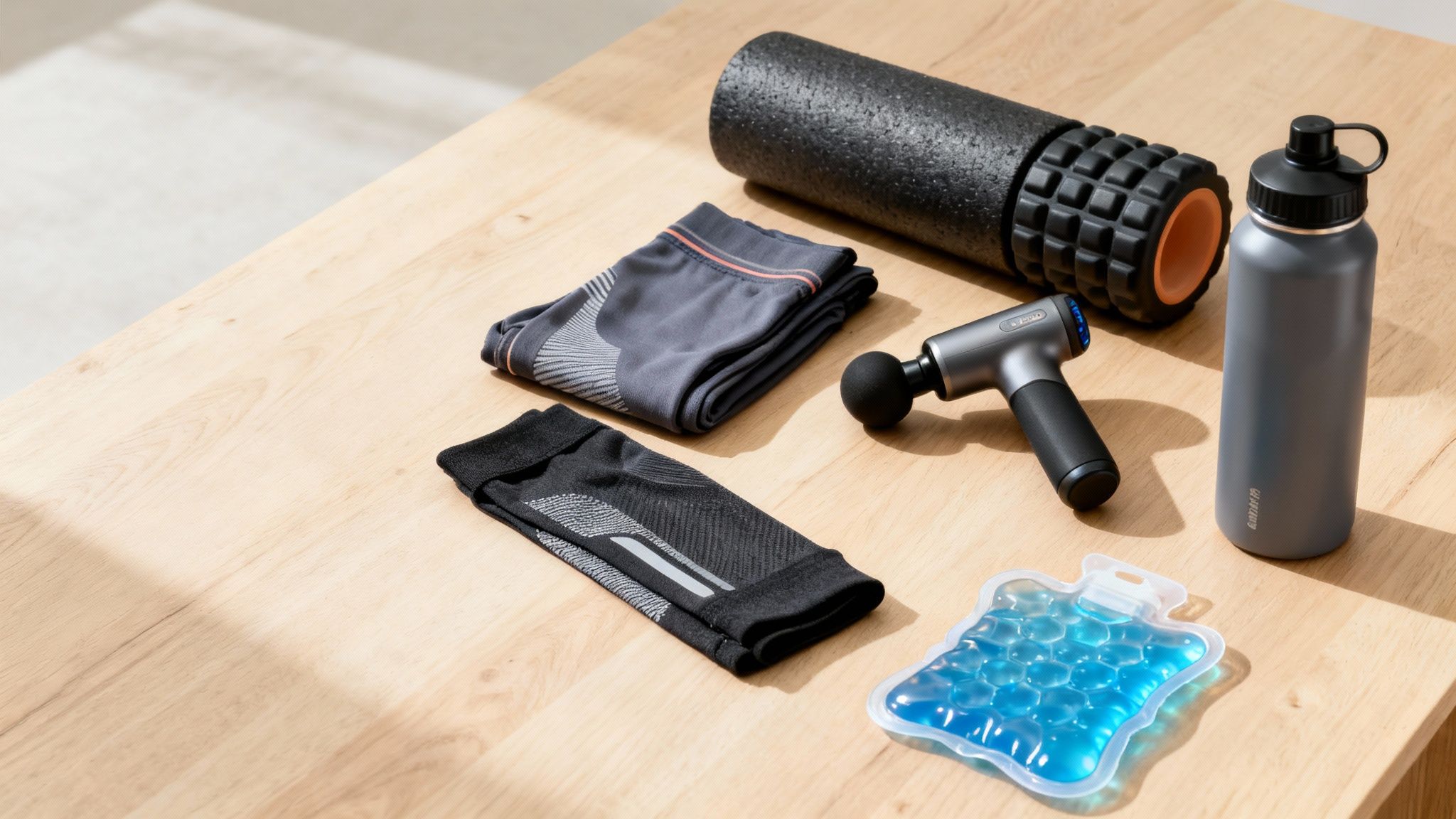
While smart training, good food, and solid sleep are the bedrock of recovery, the right tools can absolutely give you an edge. Think of them less as magic fixes and more as valuable assistants that help you work out soreness, stay mobile, and keep little niggles from turning into full-blown injuries.
It's easy to get overwhelmed by the sheer number of gadgets out there, each promising to make you a better runner overnight. But honestly, you don't need a space-age recovery lab in your living room. A few proven tools, used consistently, will do more for you than the latest trendy device ever will.
Master the Foam Roller
If I had to pick just one tool for every runner, it would be the humble foam roller. It’s the best way to perform self-myofascial release—a technical term for giving yourself a deep-tissue massage. The goal is to break up the knots and adhesions in your muscles and the fascia surrounding them, which boosts blood flow and helps your muscles function properly again.
Don't just wait until you're sore to pull it out. A consistent 10-15 minute routine a few times a week can make a world of difference in your flexibility and overall tissue health.
Key Areas to Hit:
- Quads: Get into a plank position with the roller under your thighs. Roll from just above your knee to the base of your hip. It’s usually an eye-opener.
- Hamstrings & Glutes: Sit on the roller and use your hands behind you for support. To really dig into your glutes, cross one ankle over the opposite knee and lean into that hip.
- Calves: Prop yourself up with your hands and place the roller under your calves. To add pressure, you can cross one leg over the other.
The key is to move slowly. When you find a tender spot, pause on it for 20-30 seconds and just breathe. You'll feel the muscle start to let go.
Demystifying Ice vs. Heat
Ah, the great debate. Runners have been arguing about this for decades, but the answer is pretty straightforward: it’s all about timing.
Ice (Cryotherapy): Think of ice as your emergency response team. It's for the immediate aftermath of a hard run or a new injury, specifically within the first 24-48 hours. The cold constricts your blood vessels, which tamps down inflammation and swelling. A quick ice bath or an ice pack on a tender spot for 10-15 minutes after a long run can work wonders.
Heat: Heat is for the chronic stuff—the lingering tightness and stiffness that’s been around for a few days. Heat opens up the blood vessels, bringing more blood to the area to help relax tight, grumpy muscles. A heating pad on a stiff hamstring before you head out the door can be a game-changer.
Whatever you do, never put heat on a fresh injury. That will just crank up the inflammation and make things worse. When in doubt, always go with ice first.
The Rise of Percussion Massagers
Massage guns have exploded in popularity, and for good reason. They deliver a rapid, pulsing massage that gets way deeper into the muscle than a foam roller can. They're fantastic for breaking up stubborn knots and bringing targeted relief to big muscles like your quads, glutes, and hamstrings.
A couple of minutes on a sore area can significantly reduce tightness. Just be careful around bones, your neck, and your spine, and always start on the lowest setting to see how it feels. They aren't a must-have, but for serious runners, they're an incredibly powerful tool. If you're looking for gear ideas, we’ve got some recommendations in our guide to the best gifts for marathon runners.
When to Call in a Professional
At the end of the day, your own tools can only take you so far. A qualified sports massage therapist or physical therapist has the training to find and fix underlying problems you might not even know you have. If you’ve got a nagging pain that just won’t quit, it's time to make an appointment.
Think of it as essential maintenance for your body. Investing in a professional massage once a month, especially during a tough training cycle, is one of the smartest things you can do to prevent injuries. They’ll work out the kinks before they have a chance to sideline you.
How Nutrition and Sleep Supercharge Your Recovery

While we all love our foam rollers and cool-down routines, the most powerful recovery work happens far away from the track. The real heavy lifting is done on your plate and in your bed.
It's simple, really. Without smart nutrition and deep, restorative sleep, all that hard work you put in on the road can't fully translate into fitness gains. Think of it this way: nutrition provides the raw materials to rebuild your body, and sleep is the construction crew that puts it all together. Get these two right, and you’ll find yourself bouncing back faster and stronger.
Fueling the Repair Process
Your body is a remarkable self-repairing machine, but it can’t build something from nothing. What you eat after a run provides the essential building blocks your muscles are crying out for. The two most critical pieces of that puzzle are carbohydrates and protein.
Running drains your muscle glycogen, which is your body's go-to fuel tank. If you don't top it off, you'll feel that nagging fatigue on your next run. Protein, on the other hand, delivers the amino acids needed to patch up the tiny muscle tears created during your run—which is exactly how you get stronger.
A great rule of thumb is to aim for a meal or snack with a 3:1 or 4:1 ratio of carbs to protein. But it’s not just about that one post-run meal. Eating well-balanced meals throughout the day gives your muscles a steady supply of what they need, right when they need it.
After a massive effort like a marathon, your immune function can be suppressed for up to 72 hours. Loading up on antioxidant-rich foods like berries, leafy greens, and nuts during this window is a smart move to fight inflammation and support your system when it’s most vulnerable.
Practical Meals for Recovery
These aren't fancy chef creations; they're simple, effective meals that get the job done.
- Post-Run Snack: A fruit smoothie with Greek yogurt or a scoop of protein powder is a classic for a reason.
- Recovery Lunch: Think grilled chicken or tofu with a big sweet potato and a side of roasted broccoli.
- Dinner: Salmon with quinoa and a massive spinach salad checks all the boxes.
These meals deliver the right balance of macronutrients along with vital micronutrients like magnesium for muscle function and zinc for tissue repair. Getting your fueling strategy dialled in is crucial, especially for longer distances. For more on that, check out our guide on how to improve running endurance.
The Ultimate Recovery Tool: Sleep
If food provides the building materials, sleep is when all the construction magic happens. During deep sleep, your body goes into overdrive, releasing Human Growth Hormone (HGH), which is a powerhouse for repairing muscle, bone, and connective tissue.
Seriously, skimping on sleep is one of the biggest recovery mistakes you can make as a runner. Research has shown that even one bad night can spike your cortisol levels—a stress hormone that gets in the way of tissue repair. Consistently getting less than 7-9 hours of quality sleep a night will sabotage your training, weaken your immune system, and leave you feeling completely drained.
Improving your sleep hygiene doesn't require a huge overhaul. Just a few small tweaks can make a massive difference.
- Be Consistent: Try to go to bed and wake up around the same time every day, even on weekends. Your body loves a routine.
- Create Your Cave: Keep your bedroom as cool, dark, and quiet as possible.
- Power Down: The blue light from phones, tablets, and TVs messes with your body's melatonin production (the sleep hormone). Put them away at least an hour before bed.
- Watch the Stimulants: That evening coffee or beer might seem relaxing, but both caffeine and alcohol can seriously disrupt your sleep quality.
Listening to Your Body: Red Flags and When to Rest
Learning to speak your body's language is probably the most valuable skill any runner can develop. It’s the only way to tell the difference between the satisfying ache of a hard-earned effort and the sharp, piercing signal of an oncoming injury. Pushing through the first one builds strength; ignoring the second can put you on the sidelines for weeks.
One of the trickiest things for runners to learn is how to distinguish between normal muscle soreness (DOMS) and actual pain. DOMS is that familiar, dull, all-over ache that shows up 24-48 hours after a tough workout and usually disappears within 72 hours. Injury pain, on the other hand, acts very differently.
Decoding Your Body's Warning Signals
True red flags don’t feel like the general fatigue from a long run. They are specific, persistent, and demand your attention. Spotting these early is the key to smart recovery and staying on the road.
Keep a close watch for any of these signs:
- Sharp, Localized Pain: If you can point to one specific spot that has a stabbing or shooting sensation, that's a huge warning.
- Pain That Worsens During a Run: Normal muscle fatigue might feel tough at first, but it often loosens up as you warm up. Pain from an injury almost always gets worse the longer you run.
- Limp-Inducing Discomfort: The moment you have to change your natural stride to avoid pain, you need to stop.
- Lingering Soreness: Any ache that hangs around for more than 72 hours without getting better is your body telling you it's not recovering right.
Trying to run through these signals is a massive gamble. Running-related injuries (RRIs) are unfortunately all too common. The Garmin-RUNSAFE Running Health Study found the cumulative injury rate hit 57.6% after just 1,000 kilometers of running and jumped to a staggering 69.8% by 2,000 kilometers. This stat alone shows why you can't afford to ignore early warnings. You can read more about the RRI findings from this study.
Making the Call: Rest or See a Pro
So, what’s the move when a red flag pops up? The first step is simple: take an extra rest day. Don't try to "test it" or push through. If a day or two of complete rest makes the pain vanish, you can ease back into your routine cautiously.
Hitting pause isn't a sign of weakness; it's a sign of intelligence. One unplanned rest day is infinitely better than a month of forced time off because you pushed a small issue into a full-blown injury.
But what if the pain is still there after a few days off? Or if it comes right back the second you start running again? That's your cue to see a physical therapist. A good PT can diagnose the root cause—often a hidden weakness or biomechanical imbalance you'd never find on your own. Getting an expert opinion isn't just about healing; it's about becoming a smarter, more resilient runner. You might also want to check out our guide on how to prevent running injuries.
Answering Your Biggest Running Recovery Questions
Even the most seasoned runners have questions about the finer points of recovery. It's a topic with a lot of conflicting advice, so let's clear up a few of the most common questions I hear.
How Soon Can I Run Again After a Marathon?
There's an old rule of thumb that says you need one day of rest for every mile you raced. For a marathon, that would mean a whopping 26 days of taking it easy. While that’s a decent starting point, the real answer is always: listen to your body.
Don't even think about running for the first week post-race. Focus on active recovery—gentle walks, stretching, maybe a swim. Only when the deep muscle soreness is completely gone and you actually feel like running again should you ease back in with a few short, slow jogs.
Are Ice Baths a Must-Do for Recovery?
Ice baths can be a game-changer for taming inflammation after a truly gut-busting effort, like a goal race or a killer track workout. They really help take the edge off that deep muscle ache.
But are they necessary after every single run? Absolutely not. For your daily miles, you’ll get far more bang for your buck by nailing the fundamentals: solid nutrition, consistent foam rolling, and—most importantly—plenty of quality sleep.
Think of ice baths as a special tool for your toughest efforts, not a daily chore. For everything else, your best recovery tools are your fork, your foam roller, and your pillow.
What Should I Eat the Minute I Finish a Run?
Your body is screaming for two things after a run: carbs to restock your energy stores (glycogen) and protein to start repairing muscle. The magic ratio is somewhere around 3:1 or 4:1 carbohydrates to protein.
You need to get this in quickly, ideally within 30-60 minutes of stopping your watch. Don't overthink it. Some of the best options are simple:
- A tall glass of chocolate milk (the classic for a reason!)
- A banana slathered in peanut butter
- A fruit smoothie with a scoop of protein powder
- A bowl of Greek yogurt topped with berries
Celebrate your incredible running achievements with RoutePrinter. Turn your hard-earned miles from a marathon, half marathon, or any race into a stunning piece of art. Design a personalized poster that showcases your route, time, and event details. Visit RoutePrinter to create your custom race poster today!