Ultimate 10k 6 Week Training Plan for Every Runner

Thinking about running a 10K in just six weeks? It's a fantastic goal, and absolutely doable. That timeline hits a sweet spot—it’s long enough to build real endurance and get faster, but short enough that you stay fired up and focused the whole way through.
A solid 10k 6 week training plan is your roadmap, whether you're just starting out or chasing a new personal best.
Why Six Weeks Is a Smart Move
Jumping into a 10K with just over a month to prepare might sound a little intense, but it's a surprisingly effective way to train. The shorter timeframe gives every single workout a clear purpose. There’s no room for "junk miles" here. Each run, from the easy jogs to the tougher speed sessions, is a specific building block getting you ready for race day.
This approach builds your fitness steadily, which helps you sidestep the burnout that can creep in during longer, more drawn-out training cycles.
The 6.2-mile distance is a brilliant challenge. It's a serious step up from a 5K that requires more stamina, but it doesn't demand the high-volume commitment of a half marathon. It’s no wonder it’s so popular! Around 2 million people run 10Ks every year in about 3,500 races worldwide, making it the second most popular distance after the 5K. You can dig into more global running statistics to see just how big the community is.

What Makes This Training Plan Tick
This guide is more than just a calendar with runs plugged in. It's a complete system built on training principles I've seen work time and time again, balancing the hard work with smart recovery. If you stick with these ideas, you won't just cross the finish line—you'll do it feeling strong.
Here’s the simple philosophy behind the plan:
- Smart Progression: Each week, you'll gradually add a bit more distance or intensity. This lets your body adapt and get stronger without getting overwhelmed.
- Strategic Rest: Rest days are not optional. This is when the magic happens—your muscles repair and rebuild. Skipping rest is the fastest ticket to an injury I know of.
- Workout Variety: We’ll mix things up with different types of runs. You’ll have easy runs, long runs, and faster efforts like tempo runs. This variety is key for building both your endurance engine and your top-end speed.
This plan is your guide, but your body gets the final vote. The most important skill any runner can learn is telling the difference between the good-pain of a hard workout and the bad-pain that signals an injury.
At the end of the day, this 10k 6 week training plan is meant to be flexible. Whether your goal is to finish with a smile or crush a personal record, this framework will give your training structure and purpose. It's all about making every workout count and enjoying the journey to that starting line.
Your Complete 6-Week 10K Training Schedule
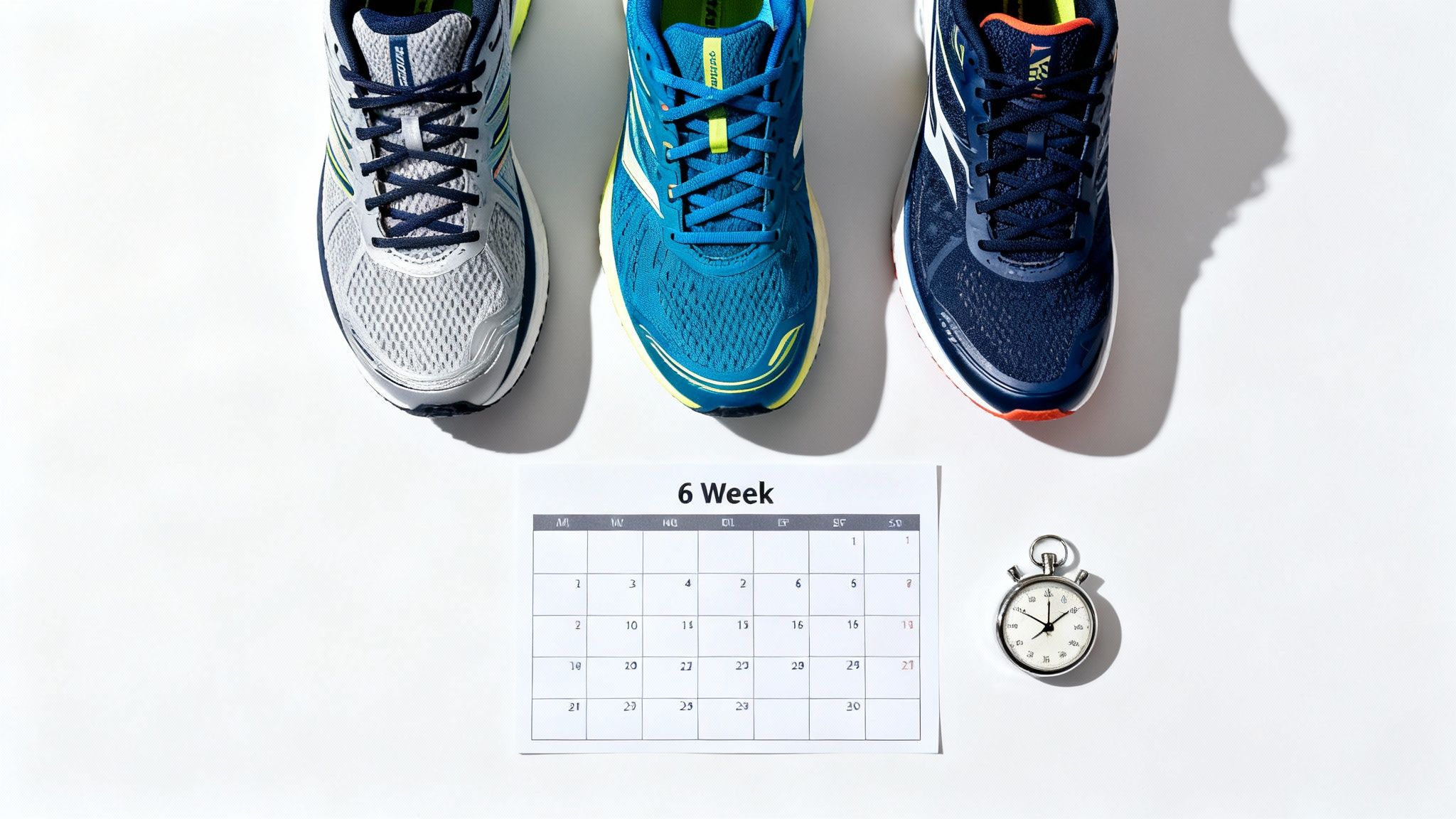
Alright, this is where the rubber meets the road. Below you’ll find your roadmap to the 10K finish line—a detailed, week-by-week schedule designed to build your fitness steadily and safely over the next six weeks.
Think of this as your guide, not a rigid set of rules. The most important thing you can do is listen to your body and stay consistent. Showing up is half the battle.
I’ve broken the plan into three different levels. Take an honest look at your current running fitness and pick the one that feels right. Whether this is your very first 10K or you're chasing down a personal best, there's a path here for you.
Understanding The Lingo: Your Workout Key
Before you jump into the schedules, let's get on the same page with the terminology. Knowing the why behind each workout is just as important as doing it.
- RPE (Rate of Perceived Exertion): This is your personal effort gauge, on a scale of 1-10. How hard does the run feel to you? It’s a simple but powerful tool.
- Easy Run: Think conversational pace (RPE 3-4). You should be able to chat without gasping for air. These runs are the foundation of your aerobic base.
- Tempo Run: Often called "comfortably hard" (RPE 6-7). You can manage a few clipped words, but a full-blown conversation is off the table. This is where you teach your body to hold a faster pace for longer.
- Intervals: These are short, intense bursts of speed (RPE 8-9) followed by recovery jogs or walks. This is your pure speed work.
- Long Run: Your longest effort of the week, done at an easy, conversational pace (RPE 3-4). This is all about building endurance and mental toughness.
- Cross-Training (XT): Any low-impact activity that gets your heart rate up without the pounding of running—think swimming, cycling, or the elliptical. It builds fitness while giving your joints a break.
- Rest: Non-negotiable. Rest days are when your muscles repair and get stronger. Don't skip them.
A Quick Tip from Experience: Learning to run by feel (using RPE) is one of the most valuable skills you can develop. It helps you push when you need to and back off before you get injured. A workout that's too hard can set you back just as much as one that's too easy.
Beginner 10K Training Plan (6 Weeks)
This plan is perfect if you're new to the 10K distance or you're currently able to run a 5K. The goal here isn't speed; it's about building the endurance to cross the finish line feeling strong. We'll use a mix of running and walking to make the distance feel achievable.
Weekly Schedule: Beginner
| Week | Day 1 | Day 2 | Day 3 | Day 4 | Day 5 | Day 6 | Day 7 |
|---|---|---|---|---|---|---|---|
| 1 | Rest | 2 miles (run/walk) | Rest/XT | 2 miles (run/walk) | Rest | 2.5 miles easy | Rest |
| 2 | Rest | 2.5 miles (run/walk) | Rest/XT | 2 miles (run/walk) | Rest | 3 miles easy | Rest |
| 3 | Rest | 2.5 miles easy | Rest/XT | 2.5 miles easy | Rest | 3.5 miles easy | Rest |
| 4 | Rest | 3 miles easy | Rest/XT | 2 miles easy | Rest | 4 miles easy | Rest |
| 5 | Rest | 3 miles easy | Rest/XT | 2.5 miles easy | Rest | 4.5-5 miles easy | Rest |
| 6 | Rest | 2 miles easy | Rest | Light XT/Walk | Rest | Race Day (6.2 miles) | Rest! |
The slow, steady increase in mileage is by design. It gives your body time to adapt, which is the single best way to prevent injuries and build a solid aerobic foundation for your race.
Intermediate 10K Training Plan (6 Weeks)
So, you’ve run a 10K before and you’re consistently logging around 15-20 miles a week? This plan is your ticket to a faster finish time. We’ll start weaving in some quality speed work, like tempo runs and intervals, to really push your pace and endurance.
This schedule steps up the intensity. If you’re trying to figure out the optimal running frequency for your goals, we have a helpful guide explaining how many times a week you should run.
To give you an idea of how to structure your week, here's a typical layout.
Weekly 10K Training Plan Overview (Intermediate Level)
This table shows a sample weekly structure for an intermediate runner, detailing the type of workout scheduled for each day of the week to balance effort and recovery.
| Day | Workout Type | Goal/Intensity |
|---|---|---|
| Monday | Rest | Full recovery |
| Tuesday | Easy Run | Maintain aerobic base |
| Wednesday | Quality Session | Tempo or Intervals for speed |
| Thursday | Rest | Full recovery |
| Friday | Easy Run | Active recovery |
| Saturday | Long Run | Build endurance |
| Sunday | Rest | Full recovery |
This structure ensures you have adequate rest days surrounding your hardest efforts, which is key for adaptation and injury prevention.
Weekly Schedule: Intermediate
| Week | Day 1 | Day 2 | Day 3 | Day 4 | Day 5 | Day 6 | Day 7 |
|---|---|---|---|---|---|---|---|
| 1 | Rest | 3 miles easy | 4 miles w/ 15 min Tempo | Rest | 3 miles easy | 4 miles easy | Rest |
| 2 | Rest | 3 miles easy | 6x400m intervals w/ 400m jog | Rest | 3.5 miles easy | 5 miles easy | Rest |
| 3 | Rest | 3.5 miles easy | 4.5 miles w/ 20 min Tempo | Rest | 3.5 miles easy | 6 miles easy | Rest |
| 4 | Rest | 3.5 miles easy | 8x400m intervals w/ 400m jog | Rest | 4 miles easy | 6.5 miles easy | Rest |
| 5 | Rest | 4 miles easy | 5 miles w/ 20 min Tempo | Rest | 3 miles easy | 4 miles easy | Rest |
| 6 | Rest | 2 miles easy | 2 miles w/ 4x30s strides | Rest | 1 mile easy/shakeout | Race Day (6.2 miles) | Rest! |
You'll notice the long run peaks in Week 4. That’s intentional. The final two weeks are a "taper," where we reduce the mileage to let your body fully recover and feel fresh for race day.
Advanced 10K Training Plan (6 Weeks)
This plan is for the seasoned runner targeting a new personal record (PR). If you’re already comfortable with weekly mileage over 25 miles and have a solid history with speed work, this aggressive schedule will sharpen your fitness for peak performance.
Be honest with yourself—only follow this plan if you are injury-free and accustomed to high-intensity training.
Weekly Schedule: Advanced
| Week | Day 1 | Day 2 | Day 3 | Day 4 | Day 5 | Day 6 | Day 7 |
|---|---|---|---|---|---|---|---|
| 1 | Rest | 4 miles easy | 6x800m intervals w/ 400m jog | Rest | 4 miles easy | 7 miles easy | Rest/XT |
| 2 | Rest | 4 miles easy | 6 miles w/ 25 min Tempo | Rest | 4.5 miles easy | 8 miles easy | Rest/XT |
| 3 | Rest | 4.5 miles easy | 5x1000m intervals w/ 400m jog | Rest | 5 miles easy | 9 miles easy | Rest/XT |
| 4 | Rest | 5 miles easy | 6 miles w/ 3x10 min Tempo | Rest | 4 miles easy | 7 miles easy | Rest/XT |
| 5 | Rest | 4 miles easy | 4x800m intervals w/ 400m jog | Rest | 3 miles easy | 4 miles easy | Rest |
| 6 | Rest | 3 miles easy | 2 miles w/ 6x30s strides | Rest | Rest | Race Day (6.2 miles) | Rest! |
We’ve added a sixth day of activity here, which can be either a very easy recovery run or cross-training. This is where listening to your body is critical. If you're feeling beat up, an extra rest day is always the smarter choice. This 10k 6 week training plan is designed to push you to your limits, but not past them.
Nailing the Key Workouts for a Faster 10K
Getting faster in just six weeks isn't about running yourself into the ground every day. It's about training smarter. Any successful 10k 6 week training plan is built around a few specific types of workouts, and each one has a very different job to do. Once you understand why you're doing each session, you'll unlock your potential and show up on race day ready to fly.
Simply logging miles won't cut it. The quality of your runs is what truly moves the needle. Let's dig into the core workouts you'll see on the schedule.

Easy Runs: The Foundation of Your Fitness
Believe it or not, the bulk of your running should feel easy. I know it sounds backward when you're trying to get faster, but these slow, conversational miles are where your body builds its real aerobic engine.
Think of it as laying the foundation for a house. You can't build the fast stuff on a flimsy base. Easy runs develop your endurance by increasing the capillaries that deliver oxygen to your muscles and teaching your body to burn fat for fuel. They are the absolute backbone of this plan.
How to Do It:
- Pace: The "talk test" is your best guide here. You should be able to hold a full conversation without gasping for air. This typically feels like an effort of 3-4 out of 10.
- Focus: Forget about your watch. The goal is simply time on your feet at a low heart rate, letting your body adapt without piling on unnecessary stress.
Tempo Runs: Finding Your "Comfortably Hard"
Tempo runs are the secret sauce for 10K training. The entire point is to raise your lactate threshold—that tipping point where fatigue really starts to set in. By pushing this threshold higher, you can hold a faster pace for much longer before your legs turn to lead.
This workout is often described as "comfortably hard." It’s a focused, challenging effort, but one you can sustain. The fitness you build here translates directly to a faster finish time.
This is your race-day simulation. Learning what this effort feels like is crucial. It’s that sweet spot between an all-out sprint and an easy jog, and it builds the mental grit you need for the tough middle miles of a 10K.
For most runners, adding structured tempos can lead to huge gains, often improving pace by 20-30 seconds per kilometer. With median finish times for major US 10Ks hovering around 52:43, that level of improvement can put a big goal within reach. You can dig deeper into 10K training and performance metrics to see how it all breaks down.
Intervals and Fartleks: Injecting Raw Speed
If you want to run faster, you have to practice running faster. Simple as that. This is where intervals and fartleks come into play. Both involve short, intense bursts of running followed by recovery periods.
- Intervals: These are highly structured and are perfect for a track or a flat, measured road. A classic example is running 6x400 meters hard, with a 400-meter recovery jog between each one.
- Fartleks: This is Swedish for "speed play," and it's all about unstructured fun. You might be out on a regular run and decide to sprint to the next lamppost, jog to the one after, and repeat as you feel.
These sessions are what boost your VO2 max—your body's ability to use oxygen at its peak. They make your goal race pace feel much more manageable and give you that extra gear for a strong finishing kick.
How to Do It:
- Effort: The "on" segments should feel tough, around an 8-9 out of 10. You shouldn't be able to chat.
- Recovery: The recovery is just as important as the hard part. Slow right down and let your heart rate drop before you go again.
By mastering these three distinct workouts—easy, tempo, and speed—you're creating a powerful and balanced training plan. You're building your base, raising your sustainable speed, and sharpening your top end. This variety is precisely what makes a 10k 6 week training plan so effective, getting you ready for whatever the race throws at you.
Fueling Smart and Staying Injury-Free
A training plan is more than just a list of runs. What you do in the 23 hours you're not running is what truly gets you to the starting line healthy, strong, and ready to go.
Think of it this way: your 10k 6 week training plan is the blueprint, but smart fueling and injury prevention are the high-quality materials that make the whole structure sound. Ignoring this stuff is a surefire way to burn out or get sidelined.
Fueling for Your Runs
Let’s get one thing straight: food is your friend. You can't run on an empty tank, and trying to is a recipe for a miserable, sluggish workout.
Carbohydrates are the high-octane fuel for runners. Don't shy away from them! Your body needs carbs to power through those miles. The key is timing.
- Before You Run: About 60-90 minutes before you head out, grab a simple, carb-rich snack. A banana, a piece of toast with jam, or a small bowl of oatmeal are all perfect choices. You want something that's easy to digest.
- After You Run: That 30-60 minute window post-run is crucial for recovery. Your muscles are like sponges, ready to soak up nutrients. Aim for a snack with a 3:1 or 4:1 carb-to-protein ratio. The classic go-to for a reason? Chocolate milk. It’s nearly perfect.
And don't forget hydration. Being even slightly dehydrated can make your run feel way harder than it should. Make a habit of sipping water all day long, not just chugging it right before a run. For those longer or hotter workouts, toss in an electrolyte drink to replace what you sweat out.
Keeping Common Running Injuries at Bay
Nothing derails progress faster than an unexpected injury. Thankfully, most common running aches and pains are entirely preventable if you're proactive. It's all about building good habits from the start. For a deeper dive, check out our complete guide on how to prevent running injuries.
The two most important habits? A proper warm-up and cool-down. Make them non-negotiable bookends for every single run.
- The Warm-Up: Don't just walk out the door and start sprinting. Take 5-10 minutes to wake your body up with dynamic movements. Think leg swings, walking lunges, high knees, or butt kicks. You're getting the blood flowing and telling your muscles it's time to work.
- The Cool-Down: When you finish, don't just stop cold. Walk for 5 minutes to let your heart rate settle. Now is the time for those classic static stretches—holding each stretch for 20-30 seconds. Focus on the big muscle groups like your quads, hamstrings, glutes, and calves.
One of the most important skills you'll develop as a runner is learning to listen to your body. There's a huge difference between the dull ache of hard-working muscles and the sharp, specific pain of an injury. If a pain sticks around for more than a day or gets worse when you run, that’s a red flag. It's always smarter to take an extra rest day than to be forced into taking weeks off.
The Secret Weapons: Strength and Cross-Training
Want to become a more resilient, efficient runner? Start spending some time doing things other than running.
Adding strength training 2-3 times per week is a game-changer. It builds a stronger support system around your joints, which helps absorb the impact of running. You don't need a fancy gym membership; simple bodyweight moves are incredibly effective.
Essential Strength Moves for Runners:
- Squats: The foundation for powerful legs.
- Lunges: Great for single-leg strength and stability.
- Glute Bridges: Wakes up your glutes, your running powerhouse.
- Planks: A strong core equals better running form, especially when you get tired.
Cross-training is your other secret weapon. Activities like swimming, cycling, or hitting the elliptical build your aerobic fitness without the constant pounding. Try swapping one of your easy runs each week for a cross-training session—your legs will thank you.
Your Race Week Taper and Race Day Game Plan
After five weeks of putting in the work, you’ve made it. Welcome to race week. The hard part is over, and now it's all about letting your body soak up that training so you can feel fresh, sharp, and ready to fly on race day. This is the taper, and it’s your secret weapon for a great performance.
The whole point is to slash your running volume way down while keeping just a touch of intensity. This is the magic combination that lets your muscles and systems fully recover without you feeling flat or sluggish. Think of it as sharpening the blade right before the big moment.

Executing the Perfect Taper
You'll notice your final week's schedule in this 10k 6 week training plan looks pretty light—that's on purpose. Trust the process. I've seen so many runners try to cram in one last "big" workout, and it almost always does more harm than good.
Instead, your energy should go into three other areas:
- Sleep: Make getting 7-9 hours a night a top priority. This is when the real magic of recovery happens.
- Hydration: Keep a water bottle handy and sip throughout the day, every day. The goal is to be fully hydrated long before you even wake up on race morning.
- Nutrition: This isn't the week for new foods or drastic diets. Stick with what you know works for you, focusing on simple carbs to make sure your glycogen stores are topped off. For a deeper dive, our guide on what to eat before a 10K is a great resource.
The hay is in the barn. Your fitness is locked in. The biggest mistake you can make during race week is doing too much. Have confidence in your training and embrace the rest.
A solid 10K is often just the beginning. The 2022 Global Runner Survey found that while 64% of runners do 5Ks or 10Ks, many have their sights set on longer races. The discipline you're building now is the perfect foundation for something like a half marathon—a distance that saw finisher numbers leap by 20.9% in 2024. You can see more fascinating running trends and statistics that show where the sport is heading.
Your Race Day Checklist and Strategy
It’s completely normal to feel a bit jittery, but having a solid routine can calm those nerves. The idea is to make race morning run on autopilot, freeing up all your mental energy for the race itself.
Your Morning Routine:
- Wake Up Early: Give yourself at least 2-3 hours before the gun goes off. No rushing!
- Eat Your Usual Breakfast: Now is not the time to try that new energy bar. Stick to the pre-run meal you’ve practiced with during training.
- Get Dressed: Lay out your entire race kit the night before. Pin your bib on your shirt so it's one less thing to think about.
- Arrive Early: Get to the venue with plenty of time to park, hit the porta-potty one last time, and do a light warm-up.
When the race starts, your biggest enemy is adrenaline. Nearly everyone takes the first mile out way too fast. Resist the urge. Run that first mile slower than your goal pace to let your body settle in.
From there, break the race down. Focus on running a strong, steady middle 4 miles. Once you get through that, see what you have left for the final push. When you finally spot that finish line, give it everything you've got and soak in the moment—you earned it.
Got Questions About Your 6-Week 10K Plan? We've Got Answers.
Jumping into a focused training plan like this always brings up a few questions. That's a good thing—it means you're thinking like a runner. Let's tackle some of the most common "what if" scenarios you might run into over the next six weeks.
"Help! I Missed a Workout. What Now?"
First, take a breath. It happens to everyone. Life gets in the way. The absolute worst thing you can do is panic and try to cram two runs into one day. That’s a fast track to burnout or, even worse, an injury.
If you miss an easy run or a cross-training day, just let it go. Seriously. One missed session won't derail your progress. Your overall consistency over the six weeks is what truly matters.
What if it was a key workout, like your long run or tempo session? You've got some wiggle room here. You can often bump it to the next day. Just be careful not to sacrifice your rest day to make it happen. Rest is when your body actually rebuilds and gets stronger.
If you find yourself sidelined for three or more days in a row—maybe from a cold, a busy work trip, or just life—don't just jump back in where you left off. Ease back into things with a short, easy run to see how your body responds before you ask it to handle any serious intensity.
"How Do I Know Which Plan is Right for Me?"
This is probably the single most important decision you'll make. Being honest with yourself about your current fitness is the key to having a successful and, more importantly, an enjoyable training cycle.
Here’s a quick guide to help you find your sweet spot:
- The Beginner Plan: This is your starting line if you're currently running less than 10-12 miles a week. It's also perfect if this is your first time following a structured plan, or if your main goal is simply to cross the finish line feeling fantastic.
- The Intermediate Plan: Ready to pick up the pace? This plan is designed for you if you're already running a consistent 3-4 days a week, clocking around 15-20 miles total. You’ve probably run a 10K or similar distance before and feel ready to introduce some speed work.
- The Advanced Plan: Choose this plan only if you're a seasoned runner, comfortable with a weekly mileage of 25+ miles. You should already have a solid base and experience with more intense interval and tempo workouts aimed at hitting a specific time goal.
"My Race is Hilly. Can I Adapt This Plan?"
Absolutely—and you definitely should. Training for the course you're actually going to run is one of the smartest things you can do. If your 10K is loaded with hills, you need to prepare your legs for that specific kind of burn.
The best approach is to swap one workout a week for some dedicated hill work. You have two great options:
- Make an Easy Run a Hilly Run: Instead of your usual flat route, find one with some rolling hills. On that day, ignore your pace and focus entirely on maintaining a steady, consistent effort as you climb and descend.
- Turn a Speed Day into Hill Repeats: This is a classic strength-builder. Find a good hill that takes you anywhere from 45-90 seconds to run up. Instead of your scheduled interval workout, run hard up the hill, then use a slow jog or walk back down as your recovery. Repeat.
"What's the Most Essential Gear I Really Need?"
One of the best things about running is its simplicity. You don't need a closet full of expensive gadgets to get going. That said, a few key pieces will make a world of difference in your comfort and safety.
Your number one priority: a good pair of running shoes. Don't just buy what looks cool online. Go to a specialty running store where they can watch you run and fit you in a shoe that supports your specific foot type and gait. This is your best defense against injury. Period.
Beyond that, stick to the basics. Moisture-wicking clothing is a must—avoid cotton at all costs unless you enjoy chafing. A simple running watch that can track your time and splits will also be a huge help for pacing your workouts. Everything else is just a bonus.
Once you cross that finish line, celebrate your incredible achievement with a custom race poster from RoutePrinter. We turn your hard-earned miles from any race or training route into beautiful, minimalist art for your home or office. It's the perfect way to commemorate your journey. Design your personalized race poster today!